
Jiangnan Water(601199)

Search documents
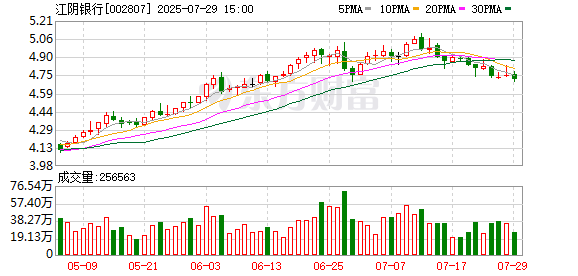
江阴银行:江南水务与新国联不构成一致行动人
Zheng Quan Ri Bao· 2025-07-29 11:39
(文章来源:证券日报) 证券日报网讯江阴银行7月29日在互动平台回答投资者提问时表示,江南水务与新国联不构成一致行动 人。 ...


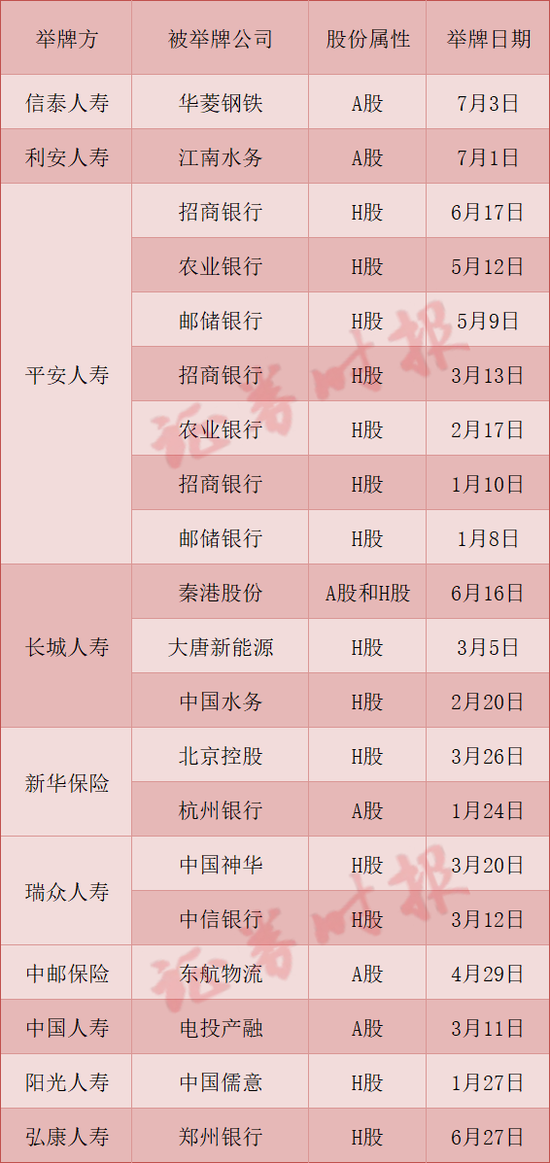
21次举牌,险资狂买!
经济观察报· 2025-07-23 06:52
Core Viewpoint - Since 2025, insurance companies have triggered 21 investment events involving stock acquisitions, surpassing the total number of such events in the previous year [4]. Group 1: Investment Activities - The A-share market has been experiencing upward fluctuations, and the Hong Kong stock market is recovering, leading to increased activity from insurance funds in the capital markets [2]. - In July 2025, Zhongyou Insurance announced its acquisition of shares in Green Power Environmental (01330.HK), triggering a stock acquisition disclosure [3][8]. - Other insurance companies, such as Xintai Life and Lianan Life, also disclosed stock acquisitions in July 2025 [9] [10]. Group 2: Specific Investment Cases - Zhongyou Insurance purchased 726,000 shares of Green Power Environmental, increasing its holdings to 20.51 million shares, representing 5.0722% of the company's H-share capital [8]. - Xintai Life increased its holdings in Hualing Steel (000932.SZ) to 345 million shares, raising its ownership from 4.99% to 5.00% [10]. - Lianan Life acquired 1.1 million shares of Jiangnan Water (601199.SH), increasing its stake from 4.91% to 5.03% [10]. Group 3: Financial Data and Trends - As of June 30, 2025, Zhongyou Insurance reported a net buy of over 90 billion yuan in public market equity investments [6]. - Xintai Life's equity assets amounted to 565.78 billion yuan, accounting for 19.07% of its total assets as of June 30, 2025 [10]. - Lianan Life's equity assets were reported at 205.6 billion yuan, making up 16.29% of its total assets as of May 31, 2025 [10]. Group 4: Market Dynamics and Regulatory Environment - The current wave of stock acquisitions by insurance companies is driven by a preference for high-dividend stocks, particularly in sectors like banking, public utilities, and pharmaceuticals, with an average dividend yield of 4.6% since 2024 [14]. - The downward trend in interest rates has increased investment pressure on insurance companies, prompting them to seek stable long-term investment returns through frequent stock acquisitions [15]. - Regulatory changes have encouraged insurance funds to engage in long-term equity investments, with new guidelines introduced to assess net asset returns over extended periods [19].



21次举牌,险资狂买!
Jing Ji Guan Cha Wang· 2025-07-23 06:46
Core Viewpoint - The insurance sector is increasingly active in the capital markets, with a notable rise in shareholding stakes in listed companies, indicating a strategic shift towards long-term equity investments driven by low interest rates and regulatory support [2][7][11]. Group 1: Shareholding Activities - In 2025, insurance companies triggered 21 shareholding events, surpassing the total for the previous year, with notable participation from companies like China Life, Postal Insurance, and Xinhua Life [3][4]. - Postal Insurance acquired 726,000 shares of Green Power Environmental, raising its stake to 5.0722%, and previously triggered a shareholding event in April by acquiring 79.42 million shares of Eastern Airlines Logistics [4][5]. - Xintai Life and Lian Life also reported shareholding increases in July, with Xintai Life raising its stake in Hualing Steel to 5.00% and Lian Life increasing its stake in Jiangnan Water to 5.03% [5]. Group 2: Investment Trends - The average dividend yield of companies targeted for shareholding by insurance funds has reached 4.6%, the highest in recent years, reflecting a preference for high-dividend stocks in sectors like banking and utilities [7][8]. - The shift towards long-term equity investments is partly due to the mismatch in asset and liability durations, with insurance liabilities averaging over 12 years compared to asset durations of about 6 years [9]. Group 3: Regulatory Environment - Recent regulatory changes encourage insurance funds to engage in long-term equity investments, with new assessment criteria introduced that emphasize long-term performance metrics [11]. - The new accounting standards allow for more stable valuation of long-term equity investments, motivating insurance companies to increase their holdings in high-dividend stocks [10].

环保行业点评:险资持续增持,环保红利凸显
Shenwan Hongyuan Securities· 2025-07-22 14:43
Investment Rating - The report rates the environmental industry as "Overweight" indicating that it is expected to outperform the overall market [2][10]. Core Insights - Insurance capital is increasingly investing in environmental assets, driven by favorable policies and the potential for long-term stable returns [2]. - The report highlights that insurance companies have made multiple significant investments in environmental firms, showcasing the sector's investment value [2]. - The water and waste management sectors are characterized by stable demand and revenue, with a strong potential for profit growth due to factors like water price adjustments and reduced financial costs [2]. - Cash flow in the environmental sector is expected to improve, leading to higher dividends as companies respond to shareholder return demands [2]. - Investing in environmental assets offers insurance companies a combination of dividends, earnings per share (EPS) growth, and valuation increases [2]. Summary by Sections Investment Opportunities - The report identifies specific companies for investment, recommending A-shares such as Hanlan Environment, Xingrong Environment, Yongxing Co., Hongcheng Environment, Green Power, Junxin Co., and Chengfa Environment, as well as H-shares like Conch Venture, Everbright Environment, and Yuehai Investment [2]. Financial Metrics - The report provides detailed financial metrics for various environmental companies, including market capitalization, dividend rates, and expected earnings growth for 2024 and 2025 [5]. For instance, Junxin Co. has a market cap of 120 billion RMB with a projected PE of 22 and a dividend yield of 4.23% for 2024 [5].


垃圾焚烧、水务运营资产:险资持续举牌,长期配置价值凸显
Changjiang Securities· 2025-07-21 08:43
Investment Rating - The report maintains a "Positive" investment rating for the environmental protection industry [10] Core Insights - In 2023, insurance capital has collectively acquired stakes in five environmental companies, focusing on waste incineration and water utility state-owned enterprises, which exhibit stable operational performance and significant free cash flow improvement, indicating high dividend potential [2][6][7] - The report emphasizes the long-term investment value of waste incineration and water utility assets due to their high dividend potential and low valuation, recommending several companies in these sectors [8][38] Summary by Sections Insurance Capital Allocation - Insurance capital is increasingly allocating to equity investments due to declining net investment returns and the need for higher-yielding assets [6][18] - Policy changes and the expansion of long-term investment trials are encouraging insurance capital to invest in dividend and high ROE assets [24] Focus on Waste Incineration and Water Utility Assets - Insurance capital has targeted five environmental companies, primarily in waste incineration and water utility sectors, indicating a preference for stable operational assets [7][26] - The report highlights the potential for increased dividend payouts as the industry has passed its infrastructure peak, with a focus on long-term equity investments [37] Long-term Investment Value - Waste incineration and water utility assets are characterized by steady growth, improving cash flows, and increasing dividends, making them attractive for long-term investment [38][41] - The report identifies specific companies such as Huanlan Environment, Xingrong Environment, and others as key recommendations for investment [8][38] Financial Performance and Valuation - The report notes that the financial performance of waste incineration and water utility companies has shown resilience, with significant improvements in free cash flow and dividend payouts expected in the coming years [30][41] - Valuation metrics indicate that these companies are not overvalued, with PE ratios suggesting room for valuation recovery [34][41]
又见险资出手!今年举牌已达20次
券商中国· 2025-07-20 09:31
Core Viewpoint - The insurance industry is experiencing a significant wave of equity stakes, with a notable increase in the number of share acquisitions by insurance companies, indicating a strategic shift in asset allocation towards high-dividend stocks and long-term equity investments [2][10][15]. Group 1: Recent Activities - Recently, Taikang Life participated as a cornerstone investor in the IPO of Fengcai Technology, investing $25 million for an 8.69% stake [3]. - In July alone, insurance companies have made three significant equity acquisitions, with Taikang Life being the latest [4]. - As of July 20, insurance companies have made a total of 20 equity acquisitions this year, surpassing the total for 2023 and matching the total for 2024 [2][7]. Group 2: Investment Trends - The current wave of equity acquisitions began in 2024 and has shown no signs of slowing down, with banks being the most frequently targeted sector [8][9]. - The insurance sector has seen three waves of equity acquisition trends over the past decade, with the current wave driven by the need for stable cash returns in a low-interest-rate environment [10][11]. - High-dividend stocks are particularly attractive to insurance companies, as they provide better yields compared to long-term bonds [11][12]. Group 3: Financial Performance - As of March 31, 2023, Xintai Life had total assets of 315.79 billion yuan, with equity assets accounting for 19.07% of total assets [5]. - Li'an Life reported total assets of 126.19 billion yuan as of March 31, 2023, with equity assets making up 16.29% of total assets [6]. - The financial performance of insurance companies is being optimized through strategic equity acquisitions, which can enhance the stability of profit reports under new accounting standards [15][19]. Group 4: Regulatory Environment - Recent regulatory changes are encouraging insurance companies to adopt long-term investment strategies, with a new five-year assessment framework introduced to evaluate performance [17][18]. - The Ministry of Finance's new guidelines aim to enhance the role of insurance funds in providing long-term capital to the market, promoting stability and healthy development [19].

大小指数开始分化!赚钱效应“有变化”,还有哪些投资机会?
Sou Hu Cai Jing· 2025-07-14 07:15
Group 1 - In July, private equity institutions showed strong interest in A-share listed companies, with 751 institutions participating in research covering 387 companies, totaling 1,769 research instances [1][5] - The electronic industry led the research focus with 275 instances involving 56 companies, followed by the pharmaceutical and biological industry with 266 instances covering 41 companies [1][5] - The technology growth sector is experiencing increasing enthusiasm, with significant capital inflows into technology-themed ETFs, indicating a positive outlook for AI-related industries [3] Group 2 - Insurance capital has been actively acquiring stakes in listed companies, with 19 instances of stake acquisitions involving 15 companies this year, indicating a trend towards long-term stable investment returns [5] - The banking sector is facing challenges due to narrowing net interest margins, prompting banks to enhance their intermediary business development, with wealth management and financial investment seen as growth areas [3] - A-share buyback enthusiasm remains high, with notable companies like China Communications Construction planning significant buybacks, reflecting a strategic move to bolster market confidence [9]




A股,新信号!
Zheng Quan Shi Bao· 2025-07-08 11:39
Group 1 - Insurance capital has become a significant force in the capital market, with at least 20 instances of shareholding increases in A-shares and H-shares this year, primarily targeting stable dividend-paying assets like banks and public utilities [1][2] - Recent announcements indicate that Li'an Life and Xintai Life have increased their holdings in Jiangnan Water and Hualing Steel, respectively, with Li'an Life acquiring 46.99 million shares (5.03% of total shares) and Xintai Life acquiring 343 million shares (5.00% of total shares) [2][3] - The trend of insurance capital actively participating in shareholding increases is attributed to a low interest rate environment, leading to a search for stable cash flow and strong performance companies [1][6] Group 2 - The increase in shareholding by insurance capital is seen as a response to "asset scarcity," with a focus on high-dividend equities to enhance returns and offset the pressure from low fixed-income asset yields [6][7] - Regulatory changes, such as adjustments to the equity asset ratio for insurance funds, have facilitated greater participation of insurance capital in the equity market, creating favorable conditions for shareholding increases [6][7] - The rise in shareholding activities is viewed as a positive signal for the long-term development of the capital market, potentially enhancing investor confidence and attracting more capital [7][8] Group 3 - The participation of various capital types, including financial capital, industrial capital, and private equity, in shareholding increases reflects a positive outlook on the long-term performance of the companies involved [7][8] - The concentration of insurance capital in high-dividend sectors, particularly banks, raises concerns about potential systemic risks due to high industry concentration [7][8] - Future strategies for insurance capital may involve diversifying into less cyclical and more diversified high-dividend sectors to balance returns and risks [8]

A股,新信号!
证券时报· 2025-07-08 11:28
Core Viewpoint - Insurance capital has become a significant force in the capital market, actively acquiring shares in A-share and H-share listed companies, particularly in stable dividend-paying sectors like banking and public utilities [1][5][12]. Group 1: Insurance Capital Activity - Insurance capital has made at least 20 acquisitions of listed companies this year, focusing on stable cash flow and dividend-yielding assets [1][5]. - Recent notable acquisitions include Li'an Life increasing its stake in Jiangnan Waterworks by 46.99 million shares (5.03%) and Xintai Life acquiring 343 million shares (5.00%) of Hualing Steel [4][5]. - Hongkang Life has also increased its stake in Zhengzhou Bank, reaching 6.68% after multiple acquisitions [4]. Group 2: Market Environment and Strategy - The current low-interest-rate environment has led funds to seek companies with stable cash flows and strong performance as optimal investment choices [2][14]. - The "asset shortage" phenomenon has intensified, pushing insurance capital to invest in high-dividend equities to enhance returns and offset the pressure from fixed-income assets [14][20]. - Regulatory changes, such as adjustments to insurance capital investment ratios, have facilitated greater participation of insurance funds in equity markets [13][12]. Group 3: Broader Participation - Besides insurance capital, other entities like Asset Management Companies (AMCs) and private equity firms have also engaged in share acquisitions [7][8][9]. - The involvement of various capital types, including financial and industrial capital, reflects a positive outlook on the long-term development of the capital market [17]. Group 4: Market Impact and Future Outlook - Increased share acquisitions serve as a market confidence booster, attracting more capital and promoting a virtuous cycle in the market [19]. - The concentration of insurance capital in specific sectors, particularly banking, raises concerns about potential systemic risks due to high industry concentration [20][21]. - Future strategies may involve diversifying investments into less cyclical and higher-dividend sectors to balance risk and return [21].

险资6个月19次举牌逼近2024全年 资产配置多元化高股息标的仍受青睐
Chang Jiang Shang Bao· 2025-07-06 22:33
Core Viewpoint - Insurance capital is increasingly entering the market, with significant investments in listed companies, indicating a trend towards high-frequency and concentrated acquisitions in 2025 [1][6]. Group 1: Insurance Capital Activity - In 2025, insurance companies have made 19 acquisitions involving 15 listed companies, matching the total number for the entire year of 2024 [1][6]. - Notable acquisitions include Xintai Life Insurance increasing its stake in Hualing Steel to 345 million shares (5% of total shares) and Lianan Life Insurance acquiring 46.9954 million shares (5.03% of total shares) in Jiangnan Water [1][2][4]. - The trend shows a preference for high-dividend equity assets, particularly in sectors like banking and public utilities, while also diversifying into undervalued cyclical stocks like Hualing Steel [1][7]. Group 2: Investment Strategy and Market Context - The increase in insurance capital activity is driven by supportive policies, optimized accounting standards, and a scarcity of alternative assets, leading to a focus on high-dividend equity assets [1][7]. - The total amount of insurance funds invested reached 33.56 trillion yuan by the end of 2024, with equity assets accounting for approximately 19.6% of this total [6]. - Recent regulatory changes have allowed for a higher allocation of equity assets, further encouraging insurance companies to invest in the stock market [6][7]. Group 3: Company-Specific Insights - Xintai Life Insurance's investment in Hualing Steel is based on a positive outlook for the company's future and aims to enhance its influence and share in the long-term benefits of Hualing Steel's growth [7][8]. - Lianan Life Insurance's acquisition of Jiangnan Water is characterized as a long-term investment based on the company's value and the insurance firm's own allocation needs [8].