Bank Of Shanghai(601229)

Search documents
城商行2024净利榜:北京银行换帅3年间从第1降至第3
Zhong Guo Jing Ji Wang· 2025-05-07 23:23
中国经济网北京5月8日讯 目前,30家A股、H股上市城商行的2024年报已披露完毕。从归母净利润表现 来看,江苏银行2024年实现归属于上市公司股东的净利润318.43亿元,排名城商行第一,宁波银行、北 京银行分别以271.27亿元、258.31亿元位列第二、三名。 银行名称 归母净利润(亿元) 归母净利润增速 江苏银行 318.43 10.76% 宁波银行 0.81% 上海银行 235.60 4.50% 南京银行 201.77 271.27 6.23% 北京银行 258.31 9.05% 杭州银行 169.83 18.07% 徽商银行 154.14 6.80% 成都银行 128.58 10.17% 长沙银行 78.27 10.16% 齐鲁银行 重庆银行 51.17 3.80% 苏州银行 4.87% 50.68 贵阳银行 51.64 -7.16% 49.86 17.77% 青岛银行 42.64 20.16% 天津银行 38.02 1.11% 贵州银行 37.79 3.43% 中原银行 34.46 6.98% 厦门银行 25.95 -2.60% 西安银行 25.59 3.91% 威海银行 19.92 2.99% ...





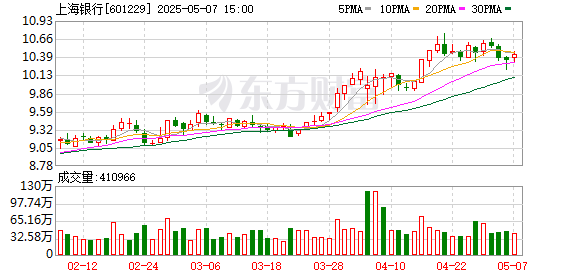
金改前沿|2024年股价涨幅居首 上海银行资产质量风险出清?
Xin Hua Cai Jing· 2025-05-07 14:18
Core Viewpoint - Shanghai Bank achieved a remarkable stock price increase of 68.98% in 2024, leading among 42 A-share listed banks, while also reporting stable operating performance with increased revenue and profit alongside a decrease in non-performing loans [2] Group 1: Financial Performance - In 2024, Shanghai Bank reported a net interest margin decline of 0.17 percentage points to 1.17%, indicating challenges in maintaining profitability [3] - The bank's net interest income ended a three-year decline, showing a 4.65% year-on-year increase in the first quarter of 2024, improving the revenue structure [3] - Shanghai Bank's operating performance is expected to maintain sustainable growth in 2025, supported by strategic leadership [2] Group 2: Asset Quality - Shanghai Bank's asset quality showed a positive trend in 2024, with both non-performing loan amounts and ratios declining for the first time in years [4] - The non-performing loan ratio decreased from 1.25% in 2022 to 1.18% in 2024, with a significant reduction in new non-performing loans [4] - The bank's provision coverage ratio has remained around 270% over the past three years, exceeding the average level of listed banks [4] Group 3: Real Estate Business - Shanghai Bank's real estate business risks have been reducing, with a notable improvement in loan quality and a steady decline in non-performing loan ratios [6] - The bank's commercial real estate loan ratio is planned to decrease by 1.5 percentage points in 2025, reflecting a cautious approach to real estate lending [6] - Support for affordable housing and urban renewal projects has been emphasized, with significant loan increases in these areas during the first quarter of 2024 [6]

新任党委书记顾建忠首次亮相,上海银行业绩发布会明确创新转型
2 1 Shi Ji Jing Ji Bao Dao· 2025-05-07 14:12
Core Viewpoint - The leadership of Shanghai Bank emphasizes the need for transformation and high-quality development, focusing on three key areas: technology innovation, green finance, and inclusive finance [1] Financial Performance - In 2023, Shanghai Bank achieved a net profit of 23.56 billion yuan, a year-on-year increase of 4.5%, with operating income of 52.99 billion yuan, up 4.79% [2] - In Q1 2024, the bank reported operating income of 13.60 billion yuan, a 3.85% increase, and a net profit of 6.29 billion yuan, growing by 2.3% [2] Liability Management - Shanghai Bank has optimized its liability structure, reducing the cost of liabilities, with a decrease in interest-bearing liabilities' interest rate by 15 basis points in 2024 and 43 basis points in Q1 2025 [3] - The bank aims to reduce high-interest deposits by 50 billion yuan in 2024, with a 4.1 percentage point decrease in the proportion of three-year and above personal deposits [3] Sustainable Development Strategy - The bank plans to enhance its sustainable development capabilities by focusing on serving the real economy and improving professional service capabilities [4] - Talent management is highlighted as a key resource, with a focus on training and team building to enhance employee motivation and operational vitality [4] Risk Management - Shanghai Bank has accelerated the resolution of existing risks, with over 20 billion yuan in risk asset resolution maintained for three consecutive years, reaching 24.6 billion yuan in 2024 [5] - The bank has implemented a differentiated management approach for real estate risks, focusing on stabilizing total volume, strengthening post-loan management, and optimizing structure [6] Credit Growth Targets - For 2025, Shanghai Bank aims for a credit growth target of around 5%, with a focus on maintaining quality while achieving reasonable growth [7] - The bank plans to increase corporate credit issuance to over 600 billion yuan in 2025, with a growth rate of over 6% [7] - In retail lending, the bank targets a positive growth rate of 5-6% in 2025, with a focus on housing and automotive loans, particularly in the new energy vehicle sector [7]
63岁“薪酬之王”刚交最差成绩单 70岁副董在职超16年仍在任
Nan Fang Du Shi Bao· 2025-05-06 23:14
Group 1 - The resignation of Jin Yu as chairman of Shanghai Bank due to age marks a significant leadership change, with Gu Jianzhong appointed as the new party secretary [2] - The banking sector is witnessing a wave of retirements as many executives approach the legal retirement age, raising concerns about maintaining strategic continuity [2][14] - Wang Liang, the chairman of China Merchants Bank, reported a slight decline in revenue and a modest increase in net profit, reflecting the pressures faced by the banking industry [3] Group 2 - Gao Yingxin, chairman of Minsheng Bank, has become the highest-paid executive in the A-share listed banks, despite the bank reporting its worst performance in nearly a decade [4][5] - Lu Jianqiang, chairman of Zhejiang Commercial Bank, has recently been re-elected, emphasizing the "good financial" concept as part of the bank's strategy [6] - The upcoming retirement of several key executives, including those from major banks, poses challenges for strategic direction and organizational culture [14][15] Group 3 - The transition of leadership in banks like CITIC Bank and Beijing Bank is critical as they navigate retail transformation and digitalization strategies [9][10] - The performance of Jiangsu Bank under the leadership of Ge Renyu has shown growth in revenue and profit, highlighting the importance of digital transformation in the banking sector [11] - The retirement of senior executives may lead to instability in team dynamics and affect customer trust, necessitating effective management of the transition [17][19] Group 4 - The implementation of a flexible retirement policy starting in 2025 may allow banks to retain key executives beyond the legal retirement age, potentially stabilizing leadership during transitions [19][20] - A well-structured corporate governance mechanism is essential for maintaining strategic consistency and navigating economic cycles in the banking industry [20]




前有“强敌”后有“追兵”,稍不留神即被超越——上海银行2024年财报分析
数说者· 2025-05-06 22:10
Core Viewpoint - Shanghai Bank has shown a recovery in operating income and net profit growth in 2024, primarily driven by investment income, despite challenges in net interest income and asset quality [4][9]. Group 1: Business Overview - Shanghai Bank was established in 1996 and was renamed in 1998, with its shares listed on the Shanghai Stock Exchange in 2016 [1]. - The bank has expanded its operations beyond Shanghai to regions such as the Yangtze River Delta, Pearl River Delta, Bohai Rim, and Central and Western China [1]. - As of the end of 2024, the loan balance in Shanghai accounted for 48.02% of the total, with the Yangtze River Delta (excluding Shanghai) at 30.25% and the Pearl River Delta at 12.07% [1]. Group 2: Financial Performance - By the end of 2024, Shanghai Bank's total assets reached 3.23 trillion yuan, a year-on-year increase of 4.57% [4]. - The bank achieved operating income of 52.986 billion yuan, up 4.79% year-on-year, and a net profit attributable to shareholders of 23.560 billion yuan, an increase of 4.50% [4]. - Despite the growth, the operating income in 2024 was still below the 53.112 billion yuan recorded in 2021 [4]. Group 3: Income Structure - The growth in operating income and profit in 2024 was mainly supported by a significant increase in investment income, which reached 13.166 billion yuan, a substantial year-on-year growth of 94.42% [9]. - Since 2021, net interest income and net fee and commission income have both experienced negative growth [9]. Group 4: Interest Margin and Income - In 2024, Shanghai Bank's net interest margin was 1.17%, a decrease of 17 basis points from 2023, which is relatively low compared to other major city commercial banks [11]. - The bank's interest income for 2024 was 32.486 billion yuan, accounting for 61.31% of operating income, which is a decline of 8.23 percentage points from 2023 [11]. Group 5: Asset Quality - As of the end of 2024, Shanghai Bank's non-performing loan (NPL) ratio was 1.18%, a decrease of 3 basis points from the end of 2023, with a provision coverage ratio of 269.81%, down 2.85 percentage points [15]. - The proportion of special mention loans was 2.06%, and the overdue loan ratio was 1.72%, both higher than the NPL ratio, indicating ongoing asset quality pressure [17]. - The bank's loan structure is predominantly corporate loans, which helps in controlling asset quality, as the corporate loan NPL ratio was 1.37%, lower than the personal loan NPL ratio of 1.14% [20][18].
银行业2025年一季报综述:预期内盈利承压,拥抱稳定、可持续、可预期的回报确定性
Shenwan Hongyuan Securities· 2025-05-06 11:18
Investment Rating - The report maintains a positive outlook on the banking sector, highlighting it as a low-volatility dividend play in a counter-cyclical environment and a strong performer in absolute returns during a pro-cyclical phase [6]. Core Insights - The first quarter of 2025 saw a decline in both revenue and net profit for listed banks, with revenue and net profit down 1.7% and 1.2% year-on-year, respectively. The main reasons for this decline were the expected decrease in interest margins and pressure from non-interest income [3][12]. - Loan growth has remained stable, with a year-on-year increase of 7.9% in the first quarter. Notably, banks in Jiangsu and Zhejiang, as well as Chengdu, continue to show strong economic performance, while Chongqing has emerged as a new growth area with loan growth exceeding 16% [3][4]. - The average net interest margin for listed banks was 1.54% in the first quarter, reflecting a slight quarter-on-quarter increase of 2 basis points, supported by a decrease in the cost of interest-bearing liabilities [4][12]. - The non-performing loan (NPL) ratio for listed banks decreased to 1.23%, with an estimated annualized NPL generation rate of approximately 0.63% [5][19]. - The report emphasizes the importance of focusing on high-dividend yield banks, particularly those with solid provisions and growth opportunities in favorable policy environments [6][19]. Summary by Sections Performance Overview - The first quarter of 2025 saw a significant impact from the decline in interest margins and non-interest income, leading to a negative growth in both revenue and profit for listed banks [10][12]. - The report indicates that the performance of state-owned banks was below expectations, while city and rural commercial banks generally met expectations [3][19]. Loan and Credit Analysis - Loan growth has been stable, with a year-on-year increase of 7.9% in the first quarter. The report highlights that the demand for loans from small and medium-sized enterprises has weakened, affecting the growth rates of rural commercial banks [3][4]. Interest Margin and Cost Analysis - The report notes that the average net interest margin for listed banks improved slightly, with a quarter-on-quarter increase attributed to a reduction in the cost of interest-bearing liabilities [4][12]. Asset Quality and Risk Management - The NPL ratio for listed banks decreased to 1.23%, with proactive measures taken to manage and dispose of non-performing assets [5][19]. - The report indicates that the retail sector is experiencing some risk exposure, but overall asset quality remains stable [5][19]. Investment Recommendations - The report recommends focusing on banks with high dividend yields and solid fundamentals, particularly those that are well-positioned to benefit from favorable policy changes [6][19].




[预告]上海银行2024年度暨2025年第一季度业绩说明会将于5月7日举行
Quan Jing Wang· 2025-05-06 08:46
Core Viewpoint - Shanghai Bank is set to hold its 2024 annual and Q1 2025 performance briefing on May 7, featuring key executives to discuss performance and address investor inquiries [1] Group 1: Strategic Vision and Development - Shanghai Bank aims to be a "boutique bank" with a focus on high-quality sustainable development, leveraging digitalization as a core driver for innovation and transformation [5] - The bank actively participates in local economic development, supporting major regional initiatives such as the Yangtze River Delta integration and the Greater Bay Area [5] - It emphasizes service to the real economy, increasing investments in inclusive finance, technology innovation, green finance, and livelihood projects [5] Group 2: Financial Performance - In 2024, Shanghai Bank reported operating revenue of 52.986 billion yuan, a year-on-year increase of 4.79%, and a net profit attributable to shareholders of 23.560 billion yuan, up 4.50% [6] - The bank's asset quality remains strong, with a non-performing loan ratio of 1.18% and a core Tier 1 capital adequacy ratio of 10.35% [6] - For Q1 2025, the bank achieved operating revenue of 13.597 billion yuan, a 3.85% increase year-on-year, and a net profit of 6.292 billion yuan, reflecting a 2.30% growth [7]
银行研究框架及24A、25Q1业绩综述:负债成本改善力度加大,息差降幅有望继续收窄
GOLDEN SUN SECURITIES· 2025-05-06 04:35
Investment Rating - The report indicates a cautious outlook for the banking sector, with expectations of continued narrowing of interest margin declines due to improved cost management on the liability side [5]. Core Insights - The overall revenue and profit growth rates for listed banks in Q1 2025 were -1.7% and -1.2%, respectively, showing a widening decline compared to 2024 [4]. - Net interest income decreased by 1.7% year-on-year, influenced by factors such as loan repricing and lower new loan rates, but the decline in interest margins is expected to continue to narrow [4][5]. - The overall asset quality remains stable, with a non-performing loan ratio of 1.23% and a provision coverage ratio of 238% [4]. Summary by Sections 1. Performance Overview - Listed banks' overall revenue and profit growth rates for Q1 2025 were -1.7% and -1.2%, respectively, with declines expanding by 1.8 percentage points and 3.5 percentage points compared to 2024 [4]. - The net interest income saw a year-on-year decline of 1.7%, attributed to factors like loan repricing and intensified competition [4]. 2. Revenue Breakdown - Fee and commission income for listed banks decreased by 0.7% year-on-year, with the decline rate narrowing by 8.7 percentage points compared to 2024 [4]. - Other non-interest income fell by 3.2% year-on-year, primarily due to significant fluctuations in the bond market affecting fair value changes [4]. 3. Asset Quality - The non-performing loan ratio stood at 1.23%, slightly down by 1 basis point from the end of Q4 2024, while the provision coverage ratio was 238%, showing a slight decrease of 2 percentage points from the previous year [4]. 4. Future Outlook - The narrowing trend in interest margin declines is expected to continue, supported by improved management of liability costs and stable asset quality [5]. - The report anticipates that the overall profit growth for the year will maintain a trend of quarterly improvement [5].


上市城商行竞争格局生变
Shang Hai Zheng Quan Bao· 2025-05-05 18:18
Core Insights - The competitive landscape among listed city commercial banks has significantly changed in Q1 2025, with Beijing Bank maintaining its leading position in asset size, while Jiangsu Bank leads in revenue and net profit [1][2] - The total number of listed city commercial banks with assets exceeding 2 trillion yuan has increased to six, including Beijing Bank, Jiangsu Bank, Ningbo Bank, Shanghai Bank, Nanjing Bank, and Hangzhou Bank [1] - Strong credit growth has driven asset expansion and supported revenue growth for major city commercial banks [1][3] Group 1: Asset Size and Rankings - As of Q1 2025, Jiangsu Bank's asset size reached 4.46 trillion yuan, closely trailing Beijing Bank by 98 billion yuan [1] - Ningbo Bank's asset size increased to 3.40 trillion yuan, surpassing Shanghai Bank's 3.27 trillion yuan [1] - Nanjing Bank approached 2.8 trillion yuan, while Hangzhou Bank exceeded 2 trillion yuan [1] Group 2: Revenue and Profitability - In Q1 2025, the revenues of Jiangsu Bank, Ningbo Bank, Beijing Bank, Nanjing Bank, and Shanghai Bank were 223.04 billion yuan, 184.95 billion yuan, 171.27 billion yuan, 141.90 billion yuan, and 135.97 billion yuan, with growth rates of 6.21%, 5.63%, -3.18%, 6.53%, and 3.85% respectively [2] - Jiangsu Bank's net profit reached 97.8 billion yuan, followed by Beijing Bank at 76.72 billion yuan and Ningbo Bank at 74.17 billion yuan [2] Group 3: Credit Growth and Interest Income - The significant increase in credit issuance has led to a rise in net interest income for several city commercial banks, with Jiangsu Bank, Nanjing Bank, and Ningbo Bank reporting net interest incomes of 165.92 billion yuan, 77.52 billion yuan, and 128.35 billion yuan, respectively [3] - The year-on-year growth rates for net interest income were 21.94% for Jiangsu Bank, 17.80% for Nanjing Bank, and 11.59% for Ningbo Bank [3] - The strong performance in public loans was noted, with Ningbo Bank, Jiangsu Bank, Hangzhou Bank, and Nanjing Bank showing increases of 17.08%, 13.49%, 9.75%, and 8.75% respectively [2]
你追我赶的长三角城商行!
券商中国· 2025-05-04 08:54
Core Viewpoint - The overall credit growth in China's banking sector has slowed from double digits to single digits, primarily due to insufficient demand, especially from the household sector. However, some regional banks in the Yangtze River Delta continue to show robust credit growth due to local economic vitality [1]. Group 1: Credit Demand and Growth - Insufficient credit demand, particularly from the residential sector, has led to a slowdown in overall credit growth in China's banking industry [1]. - Regional banks in the Yangtze River Delta, such as city commercial banks, have maintained stable credit growth due to strong local economic activity [1][2]. Group 2: Asset Scale Changes - The asset scale rankings among city commercial banks in the Yangtze River Delta have shifted, with Jiangsu Bank reaching a scale of 4 trillion yuan, surpassing Beijing Bank to become the second-largest city commercial bank in China [3]. - Ningbo Bank has overtaken Shanghai Bank, with asset totals of 3.4 trillion yuan and 3.27 trillion yuan, respectively, as of the end of Q1 [3][6]. Group 3: Q1 Performance Highlights - Q1 is typically a peak period for commercial bank lending, contributing significantly to overall credit growth. Despite a general slowdown, banks in the Yangtze River Delta achieved an average asset growth rate of 7% in Q1 [4]. - Jiangsu Bank, Ningbo Bank, Shanghai Bank, Nanjing Bank, and Hangzhou Bank reported significant asset growth, with Jiangsu Bank leading with a 12.84% increase [6]. Group 4: Interest Income and Revenue Growth - Net interest income for banks in the Yangtze River Delta has seen substantial growth, with Jiangsu Bank, Ningbo Bank, Shanghai Bank, Nanjing Bank, and Hangzhou Bank all reporting double-digit increases [8]. - The average revenue growth for city commercial banks in the Yangtze River Delta was approximately 5% in Q1, outperforming the average growth of 1.59% for listed city commercial banks [11]. Group 5: Non-Interest Income and Investment Gains - Non-interest income, particularly from investment gains, has also shown strong performance, with Jiangsu Bank, Ningbo Bank, and Nanjing Bank reporting investment income growth around 30% [12]. - Investment income has become a significant contributor to overall revenue, with some banks achieving over 100% growth in this area [13].