
Bank Of Shanghai(601229)

Search documents
温情守护城市“烟火气” 上海银行以“金融+非金融”服务筑牢民生底线
Zhong Jin Zai Xian· 2025-12-29 07:59
Group 1 - The core concept of Shanghai Bank is to enhance the quality of life through financial services, focusing on three main areas: elderly care, daily consumption, and livelihood security [1] - The bank is committed to "technology for good," planning to launch a smart service system supporting complete Shanghai dialect interaction by November 2025 to address communication challenges for the elderly [1] - The "Silver Shield" system has been implemented to combat telecom fraud, resulting in an almost 80% reduction in fraud cases among elderly clients in Q3 compared to Q2, successfully protecting 41 elderly customers and intercepting 1.7004 million yuan in fraudulent funds by the end of September [1] Group 2 - Shanghai Bank has established over 300 "Beautiful Life Studios" across the city, transforming bank branches into community cultural service stations offering courses in English, painting, and collaborating with Shanghai Senior University to meet the educational and recreational needs of the elderly [1] - The bank actively supports national consumption promotion policies, being one of the first banks in Shanghai to launch a digital coupon service for home appliances, allowing consumers to redeem discounts through mobile banking apps [1] - In the construction of the livelihood security system, Shanghai Bank has partnered with municipal medical insurance departments since 1998, establishing a "Bank-Medical Direct Link System" in 2008 for nationwide medical settlement [2] - Since 2003, the bank has managed housing repair funds, implementing a "three-review" system to standardize fund usage, currently providing fund custody services for over 3,000 residential communities in the city [2]

科创融资破局,上海银行锚定硬科技?
Sou Hu Cai Jing· 2025-12-29 07:43
2023年,专注于新能源电池关键材料的臻锂新材,正处于从实验室研发迈向中试量产的关键节点。作为苏州创新创业领军企业,其技术 前景获得IDG资本、苏创投等知名机构三轮融资认可,但尚未形成稳定现金流的现状,使其难以通过传统银行授信审批。就在企业为扩 建投产资金发愁之际,上海银行苏州自贸区支行客户经理余华主动找上门来。通过定期走访苏州工业园区科技招商中心的"行商"模式, 余华深入考察了企业的技术团队、研发进展和市场前景,最终通过"投联贷"为其提供近亿元融资支持,解了企业的燃眉之急。 这款颠覆传统信贷逻辑的创新产品,核心亮点在于打破了对抵押物和短期财务指标的依赖。"投联贷"以专业投资机构的股权融资决策为 重要参考,结合银行自身风控体系,通过投资金额与评估系数的科学核算,确定授信额度,让企业的技术实力和成长潜力成为融资的"硬 通货"。上海银行苏州分行副行长范荣表示,硬科技领域的核心价值往往隐藏在技术壁垒和团队实力中,而非短期财务报表,"投联贷"的 设计正是基于对科技企业成长规律的深刻洞察。2023年,该产品成功入选苏州工业园区"一行一品"特色金融产品库,成为服务"早小 硬"科技企业的标杆之作。 从"坐商"到"行商"的转 ...

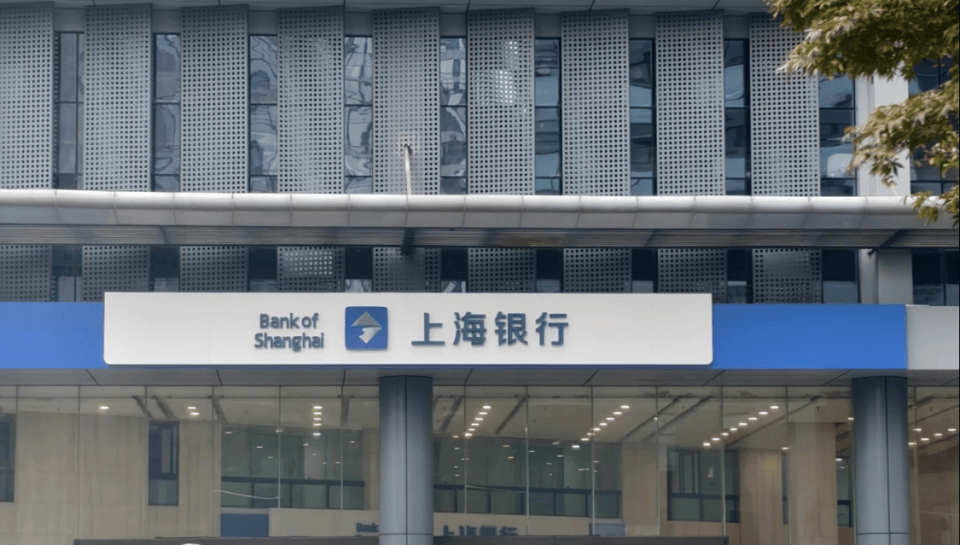
金融“陪伴者”:上海银行如何为科创企业注入穿越周期的韧性
Di Yi Cai Jing· 2025-12-29 02:53
Core Viewpoint - The Shanghai Free Trade Zone's Lingang New Area is emerging as a new engine for Shanghai's economic development, attracting global attention with its innovative spirit and world-class industrial clusters, exemplified by companies like Zhongke Xinsong [1] Company Overview - Zhongke Xinsong, established in 2014, developed China's first seven-axis collaborative robot in 2015, marking its entry into the international competitive landscape of collaborative robotics [1] - The company focuses on industrial embodied intelligence, offering a product line that includes six-axis and seven-axis collaborative robots, dual-arm robots, and humanoid composite robots [2] Employee Incentives - The company has recognized the increasing need for employee incentives as it matures, leading to a tailored "employee stock ownership financing" plan developed by Shanghai Bank [1][4] - This plan aims to bind employee interests with the long-term development of the company, addressing funding shortages for stock ownership while stabilizing core talent and attracting high-end professionals [4] Market Demand - There is a significant demand for collaborative robots, with Zhongke Xinsong operating at full production capacity and expanding its workforce to meet customer needs [3] - The company emphasizes the importance of "polygonal talents" who understand industrial scenarios and cutting-edge technologies to achieve flexible, intelligent, and cost-effective factory solutions [4] Future Trends in Robotics - The future of industrial robots is expected to involve continuous iteration towards lighter, more powerful, and multifunctional designs, with a focus on integrating AI technologies to enhance efficiency [4] - Enhanced perception capabilities and deep integration of intelligent control technologies are anticipated to bring robot behavior closer to human-like interactions [4] Financial Support and Services - Shanghai Bank has been a long-term partner of Zhongke Xinsong, providing various financial products tailored to the company's lifecycle, including the recent employee stock ownership financing plan [5][6] - The bank's approach includes a comprehensive financial product system that supports technology companies throughout their development stages, from initial startup to maturity [5][6] Ecosystem Development - Shanghai Bank aims to build a sustainable innovation ecosystem by integrating resources beyond the banking system, collaborating with local authorities and incubators to support early-stage companies [6][7] - The bank's vision includes becoming a preferred partner for technology transformation and innovation, focusing on supporting companies through their growth phases [7][8]
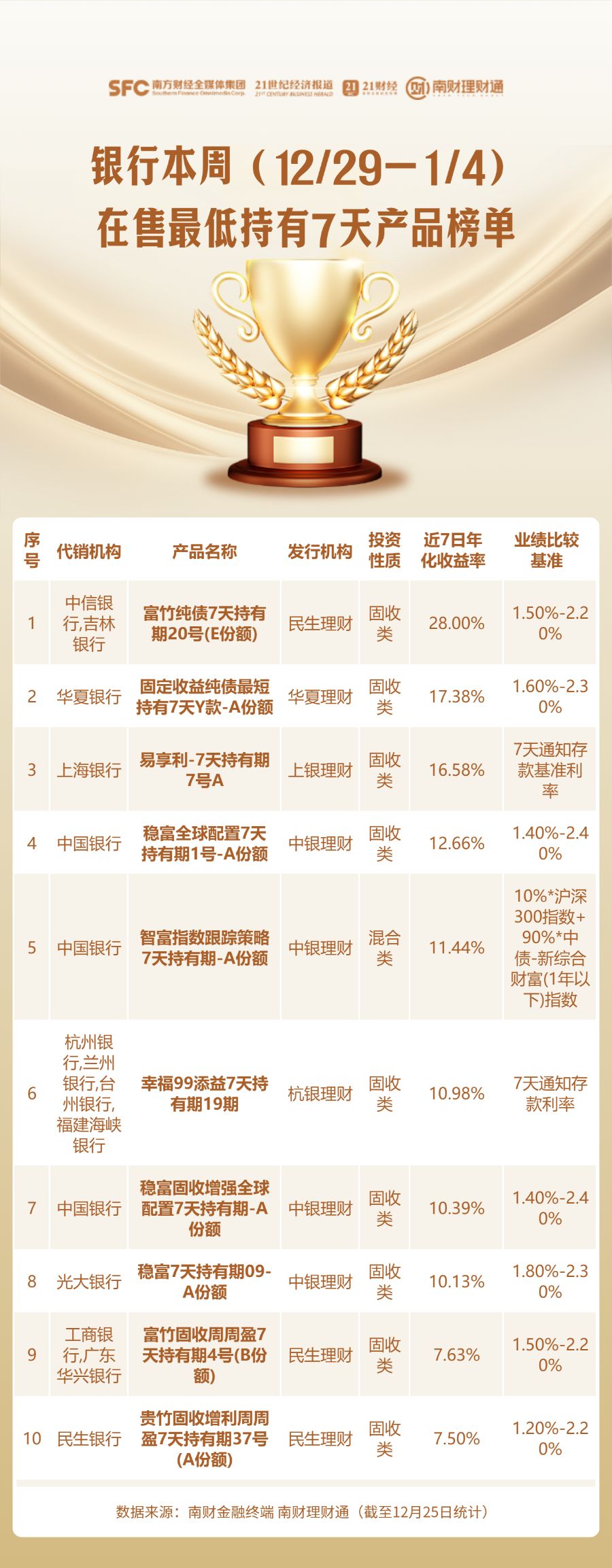
最低持有期理财榜单出炉!股份行代销产品收益居前
2 1 Shi Ji Jing Ji Bao Dao· 2025-12-29 01:20
Core Insights - The report focuses on the performance of minimum holding period RMB public funds, ranking them based on annualized returns over various holding periods: 7 days, 14 days, 30 days, and 60 days [1] - The ranking is based on annualized yield calculations, with the calculation period matching the holding period [1] Group 1: 7-Day Holding Period Products - The top-performing product is "富竹纯债7天持有期20号(E份额)" from 民生理财 with an annualized return of 28.00% [3] - Other notable products include "固定收益纯债最短持有7天Y款-A份额" from 华夏银行 with a return of 17.38% and "易享利-7天持有期7号A" from 上海银行 with a return of 16.58% [4] Group 2: 14-Day Holding Period Products - The leading product is "景前固收增利双周窓14天持有期28号" from 中信银行 with an annualized return of 15.59% [6] - Other significant products include "富竹纯债14天持有期14号(E份额)" from 民生理财 with a return of 11.68% and "嘉鑫(歳刊)固收类最低持有14天第13期-B份额" from 建信理财 with a return of 9.77% [7] Group 3: 30-Day Holding Period Products - The highest return is from "幸福99鸡益(金盈) 30天持有期" from 杭州银行 with an annualized return of 25.44% [10] - Other notable products include "盈30天持有期27号" from 民生银行 with a return of 18.61% and "易享利-28天持有期6号A" from 上海银行 with a return of 12.19% [11] Group 4: 60-Day Holding Period Products - The top product is "贵竹固收增利双月盈60天持有期3号" from 中信银行 with an annualized return of 15.26% [14] - Other significant products include "富竹纯债60天持有期12号(E份额)" from 民生理财 with a return of 7.00% and "智富指数跟踪策略60天持有期-A份额" from 中银理财 with a return of 4.63% [15]






从“看报表”到“透视未来”:一家芯片公司融资故事折射出的银行认知创新
Di Yi Cai Jing· 2025-12-28 02:17
Core Insights - The article discusses the launch of a groundbreaking visual sensor chip by Shenzhen Ruisi Zhixin Technology Co., Ltd., which integrates high-performance low-light capabilities, high frame rate motion capture, high dynamic range imaging, and ultra-low power consumption [1][3] - The chip is designed to enhance machine vision, enabling clearer video capture, real-time anomaly detection, and efficient environmental sensing, ultimately improving the performance of AI devices and robotics [1][3] Company Overview - Shenzhen Ruisi Zhixin Technology Co., Ltd. has developed a unique fusion visual sensor technology that combines traditional image sensing with emerging event sensing technologies, addressing the "impossible triangle" of frame rate, dynamic range, and power consumption [3][4] - The company emphasizes the importance of stable funding sources for semiconductor design, as the costs associated with chip development, including wafer production, can reach millions [1][4] Funding and Financial Strategy - Ruisi Zhixin has partnered with Shanghai Bank, which understands the specific funding needs of chip companies, to secure a two-year "R&D loan" that alleviates financial pressure during long development cycles [2][4][5] - The company highlights the complementary roles of equity and debt financing in supporting different stages of development, with equity financing being more suitable for long-term R&D projects and debt financing addressing short-term liquidity needs [4][5] Banking and Financial Innovation - Shanghai Bank offers a specialized "R&D loan" product tailored for technology companies, focusing on their technological advancements and future market potential rather than traditional financial metrics [7][8] - The bank's approach to credit assessment for tech companies shifts from evaluating historical performance to assessing future potential, emphasizing team capabilities, technology strength, industry relevance, and growth potential [8][9] Ecosystem and Research Development - Shanghai Bank has established a dedicated structure for supporting technology innovation, including a specialized team and a comprehensive product system that evolves with the growth of tech companies [9][10] - The bank's industry research institute focuses on strategic emerging industries, conducting in-depth research and providing insights to better support technology-driven enterprises [10][11]
成立两年、近亿元融资,上海银行“以投定贷”精准滴灌锂电材料“新星”
第一财经网· 2025-12-27 02:49
臻锂新材主要专注于研发新能源电池关键材料,最终产品应用于新能源电车、储能以及人工智能、机器 人等前沿领域。 臻锂新材创始人、董事长兼总经理李骁博毕业于上海交大机械与动力工程学院,长期从事涂层真空沉积 技术研究。2005年,上海交大成立了涂层技术小组,主要研发高性能、高效率的真空涂层制备技术,李 骁博就是该技术小组的核心成员。 目前,臻锂新材正处于初创期,其主要产品复合集流体已实现中试批量化生产。李骁博说,这个阶段, 企业往往还没有进化出很强的"造血"功能,金融的加持就变得至关重要。"我们既欢迎股权融资,也期 待债权融资,上海银行就是一个很好的债权融资伙伴,他们不仅熟悉我们所处的行业,同时还基于企业 发展阶段给出有针对性的金融服务。"李骁博说。 从中试走向投产的关键力量 2023年,李骁博创立了臻锂新材,主要瞄准锂电池复合集流体和新能源材料研发。事实上,其团队早在 2022年就已经开发出了应用于超薄柔性聚合物基膜的第一代磁控溅射一步干法工艺,不仅提升了镀层致 密性和膜基结合力,还显著降低了成本。2024年,李骁博团队在第一代的基础上研发出了第二代复合集 流体。 位于苏州工业园区的苏州臻锂新材科技有限公司(下称" ...
上海银行:12月26日召开董事会会议
Mei Ri Jing Ji Xin Wen· 2025-12-26 12:00
2025年1至6月份,上海银行的营业收入构成为:利息收入占比151.4%,非利息收入占比8.4%。 截至发稿,上海银行市值为1410亿元。 每经AI快讯,上海银行(SH 601229,收盘价:9.92元)12月26日晚间发布公告称,公司2025年第十二 次董事会会议于2025年12月26日以现场加视频接入方式召开。会议审议了《关于选举新一届董事会董事 长的议案》等文件。 每经头条(nbdtoutiao)——对话马斯克脑机接口"一号受试者":大脑植入芯片23个月,我正重新夺回 人生的独立 (记者 曾健辉) ...
上海银行(601229) - 上海银行2025年第二次临时股东会决议公告
2025-12-26 11:45
证券代码:601229 证券简称:上海银行 公告编号:临 2025-078 可转债代码:113042 可转债简称:上银转债 上海银行股份有限公司 上海银行股份有限公司(以下简称"公司")董事会及全体董事保证本公告 内容不存在任何虚假记载、误导性陈述或者重大遗漏,并对其内容的真实性、准 确性和完整性承担法律责任。 重要内容提示: 本次会议是否有否决议案:无 一、 会议召开和出席情况 2025年第二次临时股东会决议公告 | 1、出席会议的股东和代理人人数 | 599 | | --- | --- | | 2、出席会议的股东所持有表决权的股份总数(股) | 8,611,119,887 | | 3、出席会议的股东所持有表决权股份数占公司有表决权股 | | | 份总数的比例(%) | 60.6032 | (四) 表决方式是否符合《公司法》及《公司章程》的规定,股东会主持情况 1 (一) 股东会召开的时间:2025 年 12 月 26 日 (二) 股东会召开的地点:上海市浦东新区东园路 18 号中国金融信息中心 3 楼上海厅 (三) 出席会议的普通股股东和恢复表决权的优先股股东及其持有股份情况: 等。 本次会议由公司董事会 ...
上海银行(601229) - 北京市金杜律师事务所上海分所关于上海银行股份有限公司2025年第二次临时股东会的法律意见书
2025-12-26 11:45
上海市徐汇区淮海中路999号 上海环贸广场写字楼一期17层 邮编:200031 17/F. One ICC. Shanghai ICC 999 Huai Hai Road (M) Shanghai, 200031 P.R. China T +86 21 2412 6000 86 21 2412 6150 北京市金杜律师事务所上海分所关于 上海银行股份有限公司 2025年第二次临时股东会的 法律意见书 致: 上海银行股份有限公司 北京市金杜律师事务所上海分所(以下简称本所)接受上海银行股份有限公司(以下简 称公司)委托,根据《中华人民共和国证券法》(以下简称《证券法》)《中华人民共和国公 司法》(以下简称《公司法》)、中国证券监督管理委员会《上市公司股东会规则》(以下简称 《股东会规则》)等中华人民共和国境内(以下简称中国境内,为本法律意见书之目的,不包 括中国香港特别行政区、中国澳门特别行政区和中国台湾省)现行有效的法律、行政法规、 规章和规范性文件和现行有效的公司章程有关规定,指派律师出席了公司于 2025年 12月 26 日召开的上海银行股份有限公司 2025年第二次临时股东会(以下简称本次股东会),并就 ...
上海银行(601229) - 上海银行董事会2025年第十二次会议决议公告
2025-12-26 11:45
证券代码:601229 证券简称:上海银行 公告编号:临2025-079 可转债代码:113042 可转债简称:上银转债 上海银行股份有限公司 会议选举施红敏先生为公司新一届董事会副董事长。 董事会 2025 年第十二次会议决议公告 上海银行股份有限公司(以下简称"公司")董事会及全体董事保证本公告 内容不存在任何虚假记载、误导性陈述或者重大遗漏,并对其内容的真实性、准 确性和完整性承担法律责任。 公司董事会 2025 年第十二次会议于 2025 年 12 月 26 日以现场加视频接入方 式召开,会议通知已于 2025 年 12 月 19 日以电子邮件方式发出。本次会议应出 席董事 16 人,实际出席董事 16 人。本次会议的召开符合《中华人民共和国公司 法》《上海银行股份有限公司章程》《上海银行股份有限公司董事会议事规则》 的规定。 经全体与会董事一致推举,本次会议由顾建忠董事主持,会议经审议并通过 以下议案: 一、关于选举新一届董事会董事长的议案 表决情况:同意 16 票,反对 0 票,弃权 0 票。 会议选举顾建忠先生为公司新一届董事会董事长。 二、关于选举新一届董事会副董事长的议案 表决情况:同意 1 ...