
Bank Of Shanghai(601229)

Search documents
新规实施倒计时!多银行披露助贷合作名单,资金“躺赢”模式不再
Bei Jing Shang Bao· 2025-09-15 13:49
Core Viewpoint - The implementation of the new regulations on internet lending by commercial banks is prompting a significant adjustment in the banking sector's approach to internet loan business, focusing on compliance and quality improvement [1][3][5]. Group 1: Regulatory Changes and Bank Responses - The new regulations, referred to as "助贷新规," require banks to manage internet lending through a centralized system, ensuring compliance and risk management [6][7]. - Several banks, including Huishang Bank and East Asia Bank, have disclosed their lists of cooperative institutions for internet lending, primarily focusing on leading private banks and licensed financial institutions [3][4]. Group 2: Characteristics of Cooperative Institutions - The cooperative institutions disclosed by banks are mainly top-tier private banks, licensed consumer finance companies, and major online platforms, indicating a trend towards "head concentration" [3][5]. - For instance, Huishang Bank's partnerships include major players like Ant Group and WeBank, covering various aspects of the lending process from marketing to risk management [4]. Group 3: Implications for Banks - The shift towards compliance-driven operations may lead to a reduction in the autonomy of branch banks, potentially affecting their operational enthusiasm [7]. - The new regulations may disproportionately impact smaller banks that lack the resources and capabilities to compete effectively in the internet lending space [7][8]. Group 4: Strategic Recommendations - Larger banks are encouraged to develop self-operated channels and create ecosystems to maintain customer acquisition and risk control [8]. - Smaller banks should focus on regional markets and leverage local partnerships to enhance their operational efficiency and compliance with the new regulations [8].




上半年上海银行业保险业纠纷调解中心共受理纠纷案件32857件,完成调解22069件
Zhong Zheng Wang· 2025-09-15 12:30
Group 1 - The Shanghai Financial Regulatory Bureau is focusing on building a comprehensive financial consumer protection framework, aiming to elevate financial consumer protection efforts to a new level, which has now entered a normalization phase [1] - Financial institutions in the region are encouraged to enhance service capabilities, address industry challenges, and strengthen financial safety measures to protect consumer interests [1] Group 2 - The Shanghai Banking and Insurance Dispute Mediation Center has adopted a comprehensive approach to provide consumers with efficient and convenient channels for rights protection, achieving a 102.38% year-on-year increase in dispute cases accepted, totaling 32,857 cases in the first half of 2025 [2] - The center has established a structure of 1 main center and 10 sub-stations since September 2024, which has accepted 7,770 disputes involving a total amount of 410 million yuan [2] - The center is also exploring the construction of a "one point, one room, one mechanism" model to enhance the connection between financial dispute resolution and judicial processes at the grassroots level [2]
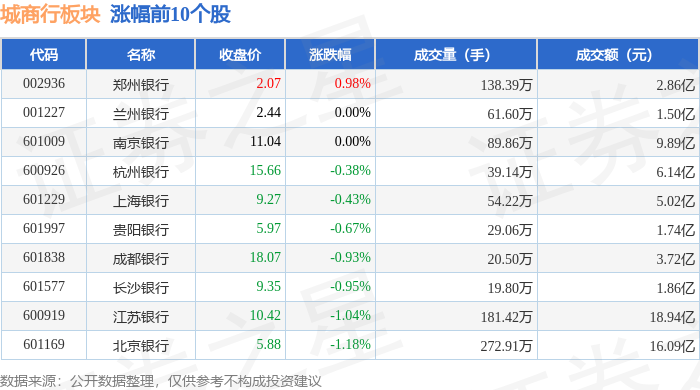
城商行板块9月15日跌0.85%,西安银行领跌,主力资金净流出7.97亿元
Zheng Xing Xing Ye Ri Bao· 2025-09-15 08:43
Market Overview - On September 15, the city commercial bank sector declined by 0.85% compared to the previous trading day, with Xi'an Bank leading the decline [1] - The Shanghai Composite Index closed at 3860.5, down 0.26%, while the Shenzhen Component Index closed at 13005.77, up 0.63% [1] Individual Bank Performance - Zhengzhou Bank closed at 2.07, up 0.98% with a trading volume of 1.38 million shares and a transaction value of 286 million yuan [1] - Xi'an Bank closed at 4.19, down 1.87% with a trading volume of 438,000 shares and a transaction value of 184 million yuan [2] - The highest decline was observed in Chengdu Bank, which closed at 18.07, down 0.93% [1] Capital Flow Analysis - The city commercial bank sector experienced a net outflow of 797 million yuan from institutional investors, while retail investors saw a net inflow of 348 million yuan [2] - The main capital inflow and outflow for individual banks varied, with Hangzhou Bank seeing a net inflow of 61.64 million yuan from institutional investors [3] - Conversely, Suzhou Bank experienced a net outflow of 11.76 million yuan from institutional investors [3]



有银行开30万年薪,和大厂争夺AI人才,金融科技招聘需求翻倍
3 6 Ke· 2025-09-15 08:26
Group 1 - The recruitment market is experiencing a peak during the "golden September and silver October" period, with major banks like ICBC, ABC, SPDB, and CMB launching their 2026 campus recruitment initiatives [1][2] - There is a significant demand for fintech talent, with some banks reporting a 100% increase in the need for such positions [2][3] - The focus on AI-related talent is growing, with banks like ICBC introducing specialized recruitment for AI roles for the first time, aiming to hire around 20 individuals with backgrounds in artificial intelligence and big data [2][3] Group 2 - Local banks are also actively seeking AI talent, with institutions like Hangzhou Bank and Shanghai Rural Commercial Bank offering positions related to AI and fintech [3] - The trend indicates a shift in the banking industry towards integrating AI into core business functions, moving from pilot projects to large-scale value creation [3][4] - The demand for AI talent reflects a broader transformation where AI is becoming a strategic foundation rather than just a tool, with three key trends: AI becoming a core driver, accelerated data value release, and deep organizational restructuring [4][5] Group 3 - The salary range for AI-related positions in banks is generally lower than that in internet companies, with annual salaries for algorithm positions in banks typically between 200,000 to 350,000 yuan [6][7] - Many banks require new hires to undergo a rotation in grassroots positions, even for tech roles, indicating a comprehensive training approach [7] - The urgent need for "AI + business" hybrid talent highlights the challenges and opportunities in the banking sector, as organizations face pressures in both recruitment and training of such talent [7]




133只个股连续5日或5日以上获融资净买入
Zheng Quan Shi Bao Wang· 2025-09-15 03:29
Core Viewpoint - As of September 12, a total of 133 stocks in the Shanghai and Shenzhen markets have experienced net financing inflows for five consecutive days or more, indicating strong investor interest in these stocks [1] Group 1: Stocks with Continuous Net Inflows - The stock with the longest consecutive net inflow is Yunnan Energy Investment, which has seen net buying for 19 consecutive trading days [1] - Other notable stocks with significant consecutive net inflows include Shanghai Bank, COFCO Sugar, Loxley Technology, Wankai New Materials, Guotou Capital, Bolong Technology, Chuzhong Technology, and China Pacific Insurance [1]


8月新增信贷恢复较大规模正增长,居民存款搬家现象较明显
Huan Qiu Wang· 2025-09-15 00:59
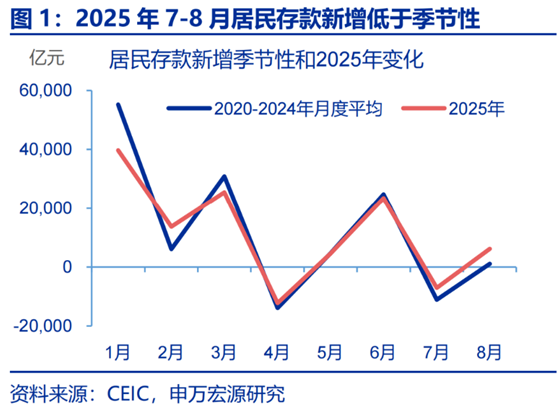
Group 1 - The core viewpoint of the article highlights the significant growth in M2 and M1, with M2 increasing by 8.8% year-on-year and M1 by 6%, indicating a strong financial support for the real economy [1] - The M1-M2 spread has narrowed to -2.8%, the lowest since June 2021, suggesting a shift in the monetary landscape [1] - In the first eight months of the year, RMB loans increased by 13.46 trillion yuan, with a notable recovery in new credit in August, reflecting robust financial support for the economy [1] Group 2 - The article emphasizes the need for future monetary policy to focus on optimizing the structure of financial growth while maintaining reasonable total growth [1] - It is noted that the current low price levels in China provide ample space for moderately loose monetary policy, with expectations for new credit and social financing to see a year-on-year increase [1] - The stock market's significant rise in August coincided with a noticeable shift in resident deposits, with a year-on-year decrease of 600 billion yuan in resident deposits and an increase of 550 billion yuan in non-bank deposits [1] Group 3 - Investment recommendations from Zheshang Securities suggest focusing on improving and high-quality A-share banks, including Pudong Development Bank, Nanjing Bank, Shanghai Bank, China Merchants Bank, and Industrial Bank [4] - The report also advises paying attention to high-dividend H-shares with improving fundamentals [4]


上海海通证券资产管理有限公司
Shang Hai Zheng Quan Bao· 2025-09-14 19:48
Core Viewpoint - The announcement details the convening of a shareholder meeting for the Haitong Anyu Medium and Short Bond Collective Asset Management Plan to discuss the change of management to Guotai Haitong Securities Asset Management Co., Ltd. and related matters [1][2][34]. Meeting Details - The meeting will be held via communication methods, with voting from September 17, 2025, to October 14, 2025, at 17:00 [2][3]. - The meeting aims to protect the interests of the shareholders and is in accordance with relevant laws and regulations [2][34]. Management and Custodian Information - The management company is Shanghai Haitong Securities Asset Management Co., Ltd., and the custodian is Shanghai Bank Co., Ltd. [2][33]. - The plan is set to expire on December 31, 2025, following the management contract's effective date [2][33]. Voting Procedures - Shareholders can vote through various methods, including paper ballots, online voting, SMS voting, and recorded phone voting, specifically for individual investors [4][5][7][11]. - The voting rights are based on the number of shares held, with each share granting one vote [14]. Agenda Items - The main agenda item is the proposal to change the management of the Haitong Anyu Medium and Short Bond Collective Asset Management Plan to Guotai Haitong Medium and Short Bond Securities Investment Fund [5][34]. - The proposal requires a two-thirds majority approval from the participating shareholders to be valid [20][34]. Legal and Regulatory Compliance - The meeting and proposed changes comply with the Securities Investment Fund Law and related regulations [34][48]. - The management company is authorized to handle the necessary adjustments and modifications to the legal documents following the approval of the proposal [47][48]. Changes to the Fund Structure - The management will change from Shanghai Haitong Securities Asset Management Co., Ltd. to Guotai Haitong Securities Asset Management Co., Ltd. [35]. - The product name will change from Haitong Anyu Medium and Short Bond Collective Asset Management Plan to Guotai Haitong Medium and Short Bond Securities Investment Fund [36]. - The investment strategy and fee structure will also be adjusted, including a reduction in sales service fees [41][42][43].

深圳多家银行启动房贷利率调整
Ge Long Hui· 2025-09-13 01:46
Core Viewpoint - Shenzhen has implemented new housing market policies, leading to significant changes in mortgage lending practices by multiple banks in the region [1] Group 1: Policy Changes - On September 5, Shenzhen introduced new housing market regulations, which prompted banks to revise their lending guidelines [1] - As of September 12, 12 banks, including Industrial Bank, Agricultural Bank of China, Industrial and Commercial Bank of China, China Construction Bank, Shanghai Pudong Development Bank, and Shanghai Bank, announced new policies [1] Group 2: Mortgage Adjustments - The new policies eliminate the distinction between first and second home purchases for mortgage lending [1] - Several banks indicated that existing second-home commercial mortgage loans are now subject to a normalization adjustment mechanism for interest rates, allowing customers to apply for adjustments immediately [1]

中国银行业正迎来重要拐点
2 1 Shi Ji Jing Ji Bao Dao· 2025-09-13 00:27
Core Viewpoint - The banking industry is facing a critical turning point as net interest margins have fallen below non-performing loan ratios, indicating a dual pressure of shrinking income and rising risk [1][4][5] Group 1: Financial Indicators - As of Q1 2025, the non-performing loan ratio for commercial banks was 1.51%, while the net interest margin was 1.43%, marking the lowest net interest margin since 2005 [1][5] - By Q2 2025, the net interest margin further declined to 1.42%, with the non-performing loan ratio rising to 1.49% [1] - Over 20% of the 42 listed banks reported net interest margins lower than their non-performing loan ratios, highlighting a concerning trend in the industry [1][6] Group 2: Industry Response - In response to these challenges, banks are shifting towards middle-income business models, with a notable resurgence in insurance and banking (银保) business, which accounted for over 50% of income for the first time in 15 years [2][21] - Major banks like China Merchants Bank and Ping An Bank reported over 40% year-on-year growth in insurance income [2] Group 3: Asset and Liability Management - The continuous decline in net interest margins is attributed to a combination of low asset yields and rigid liability costs, exacerbated by insufficient effective credit demand and external pressures from bond market financing [10][12] - Banks are adjusting their asset-liability strategies to cope with narrowing margins, focusing on optimizing their loan structures and reducing costs [13] Group 4: Asset Quality and Risk - The total non-performing loan balance for commercial banks was reported at 34,342 billion yuan in Q2 2025, with a slight decrease from Q1 [15] - The provision coverage ratio improved to 211.97%, indicating enhanced risk mitigation capabilities [15] - However, the non-performing loan generation rate and overdue loan rates are on the rise, suggesting ongoing pressure on asset quality [17][19] Group 5: Middle-Income Business Growth - The middle-income business segment is showing signs of recovery, with non-interest income growing by 6.97% year-on-year in the first half of 2025, reversing a downward trend [21][22] - The insurance business is becoming a key growth driver, with banks leveraging their networks to enhance insurance sales [23]



申请成功 当日生效
Shen Zhen Shang Bao· 2025-09-12 16:24
Core Viewpoint - The recent policy changes in Shenzhen's housing market have led multiple banks to adjust their commercial personal housing loan interest rate pricing mechanisms, eliminating the distinction between first and second homes [1] Group 1: Policy Changes - On September 5, Shenzhen introduced new housing market policies, prompting banks to revise their loan interest rate mechanisms [1] - Major banks including Industrial and Commercial Bank of China, China Construction Bank, Agricultural Bank of China, Shanghai Pudong Development Bank, and Shanghai Bank have issued announcements regarding these adjustments [1] Group 2: Loan Interest Rate Mechanism - The new policy stipulates that the specific interest rate for each customer's commercial personal housing loan will be determined based on the Shenzhen market interest rate pricing self-discipline mechanism, along with the bank's operational status and customer risk profile [1] - The distinction between first and second home loans has been removed, allowing for a more uniform approach to interest rates [1] Group 3: Impact on Existing Loans - The new policy has triggered a dynamic adjustment mechanism for some existing mortgage customers, allowing certain second-home loan borrowers to apply for adjustments effective immediately upon approval [1] - Successful applications can be checked the following day, indicating a streamlined process for borrowers affected by the new regulations [1]