
PING AN OF CHINA(601318)

Search documents
这500家企业,展现了广东经济发展的三大趋势
2 1 Shi Ji Jing Ji Bao Dao· 2025-11-21 10:52
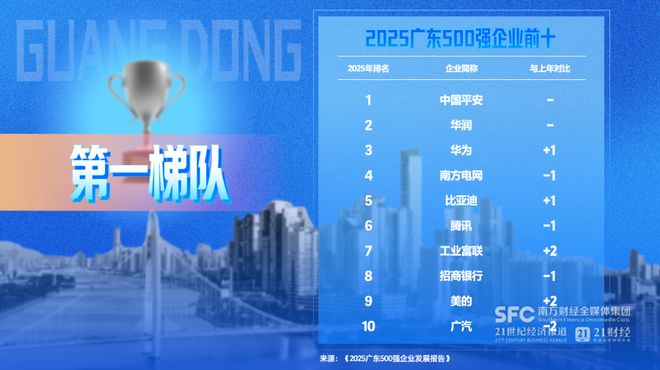
Core Insights - The report indicates that the threshold for entering the "2025 Guangdong Top 500 Enterprises Development Report" has surpassed 3 billion yuan for the first time, with Ping An ranking first and projected to exceed 1 trillion yuan in revenue for 2024 [2][4] - The total operating revenue of the 500 enterprises reached a historical high of 19.36 trillion yuan, reflecting the resilience and recovery of Guangdong's economy [4][5] - The report highlights a shift towards new industries, with a significant increase in the number of enterprises in the new energy and electronic information sectors, while traditional real estate companies have seen a decline in rankings [6][8] Group 1: Economic Trends - Guangdong's economy is steadily recovering, with a year-on-year growth rate of operating revenue increasing from 0.37% to 3.36% [7] - Net profit is expected to see a slight increase of 2.06% in 2025, following a recovery in 2024 [7] - Total assets have grown from 56.62 trillion yuan in 2021 to 68.33 trillion yuan in 2025, indicating a cumulative growth of over 11 trillion yuan [7] Group 2: Industry Transformation - The traditional "real estate-finance-local government infrastructure" model is no longer sustainable, leading to a focus on optimizing traditional industries and nurturing emerging sectors [8] - The proportion of strategic emerging industries among the top 500 enterprises reached 81.6%, with significant representation from electrical machinery and equipment manufacturing [8] Group 3: Innovation Investment - The total R&D expenditure of the top 500 enterprises reached 584.96 billion yuan, with a focus on artificial intelligence, new energy, and biomedicine [9] - The investment in scientific research and technical services accounted for 18.99% of the total R&D spending, indicating a strong commitment to innovation [9] - The report emphasizes the importance of integrating technological and industrial innovation, aligning with the "14th Five-Year Plan" objectives [9]





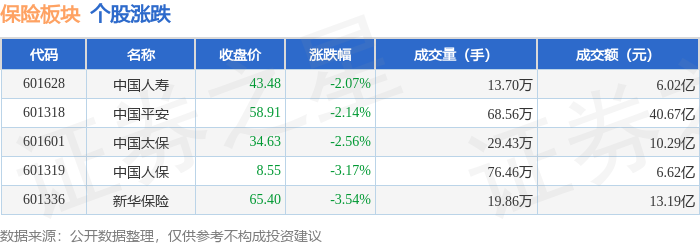
保险板块11月21日跌2.39%,新华保险领跌,主力资金净流出8.56亿元
Zheng Xing Xing Ye Ri Bao· 2025-11-21 09:33
Core Points - The insurance sector experienced a decline of 2.39% on November 21, with Xinhua Insurance leading the drop [1] - The Shanghai Composite Index closed at 3834.89, down 2.45%, while the Shenzhen Component Index closed at 12538.07, down 3.41% [1] Insurance Sector Performance - China Life (601628) closed at 43.48, down 2.07% with a trading volume of 137,000 shares and a turnover of 602 million yuan [1] - Ping An Insurance (601318) closed at 58.91, down 2.14% with a trading volume of 685,600 shares [1] - China Pacific Insurance (601601) closed at 34.63, down 2.56% with a trading volume of 294,300 shares and a turnover of 1.029 billion yuan [1] - China Reinsurance (601319) closed at 8.55, down 3.17% with a trading volume of 764,600 shares and a turnover of 662 million yuan [1] - Xinhua Insurance (601336) closed at 65.40, down 3.54% with a trading volume of 198,600 shares and a turnover of 1.319 billion yuan [1] Capital Flow Analysis - The insurance sector saw a net outflow of 856 million yuan from institutional investors, while retail investors had a net inflow of 733 million yuan [1] - The detailed capital flow for individual stocks shows that China Reinsurance had a net outflow of 51.58 million yuan from institutional investors [2] - China Life experienced a net outflow of 52.08 million yuan from institutional investors, while retail investors contributed a net inflow of 64.48 million yuan [2] - China Pacific Insurance had a net outflow of 56.32 million yuan from institutional investors, with retail investors contributing a net inflow of 85.31 million yuan [2] - Xinhua Insurance faced a significant net outflow of 258 million yuan from institutional investors, while retail investors had a net inflow of 185 million yuan [2] - Ping An Insurance had a net outflow of 43.91 million yuan from institutional investors, with retail investors contributing a net inflow of 35.8 million yuan [2]




引爆服务革命,平安把专业金融、严肃医疗装进这个AI“超级入口”
Di Yi Cai Jing· 2025-11-21 08:41
Core Insights - China Ping An is leveraging AI technology to enhance its services across various sectors, including finance, healthcare, and elder care, aiming to create a seamless user experience [1][11] - The introduction of the "AI Super Customer Service" is a significant development, designed to integrate various services and provide quick, efficient solutions to customer needs [3][4] AI Service Matrix - The "AI Super Customer Service" connects all of Ping An's financial, medical, and elder care services through a unified AI service platform, marking a shift from traditional service models to a more integrated approach [3][4] - This service emphasizes practicality and efficiency, aiming to resolve customer issues quickly, whether related to financial products, health inquiries, or emergency situations [4][5] Technological Advancements - AI technology is evolving rapidly, with significant improvements in model intelligence and capabilities, making it comparable to professional experts in finance and healthcare [7] - The expansion of AI's role from a tool to a collaborative partner in various tasks, such as medical history organization and health consultations, is transforming service delivery [8][9] Service Quality Improvement - The integration of AI in healthcare services has led to enhanced follow-up rates and personalized care, significantly improving patient engagement and service quality [9][10] - AI's deployment in grassroots healthcare settings has enabled early detection of diseases, demonstrating its potential to improve healthcare access and outcomes for underserved populations [10] Future Outlook - The company believes that the current phase of AI development presents a substantial opportunity for growth and innovation, positioning itself as a leader in harnessing AI for professional services [10][11] - The ongoing evolution of AI technology and its applications in various sectors is expected to continue shaping the future of service delivery in finance and healthcare [11][12]
引爆服务革命,平安把专业金融、严肃医疗装进这个AI“超级入口”
第一财经· 2025-11-21 08:25
Core Viewpoint - China Ping An is leveraging AI technology to enhance customer service across financial, medical, and elderly care sectors, aiming to create a seamless user experience through its three major AI services: AI Super Customer Service, AI Family Doctor, and AI Elderly Care Steward [1][4][15]. Group 1: AI Super Customer Service - The AI Super Customer Service is designed to connect all of Ping An's services, transforming service logic and making AI more accessible to users [3][5]. - This service emphasizes practicality over complexity, aiming to provide quick responses and solutions to customer needs, such as financial inquiries, health consultations, and emergency assistance [5][6]. - Currently in internal testing, the AI Super Customer Service is set to be available to 250 million Ping An customers upon completion [8]. Group 2: AI Development Trends - AI is experiencing unprecedented evolution, with significant advancements in model intelligence and capabilities, particularly in financial and medical fields [10]. - The boundaries of AI are expanding, moving from digital to physical spaces, which is crucial for services that primarily occur offline, such as healthcare and elderly care [10][11]. - AI's role is shifting from a mere tool to a collaborative partner in work and learning, with AI now capable of generating a significant portion of code used internally at Ping An [12]. Group 3: AI in Healthcare - AI Family Doctors can assist in automating processes such as medical history organization and patient follow-ups, significantly increasing efficiency and service quality [12][13]. - The integration of AI has improved follow-up rates from 40% to 44%, enhancing patient engagement and allowing human healthcare providers to focus on more personalized care [13]. - Ping An's AI eye screening model has been deployed in over 500 grassroots hospitals, screening over 200,000 people annually with a sensitivity of 98%, equivalent to that of professional ophthalmologists [14]. Group 4: Future Outlook - The introduction of AI Super Customer Service represents not just a product upgrade but an evolution of the entire service ecosystem, emphasizing the importance of useful AI over flashy technology [15][16]. - The company believes that the current phase of AI development presents significant opportunities, positioning itself as a leader in harnessing these advancements for comprehensive service delivery [14][15].
专访平安集团王晓航:AI超级客服“不是超级酷炫,是超级好用”
2 1 Shi Ji Jing Ji Bao Dao· 2025-11-21 07:36
Core Insights - Ping An Group is developing a unified AI entry point called "AI Super Customer Service," which aims to connect various services in finance, healthcare, elderly care, and daily life, facilitating direct access to consultation, service handling, and emergency rescue. This service is currently in the internal testing phase [1][3]. Group 1 - The "AI Super Customer Service" is part of Ping An Group's broader strategy to enhance service integration and accessibility [1][3]. - In addition to "AI Super Customer Service," Ping An Group is also launching "AI Family Doctor" and "AI Elderly Care Butler," which are the three major AI services being introduced [1].
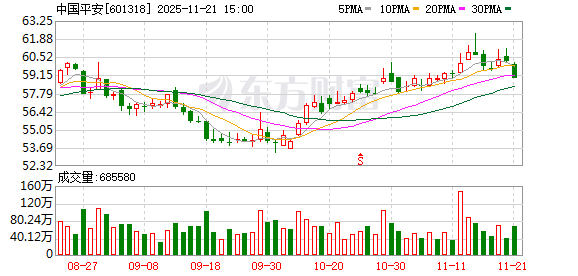
中国平安跌2.14%,成交额40.67亿元,近3日主力净流入-7.53亿
Xin Lang Cai Jing· 2025-11-21 07:16
Core Viewpoint - China Ping An's stock experienced a decline of 2.14% on November 21, with a trading volume of 4.067 billion yuan and a market capitalization of 1,066.721 billion yuan [1] Group 1: Dividend and Shareholding - The dividend yields for China Ping An over the past three years were 5.15%, 6.03%, and 4.84% respectively [2] - Among the top ten circulating shareholders, Central Huijin Asset Management Co., Ltd. and China Securities Finance Corporation Limited are included [2] - As of September 30, 2025, the total cash dividends distributed by China Ping An since its A-share listing amounted to 391.904 billion yuan, with 134.54 billion yuan distributed over the last three years [7] Group 2: Business Overview - China Ping An Insurance (Group) Co., Ltd. was established on March 21, 1988, and listed on March 1, 2007, providing diversified financial services including insurance, banking, securities, and trust [6] - The revenue composition of the company includes life and health insurance (45.76%), property insurance (34.46%), banking (13.87%), asset management (5.27%), and financial empowerment (3.85%) [6] - The company has a presence in various sectors, including internet insurance and unicorn concepts, with subsidiaries like Lufax, Ping An Good Doctor, and Ping An Health Insurance [2] Group 3: Financial Performance - For the period from January to September 2025, China Ping An reported a net profit attributable to shareholders of 132.856 billion yuan, reflecting a year-on-year growth of 11.47% [6] - The average trading cost of the stock is 52.40 yuan, with the stock price approaching a resistance level of 58.95 yuan, indicating potential for upward movement if the resistance is broken [5] Group 4: Market Activity - The net inflow of funds for the stock today was -388 million yuan, with a market ranking of 5 out of 5 in its industry, indicating no significant trend in major shareholder activity [3][4] - The main shareholders have a light control over the stock, with a relatively dispersed distribution of shares [4]
400万工程款引爆千亿房企“大雷”万亿中国平安与华夏幸福决裂?
Xin Lang Cai Jing· 2025-11-21 06:03
Core Viewpoint - The announcement of China Ping An's board member Wang Wei expressing ignorance about Huaxia Happiness's bankruptcy pre-restructuring application highlights internal conflicts and raises questions about the company's financial stability and governance [1][5]. Group 1: Company Financial Situation - Huaxia Happiness has accumulated a debt of 245.69 billion yuan, with a significant portion of this debt being unpaid to creditors, including a 417.16 million yuan construction payment owed to Longcheng Construction [2][4]. - The company's financial performance has deteriorated, reporting a revenue of 3.882 billion yuan for the first three quarters of 2025, a 72.09% decrease year-on-year, and a net loss of 9.829 billion yuan [3][4]. - As of October 31, 2025, Huaxia Happiness's total liabilities reached 2.64739 trillion yuan, with nearly 90% of financial creditors having reached debt restructuring agreements [3][4]. Group 2: Shareholder Dynamics - China Ping An holds approximately 25.05% of Huaxia Happiness's shares, having invested nearly 18 billion yuan for 7.58 million shares in 2018, but has since incurred a cumulative loss of 60 billion yuan from this investment [1][5]. - Wang Wei has consistently opposed Huaxia Happiness's financial reports and debt restructuring plans, indicating a long-standing conflict between China Ping An and Huaxia Happiness's management [6][7]. - Following the decline in Huaxia Happiness's net asset value, which has decreased by 93.54% since China Ping An's initial investment, the company plans to continue reducing its stake to mitigate losses [7].

石河子金融监管分局同意平安产险东阜城镇营销服务部变更营业场所
Jin Tou Wang· 2025-11-21 04:21
二、中国平安财产保险股份有限公司应按照有关规定及时办理变更及许可证换领事宜。 一、同意中国平安财产保险股份有限公司东阜城镇营销服务部将营业场所变更为:新疆石河子市东阜城 镇2小区97栋9号。 2025年11月17日,石河子金融监管分局发布批复称,《关于中国平安(601318)财产保险股份有限公司 东阜城镇营销服务部变更营业场所的请示》(平保产新分石河子中支发〔2025〕13号)收悉。经审核, 现批复如下: ...
中国中车(01766.HK)获中国平安增持858万股
Ge Long Hui· 2025-11-20 23:33
Group 1 - China Pacific Insurance (Group) Co., Ltd. increased its stake in CRRC Corporation Limited by acquiring 8.58 million shares at an average price of HKD 6.3429 per share, totaling approximately HKD 54.42 million [1][2] - Following this transaction, China Pacific Insurance's total shareholding in CRRC has risen to 265,816,000 shares, increasing its ownership percentage from 5.88% to 6.08% [1][2]


中国中车获中国平安增持858万股
Ge Long Hui· 2025-11-20 23:33
Group 1 - The core point of the article is that China Ping An Insurance (Group) Co., Ltd. has increased its stake in CRRC Corporation Limited by purchasing 8.58 million shares at an average price of HKD 6.3429 per share, raising its ownership percentage from 5.88% to 6.08% [1][2]. Group 2 - The total investment made by China Ping An for this acquisition amounts to approximately HKD 54.42 million [1]. - Following the purchase, China Ping An's total shareholding in CRRC Corporation is now 265,816,000 shares [1][2].