
PICC(601319)

Search documents
押宝分红险:预定利率降了 销量反而要爆?
Mei Ri Jing Ji Xin Wen· 2025-09-04 12:24
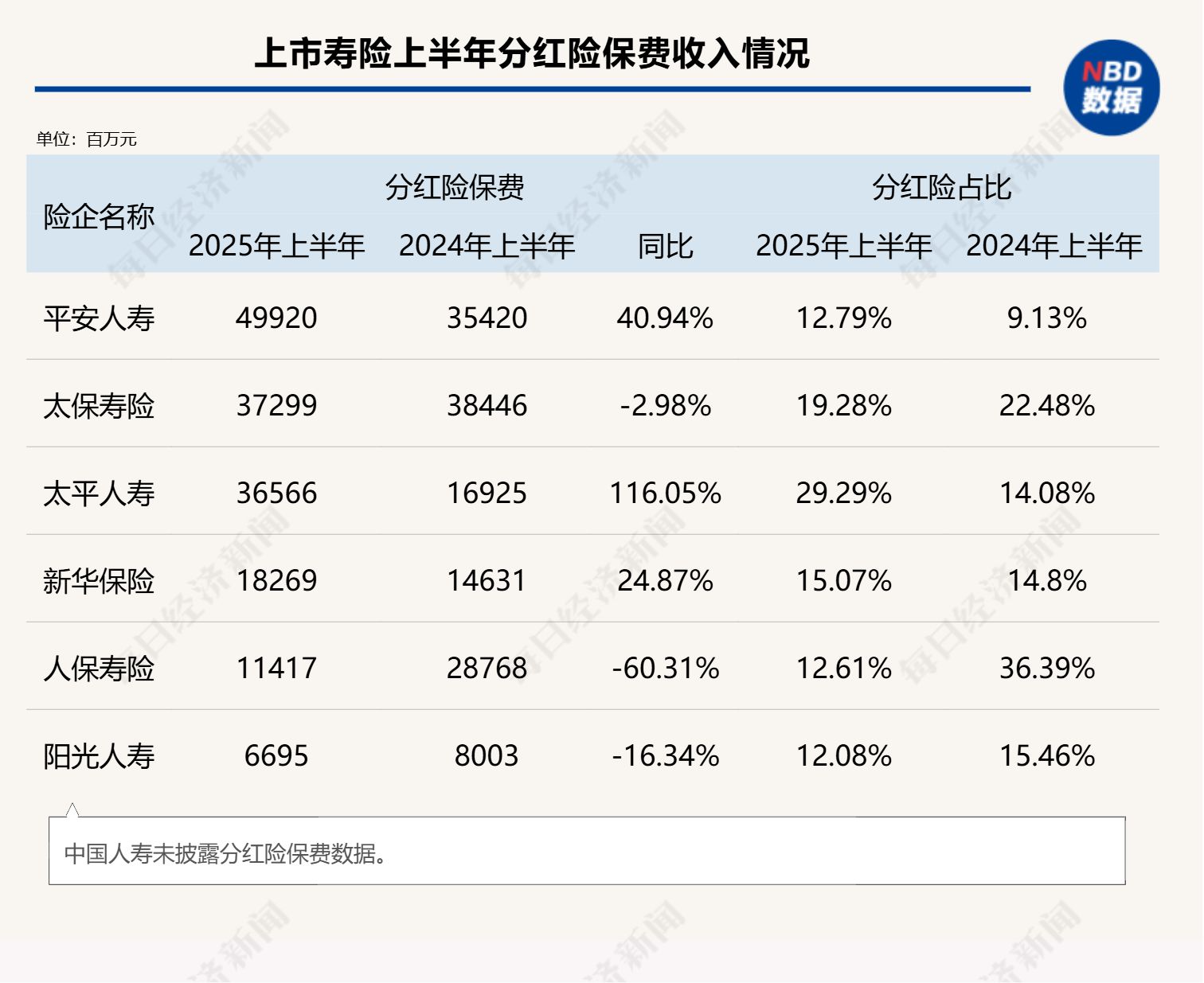
Core Viewpoint - The insurance industry is shifting towards dividend insurance sales in response to the reduction in the predetermined interest rate, with major listed insurance companies reporting significant growth in this segment despite challenges posed by the new interest rate environment [1][9]. Dividend Insurance Sales Performance - In the first half of 2025, major insurance companies have set ambitious targets for dividend insurance sales, with many aiming for a 50% sales ratio [1]. - Taiping Life reported that dividend insurance accounted for 87.1% of first-year premium income in long-term insurance, while China Pacific Life's new premium income from dividend insurance rose to 42.5%, with agent channels contributing 51% [5][2]. - China Life, Ping An, and other leading insurers have also seen substantial increases in dividend insurance premiums, with Ping An leading at approximately 500 billion yuan, a 40.94% increase year-on-year [4][5]. Market Dynamics and Challenges - The recent adjustment in predetermined interest rates has led to a decrease in the maximum rate for dividend insurance from 2% to 1.75%, which may reduce the attractiveness of these products and increase sales difficulty [1][9]. - Despite this, insurance companies are optimistic about the potential for dividend insurance to become a mainstream product, with expectations for increased market share in the second half of the year [1][10]. Strategic Initiatives for Transformation - Companies are implementing various strategies to promote dividend insurance, including performance assessments, commission adjustments, and tailored product offerings [7][8]. - China Pacific Life has outlined a four-pronged approach to enhance its dividend insurance business, focusing on mindset shifts, differentiated channel strategies, regional adaptations, and resource allocation [7]. - New China Life has established a leadership group to drive the transformation towards dividend insurance, indicating a commitment to overcoming previous sales challenges [8]. Future Outlook - The insurance sector anticipates that the shift towards dividend insurance will accelerate, with companies planning to increase the supply and competitiveness of these products [9][10]. - Ping An has indicated that wealth and pension products will transition to dividend types, reflecting a broader industry trend towards flexible, floating-yield products in response to changing market conditions [11].





持股仅差116万股直逼社保基金!中国人保神秘个人股东孔凤全锁仓近三年
Sou Hu Cai Jing· 2025-09-04 09:50
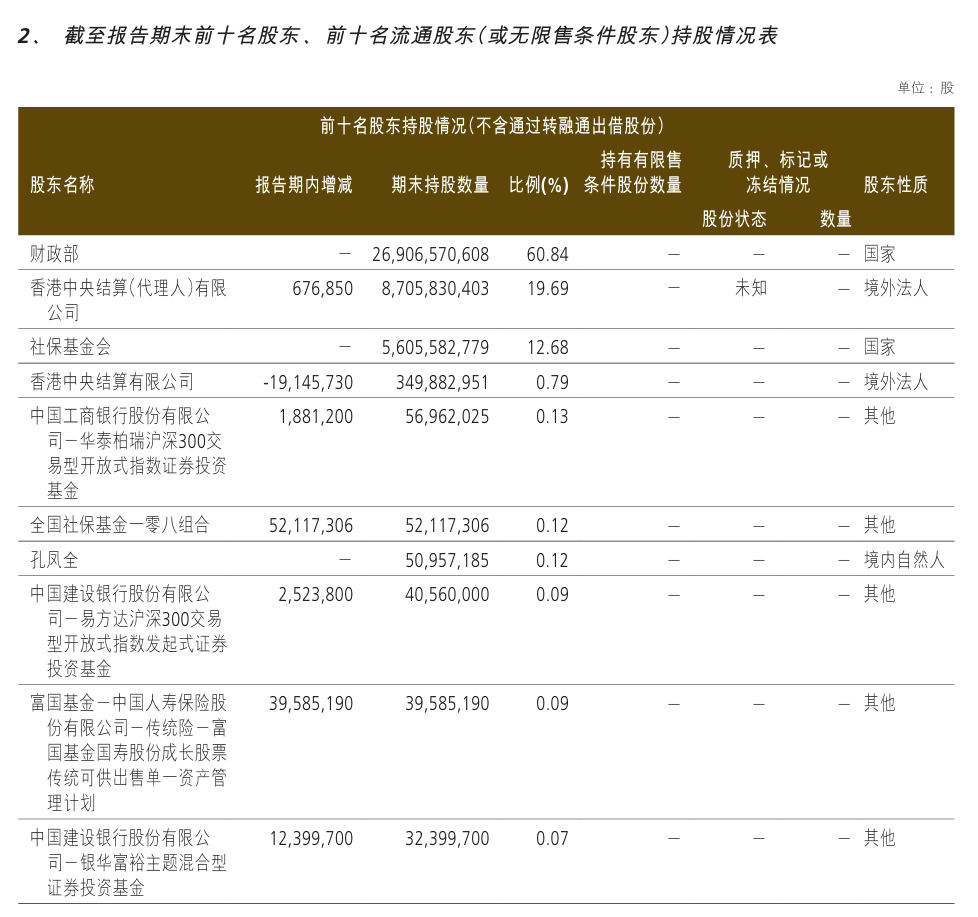
Core Viewpoint - The article discusses the changes in the shareholder structure of China Life Insurance (601319), highlighting the decline in the ranking of individual shareholder Kong Fengquan among the top shareholders due to the rise of the National Social Security Fund's 108 portfolio [1][3]. Shareholder Structure - As of the 2025 semi-annual report, Kong Fengquan's ranking among the top shareholders of China Life has dropped to 7th place, holding 50.96 million shares, which is 0.12% of the total shares [1][2]. - The top shareholder is the Ministry of Finance, holding 60.84% of the shares, followed by Hong Kong Central Clearing Limited with 19.69% [2]. - The National Social Security Fund's 108 portfolio has surpassed Kong Fengquan, who is now only 1.16 million shares behind the 6th place holder [2][3]. Shareholding History - Kong Fengquan first entered the top ten shareholders in Q3 2022 with 16.63 million shares (0.04%) and ranked 9th [3]. - His shareholding increased significantly to 34.96 million shares (0.08%) by the end of 2022, moving him to 6th place [3]. - In 2023, he continued to increase his holdings, reaching 50.96 million shares by Q3, maintaining a 5th place ranking until the recent decline [3]. Investment Performance - Kong Fengquan's investment coincided with a low point in China Life's stock price, with an average purchase price estimated at 5.37 yuan per share [4]. - Since then, the stock price has increased by over 69.4%, significantly enhancing the value of his holdings [4]. Dividend Income - Kong Fengquan has received substantial dividends during his holding period, totaling approximately 2.577 million yuan from 2022 to 2024 [5]. - The expected dividend from the 2025 semi-annual report is around 408,000 yuan based on his current holdings [5]. Company Performance - China Life's revenue grew from 2200.5 billion yuan in 2022 to 2672.1 billion yuan in 2025, reflecting a year-on-year growth rate of 6.7% [6]. - The net profit for the first half of 2025 reached 234.6 billion yuan, a significant increase of 34.4% compared to the previous year [6]. - Total assets increased from 7653.6 billion yuan in 2022 to 8050 billion yuan in 2025, marking a 9.2% year-on-year growth [6].

日赚近10亿、分红293亿,五大险企押注分红险,部分公司新业务占比超50%
3 6 Ke· 2025-09-04 09:21
Group 1: Core Insights - The five major listed insurance companies in A-shares achieved a total net profit of 1781.92 billion yuan in the first half of 2025, averaging a daily profit of 9.84 billion yuan [1][4] - These companies announced significant cash dividends, with a total proposed dividend of approximately 293.36 billion yuan, led by China Ping An at 172.02 billion yuan [1][4] - The rise of participating insurance is becoming a new growth engine for the industry, with several companies reporting substantial increases in new premium income from participating insurance [1][7] Group 2: Financial Performance - The total operating revenue of the five major insurance companies reached 1.33 trillion yuan, a year-on-year increase of 4.89% [3] - New business value for life insurance companies saw explosive growth, with China Life and Ping An Life achieving new business values of 285 billion yuan and 223.35 billion yuan, respectively, reflecting year-on-year growth rates of 20.3% and 39.8% [5] Group 3: Participating Insurance Growth - The proportion of participating insurance in new business has significantly increased, with China Life reporting that over 50% of its new business premium comes from participating insurance [7][9] - New premium income from participating insurance for New China Life reached 182.69 billion yuan, a year-on-year increase of 24.9% [7] - The shift towards participating insurance is seen as both a response to the low interest rate environment and a long-term strategy for risk-sharing with customers [2][8] Group 4: Strategic Responses - Insurance companies are focusing on optimizing their product structures and enhancing the sales capabilities of their agents to adapt to the changing market conditions [10][11] - The adjustment in product sales strategies emphasizes understanding customer needs for risk protection and financial management, moving away from solely promoting high guaranteed returns [11]

保险板块9月4日涨0.16%,中国人寿领涨,主力资金净流出1.94亿元
Zheng Xing Xing Ye Ri Bao· 2025-09-04 08:48
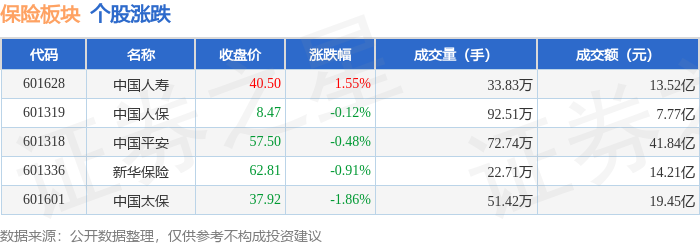
Core Insights - The insurance sector experienced a slight increase of 0.16% on September 4, with China Life leading the gains [1] - The Shanghai Composite Index closed at 3765.88, down 1.25%, while the Shenzhen Component Index closed at 12118.7, down 2.83% [1] Insurance Sector Performance - China Life (601628) closed at 40.50, up 1.55% with a trading volume of 338,300 shares and a transaction value of 1.352 billion [1] - China Pacific Insurance (601601) closed at 37.92, down 1.86% with a trading volume of 514,200 shares and a transaction value of 1.945 billion [1] - New China Life (601336) closed at 62.81, down 0.91% with a trading volume of 227,100 shares and a transaction value of 1.421 billion [1] - China Ping An (601318) closed at 57.50, down 0.48% with a trading volume of 727,400 shares and a transaction value of 4.184 billion [1] - China Re (601319) closed at 8.47, down 0.12% with a trading volume of 925,100 shares and a transaction value of 777 million [1] Fund Flow Analysis - The insurance sector saw a net outflow of 194 million from institutional investors, while retail investors experienced a net outflow of 143 million [1] - Speculative funds recorded a net inflow of 337 million into the insurance sector [1] Individual Stock Fund Flow - China Life (601628) had a net inflow of 69.29 million from institutional investors, accounting for 5.12% of total transactions [2] - New China Life (601336) had a net inflow of 66.60 million from institutional investors, accounting for 4.69% of total transactions [2] - China Ping An (601318) experienced a net outflow of 192 million from institutional investors, representing 4.59% of total transactions [2] - China Pacific Insurance (601601) had a net outflow of 91.25 million from institutional investors, accounting for 4.69% of total transactions [2] - China Re (601319) had a net outflow of 46.37 million from institutional investors, representing 5.97% of total transactions [2]
保险业交出稳中有进“周年答卷”
Jin Rong Shi Bao· 2025-09-04 08:41
Core Viewpoint - The "New National Ten Articles" released by the State Council aims to strengthen regulation, prevent risks, and promote high-quality development in the insurance industry over the next 5 to 10 years, marking a significant policy direction for the sector [1] Industry Performance - As of the end of Q2 2025, the insurance industry's asset scale reached 39.22 trillion yuan, with a year-on-year growth of 9.2% [2] - The total insurance premium income amounted to 3.74 trillion yuan, reflecting a 5.3% increase compared to the same period in 2024 [2] - Insurance companies' claims and payouts reached 1.3 trillion yuan, showing a notable growth of 9% year-on-year, outpacing premium growth [2] Social Welfare Services - The insurance sector has enhanced its role in social welfare, particularly in disaster relief, with 20.5 billion yuan paid out during extreme weather events in 2025 [3] - The urban catastrophe insurance program has provided risk protection for 64.39 million households, amounting to 22.36 trillion yuan in coverage [3] - Technological advancements have improved risk reduction services, with significant outreach for disaster warnings to millions of clients [3] Health Insurance Development - The urban commercial medical insurance, known as "惠民保," has seen significant growth, with 615.9 million participants in Shenzhen and over 22 billion yuan in claims paid [4] - The commercial health insurance sector has also expanded, with claims reaching 405.2 billion yuan in 2024 and long-term health insurance reserves exceeding 2.5 trillion yuan [4][5] Support for the Real Economy - The insurance industry is aligning with national strategies by enhancing risk protection in technology innovation and green development [6][7] - Insurance services for technology activities provided coverage of nearly 24 trillion yuan in the first half of 2025 [6] - Green insurance products have seen a 23.9% increase in risk coverage, with over 126.35 trillion yuan provided [7] Investment in Strategic Areas - Insurance companies are increasing investments in strategic sectors, with China Life establishing a fund focused on high-demand industries like AI and advanced manufacturing [8] - New China Life's investment in national strategic areas surpassed 1.21 trillion yuan, reflecting a 54% year-on-year increase [8] Industry Reform and Transformation - The insurance sector is undergoing significant reforms in pricing mechanisms and product structures to enhance quality and efficiency [10][11] - The introduction of floating yield insurance products has led to a 33% share of new life insurance products in the first half of 2025 [11] - The insurance intermediary market is also experiencing a contraction, with a 11.7% decrease in the number of professional intermediary institutions in Jilin province [11] Future Outlook - The insurance industry is expected to continue leveraging its long-term advantages to contribute to the construction of a financial strong nation and support modernization efforts in China [12]
保险业AI暗战:从“规模厮杀”到“效率竞赛”,谁能跑通新范式?
Guan Cha Zhe Wang· 2025-09-04 08:00
Core Insights - The application of artificial intelligence (AI) in China's insurance industry is experiencing a qualitative leap, transitioning from conceptual exploration to industrial implementation in the first half of 2025 [1] - Intelligent transformation is becoming the core driving force for the industry's upgrade, fundamentally changing traditional insurance business models [1] Group 1: Underwriting and Claims Processing - The underwriting process is undergoing deep transformation with AI, addressing long-standing challenges in processing unstructured data [1] - Ping An Property & Casualty has achieved an intelligent issuance rate of 81.2% in car insurance, reducing average processing time to under one minute [1] - ZhongAn Insurance's cloud core system "Wujieshan" generated 6.699 billion policies in the first half of the year, with an automated underwriting rate of 99% [1] - Claims processing has seen significant improvements, with Ping An's "111 Fast Claim" service achieving a 59% share of instant claims, and injury claims automated processing rate reaching 55% [1][2] Group 2: Customer Service and Risk Assessment - China Life's digital underwriting system has an intelligent review rate of 95.8%, and its new intelligent customer service has an accuracy rate exceeding 95% [2] - Sunshine Insurance's remote service has achieved a 65% automation rate in the entire process, with an 82% satisfaction rate for intelligent services [2] - ZhongAn's "Lingxi Platform" deployed nearly 110 intelligent robots, handling 450 million calls in the first half of the year [2] - Ping An's anti-fraud system intercepted losses of 6.44 billion yuan, a 6% year-on-year increase [2] Group 3: Strategic Development and Future Outlook - Many insurance companies are elevating AI to a core strategic level, with China Pacific Insurance emphasizing "AI+" as a key strategy [3] - The insurance industry is transitioning from "scale-driven" to "efficiency-driven" and "value-driven" models due to the deep integration of AI technology [3] - The intelligent transformation is not only enhancing operational efficiency and reducing costs but also paving new paths for high-quality development in the insurance sector [3]

险资"入市潮":五大上市险企半年增配权益资产超4000亿
Guan Cha Zhe Wang· 2025-09-04 07:59
Core Insights - The insurance funds are becoming the most steadfast incremental capital source in the equity market, with five major A-share listed insurance groups showing significant growth in stock investments [1] - By mid-2025, the total stock investment scale of these top insurance companies approached 1.8 trillion yuan, reflecting a net increase of over 400 billion yuan since the beginning of the year [1] Group 1: Investment Strategies - China People's Insurance Group exhibited a clear strategic direction in equity investments, with a 26.1% increase in A-share investment scale and an increase in equity asset proportion from 3.7% to 5.4% [2] - China Life Insurance adopted a more aggressive equity investment strategy, adding over 150 billion yuan in equity assets within six months, raising the stock investment proportion from 7.58% to 8.70% [2] - Ping An Insurance showed the most significant growth in equity investments, with a 48.5% increase in stock investment scale, reaching 10.5% of total investments, focusing on "new quality productivity" and "high-dividend value stocks" [2][3] Group 2: Investment Philosophy - New China Life Insurance's investment strategy reflects a shift towards high-dividend OCI equity investments, increasing allocation by 6.826 billion yuan, indicating a change from pure capital appreciation to a multi-dimensional goal including dividend yield and asset-liability matching [4] - China Pacific Insurance is expanding its investment boundaries by increasing allocations to alternative assets like unlisted equity, aiming to enhance overall investment returns [4] - The large-scale entry of insurance funds into the A-share market serves as a stabilizing force, improving the investor structure and market quality [4] Group 3: Future Outlook - Looking ahead to the second half of the year, the macroeconomic policy effects are expected to gradually manifest, leading to continued improvement in the A-share market fundamentals [5] - Insurance funds, as a significant institutional investment force, will continue to positively impact the market and play a crucial role in supporting the real economy and national strategic implementation [5]
盘点上市险企负债端:银保、分红险撑起增长,新能源车险进入盈利区间
第一财经· 2025-09-04 07:57
Core Viewpoint - The article highlights the significant improvement in the new business value and comprehensive cost ratio of listed insurance companies in China during the first half of the year, driven by the explosive growth of the bancassurance channel and a shift towards dividend insurance products [2]. Bancassurance Channel Explosion - The bancassurance channel saw a remarkable recovery, with new single premium income reaching 1,525.47 billion yuan, a year-on-year increase of 76.19% [4]. - Major players like New China Life and China Life reported over 100% growth in this channel, with increases of 150.3% and 111.1% respectively [4]. - The share of new single premium income from the bancassurance channel rose to 41.38%, up 13.24 percentage points year-on-year [5]. Improvement in New Business Value Rate - The new business value rate for the bancassurance channel improved, with companies like China Ping An seeing a 9.7 percentage point increase to 28.6% [6]. - The average contribution of the bancassurance channel to new business value among listed insurers rose to 38.9%, an increase of 8.4 percentage points year-on-year [6]. Shift to Dividend Insurance - Insurance companies have been transitioning from traditional products to dividend insurance since last year, with significant progress noted in the first half of this year [8]. - Companies like China Pacific and China Life have seen dividend insurance account for over 50% of their new single premium income [8]. - The overall proportion of dividend insurance in total premium income is expected to increase further as the industry pushes for this product type [9]. Profitability of New Energy Vehicle Insurance - The comprehensive cost ratio for property insurance companies improved, with reductions of 0.8 to 2.6 percentage points [11]. - New energy vehicle insurance has turned profitable, with China Ping An reporting a 46% increase in premium income and positive underwriting profits [12]. - China Pacific also reported that new energy vehicle insurance accounted for 19.8% of its auto insurance premiums, indicating a positive trend in profitability [12].

25H1上市险企人身险成本盘点:新单成本平均同比下降 65bps
Huachuang Securities· 2025-09-04 07:43
Investment Rating - The industry investment rating is "Recommended" with expectations of exceeding the benchmark index by more than 5% in the next 3-6 months [24]. Core Insights - The average new business cost for listed insurance companies has decreased by 65 basis points year-on-year as of H1 2025, driven by adjustments in preset interest rates and the integration of individual insurance channels [2][12]. - The VIF breakeven yield for listed insurance companies is estimated to be in the range of 2.21% to 3.39%, while the NBV breakeven yield is between 1.5% and 2.89% [2]. - The report indicates that the quality of liability management in the insurance industry is gradually improving, with a potential slowdown in the speed of convergence of "interest spread gains" [12]. Summary by Sections New Business Cost Analysis - The average new business cost for listed insurance companies has shown a significant decline, with a decrease of 61 basis points quarter-on-quarter and 65 basis points year-on-year [2]. - The report anticipates that as new business continues to flow in, the existing cost may trend downward [2]. Breakeven Yield Metrics - The VIF breakeven yield for major insurance companies is as follows: China Life (2.43%), Ping An (2.51%), China Pacific (2.21%), New China Life (3.00%), China Re (3.39%), and Sunshine Insurance (2.80%) [3][10]. - The NBV breakeven yield for the same companies is: China Life (1.50%), Ping An (1.73%), China Pacific (1.76%), New China Life (2.68%), China Re (2.89%), and Sunshine Insurance (2.30%) [11]. Investment Recommendations - The report recommends the following order of preference for investment: China Pacific Insurance, China Life H, China Re H, and Sunshine Insurance H. If the equity market continues to outperform expectations, New China Life H is also recommended; if there are signs of recovery in the real estate sector, Ping An is recommended [12].
昭通金融监管分局同意撤销中国人保财险水富支公司太平乡营销服务部等五家机构
Jin Tou Wang· 2025-09-04 03:41
Core Points - The Zhaotong Financial Regulatory Bureau approved the request from China People's Property Insurance Company to revoke five marketing service departments [1] - The approved departments include service units in Waterfu and Weixin counties, specifically in Taiping Township and other locations [1] - Following the approval, the five marketing service departments must cease all operations immediately and return their licenses within 15 working days [1]