PICC(601319)

Search documents
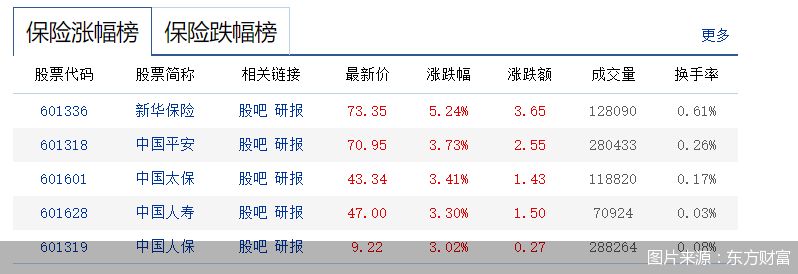
2026年首个交易日,A股保险板块集体飘红
Bei Jing Shang Bao· 2026-01-05 02:29
| 保险涨幅榜 | | 保险跌幅榜 | | | | | 題多 | | --- | --- | --- | --- | --- | --- | --- | --- | | 股票代码 | 股票简称 | 相关链接 | 最新价 | 涨跌幅 | 涨跌额 | 成交量 | 换手率 | | 601336 | 新华保险 | 股吧 研报 | 73. 35 | 5.24% | 3.65 | 128090 | 0.61% | | 601318 | 中国平安 | 股吧 研报 | 70. 95 | 3.73% | 2. 55 | 280433 | 0. 26% | | 601601 | 中国太保 | 股吧 研报 | 43. 34 | 3.41% | 1.43 | 118820 | 0.17% | | 601628 | 中国人寿 | 股吧 研报 | 47.00 | 3.30% | 1.50 | 70924 | 0.03% | | 601319 | 中国人保 | 股吧 研报 | 9.22 | 3.02% | 0.27 | | 288264 图片来源:东方财富 | 北京商报讯(记者 李秀梅)1月5日,2026年A股首个交易日,保险板块集体飘红 ...






非银金融行业周报:公募费率改革收官,非银板块向上突破动能充盈-20260105
Shenwan Hongyuan Securities· 2026-01-05 02:05
Investment Rating - The report maintains a "Positive" outlook on the non-bank financial sector for 2026, indicating strong upward momentum for the industry [3][4]. Core Insights - The brokerage sector is expected to experience a significant upward breakthrough in 2026, driven by improved chip structure, reduced turnover rates, and a favorable valuation environment. The sector is currently undervalued compared to its earnings potential [4]. - The insurance sector shows signs of stabilization post the interest rate switch, with premium growth expected to improve in 2026, particularly in the life insurance segment [4]. - Regulatory changes, including the completion of public fund fee reforms, are anticipated to benefit the non-bank financial sector by reducing costs for investors and enhancing market participation [4][22]. Summary by Sections Market Review - The Shanghai Composite Index closed at 4,629.94 with a decline of 0.59% over the week. The non-bank index fell by 1.84%, with brokerages and insurance indices declining by 1.37% and 3.33%, respectively [8][10]. Non-Bank Financial Insights - The brokerage sector's index underperformed the Shanghai Composite Index by 0.78 percentage points in 2025, with a total decline of 2.05% for the year. In contrast, major A-share indices saw significant gains [4]. - The insurance sector's original premium income reached 5.76 trillion yuan from January to November 2025, reflecting a year-on-year growth of 7.6%. The life insurance segment grew by 9.2% during the same period [4][31]. Investment Analysis - For brokerages, the report recommends focusing on leading firms with strong competitive advantages, such as Guotai Junan and CITIC Securities, as well as those with high earnings elasticity like Huatai Securities [4]. - In the insurance sector, companies like China Life and Ping An are highlighted for their potential in the upcoming market revaluation, with a focus on the growth of new business premiums [4]. Regulatory Developments - The China Securities Regulatory Commission (CSRC) has implemented new rules for public real estate investment trusts (REITs), expanding financing options for commercial properties [21]. - The completion of the public fund fee reform is expected to lower overall fund costs by approximately 20%, saving investors around 51 billion yuan annually [22].



险企积极开展中期分红
Jing Ji Ri Bao· 2026-01-05 01:40
Group 1 - The core viewpoint of the articles highlights the strong capital strength and operational confidence of Chinese insurance companies, as evidenced by their implementation of mid-term dividends for 2025, totaling approximately 29.336 billion yuan [1] - The mid-term dividend scale for the insurance industry has increased by 8.8% compared to 2024, indicating robust financial performance [1] - China Ping An has the largest dividend distribution amounting to 17.202 billion yuan, while China Life, China Pacific Insurance, and New China Life have also announced their respective dividend distributions [1] Group 2 - The overall strength of the insurance industry has improved, with total assets reaching 40.40 trillion yuan, a year-on-year increase of 15.42% as of the end of Q3 2025 [2] - Insurance companies have adjusted their investment strategies, leading to a significant increase in investment returns, with the balance of insurance funds invested in the equity market rising substantially [2] - The optimization of liability structures within insurance companies has enhanced their risk resistance and dividend stability, transitioning from traditional life insurance products to dividend-type products [2] Group 3 - The new "National Nine Articles" policy issued in April 2024 has provided clear guidance and institutional support for insurance companies to enhance dividend stability and predictability [3] - This policy has elevated the importance of dividends in corporate strategy, transforming mid-term dividends from optional to essential for listed insurance companies [3] - Future recommendations include establishing a transparent and predictable long-term dividend framework and exploring a combination of cash dividends and stock buybacks to enhance shareholder value [3]
如何为“小电驴”买保险?
Jin Rong Shi Bao· 2026-01-05 01:13
Core Viewpoint - The article discusses the rising concern among electric bicycle owners regarding insurance coverage after a significant traffic accident resulted in a 630,000 yuan compensation due to lack of insurance [1] Group 1: Insurance Market Overview - Currently, electric bicycles are not included in the mandatory insurance regulations, making commercial insurance essential for risk management [2] - Main types of insurance products available for electric bicycles include liability insurance, personal accident insurance, and vehicle damage insurance, with premiums ranging from 50 yuan to 200 yuan annually for liability insurance [2][5] - Major insurance companies offering electric bicycle insurance include China Pacific Insurance, PICC, and China Life Insurance, with various purchasing channels available [2][3] Group 2: Purchasing Channels - Online channels allow consumers to purchase insurance through official websites, apps, or third-party platforms like Alipay and WeChat [3][4] - Offline options include visiting insurance company branches or vehicle management service windows for assistance [3] - Some electric bicycle sales outlets offer bundled insurance services, although consumers should be cautious of high-priced packages [3] Group 3: Government Initiatives - Local governments have partnered with insurance companies to provide affordable insurance products, such as the "Riding Insurance" in Nanning, which offers plans starting at 68 yuan per year [5] - The "Shanghai Riding Insurance" provides comprehensive coverage for various risks associated with electric bicycle use, including emergency services [6] Group 4: Regulatory Considerations - Electric bicycles must adhere to safety standards, including a maximum speed of 25 km/h; exceeding this limit may classify them as motor vehicles, requiring mandatory insurance [7]


独立董事任职声明
Zheng Quan Ri Bao· 2026-01-04 23:12
二、本人完全清楚独立董事的职责及其法律责任。本人郑重承诺,本人将保证足够的时间和精力,诚 信、勤勉、独立履行职责,切实维护保险公司、被保险人和中小股东的合法权益。 三、本人保证上述声明真实、准确,并愿承担因不实声明导致的一切法律责任。 本人受聘担任中国人民保险集团股份有限公司独立董事。根据原中国保险监督管理委员会《保险机构独 立董事管理办法》的规定,作如下声明: 一、本人符合《保险机构独立董事管理办法》关于独立董事独立性的规定,不存在任何可能影响对公司 事务进行独立客观判断的情形。 声明人:贾若 2026年1月5日 ...
近期港股保险上涨点评:保费开门红或超预期,资负共振推动股价上行
EBSCN· 2026-01-04 12:55
Investment Rating - The report maintains an "Overweight" rating for the insurance sector [1]. Core Views - The insurance sector is expected to benefit from strong premium growth, particularly in the context of the "opening red" performance, which may exceed expectations [2][3]. - The competitive advantage of savings-type insurance products remains strong against other wealth management products, especially as traditional and participating insurance rates decline [3]. - The agency channel is anticipated to see a rebound in new business growth, while the bancassurance channel is expected to become a significant growth driver [4]. - The stable performance of the capital market is likely to continue driving profit releases for insurance companies [5]. - The report recommends specific insurance stocks that are expected to benefit from asset-driven growth, including China Life Insurance and New China Life Insurance [6]. Summary by Sections Premium Growth - The Hong Kong insurance index rose by 3.0%, outperforming the Hang Seng Index by 0.2 percentage points, with major insurers like China Life and PICC showing significant gains [2]. Product Competitiveness - Savings-type insurance products are positioned favorably due to lower bank deposit rates and a high willingness to save among residents, with a projected internal rate of return (IRR) of "1.75% guaranteed + floating" making them competitive in the wealth management market [3]. Distribution Channels - The agency channel is expected to recover in new business growth, while the bancassurance channel is set to expand due to the easing of restrictions on cooperation between banks and insurance companies [4]. Investment Performance - The investment asset scale of listed insurance companies is steadily growing, with a high stock allocation expected to enhance investment returns and profit releases [5]. Stock Recommendations - The report recommends stocks such as China Life (A+H), New China Life (A+H), and China Pacific Insurance (A+H) for their strong performance and stable operations [6].
保险基本面梳理 111:2026 保险投资四问四答-20260104
Changjiang Securities· 2026-01-04 11:38
Investment Rating - The investment rating for the insurance industry is "Positive" and maintained [9] Core Viewpoints - The focus should be on the logic of long-term profit improvement rather than short-term valuation changes. The insurance industry's ability and willingness to allocate equity will significantly boost in the foreseeable future, combined with the advantages of improved liability costs, leading to a sustained increase in industry spreads in the medium to long term. This will drive the profitability of policies, with ideal models suggesting profitability could exceed 1 times the effective business value, indicating ample room for valuation recovery [3][8]. Summary by Relevant Sections 1. Why There is No Need to Worry About Base Pressure - The trend of deposit migration is smooth, and both new business and NBV bases are not excessively high, resulting in low pressure on the liability side. The strong performance of the asset side will benefit profits, but short-term valuation is primarily influenced by investment returns, meaning profit growth or decline does not necessarily lead to corresponding changes in valuation [5][18]. 2. How to Assess Premium Space - Short-term perspective: Assuming that the incremental life insurance mainly comes from the maturity of deposits, the forecast for 2026 is a personal insurance scale of CNY 4.8 trillion, with a year-on-year growth rate of about 10% [6][56]. - Long-term perspective: As the proportion of pension asset reserves gradually approaches that of the U.S., the trend of deposit migration to insurance will continue, driven by the multi-level pension system development, maintaining a CAGR of around 10% over the next decade [6][65]. 3. Scale and Direction of Insurance Capital Market Entry - It is estimated that the scale of insurance funds allocated to A-shares in 2026 will be approximately CNY 3,127 to 7,685 billion, based on the initiative to allocate 30% of new premiums to A-shares [7][69]. 4. Why Long-term Valuation Recovery is Promising - The combination of current industry conditions and policy environment will significantly enhance the insurance industry's ability and willingness to allocate equity in the foreseeable future. This, along with improved liability cost advantages, will lead to a sustained increase in industry spreads, driving policy profitability improvement and indicating ample room for valuation recovery [8][47].
友邦保险资管获批开业;天安人寿20亿债券违约,无法按期兑付!薛继豪任泰康人寿临时负责人|13精周报
13个精算师· 2026-01-04 11:05
Regulatory Dynamics - The Ministry of Finance will coordinate various funds to address issues related to the education of children from rural migrant workers and social insurance [4] - The Financial Regulatory Bureau reported that the insurance industry generated 5.76 trillion yuan in premium income in the first 11 months of 2025, a year-on-year increase of 7.56% [4] - The China Securities Regulatory Commission is increasing efforts to guide long-term funds, including insurance and social security funds, into the market [6] - The National Medical Insurance Bureau reported that the basic medical insurance fund's income for the first 11 months of 2025 was approximately 2.63 trillion yuan [7] Company Dynamics - Ping An Life increased its stake in China Merchants Bank H-shares to 19.13% [13] - China Life Asset Management successfully established a 5 billion yuan equity investment plan [19] - AIA Asset Management has been approved to commence operations, marking a new chapter in "Investing in China" [22] - Tianan Insurance defaulted on a 20 billion yuan bond, unable to repay on time [26] Industry Dynamics - A-shares of insurance companies showed strong performance in 2025, with New China Life leading with a 46.03% increase [42] - The Financial Investment Alliance was established to support the development of long-term and patient capital [43] - Thirteen insurance companies have abolished their supervisory boards, indicating a significant change in governance structures within the industry [45] - The establishment of the Sichuan Social Security Science and Technology Innovation Equity Investment Fund with a capital of 20 billion yuan [48] Product and Service Innovations - Personal pension insurance products have rapidly expanded, with 463 products launched by insurance companies by February 26, 2025 [54] - New China Life launched an innovative group medical insurance covering original research drugs, addressing significant pain points in medication coverage [55] - The largest policy for embodied intelligent insurance was issued for over 200 million yuan, covering more than 2,000 robots [56]

公募费改收官且险企开门红向好,关注春季躁动机遇
GF SECURITIES· 2026-01-04 10:05
Core Insights - The report highlights that the public fund fee reform has concluded, and insurance companies are expected to perform well, indicating potential investment opportunities in the spring market [1][6]. Group 1: Industry Performance - As of December 31, 2025, the Shanghai Composite Index closed at 3968.84 points, up 0.13%, while the Shenzhen Component Index fell by 0.58% [11]. - The average daily trading volume in the Shanghai and Shenzhen markets reached 2.13 trillion yuan, an increase of 8.30% week-on-week [6]. Group 2: Insurance Sector - Insurance companies are anticipated to maintain high growth in performance, with short-term results expected to exceed expectations and long-term interest rate spreads likely to improve [17]. - The Ministry of Finance released a draft revision of the accounting standards, enhancing the clarity of profit sources for insurance companies and improving comparability across industries [17]. - Key stocks to watch in the insurance sector include China Ping An, China Life, and New China Life, among others [17]. Group 3: Securities Sector - The public fund fee reform is expected to save investors approximately 51 billion yuan annually, with a fee reduction of about 20% [18]. - The reform includes differentiated redemption fee structures aimed at promoting long-term investment and reducing short-term trading behaviors [19]. - The introduction of new REITs regulations is expected to enhance the market's quality and expand opportunities for securities firms [24][28]. Group 4: Valuation and Financial Analysis - China Ping An (601318.SH) has a target price of 85.17 yuan, with an estimated EPS of 8.91 yuan for 2025, reflecting a PE ratio of 7.68 [7]. - New China Life (601336.SH) has a target price of 94.21 yuan, with an estimated EPS of 14.04 yuan for 2025, indicating a PE ratio of 4.96 [7]. - The report suggests that the valuation metrics for various companies in the sector indicate potential upside, with several stocks rated as "Buy" [7].
2026年,保险股的好日子还能继续吗?
Xin Lang Cai Jing· 2026-01-04 09:54
Core Viewpoint - The insurance sector in A-shares has emerged as the standout performer of 2025, with the insurance index surging by 31.31%, significantly outperforming the Shanghai Composite Index's 18.41% increase and other financial sectors [1][11]. Performance Summary - All five major listed insurance companies experienced stock price increases, breaking free from previous sluggishness. New China Life Insurance led with a 46.03% rise, followed by Ping An Insurance with over 35%, and both China Pacific Insurance and China People's Insurance achieving over 20% gains. Even China Life Insurance, which performed relatively weaker, recorded a 10.39% return [1][11]. - The insurance sector's performance has improved significantly over the past two years, transitioning from being overlooked to becoming a market favorite. The sector faced unprecedented challenges from 2020 to 2023, including declining investment returns due to low interest rates and weak consumer demand for insurance products. However, a turnaround began in 2024, with major companies seeing stock price increases of over 30% [3][13]. Market Dynamics - In December 2025, the insurance sector experienced a notable rally, with a monthly increase of 14.77%, surpassing overall market performance. Key companies reached new highs, indicating a peak in market interest for the sector [3][13]. - The surge in insurance stocks is attributed to multiple favorable factors, including supportive regulatory policies introduced in the second half of 2025, which encouraged investment in equities and promoted the development of health and annuity insurance products [5][15]. Financial Performance - The overall stock market's positive trend in 2025 led to a significant increase in insurance companies' investment income, with net profits exceeding 420 billion yuan, a year-on-year increase of 33% [6][16]. - Insurance companies are actively transforming their product offerings, focusing on dividend insurance products to reduce liability costs while meeting consumer savings needs in a low-interest-rate environment [6][16]. Future Outlook - Industry experts are optimistic about the insurance sector's prospects for 2026, anticipating a dual recovery in both asset and liability sides. Increased consumer demand for savings and protection insurance is expected as the economy recovers, alongside improved profitability from new business lines [7][18]. - The growing proportion of equity assets held by insurance companies is likely to enhance profit margins, especially if the equity market continues to perform well in 2026, potentially driving stock prices and valuations higher [7][18].