ICBC(601398)

Search documents
六大行密集调整黄金业务相关规则,应对市场波动
Jin Rong Jie· 2026-02-02 07:43
Group 1 - The six major state-owned banks in China have announced adjustments to their gold-related business rules and issued investment risk warnings in response to market volatility [1][2] - Industrial and Commercial Bank of China (ICBC) has implemented new requirements for personal customers to assess their risk tolerance before engaging in gold accumulation and investment plans, effective from January 12 [1] - Agricultural Bank of China (ABC) has raised the risk assessment requirement for its gold accumulation business, requiring a cautious risk level or higher starting January 30 [1] Group 2 - China Bank has highlighted increased uncertainty in the precious metals market and advised customers to manage their trading based on their financial situation and risk tolerance [1] - Construction Bank has raised the minimum amount for personal gold accumulation business to 1,500 yuan, effective February 2, and urged customers to enhance their risk awareness [2] - Postal Savings Bank has increased the margin ratio for several deferred contracts to 120% starting January 22, indicating a tightening of trading conditions [2]



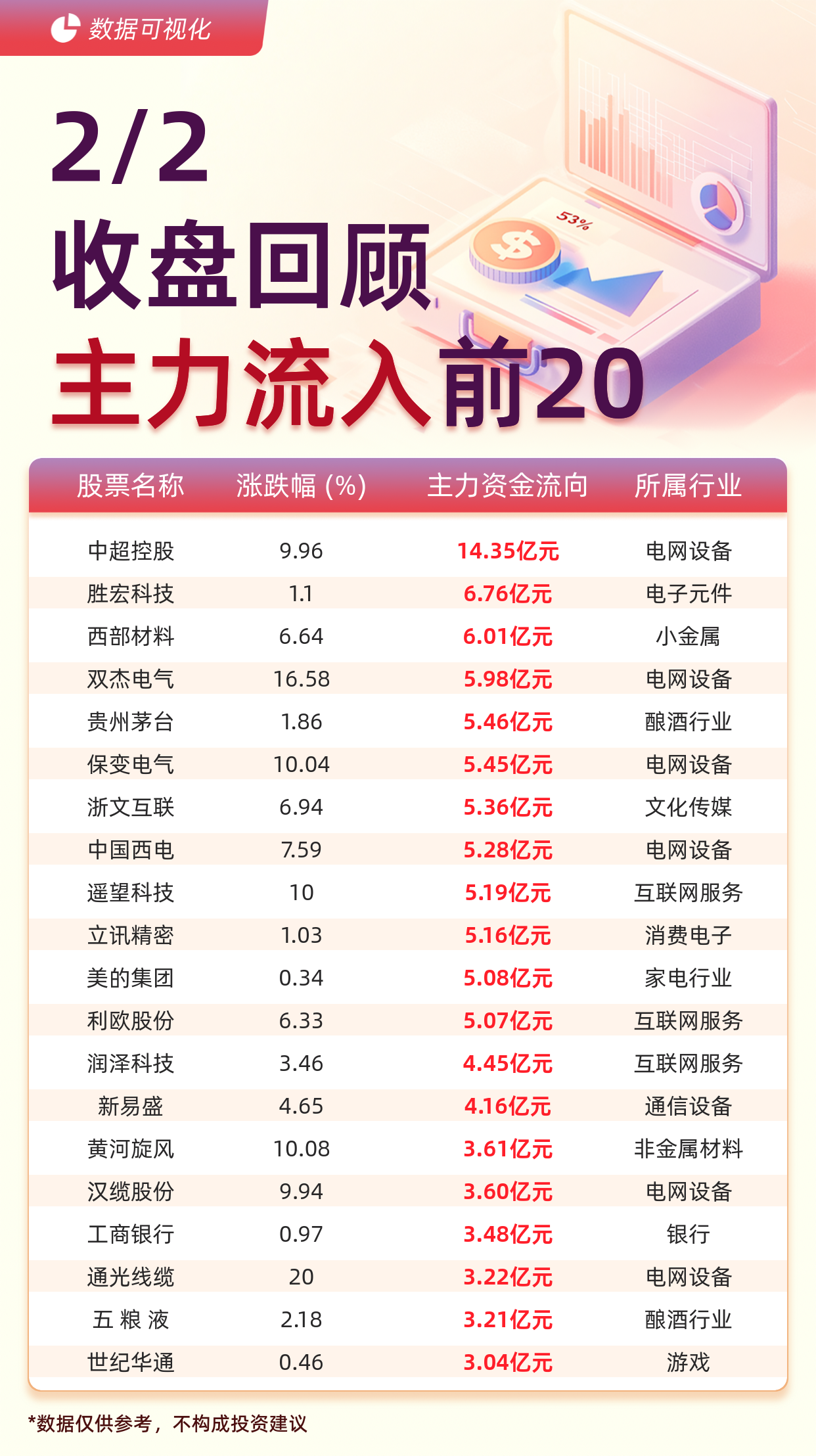
主力资金流入前20:中超控股流入14.35亿元、胜宏科技流入6.76亿元
Jin Rong Jie· 2026-02-02 07:30
Group 1 - The top 20 stocks with significant capital inflow as of February 2 include Zhongchao Holdings (1.435 billion), Shenghong Technology (676 million), and Xibu Materials (601 million) [1] - Zhongchao Holdings experienced a price increase of 9.96%, while Shuangjie Electric saw a notable rise of 16.58% [2] - The sectors represented among the top inflow stocks include power grid equipment, electronic components, and the liquor industry [2][3] Group 2 - Other notable stocks with significant inflows include Guizhou Moutai (5.46 billion), Baobian Electric (5.45 billion), and Zhejiang Wenlian (5.36 billion) [1] - The banking sector is represented by Industrial and Commercial Bank of China, which had an inflow of 348 million [3] - The highest percentage increase in stock price was observed in Tongguang Cable, which rose by 20% [3]


资金大幅流出后银行为何逆势回升?机构点出 4.4% 高分红率+信贷开门红
Mei Ri Jing Ji Xin Wen· 2026-02-02 07:20
Core Viewpoint - The banking sector experienced significant capital outflows in January 2026, with a notable recovery in stock prices despite the outflows, indicating a potential increase in long-term institutional investor interest [1]. Group 1: Market Performance - As of February 2, 2026, the China Securities Banking Index (399986) rose by 0.15%, with notable increases in individual bank stocks such as CITIC Bank (up 2.64%), Shanghai Bank (up 1.62%), and Huaxia Bank (up 1.42%) [1]. - The Bank ETF Huaxia (515020) increased by 0.18%, with the latest price at 1.65 yuan [1]. Group 2: Capital Flows - In January 2026, there was a substantial net outflow of passive funds from the banking sector, totaling 9,102 billion yuan for the month and 3,773 billion yuan for the week of January 26 to 30 [1]. - CITIC Securities estimated that the net outflow of funds from bank stocks was approximately 1,051 billion yuan in January and 485 billion yuan for the last week of January [1]. Group 3: Future Outlook - Despite the significant capital outflows, the banking index saw a 1% rebound, suggesting a strong willingness for long-term institutional investment [1]. - The banking sector is expected to benefit from a positive operating environment in the first quarter of 2026, with stable net interest margins and asset quality, leading to a recovery in revenue and profit growth [1]. - The current dividend yield of 4.4% in the sector is considered to be in a high cost-performance range, enhancing the attractiveness of core equity assets [1].




刚刚,黄金下跌超5%,白银猛跌10%,银行密集公告!
Sou Hu Cai Jing· 2026-02-02 07:17
Core Viewpoint - Precious metal prices have experienced significant declines, with gold dropping over 5% and silver falling more than 10%, prompting major banks to issue risk warnings and adjust their trading policies [1][2]. Group 1: Precious Metal Price Movements - As of February 2, spot gold prices are trading around $4636 per ounce, reflecting a decline of over 5% [1]. - Spot silver has dropped more than 10%, falling below $77 per ounce [2]. Group 2: Bank Responses and Adjustments - The Industrial and Commercial Bank of China (ICBC) has issued a risk warning, advising clients to assess their risk tolerance and adopt a rational investment approach amid increased market volatility [2]. - ICBC announced adjustments to its gold-related business operations, including changes to the processing times for certain gold products starting February 7 [2]. - Agricultural Bank of China has raised the margin requirement for gold trading contracts from 44% to 60% and emphasized the need for clients to control their positions and trade rationally [3]. - China Bank has also alerted clients to the uncertainties in the precious metals market and advised them to manage their trading activities based on their financial situation and risk tolerance [3]. - Construction Bank has increased the minimum investment amount for its gold accumulation business to 1500 yuan, citing heightened market risks [4]. - Other banks, including Bank of Communications and Postal Savings Bank, have also issued trading alerts and adjusted margin requirements for various gold contracts [4].



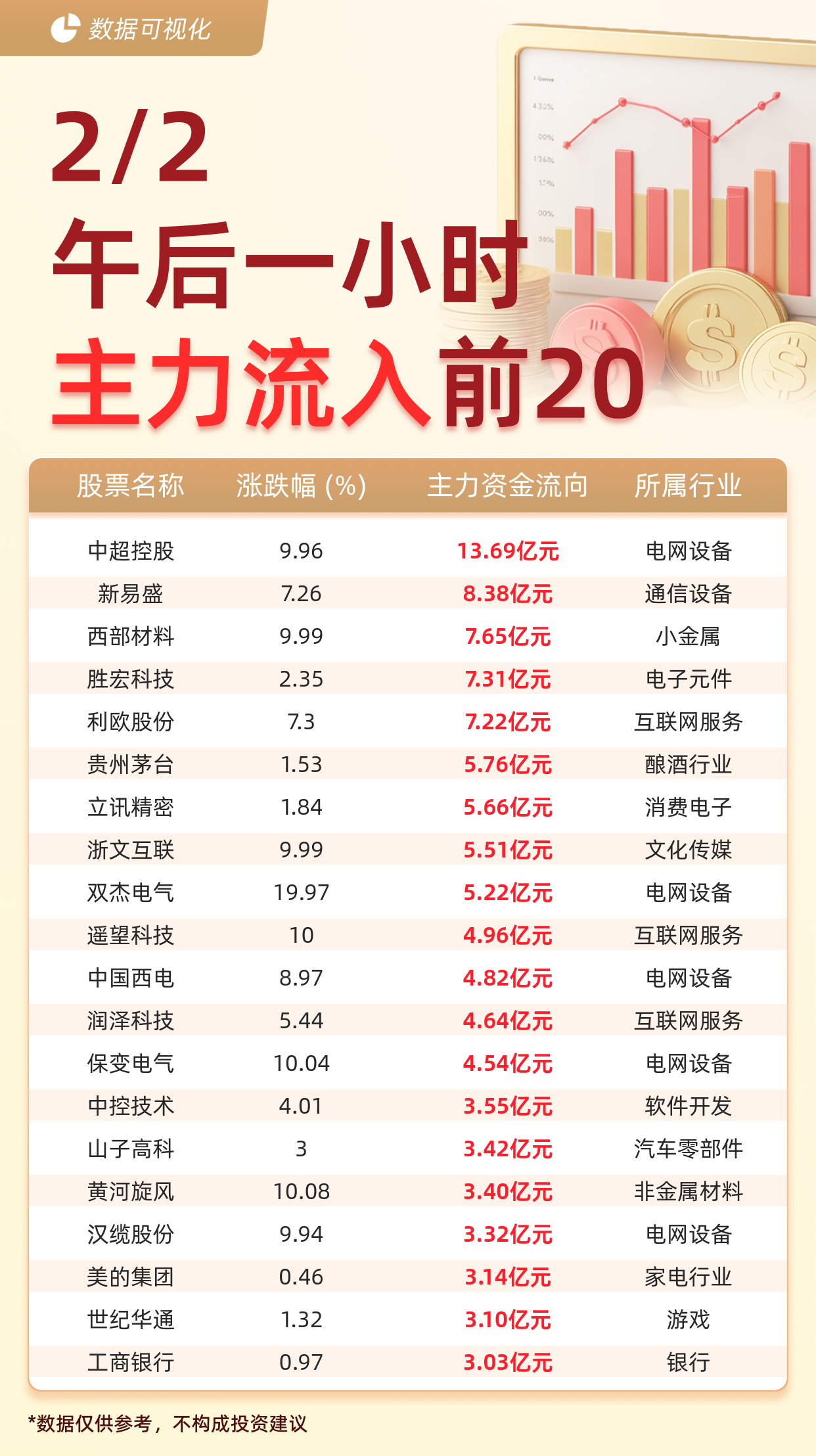
主力资金流入前20:中超控股流入13.69亿元、新易盛流入8.38亿元
Jin Rong Jie· 2026-02-02 06:33
Core Insights - The main focus of the news is the significant inflow of capital into various stocks, indicating strong investor interest and potential market trends. Group 1: Stock Performance and Capital Inflow - Zhongchao Holdings saw a capital inflow of 1.369 billion, with a price increase of 9.96% [1][2] - Xinyi Technology experienced a capital inflow of 838 million, with a price increase of 7.26% [1][2] - Western Materials had a capital inflow of 765 million, with a price increase of 9.99% [1][2] - Shenghong Technology attracted 731 million, with a price increase of 2.35% [1][2] - Liou Co. received 722 million, with a price increase of 7.3% [1][2] - Kweichow Moutai had a capital inflow of 576 million, with a price increase of 1.53% [1][2] - Luxshare Precision saw a capital inflow of 566 million, with a price increase of 1.84% [1][2] - Zhejiang Wenhu Interconnect attracted 551 million, with a price increase of 9.99% [1][2] - Shuangjie Electric received 522 million, with a price increase of 19.97% [1][2] - Yaowang Technology had a capital inflow of 496 million, with a price increase of 10% [1][2] - China Western Electric attracted 482 million, with a price increase of 8.97% [1][3] Group 2: Additional Stock Insights - Runze Technology saw a capital inflow of 464 million, with a price increase of 5.44% [3] - Baobian Electric attracted 454 million, with a price increase of 10.04% [3] - Zhongkong Technology had a capital inflow of 355 million, with a price increase of 4.01% [3] - Shanziko High-Tech received 342 million, with a price increase of 3% [3] - Huanghe Xuanfeng attracted 340 million, with a price increase of 10.08% [3] - Hancable saw a capital inflow of 332 million, with a price increase of 9.94% [3] - Midea Group had a capital inflow of 314 million, with a price increase of 0.46% [3] - Century Huayun attracted 310 million, with a price increase of 1.32% [3] - Industrial and Commercial Bank of China saw a capital inflow of 303 million, with a price increase of 0.97% [3]


工商银行云南省分行原行长郭伟涉嫌严重违纪违法被查
Xi Niu Cai Jing· 2026-02-02 06:21
公开资料显示,郭伟在工商银行工作多年,曾任工行山西省分行副行长、云南省分行行长、湖北省分行行长,后于2023年调任工行内审局南京分局局长, 2024年到龄退休。 1月28日,据中央纪委国家监委驻中国工商银行纪检监察组、河北省纪委监委消息,中国工商银行云南省分行原党委书记、行长郭伟涉嫌严重违纪违法,目 前正接受中央纪委国家监委驻中国工商银行纪检监察组纪律审查和河北省监察委员会监察调查。 值得注意的是,2019年11月,湖北银保监局发布的行政处罚信息公开表显示,工商银行湖北省分行存在因监督管理不力导致下辖多家分支机构出现违规办理 虚假贸易融资问题,被罚款50万元。时任负责人即为郭伟。 ...

金价大幅震荡,六大行公告
Sou Hu Cai Jing· 2026-02-02 06:12
Core Viewpoint - Recent fluctuations in domestic and international precious metal prices have significantly increased market uncertainty, prompting major state-owned banks to adjust their gold-related business and issue risk warnings [1]. Group 1: Bank Announcements - Industrial and Commercial Bank of China (ICBC) issued a risk warning on February 1, advising clients to maintain a rational investment mindset and avoid impulsive trading, while suggesting a long-term investment perspective and a diversified approach [3]. - Agricultural Bank of China (ABC) announced on January 29 an increase in the margin ratio for gold deferred contracts from 44% to 60%, effective from January 30, and emphasized the importance of risk assessment for clients engaging in gold accumulation transactions [5]. - Bank of China (BOC) highlighted the numerous uncertainties in the precious metals market on January 30, urging clients to manage their positions carefully to mitigate potential financial losses due to price volatility [7]. - China Construction Bank (CCB) raised the minimum amount for regular gold accumulation to 1500 yuan starting February 2, while also advising clients to enhance their risk awareness in light of increased market volatility [9]. - Both Bank of Communications and Postal Savings Bank issued trading alerts, with the former adjusting suitability management requirements for gold-related products and the latter increasing margin ratios for various gold contracts from 80% to 120% [11]. Group 2: Expert Recommendations - Experts recommend that investors base their financial decisions on personal investment experience, capabilities, and risk preferences, while avoiding impulsive trading and ensuring proper asset allocation [13].


贵金属价格波动 六大行发布风险提示
Bei Jing Wan Bao· 2026-02-02 06:07
Core Viewpoint - The recent fluctuations in gold prices have prompted major state-owned banks in China to adjust their gold-related business operations and issue risk warnings to clients regarding market volatility [1][2] Group 1: Gold Price Fluctuations - Gold prices experienced a historic surge at the beginning of 2026, reaching levels between $5000 and $5500 per ounce, followed by a significant drop on January 30 and further declines on February 2 [1] - The volatility in gold prices has led to increased market uncertainty, prompting banks to advise clients to assess their risk tolerance carefully [1] Group 2: Bank Responses - Industrial and Commercial Bank of China (ICBC) issued a risk warning on February 1, recommending clients maintain a rational investment mindset and avoid impulsive trading [1] - ICBC announced adjustments to its gold accumulation business and the sales of floating price physical gold products, effective February 7, including limits on transactions during non-trading days [1] - Other major banks, including Agricultural Bank of China and Postal Savings Bank, have also issued notifications regarding adjustments to gold trading operations and changes in margin requirements, urging clients to manage their positions prudently [2]
金银价格大幅震荡!上金所、六大行密集发布公告!
Huan Qiu Wang· 2026-02-02 05:53
Core Viewpoint - Recent fluctuations in domestic and international precious metal prices have significantly increased market uncertainty, prompting major state-owned banks to adjust their gold-related business and issue risk warnings [1][2][4]. Group 1: Shanghai Gold Exchange - On February 2, the Shanghai Gold Exchange announced adjustments to the margin levels and price limits for silver deferred contracts due to significant price volatility, increasing the margin from 20% to 26% and the price limit from 19% to 25% in case of a one-sided market [1]. - The Exchange urged members to enhance risk awareness and prepare emergency risk management plans to ensure stable market operations [1]. Group 2: Industrial and Commercial Bank of China (ICBC) - On February 1, ICBC advised clients to maintain a rational investment mindset and avoid impulsive trading amid heightened market uncertainty, recommending a diversified investment approach [2]. - ICBC announced changes to the processing times for certain gold products starting February 7, implementing limit management for transactions on non-trading days [2]. Group 3: Agricultural Bank of China - On January 29, the Agricultural Bank of China adjusted the margin ratio for gold deferred contracts from 44% to 60%, effective from January 30 [3]. - The bank also introduced a risk assessment requirement for personal clients engaging in gold accumulation transactions, mandating a cautious evaluation result for participation [3]. Group 4: Bank of China - On January 30, the Bank of China highlighted the uncertainties in the precious metals market and advised clients to manage their trading activities based on their financial status and risk tolerance [4]. Group 5: China Construction Bank - On January 30, China Construction Bank announced an increase in the minimum amount for regular gold accumulation to 1500 yuan, effective from February 2 [5]. - The bank emphasized the need for clients to enhance risk awareness and manage their positions carefully in light of increased market volatility [6]. Group 6: Other Banks - Both the Bank of Communications and Postal Savings Bank issued trading alerts, with the former adjusting suitability management requirements for its gold products and the latter increasing margin ratios for various gold contracts from 80% to 120% [7].
黄金跌停,黄金交易所突发公告,六大行曾提前预警
Sou Hu Cai Jing· 2026-02-02 05:07
Core Viewpoint - The domestic precious metals market experienced a historic shock on February 2, 2026, with significant declines in futures and stocks, prompting the Shanghai Gold Exchange to implement emergency risk control measures to stabilize the market [2][3][4]. Market Reaction - On February 2, the main silver futures contract on the Shanghai Futures Exchange hit the limit down, while gold futures fell over 10%, leading to a collective drop in the A-share precious metals sector, with over ten stocks hitting the limit down [2][6][7]. - The spot gold price fell below $4600 per ounce, with an intraday decline of 6.25%, reflecting a broader panic in the market [2][9]. Regulatory Response - The Shanghai Gold Exchange issued an urgent announcement to adjust the margin levels and price fluctuation limits for silver deferred contracts, aiming to curb excessive volatility and maintain market stability [3][4]. - The margin for silver contracts was raised from 20% to 26%, and the price fluctuation limit was increased from 19% to 25% in response to significant price movements [3][4]. Underlying Factors - The recent volatility in the precious metals market was attributed to multiple factors, including external liquidity concerns, changes in Federal Reserve policies, and panic selling among investors [11][12][14]. - The sharp decline in international gold prices, which fell over 12% in a single day, and the extreme volatility in silver prices, which dropped over 36%, were significant contributors to the market's instability [4][11]. Broader Market Impact - The panic in the precious metals market led to a domino effect, causing declines in related sectors such as oil and gas and telecommunications, with many stocks in these sectors also experiencing significant drops [10][11]. - The domestic commodity futures market saw widespread declines, with various precious metal futures hitting limit down, reflecting a broader market retreat [8][10]. Future Outlook - The long-term outlook for precious metals remains influenced by several key variables, including Federal Reserve policy adjustments, global liquidity changes, and geopolitical uncertainties [27][28]. - Despite the short-term volatility, the fundamental drivers for gold's long-term value, such as ongoing monetary easing and strong central bank demand, remain intact [24][25].