KJS(601579)

Search documents
会稽山(601579.SH):前三季度净利润1.16亿元,同比增长3.23%
Ge Long Hui A P P· 2025-10-29 11:04
Core Insights - The company reported a total operating revenue of 1.212 billion yuan for the first three quarters of 2025, representing a year-on-year increase of 14.12% [1] - The net profit attributable to shareholders of the parent company reached 116 million yuan, showing a year-on-year growth of 3.23% [1] - The basic earnings per share (EPS) stood at 0.25 yuan [1] Financial Performance - Total operating revenue: 1.212 billion yuan, up 14.12% year-on-year [1] - Net profit attributable to shareholders: 116 million yuan, up 3.23% year-on-year [1] - Basic earnings per share: 0.25 yuan [1]

会稽山:前三季度净利润1.16亿元,同比增长3.23%
Zheng Quan Shi Bao Wang· 2025-10-29 10:11
Core Insights - The company reported a third-quarter revenue of 395 million yuan, representing a year-on-year growth of 21.09% [1] - The net profit for the third quarter was 22.39 million yuan, with a year-on-year increase of 2.47% [1] - For the first three quarters of 2025, the total revenue reached 1.212 billion yuan, showing a year-on-year growth of 14.12% [1] - The net profit for the first three quarters was 116 million yuan, reflecting a year-on-year increase of 3.23% [1]
会稽山(601579) - 会稽山绍兴酒股份有限公司关于召开2025年三季度业绩说明会的公告
2025-10-29 09:30
证券代码:601579 证券简称:会稽山 公告编号:2025-028 会稽山绍兴酒股份有限公司 关于召开 2025 年第三季度业绩说明会的公告 本次投资者说明会以网络互动形式召开,公司将针对 2025 年第三季度的经 营成果及财务指标的具体情况与投资者进行互动交流和沟通,在信息披露允许的 范围内就投资者普遍关注的问题进行回答。 二、说明会召开的时间、地点 本公司董事会及全体董事保证本公告内容不存在任何虚假记载、误导性陈述 或者重大遗漏,并对其内容的真实性、准确性和完整性承担法律责任。 重要内容提示: 会议召开时间:2025 年 11 月 6 日(星期四)14:00-15:00 会 议 召 开 地 点 : 上 海 证 券 交 易 所 上 证 路 演 中 心 ( 网 址 : https://roadshow.sseinfo.com/) 会议召开方式:上证路演中心网络互动 投资者可于 2025 年 10 月 30 日(星期四)至 11 月 5 日(星期三)16:00 前 登录上证路演中心网站首页点击"提问预征集"栏目或通过公司邮箱 ir_kjs@kuaijishanwine.com 进行提问。公司将在说明会上对投资 ...
会稽山(601579) - 会稽山绍兴酒股份有限公司2025年1-9月经营数据公告
2025-10-29 09:30
| 区域名称 | 报告期末经销商数量 | 报告期内增加数量 | 报告期内减少数量 | | --- | --- | --- | --- | | 浙江大区 | 530 | 46 | 71 | | 江苏大区 | 365 | 25 | 31 | | 上海地区 | 200 | 13 | 31 | | 其他地区 | 838 | 128 | 37 | | 小计 | 1,933 | 212 | 170 | 特此公告。 证券代码:601579 证券简称:会稽山 公告编号:2025-027 会稽山绍兴酒股份有限公司董事会 会稽山绍兴酒股份有限公司 2025 年 1-9 月经营数据公告 本公司董事会及全体董事保证本公告内容不存在任何虚假记载、误导性陈述 或者重大遗漏,并对其内容的真实性、准确性和完整性承担个别及连带责任。 根据《上海证券交易所上市公司自律监管指引第 3 号——行业信息披露》之 《第十二号——酒制造》(2022 年 1 月修订)第十六条相关规定,会稽山绍兴 酒股份有限公司现将 2025 年 1-9 月主要经营数据(未经审计)公告如下: | 一、产品销售情况: | | | | | 单位:万元 | 币种:人民币 | | ...
会稽山(601579) - 2025 Q3 - 季度财报
2025-10-29 09:15
Financial Performance - The company's operating revenue for Q3 2025 reached ¥394,719,037.26, representing a year-on-year increase of 21.09%[4] - Total profit for the period was ¥39,756,207.42, reflecting a significant increase of 42.11% compared to the same period last year[4] - Net profit attributable to shareholders was ¥22,390,790.23, with a slight increase of 2.47% year-on-year[4] - Total operating revenue for the first three quarters of 2025 reached ¥1,211,525,405.23, a 14.2% increase from ¥1,061,625,048.38 in the same period of 2024[19] - Net profit for the first three quarters of 2025 was ¥116,462,889.19, representing a 3.5% increase compared to ¥112,508,377.48 in 2024[21] - Operating profit for the first three quarters of 2025 was ¥174,511,782.66, an increase of 21.1% from ¥144,062,987.04 in the previous year[20] - The basic earnings per share for the first three quarters of 2025 was ¥0.25, compared to ¥0.24 in the same period of 2024[21] Cash Flow and Assets - The net cash flow from operating activities decreased by 68.28% to ¥23,267,903.72, primarily due to increased payment for goods[4][9] - Cash flow from operating activities generated a net amount of ¥14,423,848.42, a significant recovery from a net outflow of -¥33,621,750.69 in the same period of 2024[23] - Cash and cash equivalents decreased significantly from RMB 827,145,517.53 to RMB 449,440,626.19, representing a decline of approximately 45.7%[16] - Cash and cash equivalents at the end of the third quarter of 2025 totaled ¥449,433,626.19, down from ¥552,418,495.84 at the end of the same period in 2024[24] - The company's current assets totaled RMB 2,083,111,946.63, down from RMB 2,209,583,173.30, indicating a decrease of about 5.7%[16] - The total assets at the end of the reporting period were ¥4,376,388,189.31, showing a decrease of 4.09% from the previous year[5] Liabilities and Equity - Total liabilities decreased from RMB 823,021,625.71 to RMB 707,351,659.28, a reduction of approximately 14.1%[18] - The company's equity attributable to shareholders decreased from RMB 3,709,982,961.22 to RMB 3,638,065,512.66, reflecting a decline of about 1.9%[18] Shareholder Information - The number of ordinary shareholders at the end of the reporting period was 29,918[10] - The top shareholder, Zhongjianxin (Zhejiang) Venture Capital Co., Ltd., holds 31.11% of the shares[11] Research and Development - Research and development expenses for the first three quarters of 2025 were ¥34,188,242.61, a decrease of 19.8% from ¥42,590,904.37 in 2024[20] Expenses - Total operating costs increased to ¥1,040,663,445.32, up 13.0% from ¥920,500,230.03 year-over-year[20] - Sales expenses increased to ¥334,383,604.17, up 54.5% from ¥216,161,117.40 year-over-year[20] Other Information - The company reported non-recurring gains of ¥3,752,393.78 for the current period[7] - The company has not disclosed any new product developments or market expansion strategies in this report[3] - The company has initiated a wealth management plan using idle funds, with an asset management plan registered on September 24, 2025[13] - The company has maintained its long-term equity investments at RMB 42,531,210.38, showing stability in this area[16] - The company's short-term borrowings were recorded at RMB 1,000,753.42 as of December 31, 2024, but no short-term borrowings were reported as of September 30, 2025[18] - The company reported a total cash outflow from investing activities of ¥198,513,327.19, compared to a smaller outflow of ¥4,281,406.55 in 2024[24] - The new accounting standards or interpretations will be implemented starting from 2025, affecting the financial statements from the beginning of that year[25]
会稽山:第三季度归母净利润2239.08万元,同比增长2.47%
Xin Lang Cai Jing· 2025-10-29 08:50
会稽山10月29日公告,2025年第三季度实现营业收入3.95亿元,同比增长21.09%;归属于上市公司股东 的净利润2239.08万元,同比增长2.47%;基本每股收益0.05元。前三季度实现营业收入12.12亿元,同比 增长14.12%;归属于上市公司股东的净利润1.16亿元,同比增长3.23%;基本每股收益0.25元。 ...
会稽山:第三季度净利润为2239.08万元,同比增长2.47%
Guo Ji Jin Rong Bao· 2025-10-29 08:29
Core Insights - The company reported a third-quarter revenue of 395 million yuan, representing a year-on-year increase of 21.09% [1] - The net profit for the third quarter was 22.39 million yuan, showing a year-on-year growth of 2.47% [1] - For the first three quarters, the total revenue reached 1.212 billion yuan, reflecting a year-on-year increase of 14.12% [1] - The net profit for the first three quarters amounted to 116 million yuan, with a year-on-year growth of 3.23% [1]
直通5亿酒饮消费基金,陶石泉/左颖/刘文拆解“明日之星”
Sou Hu Cai Jing· 2025-10-28 10:49
Core Insights - Industry investment is a key engine for the evolution of the liquor industry, providing necessary funding and support for channel expansion, product innovation, and brand building [2] - The rise of "micro-drinking socialization" and "self-consumption" among younger generations has made the dual approach of capital and industry essential for the liquor sector to grasp future growth opportunities [2] - The AIIC2025 Liquor Industry Investment and Innovation Conference will launch the "AIIC New Growth Liquor Consumption Fund" with an initial scale of 500 million yuan, aimed at discovering innovative projects and providing financial support [2] Industry Trends - The new liquor segment has become a typical representative of industry investment driving innovation, reflecting how capital resonates with consumer trends [3] - From 2020 to 2021, the market size of new liquor brands surged from approximately 20 billion yuan to 30 billion yuan, with a compound annual growth rate of about 30% [3] - The new liquor segment is expected to grow from 57 billion yuan to between 74.3 billion and 75 billion yuan from 2024 to 2025, maintaining a compound annual growth rate of 25% to 30% [3] Company Developments - In October, Mixue Group invested nearly 300 million yuan to gain control of the fresh beer brand "Fulu Family," marking a significant move into the fresh beer sector [4] - Bottle Planet Group achieved a 16% organic revenue growth in 2024, with its low-alcohol new liquor business growing by 30% [4] - The traditional yellow wine leader, Kuaijishan, launched a sparkling yellow wine in August 2023, achieving over 10 million yuan in sales within 72 hours during the 2024 "618" event [8] Conference Insights - The AIIC2025 conference will provide a platform for industry innovators to share practical experiences and insights [4][11] - The event will serve as a strategic window for participants to engage directly with industry capital and learn about emerging growth trends [11] - Design has become a crucial factor in attracting younger consumers, with significant collaborations established with well-known liquor companies for packaging design [10]

会稽山涨2.02%,成交额1.33亿元,主力资金净流入313.91万元
Xin Lang Zheng Quan· 2025-10-28 02:39
Core Viewpoint - The stock of Kuaijishan has shown significant performance with a year-to-date increase of 108.66%, despite a recent decline in the last five trading days [1] Group 1: Stock Performance - As of October 28, Kuaijishan's stock price increased by 2.02% to 22.26 CNY per share, with a trading volume of 1.33 billion CNY and a turnover rate of 1.26%, resulting in a total market capitalization of 10.673 billion CNY [1] - The stock has experienced a decline of 2.20% over the last five trading days, but has increased by 1.37% over the last 20 days and 17.16% over the last 60 days [1] - Kuaijishan has appeared on the stock market's "Dragon and Tiger List" three times this year, with the most recent occurrence on May 27 [1] Group 2: Financial Performance - For the first half of 2025, Kuaijishan reported a revenue of 817 million CNY, reflecting a year-on-year growth of 11.03%, and a net profit attributable to shareholders of 93.877 million CNY, which is a 3.41% increase compared to the previous year [2] - Since its A-share listing, Kuaijishan has distributed a total of 793 million CNY in dividends, with 431 million CNY distributed over the last three years [3] Group 3: Shareholder Information - As of June 30, 2025, Kuaijishan had 26,000 shareholders, a decrease of 1.25% from the previous period, with an average of 18,419 circulating shares per shareholder, which is an increase of 1.26% [2] - The top ten circulating shareholders include Hong Kong Central Clearing Limited, which holds 5.9379 million shares, an increase of 508,400 shares from the previous period, and the Wine ETF (512690), holding 4.9533 million shares, an increase of 480,100 shares [3]
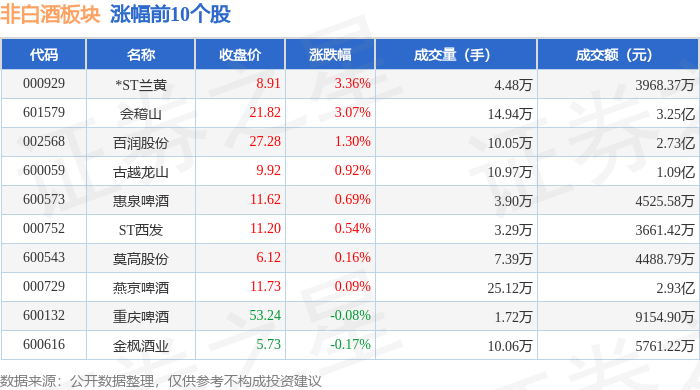
非白酒板块10月27日涨0.09%,*ST兰黄领涨,主力资金净流出79.71万元
Zheng Xing Xing Ye Ri Bao· 2025-10-27 08:25
Market Performance - The non-liquor sector increased by 0.09% compared to the previous trading day, with *ST Lanhua leading the gains [1] - The Shanghai Composite Index closed at 3996.94, up 1.18%, while the Shenzhen Component Index closed at 13489.4, up 1.51% [1] Stock Highlights - *ST Lanhua closed at 8.91, with a rise of 3.36% and a trading volume of 44,800 shares, totaling a transaction value of 39.68 million yuan [1] - Huaiqian Beer (惠泉啤酒) and ST Xifa (ST西发) also showed modest gains of 0.69% and 0.54%, respectively [1] - Zhangyu A (张裕A) experienced a decline of 1.51%, closing at 21.53 with a trading volume of 33,500 shares [2] Capital Flow Analysis - The non-liquor sector saw a net outflow of 797,100 yuan from institutional investors, while retail investors experienced a net outflow of 6,544,780 yuan [2] - Speculative funds had a net inflow of 66,245,000 yuan, indicating a shift in investor sentiment [2] Individual Stock Capital Flow - Kuaijishan (会稽山) had a net outflow of 27,921,000 yuan from institutional investors, while it saw a net inflow of 12,754,600 yuan from speculative funds [3] - Qingdao Beer (青岛啤酒) recorded a net inflow of 20,624,600 yuan from institutional investors, with a significant net outflow of 40,225,200 yuan from retail investors [3]