
KJS(601579)

Search documents
黄酒“不服老”:混饮、触网、跨界,谁能妙手回春?
Xin Lang Cai Jing· 2025-10-23 02:37
Core Insights - The yellow wine industry is facing challenges such as aging brand image and a disconnect with younger consumers, prompting brands to seek innovative solutions to break through these barriers [1][3] - Cross-industry collaboration is emerging as a significant strategy, exemplified by the partnership between Guyue Longshan and China Resources Beer to develop a new "yellow wine + beer" product [1][4] Product Innovation - Product innovation is a fundamental aspect of the yellow wine industry's efforts to revitalize itself, focusing on appealing to younger consumers through flavor, packaging, and functional value [4][5] - The collaboration between Guyue Longshan and China Resources Beer aims to combine brewing techniques and traditional yellow wine heritage to create a "yellow wine craft beer" that meets contemporary consumer preferences for lower alcohol content and enjoyable drinking experiences [4][5] - Guyue Longshan's previous launch of "craft yellow beer" achieved significant success, with 25,000 boxes ordered and over 10 million yuan in sales within the first month [4][5] - Other brands are also innovating, such as Kuaijishan's "daily smoked refreshing wine" and various herbal-infused products targeting health-conscious young consumers [7][8] Channel Innovation - The yellow wine industry is undergoing channel innovation to reach younger demographics, moving away from traditional sales methods to embrace e-commerce and modern retail strategies [8][9] - Kuaijishan has established an e-commerce company to explore digital sales strategies, achieving over 10 million yuan in sales within 72 hours during the 618 shopping festival [9][12] - Guyue Longshan is also expanding its online presence through major e-commerce platforms and is actively seeking new offline sales channels, including convenience stores and high-end restaurants [9][12] Regional Expansion - The yellow wine industry is heavily concentrated in the Jiangsu, Zhejiang, and Shanghai regions, which account for over 75% of national sales, necessitating efforts to expand beyond these areas [12][13] - The partnership between Guyue Longshan and China Resources Beer represents an attempt to penetrate new markets, leveraging China Resources' established distribution network [13][14] - Marketing initiatives, such as the "Cheers to New Yellow Wine" campaign, aim to increase brand visibility and engage younger consumers, with significant social media reach [13][16]



非白酒板块10月22日跌0.31%,会稽山领跌,主力资金净流出8581.48万元
Zheng Xing Xing Ye Ri Bao· 2025-10-22 08:19
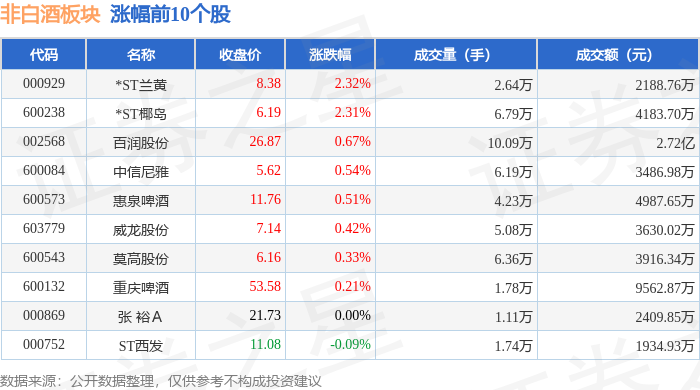
Market Overview - The non-liquor sector experienced a decline of 0.31% on the previous trading day, with Kuaijishan leading the drop [1] - The Shanghai Composite Index closed at 3913.76, down 0.07%, while the Shenzhen Component Index closed at 12996.61, down 0.62% [1] Stock Performance - Notable gainers in the non-liquor sector included *ST Lanhua, which rose by 2.32% to a closing price of 8.38, and *ST Yedao, which increased by 2.31% to 6.19 [1] - Kuaijishan saw a significant decline of 3.34%, closing at 22.00, with a trading volume of 211,800 shares and a turnover of 477 million [2] - Other notable declines included Guyue Longshan, which fell by 1.28% to 66.60, and Gu Xie La La, which decreased by 0.61% to 66.77 [2] Capital Flow - The non-liquor sector experienced a net outflow of 85.81 million from institutional investors, while retail investors saw a net inflow of 107 million [2] - The capital flow data indicates that retail investors were more active, with a net inflow despite the overall sector decline [2] Individual Stock Capital Flow - Kuaijishan had a net outflow of 4.77 million from institutional investors, while retail investors contributed a net inflow of 1.1 million [3] - Other stocks like *ST Yedao and *ST Lanhua also showed mixed capital flows, with varying degrees of institutional and retail investor activity [3]
老“CP”有新思路 黄酒场景消费如何激活
Bei Jing Shang Bao· 2025-10-21 13:44
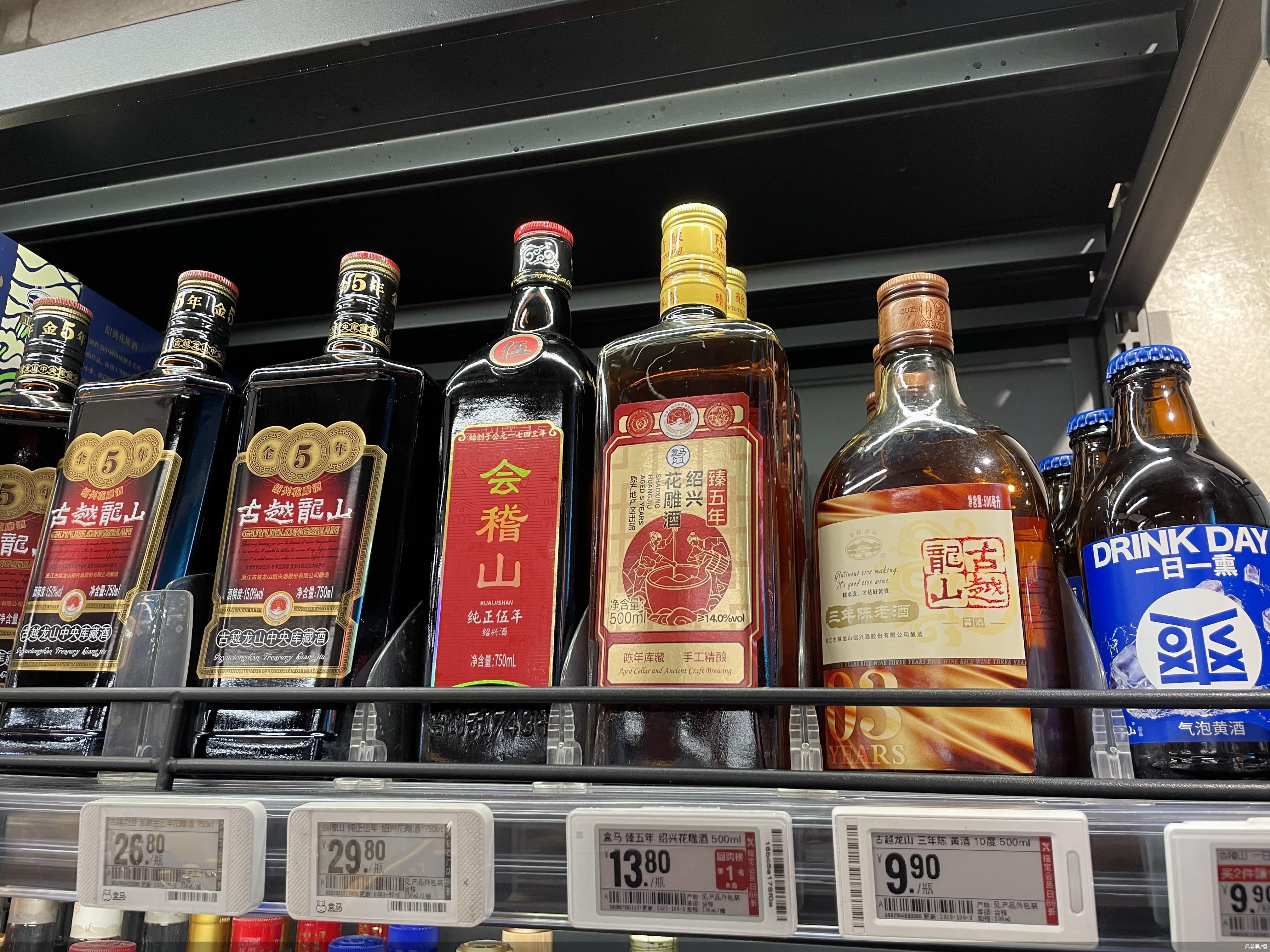
Core Insights - The consumption of yellow wine is experiencing a surge alongside the peak season for hairy crabs, with traditional products being complemented by younger, innovative offerings [1][2] - The market is characterized by intense competition among brands, both traditional and new entrants, as they seek to capitalize on the growing demand for yellow wine during the crab season [1][6] Market Trends - The introduction of youthful yellow wine products by leading brands such as Kuaijishan and Guyuelongshan is reshaping the traditional pairing of yellow wine with hairy crabs [2][11] - Sales data indicates that Kuaijishan's 8-degree sparkling yellow wine has surpassed 6,000 sales, while Guyuelongshan's similar product has exceeded 400 sales, highlighting a shift in consumer preferences towards innovative products [2][11] Industry Growth - The hairy crab market has shown significant growth, with production reaching a historical high of over 7 billion crabs in 2023, indicating a robust demand that supports the yellow wine market [7][11] - The yellow wine industry is projected to grow, with sales revenue reaching 21 billion yuan in 2023, a 2.1% increase year-on-year, and expected to exceed 30 billion yuan by 2025, maintaining a compound annual growth rate of over 5% [11][12] Consumer Behavior - The younger demographic is increasingly drawn to low-alcohol beverages, making yellow wine appealing due to its lower alcohol content and palatable taste [11][12] - Brands are focusing on expanding consumption scenarios beyond traditional dining, aiming to position yellow wine as a cultural lifestyle product through innovative venues like "slow wine bars" [12][13] Strategic Initiatives - Companies are encouraged to enhance their brand's appeal to younger consumers through innovative marketing strategies, including social media engagement and collaborations with influencers [13][14] - The establishment of experiential consumption spaces, such as slow wine bars, allows brands to gather consumer data and preferences, facilitating a deeper connection with the target audience [12][13]
会稽山10月20日获融资买入3368.22万元,融资余额6.69亿元
Xin Lang Cai Jing· 2025-10-21 01:33
Core Viewpoint - The company Kuaijishan experienced a slight decline in stock price and trading volume on October 20, with significant changes in financing activities and a stable operational performance in the first half of 2025 [1][2]. Financing Activities - On October 20, Kuaijishan's financing buy-in amounted to 33.68 million yuan, while financing repayment was 41.87 million yuan, resulting in a net financing outflow of 8.18 million yuan [1]. - As of October 20, the total financing and securities lending balance for Kuaijishan was 669 million yuan, with the financing balance accounting for 6.09% of the circulating market value, indicating a high level compared to the past year [1]. - The company had no securities lending activities on October 20, with both the securities lending amount and balance at zero, reflecting a low level compared to the past year [1]. Operational Performance - For the first half of 2025, Kuaijishan reported operating revenue of 817 million yuan, representing a year-on-year growth of 11.03%, and a net profit attributable to shareholders of 93.88 million yuan, up 3.41% year-on-year [2]. - The company has distributed a total of 793 million yuan in dividends since its A-share listing, with 431 million yuan distributed over the past three years [2]. Shareholder Information - As of June 30, 2025, Kuaijishan had 26,000 shareholders, a decrease of 1.25% from the previous period, while the average circulating shares per person increased by 1.26% to 18,419 shares [2]. - Among the top ten circulating shareholders, Hong Kong Central Clearing Limited ranked as the fifth largest, increasing its holdings by 508,400 shares to 5.94 million shares [2].
大消费行业周报(10月第3周):海南离岛免税政策5大调整落地-20251020
Century Securities· 2025-10-20 00:44
Investment Rating - The report does not explicitly state an investment rating for the industry, but it suggests focusing on the duty-free retail sector and the ice and snow economy as potential investment opportunities. Core Insights - The recent adjustments to the Hainan duty-free shopping policy are expected to enhance the attractiveness of Hainan as a free trade port, expanding the range of duty-free goods and increasing consumer participation [2][3]. - The early onset of the snow season in Xinjiang is anticipated to benefit the ice and snow economy, with government initiatives aiming for a total output value of 200 billion yuan by 2030 [2][3]. - The report highlights the performance of various sectors within the consumer industry, noting significant stock price changes among leading companies [2][3]. Summary by Sections Market Weekly Review - The consumer sector showed mixed performance, with food and beverage, retail, and home appliances experiencing gains, while beauty care and textiles saw declines [2][3]. - Notable stock performances included Kuaijishan (+11.08%) and Dongbei Group (+8.97%) leading the gains, while Jinzi Ham (-17.80%) and Biyi Co. (-19.63%) faced significant losses [2][3]. Industry News and Key Company Announcements - The Hainan duty-free policy adjustments include expanding the range of duty-free goods to 47 categories and allowing more consumer participation [2][3]. - The ice and snow industry is projected to exceed 1 trillion yuan by 2025, driven by upcoming major events and government support [2][3]. - Various companies reported significant revenue growth, such as Spring Breeze Power with a 28.56% increase in Q3 revenue [2][3].




非白酒板块10月17日跌1.28%,会稽山领跌,主力资金净流出1.63亿元
Zheng Xing Xing Ye Ri Bao· 2025-10-17 08:31
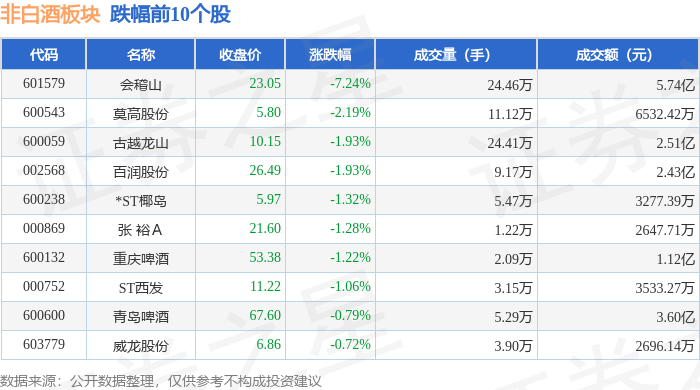
Market Overview - On October 17, the non-baijiu sector declined by 1.28% compared to the previous trading day, with Kuaijishan leading the decline [1] - The Shanghai Composite Index closed at 3839.76, down 1.95%, while the Shenzhen Component Index closed at 12688.94, down 3.04% [1] Stock Performance - Kuaijishan (601579) closed at 23.05, down 7.24% with a trading volume of 244,600 shares and a turnover of 574 million yuan [1] - Other notable declines included: - Caogao Co. (600543) down 2.19% to 5.80 - Guyue Longshan (600059) down 1.93% to 10.15 - Bailun Co. (002568) down 1.93% to 26.49 [1] Capital Flow - The non-baijiu sector experienced a net outflow of 163 million yuan from institutional investors, while retail investors saw a net inflow of 174 million yuan [1] - Detailed capital flow for selected stocks showed: - Jinfeng Wine Industry (600616) had a net inflow of 353,300 yuan from institutional investors [2] - ST Yedao (600238) saw a net outflow of 414,800 yuan from institutional investors but a net inflow of 644,300 yuan from retail investors [2] - ST Xifa (000752) had a net outflow of 2,224,400 yuan from institutional investors but a net inflow of 2,754,100 yuan from retail investors [2]
非白酒板块10月16日涨0.29%,古越龙山领涨,主力资金净流出1.29亿元
Zheng Xing Xing Ye Ri Bao· 2025-10-16 08:20
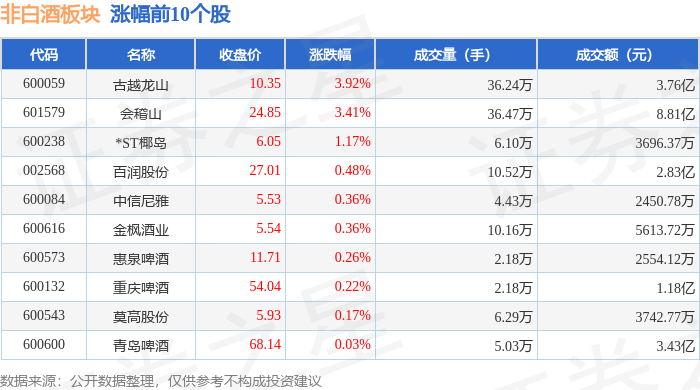
Market Overview - On October 16, the non-liquor sector rose by 0.29% compared to the previous trading day, with Guyue Longshan leading the gains [1] - The Shanghai Composite Index closed at 3916.23, up 0.1%, while the Shenzhen Component Index closed at 13086.41, down 0.25% [1] Stock Performance - Guyue Longshan (600059) closed at 10.35, up 3.92% with a trading volume of 362,400 shares and a turnover of 376 million yuan [1] - Kuaijishan (601579) closed at 24.85, up 3.41% with a trading volume of 364,700 shares and a turnover of 881 million yuan [1] - Other notable performers include *ST Yedao (600238) up 1.17%, Zhirun Co. (002568) up 0.48%, and Chongqing Beer (600132) up 0.22% [1] Capital Flow - The non-liquor sector experienced a net outflow of 129 million yuan from institutional investors, while retail investors saw a net inflow of 184 million yuan [2] - The table of capital flow indicates that *ST Yedao had a net inflow of 1.58 million yuan from institutional investors, while it faced a net outflow of 2.22 million yuan from retail investors [3] Individual Stock Analysis - *ST Yedao (600238) had a net inflow of 158,810 yuan from institutional investors, but a net outflow of 221,770 yuan from retail investors [3] - Mogaogufen (600543) saw a net inflow of 152,120 yuan from institutional investors, with a net outflow of 206,640 yuan from retail investors [3] - Chongqing Beer (600132) faced a net outflow of 652,000 yuan from institutional investors, while retail investors contributed a net inflow of 346,940 yuan [3]

古越龙山牵手啤酒龙头,将推出首款精酿黄啤
21世纪经济报道· 2025-10-16 07:55
Core Viewpoint - The strategic partnership between Guyue Longshan and China Resources Beer aims to innovate the beverage market by launching a new product, "Yellow Wine Brewed Beer," targeting a broader consumer base and leveraging each company's strengths in marketing and distribution [1][3][10]. Group 1: Strategic Collaboration - Guyue Longshan and China Resources Beer signed a strategic cooperation agreement to develop a new product that combines the characteristics of yellow wine and beer, with plans for a pilot launch in East China before expanding nationwide [3][10]. - This collaboration is part of a broader strategic framework established between the Zhejiang provincial government and China Resources Group, focusing on high-quality development and consumer expansion [8][10]. Group 2: Market Impact - Following the announcement of the partnership, Guyue Longshan's stock price rose over 3%, reflecting positive market sentiment towards the collaboration [3][15]. - The yellow wine sector has seen a resurgence in interest, with companies like Kuaijishan experiencing significant stock price increases, highlighting a competitive landscape where Guyue Longshan must adapt to maintain its market position [12][14]. Group 3: Product Innovation - The new "Yellow Wine Brewed Beer" product is expected to blend the rich flavors of yellow wine with the refreshing qualities of beer, aiming to create a unique offering in the beverage market [10][12]. - Guyue Longshan has previously attempted to innovate with products like coffee yellow wine and ice cream, but these efforts have not yet translated into significant market success [14][15]. Group 4: Future Prospects - The collaboration is seen as a crucial step for Guyue Longshan to rejuvenate its brand image and appeal to younger consumers, potentially enhancing its market competitiveness against emerging players like Kuaijishan [6][14]. - The partnership may lead to further collaborative efforts beyond product development, focusing on strategic alignment in marketing and distribution channels [15].


古越龙山反攻 与华润啤酒达成战略合作
2 1 Shi Ji Jing Ji Bao Dao· 2025-10-15 23:49
Core Insights - The strategic partnership between Guyue Longshan and China Resources Beer aims to innovate in the alcoholic beverage market by launching a new product, "Yellow Wine Brewed Beer," targeting a broader consumer base [1][2][3] - The collaboration is part of a larger strategic framework established between the Zhejiang provincial government and China Resources Group, focusing on high-quality development and consumer expansion [2] - The market for yellow wine has seen a resurgence, with companies like Kuaijishan experiencing significant stock price increases, while Guyue Longshan has lagged behind in growth [1][7][8] Company Collaboration - Guyue Longshan and China Resources Beer have signed a strategic cooperation agreement to leverage each other's strengths in marketing and product development [2][5] - The new product will first be launched in East China, with plans for nationwide expansion [3][5] - The partnership is expected to combine the youthful marketing strategies of China Resources Beer with the cultural heritage of Guyue Longshan [5][10] Market Dynamics - Kuaijishan has seen its stock price rise by over 120% this year, surpassing Guyue Longshan in market capitalization, which is currently around 9 billion [7][8] - Guyue Longshan's revenue growth has been slow, with a reported 0.4% increase in the first half of the year, while Kuaijishan's revenue exceeded 800 million with double-digit growth [8][9] - The yellow wine market is experiencing a shift, with innovative products like sparkling yellow wine gaining popularity, highlighting the need for Guyue Longshan to adapt quickly [7][9] Product Innovation - The new "Yellow Wine Brewed Beer" is positioned as a novel product that combines the characteristics of both yellow wine and beer, aiming to attract younger consumers [4][5] - Guyue Longshan has previously attempted to innovate with products like coffee yellow wine and yellow wine ice cream, but these efforts have not yet translated into significant market success [10] - The collaboration with China Resources Beer is seen as a crucial step for Guyue Longshan to enhance its product offerings and market presence [11]
11.74亿元主力资金今日抢筹食品饮料板块
Zheng Quan Shi Bao Wang· 2025-10-14 09:17
Market Overview - The Shanghai Composite Index fell by 0.62% on October 14, with 11 sectors experiencing gains, led by the banking and coal industries, which rose by 2.51% and 2.18% respectively [1] - The food and beverage sector ranked third in terms of daily gains, increasing by 1.69% [1] - A total of 936.16 billion yuan in net outflow was recorded across the two markets, with 8 sectors seeing net inflows [1] Sector Performance - The banking sector had the highest net inflow of funds, amounting to 1.725 billion yuan, contributing to its 2.51% increase [1] - The food and beverage sector saw a net inflow of 1.174 billion yuan, with 92 out of 124 stocks in the sector rising [2] - The electronic sector experienced the largest net outflow, totaling 29.910 billion yuan, followed by the non-ferrous metals sector with a net outflow of 13.214 billion yuan [1] Food and Beverage Sector Details - Within the food and beverage sector, the top three stocks by net inflow were Kweichow Moutai (6.09 billion yuan), Wuliangye (3.17 billion yuan), and Huadiao (1.72 billion yuan) [2] - The sector had 55 stocks with net inflows, while 14 stocks experienced net outflows exceeding 10 million yuan, with Yangyuan Beverage leading the outflows at 35.7869 million yuan [2][3] Notable Stocks - Kweichow Moutai saw a price increase of 2.24% with a turnover rate of 0.53% and a net inflow of 608.90 million yuan [2] - Wuliangye increased by 1.85% with a turnover rate of 0.75% and a net inflow of 316.72 million yuan [2] - Yangyuan Beverage decreased by 2.05% with a turnover rate of 2.15% and a net outflow of 35.7869 million yuan [3]

