
CPIC(601601)

Search documents
上市险企中报观察:AI赋能保险业降本增效
Zhong Guo Jing Ji Wang· 2025-09-05 03:26
Core Insights - The application of AI in the domestic insurance industry is entering a new phase of large-scale implementation, with major companies focusing on cost reduction and efficiency enhancement across the entire business chain [1][2][3] AI Integration in Business Processes - AI technology is transforming core insurance processes from manual to intelligent-driven, significantly improving service efficiency and customer experience [2] - In underwriting and customer service, AI has enhanced operational efficiency, with automated underwriting rates reaching 95.8% and customer service response accuracy exceeding 95% [3][4] Cost Control and Risk Reduction - AI applications in customer service and auditing have substantially reduced labor costs, with companies like ZhongAn Insurance utilizing over 100 active AI robots, achieving 4.5 billion calls in the first half of the year [4][5] - Enhanced AI risk control capabilities have led to significant reductions in fraud losses, with Ping An Insurance intercepting fraud claims worth 6.44 billion yuan, a year-on-year increase of 6% [5] Future Development and Strategic Direction - Several listed insurance companies have identified AI as a long-term strategic direction, with China Pacific Insurance focusing on building an enterprise-level AI capability system [7][8] - The integration of AI is expected to drive innovation in personalized products, health management services, and investment capabilities, with Ping An's investment return rate rising to 3.1% [7][8]





中国太保(601601):分红险转型加速 银保渠道NBV高增
Xin Lang Cai Jing· 2025-09-04 12:34
Core Viewpoint - The company reported a positive performance in the first half of 2025, with insurance service revenue and net profit showing year-on-year growth, indicating a stable operational environment and effective management strategies [1][2]. Group 1: Financial Performance - In H1 2025, the company achieved insurance service revenue of 141.82 billion yuan, a year-on-year increase of 3.5%, and a net profit attributable to shareholders of 27.88 billion yuan, up 11.0% year-on-year [1]. - Taiping Life Insurance generated insurance service revenue of 42.27 billion yuan (YoY +1.0%), while Taiping Property Insurance reported revenue of 96.83 billion yuan (YoY +4.0%) [1]. - The company’s total investment assets reached 2,924.7 billion yuan, reflecting a 7.0% increase from the end of the previous year [2]. Group 2: Business Segments - Taiping Life Insurance's premium income rose by 13.1% year-on-year to 193.5 billion yuan, with the proportion of participating insurance in new policy premium payments increasing to 42.5% [1]. - The new business value (NBV) for Taiping Life Insurance increased by 5.6% to 9.5 billion yuan, with individual insurance and bancassurance channels contributing 60% and 37.8% respectively [1]. - In the property insurance segment, the comprehensive cost ratio improved to 96.3%, a decrease of 0.8 percentage points year-on-year, benefiting from refined management of auto insurance [2]. Group 3: Future Outlook - The company is expected to continue promoting the "North Star Plan" under the Long Haul Phase II project, which is anticipated to enhance its fundamental performance [2]. - Earnings per share (EPS) forecasts for 2025-2027 are projected at 5.65 yuan, 6.34 yuan, and 7.19 yuan respectively, maintaining a buy rating with a target price of 43.93 yuan based on a 0.7x 2025 P/EV [2].

押宝分红险:预定利率降了 销量反而要爆?
Mei Ri Jing Ji Xin Wen· 2025-09-04 12:24
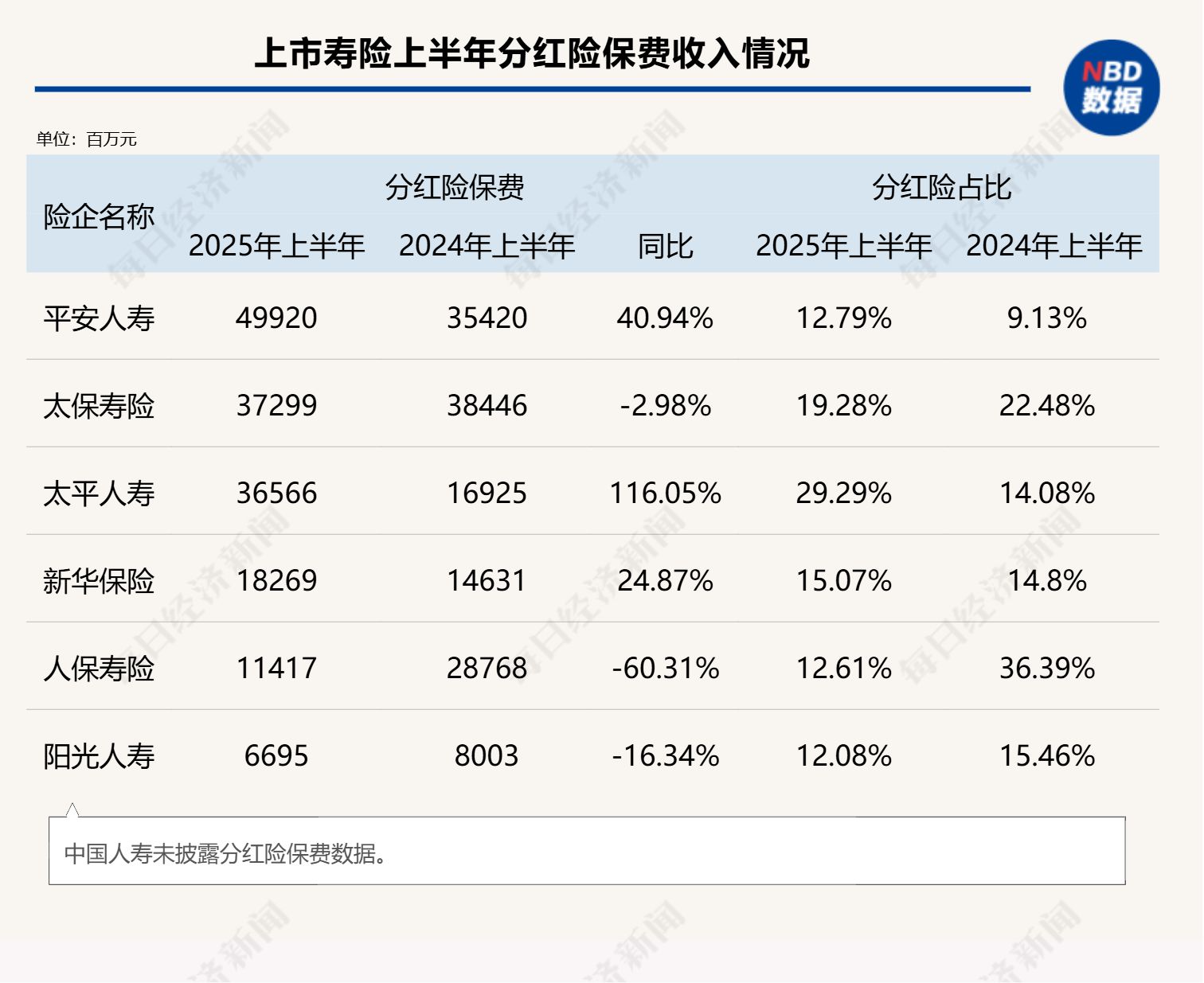
Core Viewpoint - The insurance industry is shifting towards dividend insurance sales in response to the reduction in the predetermined interest rate, with major listed insurance companies reporting significant growth in this segment despite challenges posed by the new interest rate environment [1][9]. Dividend Insurance Sales Performance - In the first half of 2025, major insurance companies have set ambitious targets for dividend insurance sales, with many aiming for a 50% sales ratio [1]. - Taiping Life reported that dividend insurance accounted for 87.1% of first-year premium income in long-term insurance, while China Pacific Life's new premium income from dividend insurance rose to 42.5%, with agent channels contributing 51% [5][2]. - China Life, Ping An, and other leading insurers have also seen substantial increases in dividend insurance premiums, with Ping An leading at approximately 500 billion yuan, a 40.94% increase year-on-year [4][5]. Market Dynamics and Challenges - The recent adjustment in predetermined interest rates has led to a decrease in the maximum rate for dividend insurance from 2% to 1.75%, which may reduce the attractiveness of these products and increase sales difficulty [1][9]. - Despite this, insurance companies are optimistic about the potential for dividend insurance to become a mainstream product, with expectations for increased market share in the second half of the year [1][10]. Strategic Initiatives for Transformation - Companies are implementing various strategies to promote dividend insurance, including performance assessments, commission adjustments, and tailored product offerings [7][8]. - China Pacific Life has outlined a four-pronged approach to enhance its dividend insurance business, focusing on mindset shifts, differentiated channel strategies, regional adaptations, and resource allocation [7]. - New China Life has established a leadership group to drive the transformation towards dividend insurance, indicating a commitment to overcoming previous sales challenges [8]. Future Outlook - The insurance sector anticipates that the shift towards dividend insurance will accelerate, with companies planning to increase the supply and competitiveness of these products [9][10]. - Ping An has indicated that wealth and pension products will transition to dividend types, reflecting a broader industry trend towards flexible, floating-yield products in response to changing market conditions [11].


2025上半年寿险公司利润榜:平安、国寿、太保TOP3,投资↑新业务价值↑行业利润三连升...
13个精算师· 2025-09-04 12:23
Core Viewpoint - The life insurance industry in the first half of 2025 has shown significant profit growth, with 73 companies reporting a total net profit of 185.8 billion, a year-on-year increase of approximately 37 billion, or 25% [10][12][13]. Group 1: Profit Growth and Performance - 52 out of 73 life insurance companies reported profits, while 21 incurred losses, indicating a positive trend in profitability [1][22]. - The net profit of major companies such as Ping An and China Life has significantly contributed to the overall profit increase, with Ping An reporting a net profit of 50.6 billion and China Life 40.3 billion [2][24]. - The industry has experienced three consecutive years of profit growth, reaching a new high that surpasses the same period in 2019 [10][12]. Group 2: Investment and Business Value - The increase in equity investment has led to a rise in investment returns, with the average investment yield for 73 companies rising to 4.22%, up from 3.59% year-on-year [16][18]. - The total amount directly invested in stocks by insurance companies exceeded 3 trillion, marking an increase of approximately 1 trillion compared to the previous year [18]. - New business value has also seen substantial growth, particularly in the bancassurance channel, with companies like China Life and Xinhua Insurance reporting over 100% growth in new single premiums [31][35]. Group 3: Company Rankings and Market Dynamics - The top six life insurance companies have shown robust performance, with significant increases in both premium income and new business value [23][28]. - Tai Kang Life has seen a notable profit increase, attributed to the implementation of new accounting standards and improved investment returns [38][40]. - AIA's new business value rate remains high at 58.6%, reflecting its strong market position and effective agent model [41]. Group 4: Losses and Challenges for Smaller Companies - Despite the overall positive trend, 21 companies reported losses, with many being smaller firms struggling with high liability costs and investment volatility [22][43]. - Companies like Heng Tai Life and Guo Lian Life have faced significant challenges, with declining investment yields contributing to their financial difficulties [49][50]. - The continuous losses among smaller firms highlight the need for capital strengthening and improved operational efficiency to enhance solvency [47][48].

中国平安人寿保险股份有限公司增持中国太保610.42万股 每股均价约35.81港元
Zhi Tong Cai Jing· 2025-09-04 11:09
Group 1 - The core point of the article is that China Ping An Life Insurance Company has increased its stake in China Pacific Insurance (601601) by acquiring 6.1042 million shares at an average price of 35.8132 HKD per share, totaling approximately 219 million HKD [1] - After the acquisition, the total number of shares held by China Ping An is approximately 198 million, representing a holding percentage of 7.14% [1]
中国太保(601601):分红险转型加速,银保渠道NBV高增
Guotou Securities· 2025-09-04 10:02
Investment Rating - The report maintains a "Buy-A" investment rating for the company with a 6-month target price of 43.93 CNY [6] Core Views - The company reported a 3.5% year-on-year increase in insurance service revenue to 1418.24 billion CNY and an 11.0% increase in net profit attributable to shareholders to 278.85 billion CNY for the first half of 2025 [2] - The proportion of participating insurance has increased, with new business value (NBV) growing significantly, particularly in the bancassurance channel, which saw a 156% year-on-year increase in NBV [2] - The comprehensive cost ratio for property insurance improved to 96.3%, benefiting from refined management of auto insurance [3] - The total investment return rate decreased to 2.3%, primarily due to declines in the fair value of fixed-income assets [3] Financial Performance Summary - For the first half of 2025, the life insurance segment achieved a premium income of 193.5 billion CNY, a 13.1% increase year-on-year, with participating insurance accounting for 42.5% of new premiums [2] - The property insurance segment reported a premium income of 112.8 billion CNY, a 0.9% increase year-on-year, with auto insurance premiums rising by 2.8% [3] - The company's investment assets reached 29,247 billion CNY, a 7.0% increase from the end of the previous year [3] - The projected earnings per share (EPS) for 2025-2027 are 5.65 CNY, 6.34 CNY, and 7.19 CNY respectively [3][4]
平安人寿中国太保H股持股比例升至7.14%。
Xin Lang Cai Jing· 2025-09-04 09:21
Group 1 - Ping An Life's stake in China Pacific Insurance (H-shares) has increased to 7.14% [1]
日赚近10亿、分红293亿,五大险企押注分红险,部分公司新业务占比超50%
3 6 Ke· 2025-09-04 09:21
Group 1: Core Insights - The five major listed insurance companies in A-shares achieved a total net profit of 1781.92 billion yuan in the first half of 2025, averaging a daily profit of 9.84 billion yuan [1][4] - These companies announced significant cash dividends, with a total proposed dividend of approximately 293.36 billion yuan, led by China Ping An at 172.02 billion yuan [1][4] - The rise of participating insurance is becoming a new growth engine for the industry, with several companies reporting substantial increases in new premium income from participating insurance [1][7] Group 2: Financial Performance - The total operating revenue of the five major insurance companies reached 1.33 trillion yuan, a year-on-year increase of 4.89% [3] - New business value for life insurance companies saw explosive growth, with China Life and Ping An Life achieving new business values of 285 billion yuan and 223.35 billion yuan, respectively, reflecting year-on-year growth rates of 20.3% and 39.8% [5] Group 3: Participating Insurance Growth - The proportion of participating insurance in new business has significantly increased, with China Life reporting that over 50% of its new business premium comes from participating insurance [7][9] - New premium income from participating insurance for New China Life reached 182.69 billion yuan, a year-on-year increase of 24.9% [7] - The shift towards participating insurance is seen as both a response to the low interest rate environment and a long-term strategy for risk-sharing with customers [2][8] Group 4: Strategic Responses - Insurance companies are focusing on optimizing their product structures and enhancing the sales capabilities of their agents to adapt to the changing market conditions [10][11] - The adjustment in product sales strategies emphasizes understanding customer needs for risk protection and financial management, moving away from solely promoting high guaranteed returns [11]
保险板块9月4日涨0.16%,中国人寿领涨,主力资金净流出1.94亿元
Zheng Xing Xing Ye Ri Bao· 2025-09-04 08:48
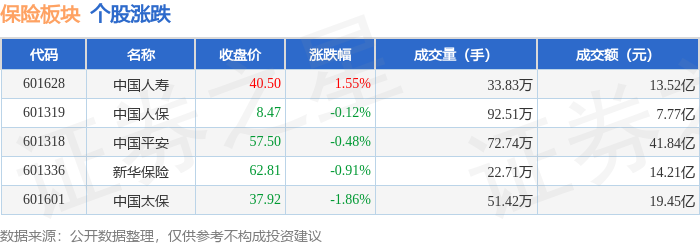
Core Insights - The insurance sector experienced a slight increase of 0.16% on September 4, with China Life leading the gains [1] - The Shanghai Composite Index closed at 3765.88, down 1.25%, while the Shenzhen Component Index closed at 12118.7, down 2.83% [1] Insurance Sector Performance - China Life (601628) closed at 40.50, up 1.55% with a trading volume of 338,300 shares and a transaction value of 1.352 billion [1] - China Pacific Insurance (601601) closed at 37.92, down 1.86% with a trading volume of 514,200 shares and a transaction value of 1.945 billion [1] - New China Life (601336) closed at 62.81, down 0.91% with a trading volume of 227,100 shares and a transaction value of 1.421 billion [1] - China Ping An (601318) closed at 57.50, down 0.48% with a trading volume of 727,400 shares and a transaction value of 4.184 billion [1] - China Re (601319) closed at 8.47, down 0.12% with a trading volume of 925,100 shares and a transaction value of 777 million [1] Fund Flow Analysis - The insurance sector saw a net outflow of 194 million from institutional investors, while retail investors experienced a net outflow of 143 million [1] - Speculative funds recorded a net inflow of 337 million into the insurance sector [1] Individual Stock Fund Flow - China Life (601628) had a net inflow of 69.29 million from institutional investors, accounting for 5.12% of total transactions [2] - New China Life (601336) had a net inflow of 66.60 million from institutional investors, accounting for 4.69% of total transactions [2] - China Ping An (601318) experienced a net outflow of 192 million from institutional investors, representing 4.59% of total transactions [2] - China Pacific Insurance (601601) had a net outflow of 91.25 million from institutional investors, accounting for 4.69% of total transactions [2] - China Re (601319) had a net outflow of 46.37 million from institutional investors, representing 5.97% of total transactions [2]
保险业交出稳中有进“周年答卷”
Jin Rong Shi Bao· 2025-09-04 08:41
Core Viewpoint - The "New National Ten Articles" released by the State Council aims to strengthen regulation, prevent risks, and promote high-quality development in the insurance industry over the next 5 to 10 years, marking a significant policy direction for the sector [1] Industry Performance - As of the end of Q2 2025, the insurance industry's asset scale reached 39.22 trillion yuan, with a year-on-year growth of 9.2% [2] - The total insurance premium income amounted to 3.74 trillion yuan, reflecting a 5.3% increase compared to the same period in 2024 [2] - Insurance companies' claims and payouts reached 1.3 trillion yuan, showing a notable growth of 9% year-on-year, outpacing premium growth [2] Social Welfare Services - The insurance sector has enhanced its role in social welfare, particularly in disaster relief, with 20.5 billion yuan paid out during extreme weather events in 2025 [3] - The urban catastrophe insurance program has provided risk protection for 64.39 million households, amounting to 22.36 trillion yuan in coverage [3] - Technological advancements have improved risk reduction services, with significant outreach for disaster warnings to millions of clients [3] Health Insurance Development - The urban commercial medical insurance, known as "惠民保," has seen significant growth, with 615.9 million participants in Shenzhen and over 22 billion yuan in claims paid [4] - The commercial health insurance sector has also expanded, with claims reaching 405.2 billion yuan in 2024 and long-term health insurance reserves exceeding 2.5 trillion yuan [4][5] Support for the Real Economy - The insurance industry is aligning with national strategies by enhancing risk protection in technology innovation and green development [6][7] - Insurance services for technology activities provided coverage of nearly 24 trillion yuan in the first half of 2025 [6] - Green insurance products have seen a 23.9% increase in risk coverage, with over 126.35 trillion yuan provided [7] Investment in Strategic Areas - Insurance companies are increasing investments in strategic sectors, with China Life establishing a fund focused on high-demand industries like AI and advanced manufacturing [8] - New China Life's investment in national strategic areas surpassed 1.21 trillion yuan, reflecting a 54% year-on-year increase [8] Industry Reform and Transformation - The insurance sector is undergoing significant reforms in pricing mechanisms and product structures to enhance quality and efficiency [10][11] - The introduction of floating yield insurance products has led to a 33% share of new life insurance products in the first half of 2025 [11] - The insurance intermediary market is also experiencing a contraction, with a 11.7% decrease in the number of professional intermediary institutions in Jilin province [11] Future Outlook - The insurance industry is expected to continue leveraging its long-term advantages to contribute to the construction of a financial strong nation and support modernization efforts in China [12]