CPIC(601601)

Search documents
公募加仓非银金融,后市机会如何?
券商中国· 2026-01-31 06:03
Core Viewpoint - Public funds are increasing their allocation to non-bank financials, particularly insurance and brokerage stocks, indicating a shift in investment strategy towards these sectors [2][3]. Group 1: Fund Allocation Trends - In Q4 2025, public funds raised their non-bank financial positions by 1 percentage point, making it the fourth largest sector increase after metals, communications, and basic chemicals [2][3]. - Notable stocks such as China Ping An and China Pacific Insurance received significant over-allocations from funds [3]. - The insurance index saw a substantial increase of 23.42% in Q4 of the previous year, outperforming traditional dividend-paying bank stocks [3]. Group 2: Brokerage Performance Expectations - Several listed brokerages have announced expected net profit increases for 2025, with many projecting year-on-year growth exceeding 50% [4]. - Notable forecasts include CITIC Securities expecting a net profit of 8.542 billion to 10.535 billion yuan, and Dongwu Securities projecting a net profit of 3.431 billion to 3.668 billion yuan, both showing significant growth [4]. - Despite the increase in fund allocations, non-bank financials remain underweight compared to historical averages, currently around 30% [4]. Group 3: Structural Opportunities in the Market - The trading volume in the Shanghai and Shenzhen markets has been increasing, suggesting a continuation of favorable market conditions for brokerage stocks [5]. - Analysts recommend focusing on brokerages with strong retail business shares and those that contribute significantly to profits, as individual stock opportunities may outweigh overall market trends [5]. - The insurance sector is benefiting from the performance of equity markets and a shift in deposit funds, with a stable interest rate environment enhancing its investment appeal [6].





非银行业持仓占比提升,保险获配显著增加:25Q4公募基金持仓点评
Hua Yuan Zheng Quan· 2026-01-30 07:41
Investment Rating - The report maintains a "Positive" investment rating for the non-bank financial sector [4][7]. Core Viewpoints - The report highlights an increase in the proportion of non-bank financial holdings by public funds, with a significant increase in insurance allocations. The current holdings in the non-bank financial sector remain underweight compared to the market [4][5]. - Public funds' holdings in the non-bank financial sector rose by 0.96 percentage points to 1.97% in Q4 2025, with insurance seeing the most notable increase [5][10]. - The report suggests that the insurance sector is expected to achieve good growth in 2026, driven by improved net premium income and reduced asset allocation pressure due to rising long-term bond yields [7][8]. Summary by Sections Public Fund Holdings - In Q4 2025, the total holding of non-bank financials by public funds reached 370.64 billion, with an allocation of 1.97%, up from 1.00% in Q3 2025 [9][10]. - The breakdown of holdings shows insurance at 1.32%, securities at 0.58%, and diversified finance at 0.06%, with significant increases in insurance holdings [5][9]. Individual Stocks - The top five A-share stocks held by public funds in the non-bank financial sector are China Ping An (158.14 billion), China Pacific Insurance (47.88 billion), CITIC Securities (37.26 billion), Huatai Securities (25.21 billion), and New China Life Insurance (20.37 billion) [6][13]. - The report notes that the largest increases in holdings were also seen in these stocks, particularly China Ping An and China Pacific Insurance [6][13]. Investment Recommendations - The report recommends China Life Insurance, China Ping An, and China Pacific Insurance for their strong growth potential and favorable market conditions [7][8]. - For the brokerage sector, it suggests focusing on CITIC Securities, Huatai Securities, and Industrial Securities due to their growth prospects and market positioning [8].

保险观点更新:把握宽基抛压缓释后的顺周期龙头机会-20260130
ZHONGTAI SECURITIES· 2026-01-30 07:25
Investment Rating - The industry investment rating is maintained at "Overweight" [2][19]. Core Insights - The report emphasizes the cyclical recovery of the insurance sector, driven by improved market conditions and a favorable interest rate environment. It highlights the potential for significant profit elasticity and value growth in the sector [5]. - The report suggests that the insurance stocks are currently the preferred choice within cyclical sectors, with expectations of valuation catalysts due to the recovery of the cyclical market [5]. - The report anticipates that the average growth rate of embedded value (EV) for listed insurance companies will be 10.6%, 10.9%, and 10.8% for the years 2025 to 2027, respectively [5]. Summary by Sections Basic Conditions - The total market capitalization of the industry is approximately 37,536.73 billion [2]. Market Trends - The report notes a significant net outflow from major broad-based ETFs, with a cumulative outflow exceeding 10 billion during the specified period, indicating a shift in market dynamics [5][8]. - The report identifies that the insurance sector's valuation is currently misaligned with the improving fundamentals of assets and liabilities [5]. Investment Recommendations - The report recommends focusing on leading insurance companies such as China Pacific Insurance, Ping An Insurance, China Life Insurance, New China Life Insurance, and China Property & Casualty Insurance, citing their attractive valuations and growth potential [5].

太平洋证券2026年2月金股
Tai Ping Yang Zheng Quan· 2026-01-29 15:16
Group 1: Key Insights - The report highlights multiple positive catalysts for the electronics sector, particularly for Huadian Co., Ltd. (002463), including the upcoming financial disclosures from overseas cloud vendors and domestic supply chain performance forecasts, which will validate the sustainability of computing power demand and industry prosperity [4] - The defense and military industry, represented by Guoke Military Industry (688543), is transitioning from conventional ammunition to intelligent and information-based ammunition, positioning the company to benefit from high industry demand and military trade orders, which are expected to drive significant growth [4] - In the pharmaceutical and biotechnology sector, Huan Huang Pharmaceutical (0013.HK) is advancing its ATTC platform with candidates entering clinical trials, including HMPL-A251, which is a first-in-class drug, and is also expanding the indications for existing drugs, indicating strong future growth potential [5] Group 2: Company-Specific Analysis - Wan Hua Chemical (600309) is reinforcing its position as a global leader in polyurethane, with significant market shares in MDI and TDI, and is expected to enhance profitability through strategic partnerships and cost advantages in its petrochemical segment [6] - Su Kan Agricultural Development (601952) anticipates a slight decline in 2025 profits due to falling grain prices, but expects a recovery driven by rising grain prices and increased farmland area through land transfer initiatives [7] - Yingwei Technology (002837) is poised for substantial growth in the server liquid cooling market, with expectations of doubling industry growth in 2026 and 2027, supported by orders from major overseas clients [8] Group 3: Financial Performance and Projections - China Pacific Insurance (601601) demonstrated strong resilience with a 11% year-on-year increase in net profit to 27.9 billion yuan, driven by robust growth in new business value in its life insurance segment [8] - Jin Jiang Shipping (601083) reported a 64% year-on-year increase in net profit for Q3, indicating strong performance relative to peers, with expectations for continued growth [8] - Xiaoshangcheng (600415) is benefiting from increased rental income and new merchant additions, with projections for profit doubling in 2026 due to enhanced service offerings and improved gross margins [8]





数千亿投向“医康养”,保险公司正在锻造第二增长曲线
第一财经· 2026-01-29 13:59
Core Viewpoint - Insurance funds are significantly penetrating the medical, health, and elderly care industries, with over 400 billion yuan invested, driven by aging population and health strategies [2][4]. Investment Scale and Focus - As of 2025, insurance funds are projected to invest over 1.5 trillion yuan in medical-related assets through various investment products, including debt and equity plans [4]. - Direct investments in the medical and elderly care sectors have reached nearly 30 billion yuan, covering biotechnology, new drug technology, and medical devices [4]. - The insurance industry is also focusing on building elderly care communities, with 130 projects expected by the end of 2024, marking a 38% year-on-year increase [5]. Strategic Shift - Insurance companies are transitioning from "risk compensators" to "health and elderly care ecosystem builders," aiming to create a "second growth curve" through integrated services [2][6]. - The competition is shifting from resource allocation to ecological collaboration efficiency, emphasizing the integration of insurance, services, and data [10]. Market Potential - The health and elderly care industry in China is projected to reach a market size of 9.8 trillion yuan by 2025, with expectations to grow to 14.6 trillion yuan by 2030 [7]. - Policies are encouraging insurance companies to integrate their services with health management and elderly care, enhancing their strategic importance [8]. Future Outlook - The insurance sector is expected to accelerate its investment in health and elderly care, leveraging policy guidance to create differentiated competitive advantages [8][9]. - The focus will be on transforming health management from a cost center to a profit center, with a need for sustainable business models [12]. - Challenges include talent shortages, data integration, and aligning product design with the actual risks faced by the elderly population [12].

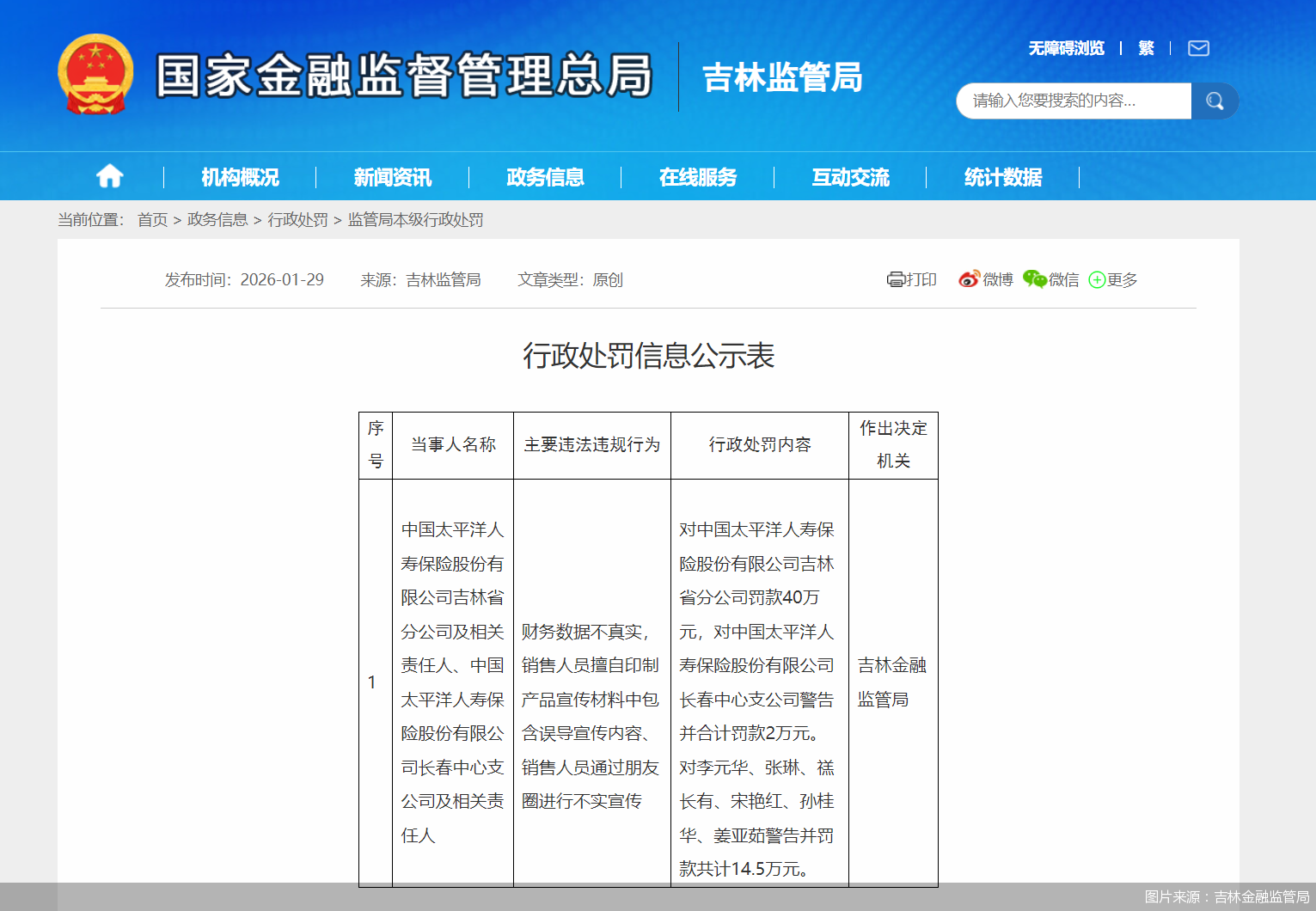
涉销售人员朋友圈不实宣传等,太保寿险吉林两分支机构被罚
Bei Jing Shang Bao· 2026-01-29 13:00
| 序 | 当事人名称 | 主要违法违规行为 | 行政处罚内容 | 作出决定 | | --- | --- | --- | --- | --- | | 를 | | | | 机关 | | | 中国太平洋人 | | 对中国太平洋人寿保 | 吉林金融 监管局 | | | 寿保险股份有 | | 险股份有限公司吉林 | | | | 限公司吉林省 | | 省分公司罚款40万 | | | | 分公司及相关 | 财务数据不真实。 | 元,对中国太平洋人 | | | | 责任人、中国 | 销售人员擅自印制 | 寿保险股份有限公司 | | | 1 | 太平洋人寿保 | 产品宣传材料中包 | 长春中心支公司警告 | | | | 险股份有限公 | 含误导宣传内容、 | 并合计罚款2万元。 | | | | 司长春中心支 | 销售人员通过朋友 | 对李元华、张琳、谎 | | | | 公司及相关责 | 圈进行不实宣传 | 长有、宋艳红、孙桂 | | | | 任人 | | 华、姜亚茹警告并罚 | | | | | | 款共计14.5万元。 | | 北京商报讯(记者 李秀梅)1月29日,吉林金融监管局发布行政处罚信息显示,中国太平洋人寿保险股份有 ...
数千亿投向“医康养”,保险公司正在锻造第二增长曲线
Di Yi Cai Jing· 2026-01-29 12:33
Core Insights - Insurance funds are significantly penetrating the healthcare and elderly care industries, with over 400 billion yuan invested through various channels [1][2] - The insurance industry is transitioning from being "risk compensators" to "health and elderly care ecosystem builders," aiming to create a second growth curve through integrated services [1][4] - The competition in the industry is shifting from "resource layout" to "ecological synergy efficiency," focusing on creating a positive cycle of "service-data-insurance" [7] Investment Trends - As of 2025, insurance asset management products are projected to channel over 150 billion yuan into healthcare through debt, equity, and private equity funds [2] - Direct investments in the healthcare and elderly care sectors have reached nearly 30 billion yuan, covering various sub-sectors like biotechnology and medical devices [2] - The insurance sector is also focusing on building elderly care communities, with 130 projects planned by the end of 2024, reflecting a 38% year-on-year increase [3] Market Potential - The Chinese health and elderly care market is expected to reach 9.8 trillion yuan by 2025, with projections of nearly 14.6 trillion yuan by 2030 due to demographic changes and policy support [4][5] - Policies such as the "New National Ten Articles" and local initiatives are encouraging insurance companies to integrate their services with healthcare and elderly care [5] Strategic Shifts - Major insurance companies are prioritizing health and elderly care in their strategic frameworks, with firms like China Pacific Insurance and Ping An emphasizing comprehensive financial services combined with healthcare [5][6] - The "insurance + health care" strategy is seen as a way to enhance customer loyalty and operational efficiency, shifting focus from post-event compensation to proactive health management [6][8] Challenges Ahead - The industry faces challenges in achieving sustainable profit models, particularly in the capital-intensive elderly care sector, where returns may take time to materialize [8][9] - There is a significant talent shortage in the healthcare sector, which could impact service quality, alongside challenges in data integration and compliance with privacy regulations [9]
2月金股报告:指数震荡,行业关注资源、出海、科技
ZHONGTAI SECURITIES· 2026-01-29 11:18
Group 1 - The report indicates that the A-share market is experiencing a typical spring rally characterized by initial strength followed by stabilization and structural differentiation, with major indices recording positive returns as of January 28, 2026 [6] - The average daily trading volume in January reached 3.04 trillion yuan, an increase of 1.16 trillion yuan month-on-month, indicating a significant influx of new capital and a loose liquidity environment driving the index upward [2] - Regulatory measures, including raising the minimum margin requirement from 80% to 100%, have led to fluctuations in market sentiment and a deceleration in the index's upward momentum [3] Group 2 - The report highlights that technology assets are experiencing a rotation between thematic and cyclical investments, with thematic investments (e.g., commercial aerospace, AI applications) initially favored but cooling off due to increased margin requirements [4] - In the cyclical sector, non-ferrous metals, basic chemicals, and oil & petrochemicals have shown strong performance driven by three factors: demand from high-end manufacturing, proactive supply-side adjustments, and external geopolitical risks [4] - The report anticipates a structural market characterized by a focus on "resources + technology + overseas expansion," with low-risk preference assets potentially outperforming in certain phases [5] Group 3 - The investment strategy emphasizes focusing on "external demand cyclical + AI industry chain," highlighting the potential for global manufacturing recovery to support resource prices and opportunities for Chinese manufacturing to expand overseas [5] - The AI industry remains a clear investment theme, with a shift from thematic to performance-driven investments, particularly in areas with supply shortages such as power supply and semiconductor sectors [5] - The report recommends a selection of stocks across various sectors, including Invesco's Nonferrous ETF, Dongpeng Beverage, and Huazhong Precision, among others, reflecting a diversified investment approach [10]




2025Q4打新基金持仓和收益分析:未盈利新股显著增厚打新收益
GUOTAI HAITONG SECURITIES· 2026-01-29 11:07
Group 1: IPO Performance and Fund Analysis - In Q4 2025, the average first-day increase of new stocks reached 176%[10] - The median return for IPO funds in Q4 2025 was 0.45%[15] - A total of 297 IPO funds were analyzed, with total assets of 208.9 billion and net assets of 190.4 billion, remaining stable compared to Q3[10] Group 2: Contribution of Unprofitable IPOs - Six unprofitable IPOs were issued in 2025, contributing nearly 1% to the A2 account of a 500 million product[10] - The A2/B class accounts' new stock subscription returns were estimated at 14.98 million and 10.92 million respectively, with yield rates of 2.09% and 1.72%[10] Group 3: Fund Size and Sector Analysis - Funds with over 1 billion in assets performed better, with median returns of 1.19% for funds between 10-20 billion[15] - The top five sectors for IPO funds were electronics, non-ferrous metals, power equipment, non-bank financials, and communications, with significant reductions in non-ferrous metals[17] Group 4: Risk Factors - The report highlights risks associated with the pace and magnitude of new stock issuances not meeting expectations[44]




刚刚!大面积涨停!三大原因!
天天基金网· 2026-01-29 09:12
Core Viewpoint - The A-share market is experiencing a sideways trend with differentiated performance among the three major indices, while consumer stocks, particularly in the liquor sector, are showing strong activity [2][3]. Group 1: Liquor Sector Performance - The liquor sector has seen a significant surge due to three main reasons: the trading logic of recent hot sectors has been fully played out, the liquor sector is at a cyclical bottom, and there is an inherent market demand for "high-low switching" [2]. - The wholesale price of Feitian Moutai has been gradually recovering, with the price for 2025 and 2026 Moutai increasing by 20 yuan per bottle to 1620 yuan and 1610 yuan respectively [2]. - The recent trend of price increases in commodities and upstream semiconductor industries is expected to benefit the liquor sector, which is becoming a new trading expectation in the market [2]. Group 2: Market Indices and Sector Performance - As of the market close, the Shanghai Composite Index rose by 0.16%, while the Shenzhen Component Index and the ChiNext Index fell by 0.3% and 0.57% respectively [3]. - The white liquor, oil and gas extraction and services, precious metals, cultural media, and AI application sectors led the gains, while sectors like photolithography machines, semiconductors, components, and storage chips experienced adjustments [5]. Group 3: Consumer Stocks and Investment Opportunities - Consumer stocks remain active, with significant gains in the liquor sector and related concepts such as Xiaohongshu, beverage manufacturing, and retail [8]. - Institutions believe that the liquor sector is at a bottoming phase, with a clear recovery trend expected, particularly as the Spring Festival approaches in 2026, which is anticipated to boost liquor sales [11]. - Open-source Securities suggests focusing on high-quality companies in the emotional consumption theme, particularly in gold and jewelry, offline retail, and cosmetics sectors [12]. Group 4: Insurance Sector Performance - The insurance sector saw a strong rally, with China Ping An rising over 5% and New China Life Insurance reaching a historical high [14]. - Institutions view the insurance sector as being in a historically undervalued range, recommending attention to large listed insurance companies with significant competitive advantages [15]. - Donghai Securities notes that the transformation of life insurance liabilities is progressing, and there is a significant improvement in production capacity, which should be monitored [16].