
CPIC(601601)

Search documents
保险行业周报(20260112-20260116):险资举牌再启,”长钱长投“夯实投资端-20260117
Huachuang Securities· 2026-01-17 15:01
Investment Rating - The report maintains a "Recommended" rating for the insurance industry, expecting the industry index to outperform the benchmark index by over 5% in the next 3-6 months [19]. Core Insights - The insurance sector index decreased by 3.64% this week, underperforming the broader market by 3.07 percentage points. Individual stock performances varied, with notable declines in major companies like Ping An and China Pacific [1][3]. - China Pacific Life Insurance increased its stake in Shanghai Airport to 5% through block trading, marking the first significant acquisition by insurance capital in 2026. This trend reflects a growing interest in high-dividend assets amid a low-interest-rate environment [2][3]. - The report highlights a shift towards long-term investments by insurance capital, focusing on stable cash flow and high dividend yield assets, particularly in sectors like banking and public utilities [3]. - Regulatory support for long-term capital market participation is emphasized, with expectations of continued downward pressure on long-term interest rates, prompting insurance companies to seek dividend assets as a strategic choice [3]. Summary by Sections Market Performance - The insurance index fell by 3.64%, with significant declines in major stocks such as Ping An (-3.87%) and China Pacific (-4.97%). The 10-year government bond yield is at 1.84%, down 4 basis points from the previous week [1]. Recent Developments - China Pacific Life's acquisition of 72.424 million shares of Shanghai Airport, increasing its total holdings to approximately 124 million shares, represents a strategic move in the current market [2]. - The establishment of the Honghu Zhiyuan Fund, focusing on well-governed, high-dividend large-cap stocks, indicates a trend towards stable investment strategies among insurance companies [2]. Investment Recommendations - The report suggests focusing on undervalued stocks like China Pacific, which shows strong operational stability and recovery potential in both A and H shares. It also notes that Ping An's performance is expected to remain resilient despite market pressures [3][8]. - Valuation metrics indicate that major players like New China Life and China Life are trading at PEV multiples of 0.92x and 0.91x, respectively, while Ping An is at 0.80x, suggesting potential for upside [4][8].

保险板块1月16日跌2.1%,中国人寿领跌,主力资金净流出5.47亿元
Zheng Xing Xing Ye Ri Bao· 2026-01-16 08:55
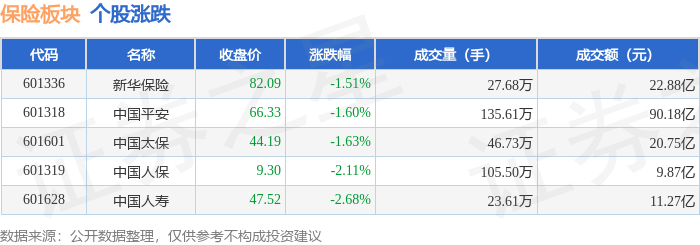
证券之星消息,1月16日保险板块较上一交易日下跌2.1%,中国人寿领跌。当日上证指数报收于 4101.91,下跌0.26%。深证成指报收于14281.08,下跌0.18%。保险板块个股涨跌见下表: | 代码 | 名称 | 收盘价 | 涨跌幅 | 成交量(手) | 成交额(元) | | --- | --- | --- | --- | --- | --- | | 601336 | 新华保险 | 82.09 | -1.51% | 27.68万 | 22.88亿 | | 601318 | 中国平安 | 66.33 | -1.60% | 135.61万 | 90.18亿 | | 601601 | 中国太保 | 44.19 | -1.63% | 46.73万 | 20.75亿 | | 616109 | 中国人保 | 9.30 | -2.11% | 105.50万 | 9.8717 | | 601628 | 中国人寿 | 47.52 | -2.68% | 23.61万 | 11.27 Z | 从资金流向上来看,当日保险板块主力资金净流出5.47亿元,游资资金净流出3.97亿元,散户资金净流入 9.44亿元。保险板块个股资金 ...





ETF主力榜 | 国债政金债ETF(511580)主力资金净流出4.31亿元,居全市场第一梯队-20260116
Xin Lang Cai Jing· 2026-01-16 08:48
Group 1 - The core viewpoint of the article highlights that the government bond ETF (511580.SH) experienced a slight increase of 0.02% on January 16, 2026, despite significant net outflows of main funds [1] - Over the past two days, the fund has seen accelerated outflows totaling 672 million yuan, ranking it among the top tier in the market [1] - The latest trading volume for the fund reached 14.2976 million units, with a total transaction amount of 1.552 billion yuan, indicating that the net outflow of main funds accounted for 27.78% of the transaction amount on that day [1]
保险资管产品打了“翻身仗”:2025年超1500只获正收益,权益类Top20年化突破50%
Hua Xia Shi Bao· 2026-01-16 03:57
Core Insights - The insurance asset management products are expected to perform exceptionally well in 2025, with 90% of the 1,637 products achieving positive returns, totaling 1,500 products [2] - Equity products have shown remarkable performance, with some achieving annualized returns exceeding 90%, such as "ICBC Credit Suisse Cycle Growth No. 1" with a return of 115.37% [2][5] - The average return for equity products reached 24.96%, a significant increase of 16.87 percentage points year-on-year, while fixed income products saw a decline in average returns [5][10] Performance Overview - In 2025, 1,528 out of 1,637 insurance asset management products reported positive returns, representing 93.4% of the total [5] - The overall average return for all products was 8.50%, up by 3.33 percentage points from the previous year, with a median return of 3.47% [5] - Notable equity products include "ICBC Credit Suisse Cycle Growth No. 2" at 76.56%, "Taikang Asset - Cycle Selection" at 69.97%, and several others with returns above 50% [5][6] Market Dynamics - The insurance asset management sector is experiencing a "turnaround" in equity products, outperforming the Shanghai Composite Index's 18% increase [4] - Newer products tend to have higher annualized returns, benefiting from favorable market conditions and timely investment themes [6] - The competition in the insurance asset management industry is expected to intensify in 2026, with the approval of new foreign-funded insurance asset management companies [8] Regulatory Environment - Multiple policies have been introduced to encourage insurance capital to enter the market, including increasing the investment ratio of commercial insurance funds in A-shares [9][10] - The regulatory framework has been optimized to support long-term investments, with pilot programs allowing significant amounts of insurance capital to be allocated [10] - The focus on high-dividend strategies and investments in high-tech, new energy, and advanced manufacturing sectors is anticipated to continue [10]

邹城金融监管支局多维发力,推进普惠保险精准服务见实效
Qi Lu Wan Bao· 2026-01-16 03:22
Core Viewpoint - The focus is on enhancing inclusive financial services in Zoucheng, aiming to improve product innovation, service optimization, and effectiveness to drive economic development and improve livelihoods in the region [1] Group 1: Product Innovation - Customized products are being developed to meet diverse risk needs, such as "Zhu Wei Bao" for small and micro enterprises, providing risk coverage of approximately 26 million yuan [2] - Insurance products like "Ji Hui Bao" and "Employer Anxin Bao" are being promoted to enhance the risk protection system for small businesses [2] - Health insurance products like "Hui Min Bao" are being introduced to cover around 800 individuals, focusing on residents' health [2] - Insurance for local specialty industries, such as coverage for "Zoucheng Mushroom" against intellectual property infringement, has been initiated, providing risk protection of 80,000 yuan [2] - Long-term care insurance for the aging population is being offered, benefiting over 1.08 million people [2] Group 2: Service Optimization - The insurance institutions are optimizing service processes with a focus on cost reduction and efficiency, enhancing customer experience through convenience, intelligence, and efficiency [3] - Simplified insurance application processes and mobile payment options are being implemented to improve service efficiency [3] - A hybrid service model combining online and offline services has been established, achieving 100% online processing of business, significantly reducing application time [3] - Advanced data technology is being utilized to enhance risk identification and warning capabilities [3] - Claims processing has been expedited, with average case resolution time reduced to one day and small claims processed in as little as 24 hours [3] Group 3: Deepening Inclusive Impact - The reach of inclusive insurance services is expanding, with projections indicating that by 2025, over 2,000 small enterprises and 300 individual businesses will be served by Ping An Insurance [4] - Premium income from inclusive insurance is expected to grow by approximately 80% year-on-year for Taiping Insurance by 2025, indicating steady business growth [4] - The inclusive insurance network is extending to cover various demographics, including small business owners, low-income urban residents, and the elderly, while also targeting high-tech enterprises and training institutions [4] - This comprehensive risk protection system is designed to meet the diverse needs of different groups, supporting social stability and promoting high-quality local economic development [4]
ETF融资榜 | 半导体设备ETF 广发(560780)融资净买入633.81万元,居可比基金前2-20260115
Xin Lang Cai Jing· 2026-01-16 02:00
Group 1 - The semiconductor equipment ETF, Guangfa (560780.SH), experienced a rise of 5.38% on January 15, 2026, with a trading volume of 253 million yuan [1] - The fund saw a net inflow of leveraged funds totaling 16.30 million yuan over the past two days, ranking it among the top two comparable funds [1] - The financing buy-in for the ETF amounted to 19.52 million yuan, while financing repayments were 13.18 million yuan, resulting in a net financing buy-in of 6.34 million yuan [1] Group 2 - The ETF has both onshore connection classes: Class A (020639) and Class C (020640) [1]
太保寿险增持上海机场 今年险资首例举牌出现
Zheng Quan Ri Bao· 2026-01-15 22:30
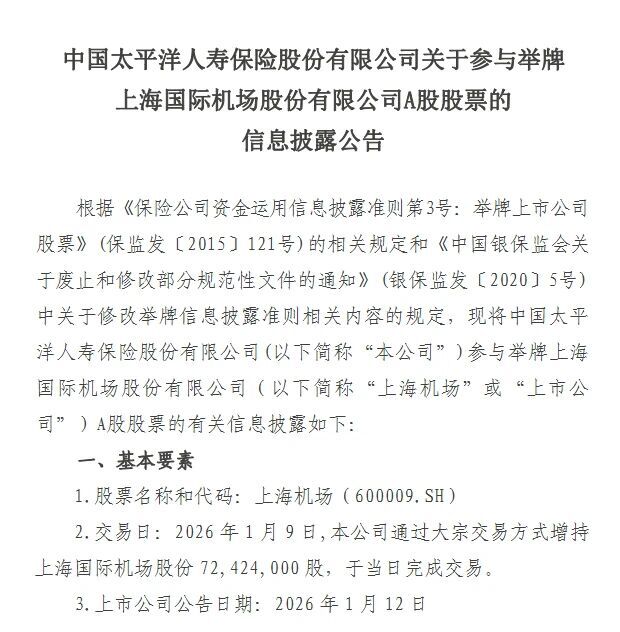
Core Viewpoint - China Pacific Life Insurance Co., Ltd. (CPIC) has increased its stake in Shanghai International Airport Co., Ltd. (Shanghai Airport) by acquiring 72.424 million shares, bringing its total holdings to approximately 124 million shares, which represents 5.00% of the company's A-share capital. This marks the first instance of insurance capital participating in a stake increase in 2024 [1][2]. Group 1: Investment Activity - CPIC's investment in Shanghai Airport is part of its equity investment management strategy, driven by its own investment needs [2]. - The frequency of insurance capital stake increases has been rising, with 20 instances in 2024 and a projected increase to 41 instances in 2025, reaching a near-decade high, second only to the 62 instances recorded in 2015 [2]. Group 2: Reasons for Increased Activity - The rise in stake increases is attributed to three main factors: low interest rates and "asset scarcity," the implementation of new accounting standards, and low market valuations [2]. - Insurance capital is particularly attracted to high-dividend stocks as a means to match long-term liabilities and enhance returns, especially in a low-interest environment [3]. Group 3: Sector Preferences - The sectors favored by insurance capital for stake increases include banking, insurance, renewable energy, infrastructure logistics, and public utilities, with a significant focus on H-shares [3]. - In 2025, 44% of the stake increases were in the banking sector, and over 80% of the targets were H-shares, which often offer higher dividend yields [3]. Group 4: Future Outlook - The demand for stake increases is expected to be categorized into two main types: one focused on stable dividend cash flows and the other on companies with strong return on equity (ROE) and established market positions [4]. - The trend of active stake increases is anticipated to continue, with a shift towards technology and green energy sectors, while maintaining a focus on traditional high-dividend sectors [5].

太保寿险增持上海机场今年险资首例举牌出现
Zheng Quan Ri Bao Zhi Sheng· 2026-01-15 16:34
Core Viewpoint - China Pacific Life Insurance Co., Ltd. (CPIC) has increased its stake in Shanghai International Airport Co., Ltd. (Shanghai Airport) by acquiring 72.424 million shares, bringing its total holdings to approximately 124 million shares, which represents 5.00% of the company's A-share capital. This marks the first instance of insurance capital participating in a stake increase in 2024 [1][2]. Group 1: Investment Activity - CPIC's investment in Shanghai Airport is part of its equity investment management strategy, driven by its own investment needs [2]. - The frequency of insurance capital stake increases has been rising, with 20 instances in 2024 and a projected increase to 41 instances in 2025, marking a near ten-year high [2]. Group 2: Reasons for Increased Activity - The rise in stake increases is attributed to several factors: low interest rates, the implementation of new accounting standards, and low market valuations [2]. - Experts indicate that the low interest rate environment and "asset shortage" pressures have made high-dividend stocks a core choice for insurance capital to match long-term liabilities and enhance returns [2]. Group 3: Target Industries and Preferences - Insurance capital has primarily targeted industries such as banking, insurance, new energy, infrastructure logistics, and public utilities, with a significant focus on H-shares [3]. - In 2025, 44% of the stake increases were in the banking sector, and over 80% of the targets were H-shares, which often have higher dividend yields [3]. Group 4: Future Outlook - The demand for stake increases is expected to be categorized into two main types: one focused on stable dividend cash flows and the other on companies with strong return on equity (ROE) and established market positions [4]. - The active participation of insurance capital in stake increases is anticipated to continue, with a shift towards technology and green energy sectors while maintaining a focus on traditional high-dividend sectors [5].
新年首例!太保寿险举牌上海机场,险资入市马不停蹄
Guo Ji Jin Rong Bao· 2026-01-15 14:13
Core Viewpoint - China Pacific Life Insurance Co., Ltd. (CPIC Life) has increased its stake in Shanghai International Airport Co., Ltd. (Shanghai Airport) to 5.00%, triggering a regulatory notification due to the acquisition of 72.424 million A-shares through block trading [1][4]. Group 1: Investment Details - CPIC Life and its affiliates now hold a total of 124 million A-shares of Shanghai Airport, representing 5.00% of the company's A-share capital, up from 51.9917 million shares (2.09%) prior to the acquisition [1][4]. - The market value of CPIC Life's holdings in Shanghai Airport is approximately 4.067 billion yuan, accounting for 0.15% of CPIC Life's total assets as of Q3 2025 [4][5]. Group 2: Company Background - Shanghai Airport was established in May 1997 and listed on the Shanghai Stock Exchange in February 1998. The company underwent a significant asset restructuring in 2022, unifying the management of its air transport business [5]. - For the first three quarters of 2025, Shanghai Airport reported total revenue of 9.714 billion yuan, a year-on-year increase of 5.69%, and a net profit of 1.634 billion yuan, up 35.98% [5]. Group 3: Industry Trends - The insurance sector has seen a significant increase in equity market participation, with 20 instances of stake acquisitions in 2024 and 36 in 2025, marking a new high since 2016 [6][7]. - Analysts suggest that insurance companies are motivated by two main factors for these acquisitions: stable dividend cash flows and investments in companies with strong return on equity (ROE) and market positions [6][7].
资负共振驱动保险板块估值修复
Huafu Securities· 2026-01-15 10:10
Group 1 - The insurance sector has entered a valuation recovery phase since 2025, with a cumulative increase of 31.31% in the insurance sector, continuing strong momentum into 2026, driven by improved capital market sentiment and rising equity markets, leading to a collective strength in insurance stocks, with major companies like China Ping An reaching multi-year highs [1][7]. - The new individual insurance premium growth for major insurers such as China Life, Ping An, Taikang, and Xinhua has exceeded expectations, with first-day growth rates reaching 40-60%, driven by the "deposit migration" effect, product structure optimization, and the ongoing reinforcement of anti-involution policies in the insurance industry [1][8][16]. Group 2 - Regulatory measures have opened up space for asset-side expansion, with significant potential for increasing equity allocation by insurance funds. The total investment return rate for listed insurance companies has shifted to a range of 5%-6%, with a systematic increase in investment yield driven by regulatory policy collaboration [2][22]. - The insurance sector is expected to benefit from the recovery of the real estate market, with improved financing conditions for property companies and a narrowing of credit risk premiums, enhancing the valuation framework for the insurance sector [2][27]. Group 3 - The recent strong performance of the insurance sector reflects a resonance repair driven by multiple positive factors on both the asset and liability sides. The "deposit migration" trend has brought continuous incremental premiums, while the adjustment of product interest rates has effectively controlled long-term cost pressures [3][27]. - The regulatory adjustments have significantly expanded the equity allocation space for insurance funds, allowing for a more flexible allocation of equity assets and enhancing overall portfolio returns [21][22].