CPIC(601601)

Search documents
中国太保涨2.01%,成交额3.30亿元,主力资金净流入656.38万元
Xin Lang Zheng Quan· 2025-11-25 02:52
Core Viewpoint - China Pacific Insurance (Group) Co., Ltd. has shown a mixed performance in stock price and financial metrics, with a notable increase in net profit year-on-year despite fluctuations in stock price over different time frames [1][2]. Financial Performance - As of September 30, 2025, China Pacific Insurance reported a net profit of 45.7 billion yuan, representing a year-on-year growth of 19.29% [2]. - The company has cumulatively distributed dividends amounting to 119.281 billion yuan since its A-share listing, with 30.015 billion yuan distributed over the past three years [3]. Stock Market Activity - On November 25, the stock price of China Pacific Insurance increased by 2.01%, reaching 34.99 yuan per share, with a trading volume of 330 million yuan and a turnover rate of 0.14% [1]. - The stock has experienced a year-to-date increase of 6.03%, a slight rise of 0.37% over the last five trading days, but a decline of 6.19% over the last 20 days and 15.83% over the last 60 days [1]. Shareholder Information - As of September 30, 2025, the number of shareholders increased by 16.49% to 102,000, while the average circulating shares per person decreased by 14.76% to 69,643 shares [2]. - The top ten circulating shareholders include China Securities Finance Corporation, holding 271 million shares, and Hong Kong Central Clearing Limited, holding 161 million shares, with the latter reducing its holdings by 57.9472 million shares [3]. Business Overview - China Pacific Insurance operates as a comprehensive insurance group, primarily through its subsidiaries, providing life and property insurance products and services [2]. - The revenue composition includes 51.25% from property insurance, 46.78% from life and health insurance, and 0.97% from asset management [2].

多家险企达成今年销售目标 明年开局聚焦分红险
Zheng Quan Ri Bao Zhi Sheng· 2025-11-24 16:36
Core Viewpoint - Multiple insurance companies have achieved or are close to achieving their 2025 sales targets, shifting focus to the 2026 sales kickoff, with a strong emphasis on participating in dividend-type life insurance products [1][2] Group 1: Sales Performance - In the first ten months of this year, New China Life Insurance reported a premium income of approximately 181.97 billion yuan, a year-on-year increase of 17%, while China Pacific Insurance's Pacific Life reported a premium income of about 241.32 billion yuan, up 9.9% year-on-year [2] - Many insurance companies have completed over 95% of their new standard premium sales targets for the year, with sales efforts for 2026 already initiated [2][3] - The cumulative premium income for life insurance companies in the first nine months of this year grew by 10.2% year-on-year, despite a decline in January due to regulatory changes [3] Group 2: Product Trends - The trend towards dividend-type insurance products is evident, with over 40% of new life insurance products being dividend-based, and 44% of newly launched life insurance products being dividend-type [4] - Major insurance companies like Ping An and New China Life have committed to increasing the proportion of dividend-type insurance products in their offerings [4] - The introduction of new insurance products for 2026 is focused on dividend-type whole life insurance and dividend-type annuities, which are expected to drive double-digit growth in new premium income and new business value in the first quarter of 2026 [5] Group 3: Market Environment - The low interest rate environment continues to favor insurance products over traditional savings, as insurance rates remain attractive compared to bank deposit rates [5] - The insurance industry is undergoing a transformation in distribution channels, with a focus on enhancing the quality of individual insurance sales teams and recognizing the growing importance of bank insurance partnerships [5]

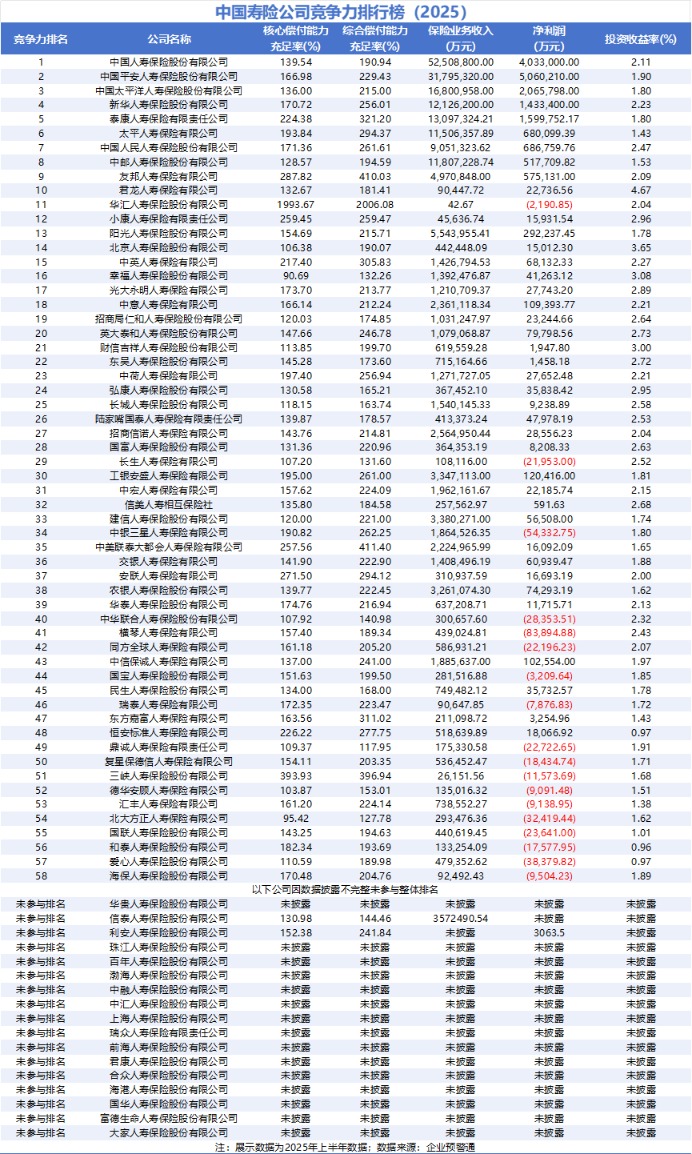
58家寿险公司上半年盈利1763亿元 国寿、平安、太保领跑
2 1 Shi Ji Jing Ji Bao Dao· 2025-11-24 10:37
Core Insights - The report indicates a significant "stronger gets stronger" trend in China's life insurance industry, with the top ten companies accounting for 94.6% of the net profits in the first half of 2025 [1][5] - The top five life insurance companies achieved a combined premium income of 1.25 trillion yuan, showcasing their dominant market position [4][5] Group 1: Industry Overview - The report categorizes life insurance companies into four types: life insurance, property insurance, pension insurance, and health insurance, analyzing their competitiveness based on various dimensions [1] - In the first half of 2025, the life insurance sector's total profit reached 176.31 billion yuan, with 58 companies participating in the competitiveness ranking [1] Group 2: Top Companies Performance - The top five life insurance companies are China Life, Ping An Life, Taiping Life, New China Life, and TaiKang Life, all achieving net profits exceeding 10 billion yuan in the first half of 2025 [2][5] - China Life led with a premium income of 525.09 billion yuan and a net profit of 40.33 billion yuan, maintaining its market leadership [5] - Ping An Life reported a net profit of 50.60 billion yuan, the highest among life insurers [5] Group 3: Financial Metrics - The solvency ratios of the top companies remained robust, with TaiKang Life having a core solvency ratio of 224.38% and a comprehensive solvency ratio of 321.20% [5] - New China Life and Ping An Life also reported comprehensive solvency ratios exceeding 200% [5] Group 4: Investment Performance - New China Life achieved the highest investment return rate of 2.23% among the top five companies, followed by China Life at 2.11% [6] - Overall, the investment returns for the leading companies remained stable within a healthy range [6] Group 5: Market Dynamics - The report highlights a growing divide between large and small insurance companies, with 18 out of 58 companies reporting losses in the first half of 2025 [9] - Companies like Huahui Life, despite high solvency ratios, faced challenges due to low business income, indicating a need for operational revitalization [9] Group 6: Regulatory Impact - The insurance industry is transitioning from scale expansion to value creation, driven by regulatory changes such as the introduction of a dynamic adjustment mechanism for premium rates linked to market rates [10] - The report emphasizes that leading companies are focusing on cost control and risk management to adapt to the evolving market landscape [10]



保险业竞争力报告:老三家地位稳固 融通等凭专业化进十强
2 1 Shi Ji Jing Ji Bao Dao· 2025-11-24 10:35
Core Insights - The report indicates a clear trend in the Chinese property insurance industry shifting from scale-driven growth to efficiency-oriented development since 2024, entering a phase of high-quality growth [1][6] - The profitability of leading companies is increasing, while smaller insurers are facing significant challenges, with nearly half of the companies reporting underwriting losses [1][6] Group 1: Industry Overview - The "2025 China Insurance Industry Competitiveness Research Report" highlights that 40 out of 82 participating property insurance companies had a comprehensive cost ratio exceeding 100% in the first half of 2025, indicating that nearly half are operating at a loss [1][6] - The top three companies, People's Insurance Company of China (PIC), Ping An Property & Casualty Insurance, and China Pacific Insurance, collectively accounted for approximately 77% of the industry's total profit, reinforcing the "stronger getting stronger" competitive landscape [1][2] Group 2: Company Rankings - PIC ranked first with a core solvency adequacy ratio of 213.16%, total insurance revenue of 3,240.16 billion yuan, and a net profit of 243.76 billion yuan in the first half of 2025 [2][3] - Ping An ranked second with a core solvency adequacy ratio of 179.60%, total insurance revenue of 1,720.61 billion yuan, and a net profit of 103.66 billion yuan [2][3] - China Pacific Insurance ranked third with a core solvency adequacy ratio of 195.80%, total insurance revenue of 1,138.29 billion yuan, and a net profit of 57.33 billion yuan [3] Group 3: Emerging Competitors - Companies such as Jiulong Insurance, China Railway Property Insurance, and Dinghe Insurance have entered the top ten by focusing on specialized and niche markets [4][5] - These specialized companies generally have solvency ratios above the industry average, indicating a unique competitive advantage [5] Group 4: Challenges and Policy Environment - The report notes that the property insurance industry is facing challenges such as high claims costs from new energy vehicle insurance and natural disasters, which are pressuring the comprehensive cost ratios of many companies [6][8] - Regulatory measures introduced since 2024 aim to promote high-quality development and mitigate inefficient competition within the industry [7][8]
宁德监管分局同意太保寿险福建分公司宁德中心支公司霞浦营销服务部营业场所变更
Jin Tou Wang· 2025-11-24 09:15
Group 1 - The National Financial Supervision Administration of Ningde approved the request for the change of business location for China Pacific Life Insurance Co., Ltd. Fujian Branch's Ningde Central Sub-branch Xia Pu Marketing Service Department [1] - The new business location is specified as Room A501, Southwest Side, No. 8 Changxi Road, Jiulong Commercial Street, Dongxing Community, Songgang Street, Xiapu County, Fujian Province [1] - The company is required to handle the change and obtain the new license in accordance with relevant regulations [1]
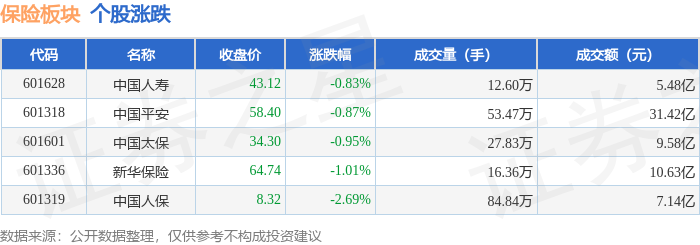
保险板块11月24日跌1.12%,中国人保领跌,主力资金净流出1.62亿元
Zheng Xing Xing Ye Ri Bao· 2025-11-24 09:12
| 代码 | 名称 | 主力净流入(元) | 主力净占比 游资净流入 (元) | | 游资净占比 散户净流入 (元) | | 散户净占比 | | --- | --- | --- | --- | --- | --- | --- | --- | | 601318 中国平安 | | = 170.25万 | 0.05% | -8620.72万 | -2.74% | 8450.47万 | 2.69% | | 601628 中国人寿 | | -1301.28万 | -2.37% | 2832.46万 | 5.17% | -1531.18万 | -2.79% | | 601319 中国人保 | | -3669.59万 | -5.14% | 1798.55万 | 2.52% | 1871.03万 | 2.62% | | 601601 中国太保 | | -4434.85万 | -4.63% | 6462.75万 | 6.74% | -2027.91万 | -2.12% | | 601336 新华保险 | | -6998.32万 | -6.58% | 7.75万 | 0.01% | 6990.57万 | 6.57% | 以上内容 ...

保险行业周报(20251117-20251121):报行合一再深化,《人身险产品费用分摊指引》出炉-20251123
Huachuang Securities· 2025-11-23 09:45
Investment Rating - The report maintains a "Recommendation" rating for the insurance industry, expecting the industry index to outperform the benchmark index by over 5% in the next 3-6 months [21]. Core Insights - The insurance index fell by 3.06% this week, outperforming the broader market by 0.71 percentage points. Major insurance stocks experienced declines, with notable drops from Sunshine Insurance (-4.8%) and China Pacific Insurance (-4.57%) [1]. - The China Actuarial Society released the "Guidelines for Expense Allocation of Life Insurance Products," which aims to enhance the scientific management of expenses within insurance companies and supports the implementation of the "reporting and operation integration" policy [2][4]. - As of the end of 2024, 34 insurance asset management companies managed a total of CNY 33.30 trillion, reflecting a year-on-year growth of 10.60% [2]. - The report highlights that 172 insurance companies have disclosed their solvency data for Q3 2025, with 14 achieving an AAA risk rating, while 4 companies fell below solvency standards [2]. Summary by Sections Market Performance - The insurance sector's performance was characterized by a 3.06% decline in the insurance index, with individual stocks like China Life and Ping An also showing significant decreases [1]. Regulatory Developments - The newly released guidelines categorize life insurance business expenses into variable and fixed costs, specifying which expenses should not be allocated and providing methods for expense allocation [4]. Financial Data - The total market capitalization of the insurance sector is CNY 32,109.56 billion, with a circulating market value of CNY 22,103.29 billion [6]. Valuation Metrics - The report provides PEV valuations for major life insurance companies, with China Life at 0.83x and Ping An at 0.71x [5]. - For property insurance, the PB valuations are noted, with China Re at 0.58x and PICC at 1.2x [10]. Investment Recommendations - Short-term recommendations focus on companies with performance elasticity, suggesting investments in New China Life, China Property & Casualty, and China Life. Long-term recommendations include China Pacific Insurance and China Ping An based on fundamental and valuation considerations [10].
机器人闯祸了怎么办?保险公司密集研发具身智能保险
Di Yi Cai Jing· 2025-11-23 05:53
Core Insights - The rapid development of artificial intelligence and embodied intelligence technologies is leading to the commercialization of humanoid robots, but concerns about risks such as "not daring to use, fear of damage, and inability to afford" are bottlenecks for large-scale implementation [1][2] - Major domestic property insurance companies in China, including Ping An, Taikang, and PICC, have launched specialized insurance products for embodied intelligence to address these commercialization challenges [1][5] Industry Overview - Humanoid robots, integrating advanced technologies like AI and high-end manufacturing, are becoming a new frontier in technology competition, with the domestic market expected to reach 1.25 trillion yuan by 2027 [2] - These robots can fill labor gaps across various sectors, including industrial applications like welding and assembly, as well as service scenarios such as elderly care and massage [2] Risk Landscape - The market promotion and use of humanoid robots raise significant safety concerns, with users particularly focused on the risks of damage to the robots themselves and potential harm to people or property in their vicinity [3] - The lack of comprehensive international or industry standards for AI and embodied intelligence technologies poses compatibility and safety risks for products [3][4] Insurance Innovations - Since September, leading insurance companies have been actively launching insurance products related to embodied intelligence [5] - China Pacific Insurance has introduced a specialized product called "Smart Insurance," which offers comprehensive risk coverage across the entire supply chain, integrating various types of protection [6] - PICC has launched a comprehensive insurance product for embodied intelligence, covering both the robot's physical damage and third-party liability, addressing various scenarios including natural disasters and operational failures [6] - Ping An has developed a comprehensive financial solution for embodied intelligence enterprises, providing extensive risk coverage and support across multiple sectors [7]

【中国经济新看点】保险业服务全链条科技创新
Jing Ji Ri Bao· 2025-11-21 22:53
Group 1: Market Growth and Support - The technology insurance market in China has been experiencing rapid growth, supported by increasing policy backing and a richer product system, providing substantial risk protection for technological innovation [1] - During the "14th Five-Year Plan" period, technology insurance has provided cumulative risk protection exceeding 10 trillion yuan, with 3,600 projects supported for innovative applications [1] Group 2: Policy Support and Product Innovation - China Pacific Insurance has launched a dedicated insurance product called "Smart Insurance" for humanoid robots, addressing the risk protection needs associated with their commercialization [2] - Various provinces have introduced technology insurance policies, such as Beijing's subsidy for insurance premiums on major technological equipment, covering 80% of the premium costs up to 2 million yuan per enterprise annually [3] - The Ministry of Science and Technology and other departments have issued policies to enhance the technology finance system, emphasizing the importance of technology insurance in supporting innovation [3] Group 3: Reinsurance Functionality - Reinsurance serves as an effective risk management tool, providing support for major technology projects and facilitating international market interaction [4] - Reinsurance companies enhance risk protection for technological innovation by offering technical support and underwriting capacity, helping to mitigate and transfer risks [4] Group 4: Challenges and Future Directions - The technology insurance sector faces challenges such as inadequate risk protection capabilities and a lack of innovative products tailored to specific enterprise needs [7] - There is a need for improved risk pricing support and the development of mature pricing models to better assess risks associated with technology insurance [7] - Future efforts should focus on optimizing technology risk management models, enhancing insurance product innovation for strategic emerging industries, and building an information-sharing platform among government, technology enterprises, and insurance companies [8]

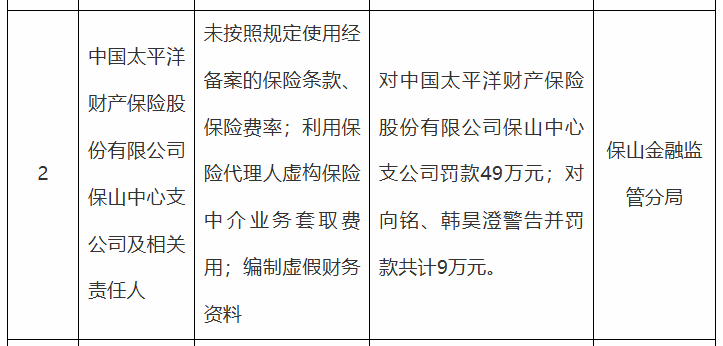
太平洋产险保山中支被罚49万元
Sou Hu Cai Jing· 2025-11-21 18:14
同时,保山金融监管分局对相关责任人向铭、韩昊澄警告并罚款共计9万元。 | | 中国太平洋 | 未按照规定使用经 备案的保险条款、 | 对中国太平洋财产保险 | | | --- | --- | --- | --- | --- | | | 财产保险股 份有限公司 | 保险费率;利用保 | 股份有限公司保山中心 | 保山金融监 | | 2 | | 险代理人虚构保险 | 支公司罚款49万元;对 | | | | 保山中心支 | 中介业务套取费 | 向铭、韩昊澄警告并罚 | 管分局 | | | 公司及相关 责任人 | 用:编制虚假财务 | 款共计9万元。 | | | | | 资料 | | | 责编:王时丹 | 审核:李震 | 监审:古筝 【大河财立方消息】11月21日,保山金融监管分局披露的行政处罚信息公示列表显示,中国太平洋财产 保险股份有限公司保山中心支公司被罚49万元。 主要违法违规行为包括:未按照规定使用经备案的保险条款、保险费率;利用保险代理人虚构保险中介 业务套取费用;编制虚假财务资料。 ...