
CPIC(601601)

Search documents
中国太保:公司始终重视对投资者的合理回报
Zheng Quan Ri Bao Wang· 2025-11-26 13:42
证券日报网讯中国太保(601601)11月26日在互动平台回答投资者提问时表示,公司已完成的2024年度 现金分红为每股1.08元,较上年度增长5.9%。公司始终重视对投资者的合理回报,重视中小投资者权益 保护,坚持以高质量发展为目标,努力为投资者创造长期可持续的价值。 ...

分红型重疾险“杀”了个回马枪?平安、太保、新华表示跟进
Xin Lang Cai Jing· 2025-11-26 09:44
Core Viewpoint - The introduction of dividend-type critical illness insurance in China is being pursued by major insurance companies like Ping An, China Pacific Insurance, and New China Life, following the regulatory approval that allows such products after a 22-year ban [1][3]. Group 1: Regulatory Changes and Market Context - The National Financial Regulatory Administration's guidelines effective from October 2025 will enable insurance companies with good ratings to offer dividend-type long-term health insurance, marking the official "unbanning" of these products [1]. - The previous ban in 2003 was due to concerns that some insurers were misusing dividend-type critical illness insurance as pure financial products, straying from their intended purpose of health coverage [1][2]. Group 2: Market Demand and Product Development - The traditional critical illness insurance market has seen a decline in new premiums for five consecutive years, as consumers seek products that combine coverage with wealth management features [2]. - The low interest rate environment has diminished the appeal of fixed-income insurance products, making dividend-type insurance with variable returns more attractive [2]. Group 3: Industry Response and Strategic Focus - Major insurers are actively preparing to launch dividend-type critical illness insurance, with Ping An and China Pacific Insurance confirming their commitment to follow regulatory developments closely [3]. - The health insurance market is expanding, with leading insurers integrating health management into their broader strategic frameworks, such as China Pacific's "352 Health Service Blueprint" and Ping An's focus on "comprehensive finance + medical health" [3][4]. Group 4: Company Initiatives and Health Management - Companies like Ping An, China Pacific, and New China Life have established specialized health insurance and management companies, indicating a significant investment in health-related services [4]. - The establishment of health management companies by major insurers reflects a strategic shift towards enhancing health insurance offerings in response to regulatory changes [4].

保险板块11月26日跌0.56%,中国人保领跌,主力资金净流出1.98亿元
Zheng Xing Xing Ye Ri Bao· 2025-11-26 09:05
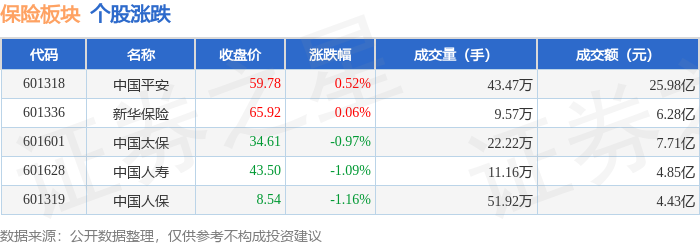
Core Viewpoint - The insurance sector experienced a decline of 0.56% on November 26, with China Life Insurance leading the losses, while the overall market showed mixed results with the Shanghai Composite Index down by 0.15% and the Shenzhen Component Index up by 1.02% [1] Summary by Category Market Performance - The Shanghai Composite Index closed at 3864.18, down 0.15% - The Shenzhen Component Index closed at 12907.83, up 1.02% [1] Insurance Sector Performance - The insurance sector saw a net outflow of 198 million yuan from main funds, while retail funds experienced a net inflow of 266 million yuan [1] - Individual stock performances included: - China Ping An (601318) closed at 59.78, up 0.52% with a trading volume of 434,700 shares and a transaction value of 2.598 billion yuan - New China Life Insurance (601336) closed at 65.92, up 0.06% with a trading volume of 95,700 shares and a transaction value of 628 million yuan - China Pacific Insurance (601601) closed at 34.61, down 0.97% with a trading volume of 222,200 shares and a transaction value of 771 million yuan - China Life Insurance (601628) closed at 43.50, down 1.09% with a trading volume of 111,600 shares and a transaction value of 485 million yuan - China Reinsurance (601319) closed at 8.54, down 1.16% with a trading volume of 519,200 shares and a transaction value of 443 million yuan [1] Fund Flow Analysis - The fund flow analysis for individual stocks showed: - China Pacific Insurance had a main fund net inflow of 29.7664 million yuan, with a retail net outflow of 20.0910 million yuan - New China Life Insurance had a main fund net inflow of 19.6665 million yuan, with a retail net outflow of 26.0477 million yuan - China Reinsurance had a main fund net outflow of 16.4563 million yuan, with a retail net inflow of 14.2729 million yuan - China Life Insurance had a main fund net outflow of 60.9273 million yuan, with a retail net inflow of 38.4305 million yuan - China Ping An had a main fund net outflow of 170.1 million yuan, with a retail net outflow of 74.5134 million yuan [2]





石河子金融监管分局同意太平洋产险石河子中心支公司变更营业场所
Jin Tou Wang· 2025-11-26 04:22
Core Viewpoint - The approval for the relocation of China Pacific Property Insurance Co., Ltd.'s Shihezi branch has been granted by the Shihezi Financial Regulatory Bureau, indicating a strategic move to a new operational location [1] Group 1 - The new business address for China Pacific Property Insurance Co., Ltd.'s Shihezi branch is specified as No. 50, Tianshan Road, 15-2 and 15-3, East City Street, Shihezi City, Xinjiang [1] - The company is required to complete the necessary procedures for the change and obtain a new license in accordance with relevant regulations [1]

新启航再出发!中国太保产险为“零碳进博 绿色办博”注入新内涵
Qi Lu Wan Bao· 2025-11-26 04:07
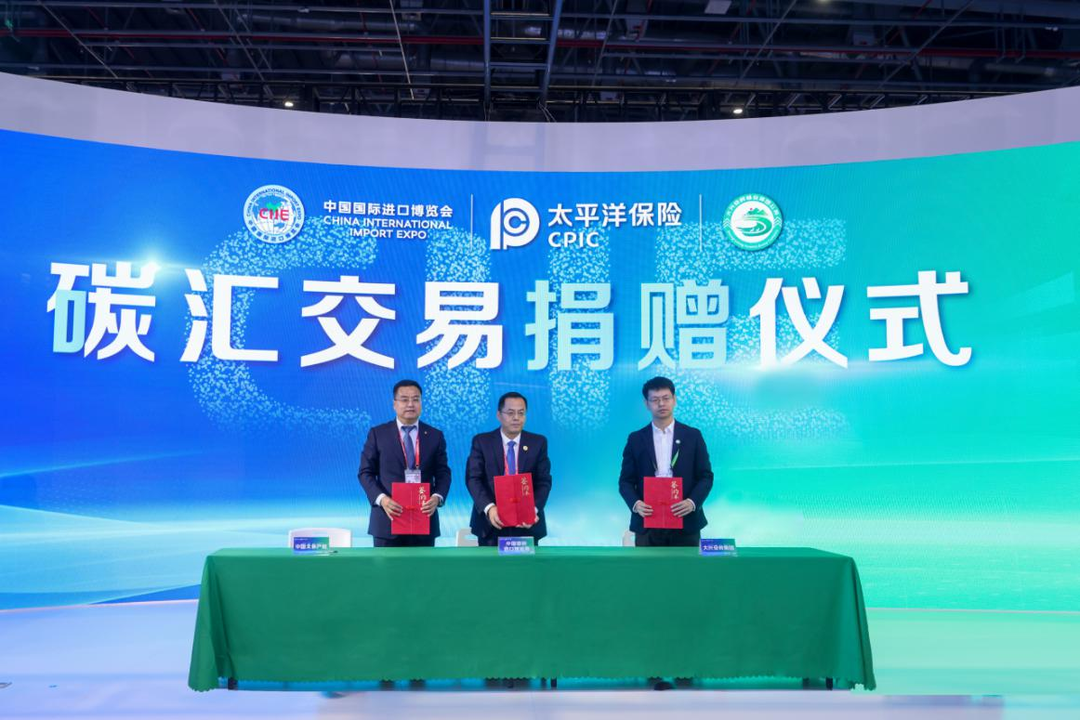
Core Viewpoint - China Pacific Insurance (601601) is actively participating in sustainable development initiatives, showcasing its commitment to ecological conservation and green development through its involvement in the China International Import Expo [5]. Group 1: Event Overview - On November 6, China Pacific Insurance's subsidiary, China Pacific Property Insurance, held a themed event titled "Zero Carbon Import Expo Green Hosting" at the National Exhibition and Convention Center in Shanghai [1]. - The event was attended by officials from the China International Import Expo Bureau and Daxing'anling Forestry Group, highlighting collaboration among various stakeholders [1]. Group 2: Carbon Neutrality Initiatives - During the event, a carbon credit donation ceremony was held, where China Pacific Property Insurance purchased and donated approximately 8,000 acres of forest land and 640,000 trees from Daxing'anling, along with carbon credits from Shanghai's carbon reduction initiatives [3]. - This initiative supports the goal of achieving a "zero carbon" Import Expo and aligns with national strategies for rural revitalization and ecological protection [3]. Group 3: Strategic Implications - The Import Expo serves as a significant national platform for showcasing China's commitment to green development, and the activities conducted by China Pacific Insurance reflect its proactive approach to sustainable development [5]. - The company's efforts are positioned as a model for integrating insurance mechanisms with ecological protection and green development, contributing to a harmonious coexistence between humans and nature [3][5].
国投期货打造生猪“保险+期货”滑县样本
Zheng Quan Ri Bao Wang· 2025-11-25 11:42
本报讯 (记者王宁)近日,随着大连商品交易所"农民收入保障计划"生猪"保险+期货"项目推介会圆满 落幕,由国投期货联合民生银行北京分行、中国太平洋产险河南分公司共同推动的金融助农"滑县模 式"第一期项目已正式完结。该项目在生猪价格深度回调的行业困境中,实现总赔付84.04万元,赔付率 达373.61%,为当地养殖产业筑起一道坚实的风险屏障。 国投期货"保险+期货"业务负责人曹亚表示,该项目既是期货服务实体经济的生动注脚,更是金融赋能 乡村振兴的创新实践。未来国投期货将持续深化与政府、交易所及金融机构的战略合作,以专业能力为 产业高质量发展注入金融动能。 "'保险+期货'不是终点,而是新征程的起点。"滑县人民政府副县长徐继峰表示,县政府牵头积极探 索,联合金融机构借助"保险+期货"风险管理新模式,持续完善补贴机制,优化财政资金使用效率,让 更多中小养殖户享受到政策红利。希望大商所、期货公司、保险公司聚焦生猪产业所需、聚焦群众所 盼,科学指导项目稳步有序推进,切实为滑县生猪养殖插上金融的翅膀。 为此,国投期货联合民生银行北京分行启动专项帮扶,依托"保险+期货"这一成熟金融工具,为滑县量 身定制风险管理方案。国投期 ...

人形机器人如何“放心用”?头部险企接连推专属产品,尚需跨越三大核心障碍
Mei Ri Jing Ji Xin Wen· 2025-11-25 11:08
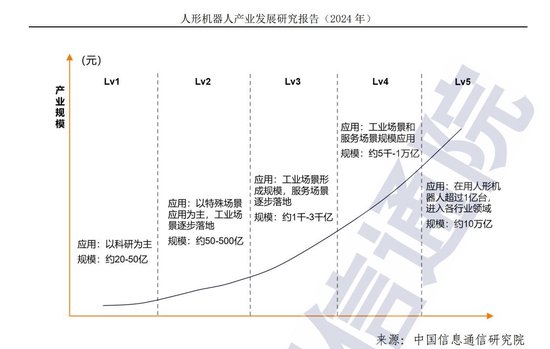
Core Viewpoint - The rapid advancement of artificial intelligence has led to a pressing need for humanoid robots, which are transitioning from laboratory demonstrations to commercial applications, indicating a new phase in industry development [1][3]. Industry Overview - The humanoid robot market in China is projected to reach a scale of 100 billion RMB by 2035, driven by applications in manufacturing, social services, and special operations [1][9]. - The insurance industry is responding to the emerging risks associated with humanoid robots by developing specialized insurance products to cover various dimensions such as property loss, third-party liability, cybersecurity, and data breaches [1][2]. Insurance Product Development - Major insurance companies like China Pacific Insurance and People’s Insurance Company of China have launched dedicated insurance products for humanoid robots, addressing risks from operational failures to third-party injuries [3][4]. - The "Smart Insurance" product by China Pacific Insurance offers integrated coverage for property loss, third-party liability, and flexible policy durations tailored to various commercial scenarios [3][4]. Risk Management Challenges - The application of humanoid robots faces significant challenges, including safety risks, property damage, and liability issues, which are critical for scaling their use [5][7]. - The complexity of humanoid robots, which integrate mechanical, electronic, and AI components, leads to multifaceted risks that traditional insurance products may not adequately cover [8][12]. Market Potential and Support - The humanoid robot market is expected to expand significantly, with projections indicating a market size of 1 trillion to 3 trillion RMB by 2040, and over 100 million humanoid robots in use by 2045 [9][11]. - Government initiatives are increasingly supporting the humanoid robot industry, including financial incentives for insurance premiums to encourage innovation and adoption [13][12]. Ethical and Regulatory Considerations - The industry faces ethical challenges and a lack of unified standards, complicating the insurance landscape and raising questions about liability in cases of malfunction or harm caused by humanoid robots [15][16]. - The need for new insurance products that address algorithmic responsibility and system failures is highlighted, along with the importance of establishing a risk database for accurate pricing [16][14].

机器人险会和车险一样普及吗?
机器人大讲堂· 2025-11-25 09:18
Group 1 - Figure AI's former product safety chief Robert Grendel has filed a lawsuit claiming that the company's humanoid robots could cause skull fractures and alleges he was fired for raising safety concerns [1] - Grendel warned CEO Brett Adcock and chief engineer Kyle Edelberg about the robots' deadly performance, highlighting an incident where a robot caused a quarter-inch crack on a steel refrigerator door [1] - After submitting documented safety complaints, Grendel was terminated in September, claiming he was asked to prepare a safety roadmap for potential investors, which was later abandoned [1] Group 2 - The emergence of humanoid robots in crowded public events raises significant safety risks due to the lack of comprehensive international or industry standards, leading to compatibility and safety issues [3] - An incident at the 2025 World Humanoid Robot Games involved a robot colliding with an engineer, emphasizing the risks associated with humanoid robots [3] - The insurance industry faces challenges in providing risk coverage for robot companies, including complex risk assessments due to rapid technological advancements and the dynamic nature of risk characteristics [3][4] Group 3 - The lack of long-term risk data in the emerging field of robot insurance complicates accurate risk assessment and premium pricing, as traditional actuarial models are not directly applicable [6] - Insurers are developing innovative financial products to mitigate risks in the robot industry, with major companies like Ping An and China Pacific Insurance launching specialized insurance products for humanoid robots [6][7] - The insurance products available include property insurance, machinery damage insurance, third-party liability insurance, and cybersecurity insurance, aimed at covering various risks associated with robot operations [7] Group 4 - The first breakthrough in robot insurance occurred in early 2022 with the launch of the "Mobile Robot Quality Liability Insurance" by PICC, addressing various product quality issues [8] - In 2023, a pilot project in Changzhou provided insurance for local robot companies, demonstrating regional support for the robot insurance market [8] - By 2025, the insurance industry is transitioning from policy formulation to implementation, with various events and initiatives promoting insurance coverage for robots [10] Group 5 - Local governments are responding to the need for robot insurance, with policies in cities like Ningbo and Hainan promoting the development of humanoid robot application insurance [10][11] - Insurance products are being tailored to cover risks from design defects, operational failures, and cyberattacks, with a focus on third-party liability [11][12] - New insurance offerings include specialized products for exoskeleton robots and smart agricultural robots, indicating a growing market for tailored insurance solutions [12][14] Group 6 - The insurance industry views robot insurance as a means to provide comprehensive risk coverage across the entire lifecycle of humanoid robots, addressing various operational scenarios [15][16] - Insurers are adapting their pricing and claims processes based on accumulated data from existing industrial robots, but face challenges due to the rapid evolution of humanoid robots and the lack of historical data [16]

保险板块11月25日涨2.17%,中国人保领涨,主力资金净流入1.48亿元
Zheng Xing Xing Ye Ri Bao· 2025-11-25 09:09
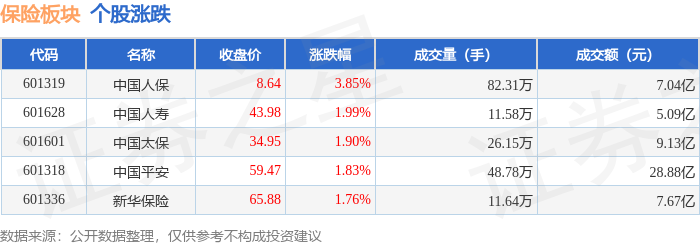
Core Insights - The insurance sector experienced a rise of 2.17% on November 25, with China Pacific Insurance leading the gains [1] - The Shanghai Composite Index closed at 3870.02, up 0.87%, while the Shenzhen Component Index closed at 12777.31, up 1.53% [1] Insurance Sector Performance - China Life Insurance closed at 43.98, up 1.99%, with a trading volume of 115,800 shares and a transaction value of 509 million [1] - China Pacific Insurance closed at 34.95, up 1.90%, with a trading volume of 261,500 shares and a transaction value of 913 million [1] - Ping An Insurance closed at 59.47, up 1.83%, with a trading volume of 487,800 shares and a transaction value of 2.8887 billion [1] - New China Life Insurance closed at 65.88, up 1.76%, with a trading volume of 116,400 shares and a transaction value of 767.1 million [1] Fund Flow Analysis - The insurance sector saw a net inflow of 148 million from institutional investors, while retail investors experienced a net inflow of 40.68 million [1] - Major stocks like Ping An Insurance had a net inflow of 114 million from institutional investors but a net outflow of 54.29 million from retail investors [2] - China Life Insurance had a net inflow of 39.99 million from institutional investors, with retail investors showing a net outflow of 18.06 million [2]
黄南金融监管分局同意太平洋产险青海分公司黄南支公司变更营业场所
Jin Tou Wang· 2025-11-25 09:04
二、中国太平洋财产保险股份有限公司青海分公司黄南支公司应按照有关规定及时办理变更及许可证换 领事宜。 一、同意中国太平洋财产保险股份有限公司青海分公司黄南支公司将营业场所变更为:青海省黄南藏族 自治州同仁市隆务镇迎宾大道西侧(气象局附近)。 2025年11月18日,黄南金融监管分局发布批复称,《中国太平洋财产保险股份有限公司青海分公司关于 中国太平洋财产保险股份有限公司黄南支公司变更营业场所的请示》(青太保产〔2025〕178号)收 悉。经审核,现批复如下: ...