CPIC(601601)

Search documents
招商仁和人寿新任董事长获批;储蓄国债(电子式)纳入个人养老金产品范围 | 慧保日报11.21
Sou Hu Cai Jing· 2025-11-21 14:36
Group 1: Policy Changes - The Ministry of Finance and the Central Bank announced that electronic savings bonds will be included in the personal pension product range starting from June 2026 [1] - Pension fund institutions will need to open dedicated accounts for pension investors linked to pension fund accounts, with quarterly adjustments to the exclusive allocation ratio based on the proportion of uninvested amounts [1] Group 2: Regulatory Developments - The Ministry of Civil Affairs and the National Financial Regulatory Administration issued guidelines to strengthen and standardize the prepayment supervision of pension institutions, requiring them to open a dedicated deposit account with a bank from a published list [2] - The guidelines stipulate that funds collected must be transferred to the dedicated account promptly, and any unusual fund movements must be reported [2] Group 3: Industry Innovations - The Shenzhen Financial Regulatory Bureau and other departments released a plan to enhance innovation in financial products related to intellectual property insurance and credit guarantees, aiming to create a financial ecosystem for intellectual property in the Shenzhen-Hong Kong region [4] Group 4: Leadership Changes - Huang Zhiwei was approved to serve as the chairman of China Merchants Renhe Life Insurance, bringing extensive experience from various leadership roles in the insurance sector [6] - Li Chaohui stepped down as the general manager of Taikang Online due to age, with Fang Yuanjin appointed as the interim head [7][8] - Zhang Yaohui was approved as the deputy general manager of Zhonghui Mutual Insurance, while Jean-Paul Welf Cyr was appointed as the deputy general manager of Lloyd's Insurance (China) [9][10] Group 5: Financial Transactions - Zhongcai Property Insurance received approval to issue 4 billion yuan in capital supplementary bonds in the interbank bond market [13] - A 6.5% stake in Dinghe Property Insurance is set to be transferred from Southern Power Grid Finance Company to Southern Power Grid Industrial and Financial Holdings [12]
电厂 | 保险巨头迎来黄金周期 但如何才能进入“黄金时代”
Xin Lang Cai Jing· 2025-11-21 11:17
Core Insights - The insurance giants in China are experiencing a significant upturn, driven by a recovery in the capital markets and stable growth in the new business value of life insurance [1][4][10] - The combined revenue of the five major insurance companies reached 2.37 trillion yuan, with a net profit of 426.04 billion yuan in the first three quarters, indicating a revenue growth of 13.6% and a net profit growth of 33.54% [1][4] - The net profit growth in Q3 alone was remarkable, with an increase of 68.34%, surpassing market expectations [1][4] Revenue and Profit Growth - The five major insurance companies reported the following revenues for the first three quarters: China Ping An (832.94 billion yuan), China Life (537.895 billion yuan), China Pacific Insurance (344.904 billion yuan), China Property & Casualty Insurance (520.99 billion yuan), and New China Life (137.252 billion yuan) [4] - The corresponding profit figures were: China Ping An (132.856 billion yuan), China Life (167.804 billion yuan), China Property & Casualty Insurance (46.822 billion yuan), China Pacific Insurance (45.7 billion yuan), and New China Life (32.857 billion yuan) [4] - The net profit growth rates were significantly higher than revenue growth, with China Life and New China Life showing around 60% growth [4][7] Business Value and Channel Quality - The new business value for the five major insurance companies saw substantial increases, with China Life up 41.8%, Ping An Life and Health up 46.2%, and China Property & Casualty Insurance up 76.6% [7] - The improvement in channel quality and the growth of new business value were identified as key drivers for the profit increases [4][7] - The insurance giants are focusing on channel transformation, enhancing productivity, and developing bancassurance channels to boost new business value [4][6] Investment Performance - The total investment income for the five major insurance companies reached 887.5 billion yuan, a year-on-year increase of 35.64% [11] - The investment asset scale reached 20.26 trillion yuan, with significant growth in stock investments, which increased by 36.2% [11][13] - The companies are benefiting from a favorable capital market environment, which has strengthened their financial foundations [11][13] Cost Efficiency and Operational Improvements - The insurance sector has made notable progress in cost reduction and efficiency improvements, with life insurance companies reducing costs by 350 billion yuan since 2024 [14][15] - Companies are leveraging technology, such as AI, to enhance operational efficiency and reduce costs [15] - The overall industry is witnessing a shift towards more reliable and stable operations, driven by the reforms initiated by the major players [18] Industry Outlook - The insurance industry is entering a new growth phase, with the potential for high-quality development contingent on continuous internal improvements and reforms [18] - While the major companies are thriving, some smaller firms are struggling, indicating a polarization within the industry [16][18] - The overall health and standardization of the industry are expected to improve as the major companies lead the way in reforms and operational excellence [18]





保险板块11月21日跌2.39%,新华保险领跌,主力资金净流出8.56亿元
Zheng Xing Xing Ye Ri Bao· 2025-11-21 09:33
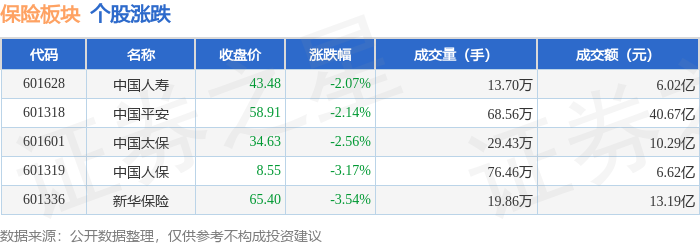
Core Points - The insurance sector experienced a decline of 2.39% on November 21, with Xinhua Insurance leading the drop [1] - The Shanghai Composite Index closed at 3834.89, down 2.45%, while the Shenzhen Component Index closed at 12538.07, down 3.41% [1] Insurance Sector Performance - China Life (601628) closed at 43.48, down 2.07% with a trading volume of 137,000 shares and a turnover of 602 million yuan [1] - Ping An Insurance (601318) closed at 58.91, down 2.14% with a trading volume of 685,600 shares [1] - China Pacific Insurance (601601) closed at 34.63, down 2.56% with a trading volume of 294,300 shares and a turnover of 1.029 billion yuan [1] - China Reinsurance (601319) closed at 8.55, down 3.17% with a trading volume of 764,600 shares and a turnover of 662 million yuan [1] - Xinhua Insurance (601336) closed at 65.40, down 3.54% with a trading volume of 198,600 shares and a turnover of 1.319 billion yuan [1] Capital Flow Analysis - The insurance sector saw a net outflow of 856 million yuan from institutional investors, while retail investors had a net inflow of 733 million yuan [1] - The detailed capital flow for individual stocks shows that China Reinsurance had a net outflow of 51.58 million yuan from institutional investors [2] - China Life experienced a net outflow of 52.08 million yuan from institutional investors, while retail investors contributed a net inflow of 64.48 million yuan [2] - China Pacific Insurance had a net outflow of 56.32 million yuan from institutional investors, with retail investors contributing a net inflow of 85.31 million yuan [2] - Xinhua Insurance faced a significant net outflow of 258 million yuan from institutional investors, while retail investors had a net inflow of 185 million yuan [2] - Ping An Insurance had a net outflow of 43.91 million yuan from institutional investors, with retail investors contributing a net inflow of 35.8 million yuan [2]

中国太保:选举周丽赟为职工董事
Zhi Tong Cai Jing· 2025-11-21 09:31
Core Viewpoint - China Pacific Insurance (Group) Co., Ltd. has elected Ms. Zhou Liyun as the employee director of the 10th Board of Directors during a recent employee representative meeting, with her term starting upon approval from the National Financial Regulatory Administration [1] Group 1 - The election of Ms. Zhou Liyun marks a significant governance change within the company [1] - Ms. Zhou's term will last until the 10th Board of Directors concludes, pending necessary regulatory approvals [1]
中国太保(02601):选举周丽赟为职工董事
智通财经网· 2025-11-21 09:29
智通财经APP讯,中国太保(02601)发布公告,公司于近期召开职工代表大会,选举周丽赟女士为公司第 十届董事会职工董事,其任期自公司于2025年第一次临时股东大会审议通过的《中国太平洋保险(集团) 股份有限公司章程》获国家金融监督管理总局核准及其董事任职资格获国家金融监督管理总局核准之日 起至第十届董事会届满。 ...
中国太保(02601.HK):选举周丽贇为职工董事
Ge Long Hui· 2025-11-21 09:28
格隆汇11月21日丨中国太保(02601.HK)宣布,公司于近期召开职工代表大会,选举周丽贇为公司第十届 董事会职工董事,其任期自公司于2025年第一次临时股东大会审议通过的《中国太平洋保险(集团)股 份有限公司章程》获国家金融监督管理总局核准及其董事任职资格获国家金融监督管理总局核准之日起 至第十届董事会届满。 ...
中国太保(02601) - 选举职工董事
2025-11-21 09:20
香港交易及結算所有限公司及香港聯合交易所有限公司對本公告的內 容 概 不 負 責,對 其 準 確 性 或 完 整 性 亦 不 發 表 任 何 聲 明,並 明 確 表 示,概 不對因本公告全部或任何部分內容而產生或因倚賴該等內容而引致的 任 何 損 失 承 擔 任 何 責 任。 周女士未與本公司訂立服務合約,其將按照本公司有關薪酬制度領取薪酬。 待 周 女 士 正 式 履 職 後,公 司 將 根 據 相 關 監 管 機 構 要 求,在 年 報 中 披 露 其 具 體 薪 酬。 就 董 事 所 知,除 上 文 披 露 者 外,周女士(i)並無於過去三年內在任何其他 上市公司擔任董事職務; (ii)並無於本公司或其任何附屬公司擔任任何 其他職務; (iii)與 本 公 司 任 何 董 事、監 事、高 級 管 理 人 員、主 要 股 東 概 無 任 何 其 他 關 連;以 及(iv)亦不持有證券及期貨條例第XV部所指本公司任 何 股 份 權 益。此 外,周女士 無任何根據香港上市規則第13.51(2)(h)至(v)條 的規定而須予披露的資料,亦無任何其他須提請本公司股東注意的事項。 承董事會命 中國太平洋保險(集團) ...
中国太保(601601) - 中国太保关于选举职工董事的公告
2025-11-21 09:00
中国太平洋保险(集团)股份有限公司 关于选举职工董事的公告 本公司于近期召开职工代表大会,选举周丽贇女士为本公司第十 届董事会职工董事,任期至第十届董事会届满。周丽贇女士的简历详 见本公告附件。周丽贇女士的董事任职自公司 2025 年第一次临时股 东大会审议通过的《中国太平洋保险(集团)股份有限公司章程》获 国家金融监督管理总局核准及其董事任职资格获国家金融监督管理 总局核准后生效。 特此公告。 中国太平洋保险(集团)股份有限公司董事会 证券代码:601601 证券简称:中国太保 公告编号:2025-063 重要提示 本公司董事会及全体董事保证本公告内容不存在任何虚假记载、误导性陈述 或者重大遗漏,并对其内容的真实性、准确性和完整性承担法律责任。 1 附件: 周丽贇女士简历 周丽贇女士,1974 年 9 月出生,现任本公司党委副书记、监事 会副主席、职工代表监事、工会主席、党校校长、直属党委书记。周 女士曾任上海市人事业务受理咨询中心副主任,上海市城市建设投资 开发总公司组织人事部(人力资源部)总经理,上海城投水务(集团) 有限公司副总经理,上海城投(集团)有限公司副总裁。周女士拥有 硕士学位、政工师职称。 ...
曲靖金融监管分局同意太平洋产险曲靖中心支公司变更营业场所
Jin Tou Wang· 2025-11-21 04:20
二、中国太平洋财产保险股份有限公司云南分公司应按照有关规定及时办理变更及许可证换领事宜。 一、同意中国太平洋财产保险股份有限公司曲靖中心支公司将营业场所变更为云南省曲靖市麒麟区南片 区银屯路西段和文笔路交叉口福邦酒店C区1层7-8号商铺、11层。 2025年11月18日,曲靖金融监管分局发布批复称,《中国太平洋财产保险股份有限公司云南分公司关于 中国太平洋财产保险股份有限公司曲靖中心支公司变更营业场所的请示》(云太保产〔2025〕64号)收 悉。经审核,现批复如下: ...

月内超150亿元!险企发债“补血”迎小高潮
Guo Ji Jin Rong Bao· 2025-11-20 15:48
Core Viewpoint - Insurance companies are increasingly issuing perpetual bonds and capital supplementary bonds to enhance their capital and solvency, with a total issuance exceeding 15 billion yuan since November [1][2]. Group 1: Bond Issuance Trends - The total bond issuance by insurance companies has decreased compared to last year but remains at a high level, with a notable preference for perpetual bonds [1][2]. - In November, several insurance companies accelerated their bond issuance, including Zhongyou Life (1.27 billion yuan), Yingda Taihe Life (2.5 billion yuan), Zhongzheng Property Insurance (4 billion yuan), Ping An Property Insurance (6 billion yuan), and others [2]. - The primary purpose of these bond issuances is to supplement capital and enhance the companies' solvency to support sustainable business development [2]. Group 2: Factors Influencing Bond Issuance - The surge in bond issuance is attributed to multiple factors, including a favorable regulatory approval timeline and the need to address the impact of new accounting standards on solvency ratios [3]. - The relatively low financing costs have also encouraged insurance companies to issue bonds, with coupon rates ranging from 2.15% to 2.40%, significantly lower than the previous years' rates around 3.5% [3][4]. Group 3: Perpetual Bonds as a Financing Tool - Perpetual bonds have emerged as a new tool for capital supplementation, allowing insurance companies to meet regulatory capital requirements without a fixed maturity [5]. - The issuance of perpetual bonds has gained momentum since the regulatory framework was established in 2022, with major companies like Taikang Life leading the way [5][6]. - The total issuance of perpetual bonds in 2023 reached 35.77 billion yuan, with projections for 2024 indicating further growth [6]. Group 4: Long-term Capital Strategies - While bond issuance provides short-term capital relief, the long-term solution lies in enhancing the insurance companies' internal capital generation capabilities [7]. - Companies are encouraged to focus on high-quality development, optimize business structures, and improve operational efficiency to reduce reliance on external capital [7]. - Strengthening asset-liability management and leveraging technology for operational efficiency are essential for sustainable growth in the insurance sector [7].