
GWMOTOR(601633)

Search documents
迎接繁荣的起点,1月如何布局?
2026-01-05 15:43
Summary of Conference Call Records Industry or Company Involved - The records primarily discuss the Chinese economy, monetary policy, and specific companies in the metals and manufacturing sectors, including A-shares, copper, aluminum, and electric equipment manufacturers. Key Points and Arguments Economic Outlook and Monetary Policy - The current phase of economic recovery in China is linked to the Federal Reserve's decision to restart interest rate cuts, which is expected to facilitate the return of cross-border capital and improve cash flow statements for Chinese companies [1][2][5] - The necessity of debt restructuring in China is emphasized, drawing parallels to Japan's economic stagnation in the 1990s due to a lack of decisive action in addressing debt issues [2] - The potential for a quantitative easing (QE) policy from the Federal Reserve in the coming year is seen as a critical factor that could allow for debt restructuring in China, leading to a more prosperous economic phase starting in 2026 [4][5] Capital Flows and Currency Dynamics - The depreciation of the RMB during the Fed's rate hikes has been a concern, but with the Fed halting rate increases, there is an expectation for the RMB to appreciate, which could enhance domestic asset values and attract capital back to China [1][5] - The A-share market has shown signs of recovery, with non-financial A-share companies reporting improved free cash flow over three consecutive quarters [5] Sector-Specific Insights - The metals sector, particularly copper and aluminum, is highlighted as having strong growth potential, with expectations for price increases due to supply constraints [9][10][16] - Companies like Zijin Mining and Huafeng Aluminum are recommended for their strong market positions and growth prospects, with Zijin expected to achieve significant revenue growth by 2026 [10][12][22] - The electric equipment sector, particularly companies like Dongfang Electric, is also noted for its growth potential driven by increased global power generation investments [23][24] Investment Recommendations - A focus on cyclical recovery in sectors such as non-ferrous metals, high-end manufacturing, and new consumption trends is advised, with specific recommendations for companies like Zijin Mining, Huafeng Aluminum, and Dongfang Electric [5][6][23] - The importance of monitoring the performance of companies in the context of macroeconomic changes and sector dynamics is emphasized, with a recommendation to remain cautious about potential volatility in the market [5][22] Risks and Considerations - Potential risks include the impact of global economic conditions on domestic markets, the possibility of asset price corrections, and the need for careful management of capital flows to avoid currency depreciation [3][4][5][22] - The importance of understanding the supply-demand dynamics in the metals market, particularly for nickel and cobalt, is highlighted as critical for future investment decisions [18][21] Other Important but Possibly Overlooked Content - The records indicate a strong belief in the cyclical nature of the economy, with expectations for a significant recovery phase starting in 2026, which could lead to increased volatility in the A-share market [5][6] - The discussions also touch on the importance of new product developments and market expansions for companies like Huafeng Aluminum, which is diversifying its customer base beyond traditional automotive sectors [15][16]



长城汽车20260105
2026-01-05 15:42
Summary of Changan Automobile Conference Call Company Overview - **Company**: Changan Automobile - **Year**: 2025 - **Sales Performance**: Achieved record sales of 2.84 million vehicles, a year-on-year increase of 7.33% [2][3] Key Points Sales and Market Performance - **New Energy Vehicles (NEVs)**: Sold 403,700 units, up 25.44% year-on-year [2][3] - **Overseas Sales**: Cumulative overseas sales reached 506,100 units, a growth of 11.68% [2][3] - **December Sales**: Sold 124,000 new vehicles in December, with overseas sales exceeding 57,000 units, a 39.05% increase [3] Strategic Goals for 2026 - **Overseas Market Target**: Aim to sell 600,000 units, with plans to introduce new models like the Tank 700 and expand into Eurasian markets [2][5] - **Brand Expansion**: Focus on launching products in Mexico, Brazil, South Africa, and Australia, enhancing the Ora brand's presence [5] Domestic Market Strategy - **High-end Strategy**: Focus on the Wei brand for NEVs and Tank SUVs, targeting the market above 200,000 yuan [2][6] - **Product Line Expansion**: Plans to launch over 10 new models in 2025, including those on the D1 and EC platforms [4][6] Product Development and Technology - **D1 Platform**: Will introduce multiple hybrid and electric SUVs, enhancing service capabilities and product competitiveness [6][8] - **Smart Driving Technology**: Aiming to promote smart driving features across different market segments, including the introduction of city NOA functions in the Ora 5 model [11] Financial Outlook - **Profitability**: Expect improved profitability with the launch of new models on the D1 platform, targeting higher average selling prices and profit margins [18][19] Competitive Landscape - **Market Positioning**: Changan aims to differentiate itself through a diverse product lineup and flexible pricing strategies, particularly in the face of competition from other Chinese automakers [28] Future Plans - **New Model Launches**: Plans to introduce a variety of new models from February to March 2026, with a focus on managing inventory before new releases [29] Additional Insights - **Subsidy Policies**: The old-for-new subsidy policy is expected to positively impact sales by enhancing consumer purchasing willingness [12] - **Market Adaptation**: Changan is adapting its strategies to meet the demands of different markets, particularly in Europe, where it plans to introduce a range of vehicles including traditional, HEV, BEV, and PHEV models [26][27] Conclusion Changan Automobile is poised for significant growth in both domestic and international markets, with a strong focus on new energy vehicles, smart technology, and an expanded product lineup to enhance competitiveness and profitability in the coming years.

【整车主线周报】2026年以旧换新政策落地,景气度向上
东吴汽车黄细里团队· 2026-01-05 13:30
Investment Highlights - The automotive industry is expected to see a recovery in passenger vehicle demand in Q1 2026 due to the implementation of subsidy policies, with a focus on high-end electric vehicles and established export-oriented companies [3][4][5][34] - The heavy truck sector benefits from a new policy that maintains subsidy levels, with expectations of 800,000 to 850,000 units sold domestically in 2026, reflecting a 3% year-on-year increase [4][29][38] - The bus sector anticipates a slight increase in sales to 40,000 units in 2026, supported by the continuation of subsidy policies [4][28][38] - The motorcycle market is projected to grow, with total industry sales expected to reach 19.38 million units in 2026, a 14% increase year-on-year, driven by strong export growth [5][35] Passenger Vehicle Sector - The implementation of subsidy policies is expected to convert pent-up demand into sales, with a focus on companies less sensitive to policy changes, such as Jianghuai Automobile and high-end brands like Geely and Great Wall [3][34] - The domestic market is expected to prioritize stability, while exports will focus on companies with proven execution capabilities, such as BYD and Changan [3][34] Heavy Truck Sector - The new policy for heavy trucks has exceeded expectations, maintaining subsidy levels from 2025, which is anticipated to accelerate the rollout compared to previous years [4][29][38] - The domestic sales forecast for heavy trucks in 2026 is optimistic, with expectations of 80,000 to 85,000 units sold, reflecting a 3% increase year-on-year [4][29][38] Bus Sector - The bus sector's subsidy policy has also exceeded expectations, with sales projected to reach 40,000 units in 2026, a 5% increase year-on-year [4][28][38] - The market anticipates a continued push for electric buses, supported by government incentives [28][38] Motorcycle Sector - The motorcycle market is expected to see significant growth, particularly in the large-displacement segment, with total sales projected at 1.26 million units in 2026, a 31% increase year-on-year [5][35] - Exports are expected to rise significantly, with a forecast of 830,000 units in 2026, reflecting a 50% increase [5][35] Overall Market Outlook - The overall automotive market is projected to grow, with total industry sales expected to reach 19.38 million units in 2026, a 14% increase year-on-year [5][35] - The heavy truck and motorcycle sectors are particularly well-positioned for growth due to favorable policy environments and increasing export opportunities [4][5][35]




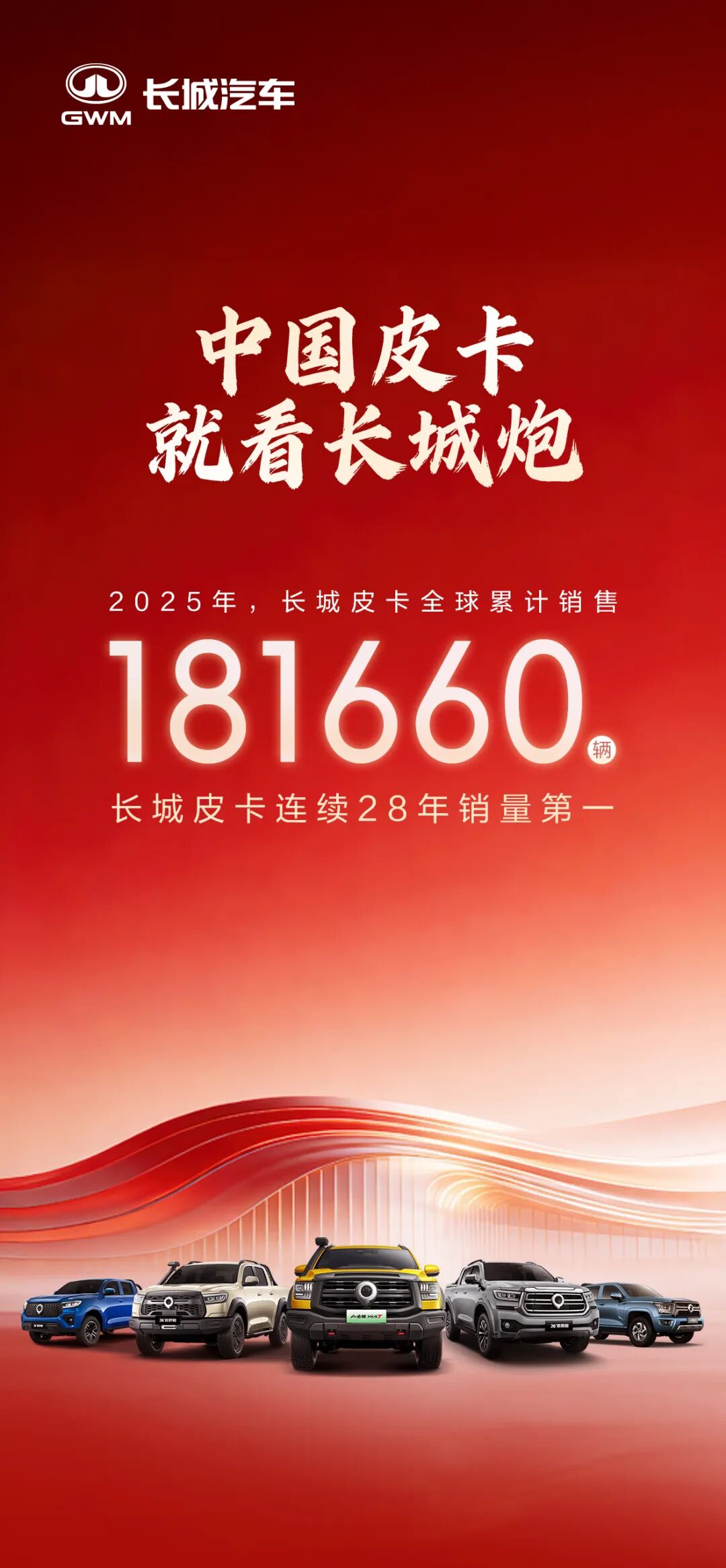
2025年突破18万辆!长城皮卡连续28年销量第一
Xin Lang Cai Jing· 2026-01-05 10:32
Group 1 - The core point of the article highlights that Great Wall Motors' pickup trucks achieved significant sales milestones in 2025, with the Great Wall Cannon leading the market [1][3][12] - In 2025, Great Wall Motors' total global sales of pickups reached 181,660 units, with the Great Wall Cannon alone selling 132,488 units [1][12] - The Great Wall Cannon, Wingle, and King Kong Cannon secured the top three positions in single model sales in the pickup market for 2025 [7][17] Group 2 - The Great Wall Cannon has maintained its position as the best-selling pickup in China for 28 consecutive years [14][15] - The Great Wall Cannon has achieved over 62 months of sales exceeding 10,000 units [5][15] - In 2025, Great Wall pickups held the number one market share in 29 provinces and cities, dominating over 280 cities (89% of cities) [10][21]
长城汽车(601633) - 长城汽车股份有限公司关于可转换公司债券转股及2023年股票期权激励计划自主行权结果暨股份变动公告
2026-01-05 10:16
| | | 可转债转股情况:2025年12月1日至2025年12月31日期间,共有3,000元"长汽 转债"已转换成公司股票,转股数为75股。自2021年12月17日至2025年12月31 日,累计共有4,947,000元"长汽转债"已转换为公司股票,累计转股数为129,727 股,占可转债转股前公司已发行股份总额的0.0014%。 未转股可转债情况:截至2025年12月31日,尚未转股的可转债金额为 3,495,052,000元,占可转债发行总量的99.8586%。 2023年股票期权激励计划首次授予期权行权结果:2023年股票期权激励计划首 次授予第一个行权期可行权股票期权数量为18,948,783股,行权方式为自主行 权,行权期为2025年5月12日至2026年1月25日。2025年12月行权0股,占2023 年股票期权激励计划首次授予第一个行权期可行权股票期权总量的0%。 经上海证券交易所自律监管决定书[2021]287号文同意,公司35亿元可转换公司债 券于2021年7月8日起在上海证券交易所挂牌交易,债券简称"长汽转债",债券代码 "113049"。 长城汽车股份有限公司 关于可转换公司债券转股及 ...
长城汽车(02333) - 海外监管公告
2026-01-05 09:55
香港交易及結算所有限公司及香港聯合交易所有限公司對本公告的內容概不負責,對其準確性或完整性亦不發表任何 聲明,並明確表示,概不對因本公告全部或任何部份內容而產生或因倚賴該等內容而引致的任何損失承擔任何責任。 長 城 汽 車 股 份 有 限 公 司 GREAT WALL MOTOR COMPANY LIMITED* (於中華人民共和國註冊成立的股份有限公司) 股份代號:02333(港幣櫃台)及82333(人民幣櫃台) 海外監管公告 此海外監管公告是根據香港聯合交易所有限公司證券上市規則第 13.10B 條發出。以下為長城汽 車股份有限公司於上海證券交易所網站(www.sse.com.cn)所刊發之「長城汽車股份有限公司 於可轉換公司 券 股及2023年股 期權激勵計劃自主行 結果暨股份變動公告」。 承董事會命 長城汽車股份有限公司 公司秘書 李紅栓 中國河北省保定市,2026 年 1 月5 日 於本公告日期,董事會成員如下: 长城汽车股份有限公司 关于可转换公司债券转股及 2023 年股票期权激励计划 自主行权结果暨股份变动公告 本公司董事会及全体董事保证本公告内容不存在任何虚假记载、误导性陈述或者重 大遗漏, ...
长城汽车(601633) - H股公告-长城汽车股份有限公司股份发行人的证券变动月报表
2026-01-05 09:00
股份發行人及根據《上市規則》第十九B章上市的香港預託證券發行人的證券變動月報表 截至月份: 2025年12月31日 狀態: 新提交 致:香港交易及結算所有限公司 公司名稱: 長城汽車股份有限公司 呈交日期: 2026年1月5日 I. 法定/註冊股本變動 | 1. 股份分類 | 普通股 | | 股份類別 | H | | | 於香港聯交所上市 (註1) | 是 | | | --- | --- | --- | --- | --- | --- | --- | --- | --- | --- | | 證券代號 (如上市) | 02333 | | 說明 | 無 | | | | | | | 多櫃檯證券代號 | 82333 | RMB | 說明 | 無 | | | | | | | | | | 法定/註冊股份數目 | | | 面值 | | 法定/註冊股本 | | | 上月底結存 | | | | 2,318,776,000 | RMB | | 1 RMB | | 2,318,776,000 | | 增加 / 減少 (-) | | | | 0 | | | RMB | | | | 本月底結存 | | | | 2,318,776,00 ...
乘用车板块1月5日跌0.02%,海马汽车领跌,主力资金净流出5.24亿元
Zheng Xing Xing Ye Ri Bao· 2026-01-05 08:59
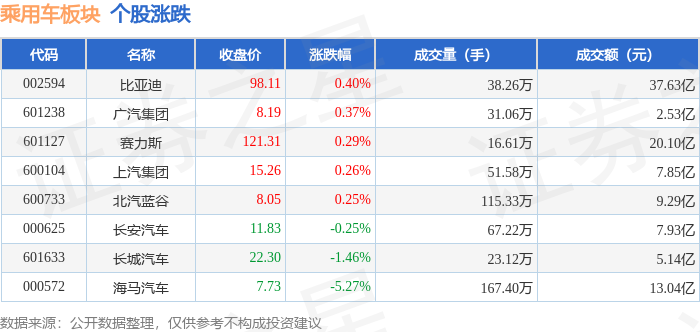
Market Overview - The passenger car sector experienced a slight decline of 0.02% on January 5, with Haima Automobile leading the drop [1] - The Shanghai Composite Index closed at 4023.42, up by 1.38%, while the Shenzhen Component Index closed at 13828.63, up by 2.24% [1] Individual Stock Performance - BYD (002594) closed at 98.11, with a gain of 0.40% and a trading volume of 382,600 shares, amounting to 3.763 billion yuan [1] - GAC Group (601238) closed at 8.19, up by 0.37%, with a trading volume of 310,600 shares, totaling 253 million yuan [1] - Seres (601127) closed at 121.31, increasing by 0.29%, with a trading volume of 166,100 shares, amounting to 2.010 billion yuan [1] - SAIC Motor (600104) closed at 15.26, up by 0.26%, with a trading volume of 515,800 shares, totaling 785 million yuan [1] - BAIC Blue Valley (600733) closed at 8.05, increasing by 0.25%, with a trading volume of 1.1533 million shares, amounting to 929 million yuan [1] - Changan Automobile (000625) closed at 11.83, down by 0.25%, with a trading volume of 672,200 shares, totaling 793 million yuan [1] - Great Wall Motors (601633) closed at 22.30, down by 1.46%, with a trading volume of 231,200 shares, totaling 514 million yuan [1] - Haima Automobile (000572) closed at 7.73, down by 5.27%, with a trading volume of 1.674 million shares, amounting to 1.304 billion yuan [1] Fund Flow Analysis - The passenger car sector saw a net outflow of 524 million yuan from institutional investors, while retail investors contributed a net inflow of 425 million yuan [1] - Notable fund flows for individual stocks include: - SAIC Motor: Institutional net inflow of 14.6084 million yuan, retail net outflow of 29.7881 million yuan [1] - GAC Group: Institutional net inflow of 5.9313 million yuan, retail net inflow of 503.72 million yuan [1] - Great Wall Motors: Institutional net inflow of 1.8031 million yuan, retail net outflow of 2.81908 million yuan [1] - BAIC Blue Valley: Institutional net outflow of 41.4566 million yuan, retail net inflow of 178.232 million yuan [1] - Changan Automobile: Institutional net outflow of 76.5608 million yuan, retail net inflow of 566.669 million yuan [1] - Seres: Institutional net outflow of 86.9124 million yuan, retail net inflow of 78.6812 million yuan [1] - BYD: Institutional net outflow of 131 million yuan, retail net inflow of 87.1496 million yuan [1] - Haima Automobile: Institutional net outflow of 211 million yuan, retail net inflow of 238 million yuan [1]




电动载人汽车出海月报|11月出口额同比飙升140%,全球市场加速渗透
Xin Lang Cai Jing· 2026-01-05 08:41
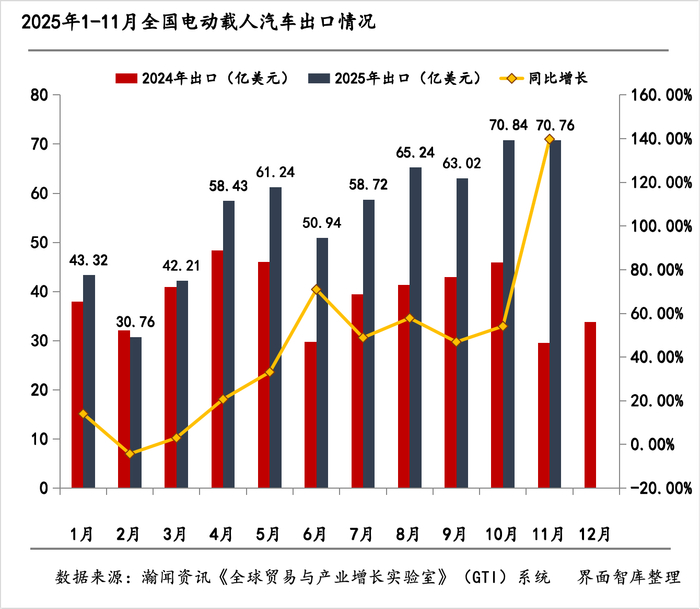
Core Insights - The export of electric passenger vehicles from China has seen a significant surge, with November exports reaching $7.076 billion, a year-on-year increase of 139.83% and a month-on-month decrease of 0.11% [1][5] - Cumulatively, from January to November, the total export volume reached 3.3731 million units, marking a year-on-year growth of 63.59% [5] Export Performance - In November, the export volume of electric passenger vehicles was 399,400 units, a year-on-year increase of 144.93% and a month-on-month increase of 6.52% [1][5] - The average export price for electric passenger vehicles in November was $17,715.65, reflecting a year-on-year decrease of 2.08% [5] Market Segmentation - The passenger car segment dominated the export market, accounting for 99.73% of the total export volume with 398,300 units exported, a year-on-year increase of 146.12% [2][7] - The average price for pure electric passenger vehicles increased by 6.11%, while the average price for plug-in hybrid vehicles decreased by 24.40% [2][7] Regional Export Dynamics - Shanghai, Jiangsu, and Anhui were the top three provinces for electric vehicle exports, with export amounts of $13.341 billion, $7.366 billion, and $6.747 billion respectively [10] - The top ten provinces accounted for 85.58% of the total national electric vehicle exports [10] Export Destinations - Belgium was the largest export destination with $6.180 billion, followed by the UK at $5.488 billion and the UAE at $3.773 billion [17] - The top ten destinations collectively accounted for 53.86% of the total export amount [17] Growth in Emerging Markets - North America showed a remarkable year-on-year growth of 404.36%, with exports rising from $1.66 million to $8.36 million [21] - South America also demonstrated significant growth, with exports reaching $499 million, a year-on-year increase of 248.76% [21] Industry Trends - Chinese automakers are enhancing their overseas production capabilities through joint ventures and local manufacturing [21][24] - Technological innovation and cross-industry collaboration are driving the evolution of the electric vehicle sector, with companies like Xpeng and GAC collaborating with tech firms [24]


长城汽车(02333) - 月报表
2026-01-05 08:34
截至月份: 2025年12月31日 狀態: 新提交 致:香港交易及結算所有限公司 公司名稱: 長城汽車股份有限公司 呈交日期: 2026年1月5日 I. 法定/註冊股本變動 股份發行人及根據《上市規則》第十九B章上市的香港預託證券發行人的證券變動月報表 | 1. 股份分類 | 普通股 | | 股份類別 | H | | | 於香港聯交所上市 (註1) | 是 | | | --- | --- | --- | --- | --- | --- | --- | --- | --- | --- | | 證券代號 (如上市) | 02333 | | 說明 | 無 | | | | | | | 多櫃檯證券代號 | 82333 | RMB | 說明 | 無 | | | | | | | | | | 法定/註冊股份數目 | | | 面值 | | 法定/註冊股本 | | | 上月底結存 | | | | 2,318,776,000 | RMB | | 1 RMB | | 2,318,776,000 | | 增加 / 減少 (-) | | | | 0 | | | RMB | | | | 本月底結存 | | | | 2,318,776,00 ...