
PSBC(601658)

Search documents
邮储银行陕西省分行、西安市分行被罚款117万元 存在多项违规行为
Xi Niu Cai Jing· 2025-09-13 14:05
Group 1 - The China Postal Savings Bank has faced multiple administrative penalties due to various violations, including improper management of fixed asset loans and misappropriation of personal loan funds [3] - A total fine of 1.17 million yuan was imposed on the bank's Shaanxi Province and Xi'an branches for their lack of prudent management practices [3] - Several employees of the bank have received warnings and fines, with some being banned from the banking industry for varying periods due to their involvement in these violations [1][2] Group 2 - In April 2025, the bank was fined 300,000 yuan by the Jilin Financial Regulatory Bureau for employees illegally occupying customer funds, with one employee banned from the banking industry for four years [2] - In March 2023, the Benxi Banking and Insurance Regulatory Bureau reported cases of embezzlement and illegal loan issuance, resulting in lifetime bans for six employees [2]



银行业协同发力赋能电子信息制造业
Zheng Quan Ri Bao Zhi Sheng· 2025-09-13 10:10
Core Viewpoint - The "Action Plan" issued by the Ministry of Industry and Information Technology and the State Administration for Market Regulation aims to guide the expansion, technological breakthroughs, and resilience enhancement of the electronic information manufacturing industry, emphasizing the need for banks to provide comprehensive financial support to ensure stable growth [1] Group 1: Financial Innovation and Support - Banks are actively exploring ways to serve electronic information manufacturing enterprises, exemplified by the "Science and Technology Credit Loan" which enabled a company to secure 20 million yuan quickly, resulting in over 53% year-on-year revenue growth in the first half of 2025 [2] - Various innovative financial products have been launched to address the high R&D investment and insufficient collateral issues faced by electronic information manufacturing companies, including "Innovation Points Loan" and "Intellectual Property Pledge Loan" [2] - A comprehensive financing solution combining policy loans and special subsidies was tailored for a semiconductor company, providing 95 million yuan in low-cost loans to facilitate technological breakthroughs [2] Group 2: Cross-Border Financial Services - Cross-border financial services are being upgraded to meet the "going out" needs of electronic information manufacturing enterprises, with a service plan that converts "intangible credit" into "tangible funds" to help companies mitigate exchange rate risks and accelerate capital turnover [3] - Banks are encouraged to develop customized financial products based on the specific funding needs of different enterprises, promoting services like intellectual property pledges and accounts receivable pledges [3] Group 3: Supply Chain Financial Support - The banking sector is leveraging supply chain finance to alleviate funding bottlenecks in the industry chain, providing innovative products to support core enterprises while injecting growth momentum into related businesses [4] - A bank provided 11 million yuan in funding to a national-level specialized enterprise to support its capacity expansion amid rising market demand [4] Group 4: Comprehensive Service Models - Banks are establishing online service platforms for electronic information enterprises, allowing them to submit financing requests 24/7, ensuring seamless integration of online and offline services [6] - In addition to financing support, banks are extending their service offerings to include cross-border settlement, foreign exchange hedging, and overseas financing, enhancing the global competitiveness of enterprises [6] - The banking industry is shifting from "single-point financing support" to "full-chain ecological services," emphasizing the need for deeper engagement with the electronic information manufacturing sector [6]



汇聚金融力量 释放文旅消费潜力
Zheng Quan Ri Bao Zhi Sheng· 2025-09-13 09:39
Core Insights - The article emphasizes the importance of financial support for the cultural and tourism industry in China, particularly in the context of the recent guidelines issued by the People's Bank of China and other departments to boost consumption [1] Group 1: Financial Support for Tourism - The tourism industry in Heilongjiang, especially Harbin, is experiencing a surge in visitor numbers due to its favorable summer climate, with local entertainment orders increasing by 176% during the summer vacation [2] - Financial institutions in Heilongjiang are actively providing funding support for scenic area operations and construction projects, offering customized "cultural tourism +" integrated solutions to enhance the quality and efficiency of the tourism industry [2] Group 2: Innovative Financial Services - The financial sector is focusing on increasing credit supply, innovating financial service models, and reducing overall financing costs to tap into the consumption potential of the tourism industry [2] - The aim is to transition the tourism industry from a seasonal to a year-round model, promoting a comprehensive ecosystem of financial services centered around cultural tourism [2] Group 3: Customer Experience Initiatives - Postal Savings Bank in Heilongjiang has established a volunteer service team to provide free luggage storage for tourists, enhancing their travel experience and creating a memorable service point [3] - The bank has served nearly 10,000 tourists with free luggage storage and has created themed areas to enrich the visitor experience [3][4]
服贸会秀“绿”绩
2 1 Shi Ji Jing Ji Bao Dao· 2025-09-12 23:06
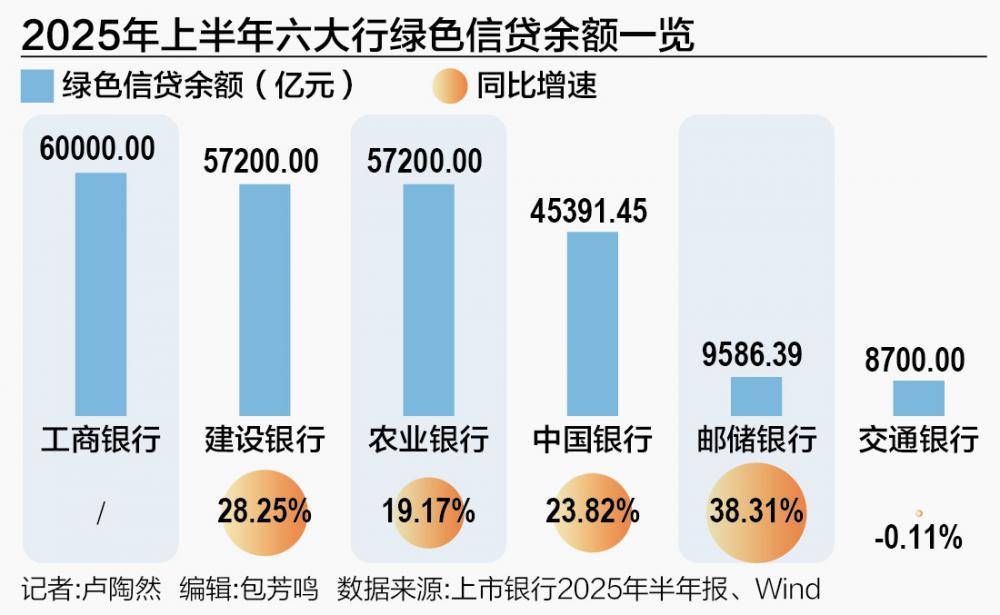
Core Insights - As of the end of Q2 2025, China's green loan balance reached approximately 42.4 trillion yuan, and the green bond balance exceeded 2.2 trillion yuan, positioning China among the top globally [1] - The carbon reduction support tool has guided financial institutions to issue carbon reduction loans exceeding 1.38 trillion yuan [1] - A total of 37 listed banks reported a combined green loan balance of 29.22 trillion yuan, with an average balance exceeding 800 billion yuan, reflecting a year-on-year growth of 41.79% [1][5] Green Loan Growth - The green loan balance of the banking system in China is leading globally, with state-owned banks playing a significant role [4] - Among the six major state-owned banks, the Industrial and Commercial Bank of China (ICBC) leads with a green loan balance of 6 trillion yuan, followed by China Construction Bank and Agricultural Bank of China, each with 5.72 trillion yuan [5] - Postal Savings Bank of China showed a remarkable year-on-year growth rate of 38.31%, nearing the 1 trillion yuan mark [5] Innovation in Green Financial Products - Banks are actively expanding and innovating specialized green financial products and service models, covering areas such as clean energy and environmental remediation [2] - The green financial product system is becoming increasingly diverse, showcasing various practical paths and innovative outcomes [2] Carbon Reduction Support Tool - The carbon reduction support tool is becoming a key indicator of banks' green financial capabilities, effectively directing financial resources towards green and low-carbon sectors [9] - In Q2 2025, 16 banks reported carbon reduction loans that facilitated a carbon reduction equivalent of over 7 million tons, with a total loan amount of nearly 24 billion yuan [9] - Major banks like ICBC and China Construction Bank have over 100 projects funded through carbon reduction loans, leading in both project numbers and loan amounts [9] Performance of Smaller Banks - Smaller banks, including city commercial banks and rural commercial banks, are showing significant growth in green loan balances, with some achieving substantial year-on-year increases [8] - Zhangjiagang Rural Commercial Bank led the rural commercial banks with a growth rate of 30.25% in green loan balances [7] - Smaller banks are encouraged to leverage local advantages and develop differentiated paths to support local green projects [8]





金融机构发行科创债研究
Yuan Dong Zi Xin· 2025-09-12 12:10
1. Report Industry Investment Rating No information provided in the content. 2. Core Views of the Report - The launch of the "Technology Board" in the bond market in May 2025 included financial institutions in the issuers of science - innovation bonds. Financial institutions have become one of the main issuers. Their issuance of science - innovation bonds can guide funds to the innovation field, build a "technology - industry - finance" cycle, and also bring benefits to themselves [2][4]. - With the implementation of supporting policies, the scale of financial institutions' issuance of science - innovation bonds is expected to increase. The proportion of medium - and long - term bonds needs to be further increased to match the long - cycle characteristics of the technology field [4][54]. 3. Summary According to Related Catalogs Background - Technology finance has developed rapidly under policy, technology, and market demand. In 2025, the central bank and the CSRC launched the "Technology Board" in the bond market, allowing financial institutions to issue science - innovation bonds. The move aims to improve the financing channels for scientific and technological innovation and promote the development of technology finance [2][6][7]. - Since the release of the relevant announcement, financial institutions have actively responded. From May 7th to August 25th, they issued 89 science - innovation bonds with a total face value of 293.27 billion yuan, accounting for 11.14% and 29.36% of the total number and face value of science - innovation bonds issued during the same period [8]. Financial Institutions' Issuance of Science - Innovation Bonds Overview - **Issuance Structure**: Commercial banks dominate in terms of issuance scale, with 226.3 billion yuan (77.16% of the total). Securities companies lead in the number of issuances, with 48 (53.93% of the total). Policy banks have the highest average single - issue amount, at 550 million yuan per bond [3][12]. - **Issuance Term/Rating**: The term structure is mainly medium - and short - term, with 2 - 5 - year bonds accounting for 94.24% of the total issuance amount. The bond ratings are mainly AAA, accounting for 92.11% [16][18]. - **Issuance Interest Rate/Spread**: The weighted average issuance interest rate of financial institutions' science - innovation bonds is 1.68%, significantly lower than that of non - financial institutions (1.92%). The average issuance spread of financial institutions' science - innovation bonds is also lower than that of non - financial enterprises [3][19]. - **Fund - Raising Use**: The funds are mainly used in the scientific and technological innovation field. Commercial banks mainly use the funds for "issuing loans" and "issuing loans + investing in bonds". Securities companies mainly use them for "investment in the science - innovation field" and "replacing relevant investments in the science - innovation field" [24]. - **Regional Distribution**: The issuance is concentrated in economically developed and innovation - rich regions, such as Beijing, the Yangtze River Delta, and Guangdong [28]. - **Issuing Subjects**: The issuing financial institutions generally have high credit ratings, large asset sizes, and strong operating capabilities. The issuers are gradually expanding from large - scale to medium - and small - sized financial institutions [30]. Understanding Financial Institutions' Issuance of Science - Innovation Bonds - **From the Perspective of Industrial Development**: Financial institutions can raise low - cost funds through science - innovation bonds and direct them to the science - innovation field, mainly to science - and technology - based enterprises and equity investment funds. The technology loans of commercial banks are increasing in both balance and growth rate [35][40]. - **From the Perspective of Business Development**: For commercial banks, issuing science - innovation bonds can balance asset - liability pressure, promote loans, and improve the product and service system. For securities companies, it can optimize the debt structure, expand business, and disperse risks [41][45]. - **From the Perspective of Asset Allocation**: The risk - return characteristics of science - innovation bonds are between those of interest - rate bonds and traditional financial bonds, providing a target for optimizing the risk - return structure of investment portfolios. The bond spreads of financial institutions' science - innovation bonds are lower than those of non - financial bonds, and there are differences in the spread fluctuations among different types of financial institutions [47][49]. Summary - Since May 2025, financial institutions have become one of the main issuers of science - innovation bonds. Their issuance has characteristics in terms of structure, term, rating, interest rate, and fund - raising use [51]. - The issuance of science - innovation bonds by financial institutions can promote the development of the science - innovation field and bring benefits to themselves. The scale of issuance is expected to increase, and the proportion of medium - and long - term bonds needs to be further improved [52][54].

央行:调整后的一级交易商考评办法将从2025年启用,考评期内行为不当的一级交易商将被暂停参与公开市场操作
Sou Hu Cai Jing· 2025-09-12 10:45
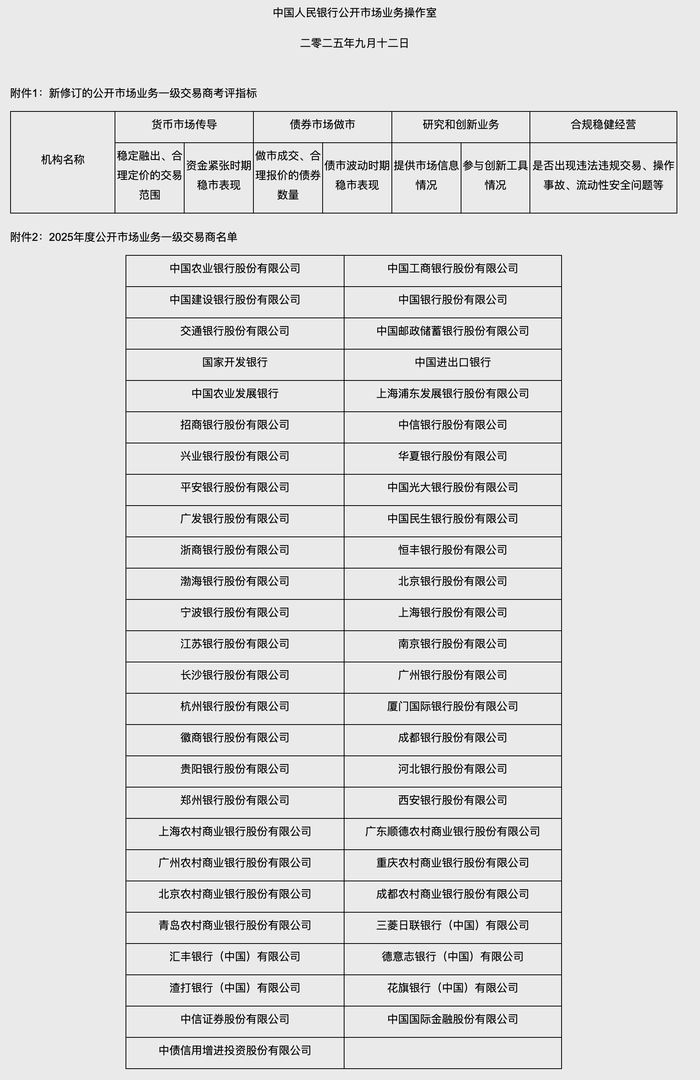
Core Viewpoint - The People's Bank of China (PBOC) has established a new evaluation mechanism for primary dealers in the open market, which will be implemented in 2025, aiming to enhance the transmission of monetary policy and adapt to the evolving financial market [1]. Group 1: Evaluation Mechanism - The PBOC's evaluation mechanism for primary dealers was first established in 2004 and adjusted in 2018 to support smooth open market operations [1]. - The new evaluation method will focus on optimizing and simplifying assessment indicators, categorizing institutions for evaluation, and strengthening the linkage with bond market makers [1]. - The list of primary dealers for the year 2025 will remain unchanged, and any dealer exhibiting inappropriate behavior during the evaluation period may be suspended from participating in open market operations [1]. Group 2: Institutions Involved - A comprehensive list of institutions that will be evaluated includes major banks such as Agricultural Bank of China, Industrial and Commercial Bank of China, China Construction Bank, and Bank of China, among others [3][4]. - The evaluation will consider factors such as stable lending, reasonable pricing, market performance during tight funding periods, and compliance with operational standards [3].





谋定而后动 解码邮储银行财富管理的稳健发展体系
Zhong Guo Zheng Quan Bao· 2025-09-12 09:56
Core Viewpoint - China Postal Savings Bank is undergoing a "second upgrade" in retail banking, focusing on wealth management to enhance value and deepen customer engagement, supported by a robust asset base exceeding 18 trillion yuan [2][14]. Wealth Management Strategy - The bank established a wealth management department to enhance its core layout, achieving a personal asset management (AUM) of 17.67 trillion yuan, a 5.87% increase from the previous year [2][14]. - Wealth management has become a crucial link connecting 670 million retail customers, integrating inclusive finance with professional services [2][14]. Intermediate Business Income Growth - The bank's intermediate business income reached 16.918 billion yuan, with a year-on-year growth of 11.59%, outperforming peers [4][5]. - Wealth management-related income, particularly from financial advisory and custody services, saw significant growth, with financial advisory fees increasing by 47.89% [4][5]. High-Value Business Focus - The bank's growth in intermediate business income is driven by high-value sectors such as investment banking and transaction banking, with corporate segment income growing by 42% [5][6]. - The bank's asset quality remains stable, with a non-performing loan ratio of 0.30%, indicating strong credit management [5][6]. Market Opportunities and Growth - The bank capitalized on national policies aimed at boosting consumption and supporting innovation, resulting in a personal loan total of 4.86 trillion yuan, a 1.86% increase [6][7]. - The bank's investment management capabilities have improved, with non-interest income growing by 4.51% [7]. Unique Channel Advantages - The bank's extensive network of nearly 40,000 outlets and a customer base of over 670 million provides a competitive edge in wealth management, enabling precise customer targeting and service delivery [8][9]. - The "self-operated + agency" model creates a strong customer and channel moat, enhancing service capabilities [8][9]. Capital Strength and Efficiency - The bank's capital base was bolstered by a 130 billion yuan injection, raising its core tier one capital adequacy ratio to 10.52% [11][12]. - Cost management initiatives have led to a reduction in agency fees and an improvement in the cost-to-income ratio, allowing for reinvestment in wealth management capabilities [12][13]. Future Directions - The bank is focusing on a lightweight transformation strategy to enhance its non-interest income through improved capabilities rather than relying solely on resources [13][14]. - A clear path for wealth management transformation has been established, emphasizing the importance of customized asset allocation based on customer needs [14].
谋定而后动,解码邮储银行财富管理的稳健发展体系
Zhong Guo Zheng Quan Bao· 2025-09-12 09:03
Core Viewpoint - China Postal Savings Bank is transitioning from a phase of rapid expansion to a focus on deepening existing customer relationships and enhancing value through wealth management, marking a significant upgrade in its retail banking strategy [1] Group 1: Wealth Management Strategy - The bank has established a dedicated wealth management department, achieving a personal asset management (AUM) scale of 17.67 trillion yuan, a 5.87% increase from the previous year [1][7] - Wealth management has become a core link connecting 670 million retail customers, integrating inclusive finance with professional services [1][12] - The bank's wealth management strategy has led to a 47.89% year-on-year increase in wealth management service fee income [2][3] Group 2: Intermediate Business Income - The bank's intermediate business income reached 16.918 billion yuan, with an 11.59% year-on-year growth, outperforming peers [2][3] - Wealth management-related income has been a major contributor, with significant growth in service fees from wealth management and custody services [2][4] - The bank's focus on high-value areas such as investment banking and transaction banking has led to a structural optimization of income [3][4] Group 3: Customer Base and Channel Advantage - The bank serves over 670 million personal customers through nearly 40,000 outlets, providing a unique advantage in reaching rural and urban clients [6][7] - The integration of postal services with banking has allowed the bank to embed wealth management services into everyday life for customers [6][7] - The bank's customer segmentation strategy addresses diverse needs, offering tailored services for different customer groups [7][8] Group 4: Capital Strength and Efficiency - The bank raised 130 billion yuan through a targeted A-share issuance, enhancing its capital adequacy ratio to 10.52% [10][11] - Cost management initiatives have led to a reduction in agency fees and an improvement in the cost-to-income ratio, allowing for reinvestment in wealth management capabilities [11][12] - The bank aims to transition from a reliance on interest income to a diversified income model through enhanced capabilities in wealth management [11][12]
国有大型银行板块9月12日跌0.5%,交通银行领跌,主力资金净流出10.08亿元
Zheng Xing Xing Ye Ri Bao· 2025-09-12 08:38
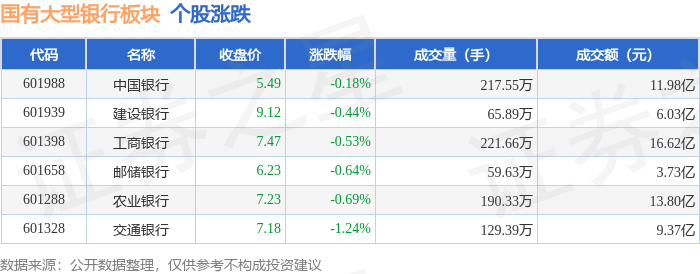
Group 1 - The state-owned large bank sector experienced a decline of 0.5% on September 12, with Bank of Communications leading the drop [1] - The Shanghai Composite Index closed at 3883.69, up 0.22%, while the Shenzhen Component Index closed at 12996.38, up 0.13% [1] - The trading volume and turnover for major state-owned banks showed significant activity, with Industrial and Commercial Bank of China having a turnover of 1.662 billion and China Bank at 1.198 billion [1] Group 2 - The net outflow of main funds from the state-owned large bank sector was 1.008 billion, while retail investors saw a net inflow of 559 million [1] - The detailed fund flow for individual banks indicated that China Bank had a main net inflow of 60.06 million, while Agricultural Bank experienced a significant outflow of 1.80 billion [2] - Bank of Communications had the highest net outflow among the major banks, totaling 777 million, while retail investors contributed a net inflow of 327 million [2]
深耕云岭 金融活水润山珍 邮储银行文山分行全力支持人工菌产业高质量发展
Jin Rong Shi Bao· 2025-09-12 01:56
Group 1 - The core viewpoint of the article highlights the emergence of a "green revolution" in the artificial mushroom industry in Yunnan, driven by financial support from Postal Savings Bank to enhance rural revitalization [1][3] - The artificial mushroom industry faces challenges such as high initial investment, technical barriers, and long return cycles, leading to financing difficulties for enterprises [2] - Postal Savings Bank has developed customized financial solutions using big data and IoT technologies to address the financing challenges faced by the artificial mushroom industry [2][3] Group 2 - A notable case is Yunnan Qiangfeng Agricultural Technology Co., Ltd., which received a tailored financial solution of 3.71 million yuan to alleviate its funding pressure during expansion [2] - The bank's efforts not only provide funding but also aim to enhance the "Yun Mushroom" brand, supporting the industry's transition from small-scale operations to standardized and branded production [3] - Looking ahead, Postal Savings Bank plans to continue optimizing financial products and services while collaborating with government and industry associations to build a comprehensive financial service ecosystem for the mushroom industry [4]