CHINA TELECOM(601728)

Search documents
三大运营商定调2026:继续战略收缩 聚焦AI转型
Zhong Guo Jing Ying Bao· 2026-01-20 13:24
Core Insights - The three major telecom operators in China are shifting their strategies towards "strategic contraction and focused transformation," moving away from a "large and comprehensive" approach to concentrate resources on core business areas such as computing power, AI applications, and enterprise markets [1][4] Financial Performance - In 2024, the total revenue of the three operators approached 2 trillion yuan, with a year-on-year growth rate slowing to approximately 3%, a significant decline compared to previous years. The combined net profit was about 192 billion yuan, reflecting a year-on-year increase of approximately 6.1%. The combined EBITDA was around 574 billion yuan, showing a slight decline of about 0.7%, indicating a fatigue in profitability [2] Strategic Focus - China Telecom is upgrading its strategy from "cloud transformation" to "intelligent and beneficial cloud transformation," emphasizing AI empowerment and security in enterprise construction. In 2024, the revenue from digitalization in its industry is expected to increase, with a 22% year-on-year growth in capital expenditure for computing power [3] - China Unicom is focusing on four core areas: connectivity, computing power, services, and security, moving away from a comprehensive coverage model. Its investment in computing power is expected to rise by 19% in 2024, with plans to build a multi-layered computing supply system [3] - China Mobile aims to strengthen its three main businesses: communication services, computing services, and intelligent services, with a focus on technology leadership and scale synergy. The planned investment in computing power for 2025 is 37.3 billion yuan, maintaining the same level as 2024 but increasing its share in capital expenditure to 25% [4] Embracing AI - All three operators are sending a clear signal of "fully embracing AI." China Unicom is focusing on the synergy between AI and its core areas, while China Telecom is integrating AI throughout its operations. China Mobile is also prioritizing intelligent services and plans to develop 15 million AI terminals by 2026 [5][6] Capital Expenditure Trends - The capital expenditure of the three operators is showing a trend of "overall contraction with localized increases," with a total planned capital expenditure for 2025 reduced by 9.1% to 289.8 billion yuan. The focus is shifting towards "intelligent computing centers" and "massive card clusters" [7]



通信服务板块1月20日跌0.57%,三维通信领跌,主力资金净流出11.16亿元
Zheng Xing Xing Ye Ri Bao· 2026-01-20 08:59
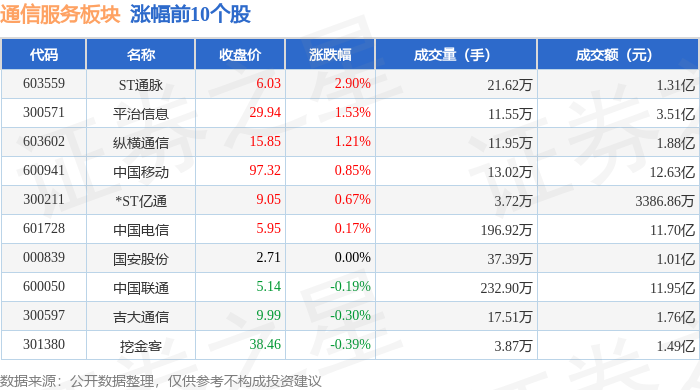
Core Viewpoint - The communication services sector experienced a decline of 0.57% on January 20, with significant losses from Sanwei Communication, while the overall market indices showed slight decreases [1]. Group 1: Market Performance - The Shanghai Composite Index closed at 4113.65, down 0.01%, and the Shenzhen Component Index closed at 14155.63, down 0.97% [1]. - The communication services sector saw a net outflow of 1.116 billion yuan from major funds, while retail investors contributed a net inflow of 730 million yuan [2][3]. Group 2: Individual Stock Performance - Sanwei Communication (002115) led the decline with a drop of 9.98%, closing at 14.25 yuan, with a trading volume of 3.1924 million shares and a transaction value of 4.632 billion yuan [2]. - Other notable declines included Putian Technology (002544) down 5.30% and Yinhua Holdings (300292) down 5.23% [2]. - In contrast, ST Tongmai (603559) increased by 2.90%, closing at 6.03 yuan, with a trading volume of 216,200 shares and a transaction value of 131 million yuan [1]. Group 3: Fund Flow Analysis - China Mobile (600941) had a net inflow of 1.23 billion yuan from major funds, while China Unicom (600050) saw a net inflow of 1.22 billion yuan [3]. - Jiada Communication (300597) reported a net inflow of 27.2269 million yuan from major funds, indicating strong interest despite overall sector declines [3].




济南今年将抓好中科(济南)超级云等重点项目建设
Qi Lu Wan Bao· 2026-01-19 03:02
Group 1 - Jinan will focus on key projects such as the Super Cloud of China Science and Technology (Jinan) and the Intelligent Computing Center of China Telecom (Jinan) to integrate into the national unified computing power network, aiming to build a computing power hub that serves the entire province and the nation [3] - The city plans to enhance the capabilities of the Inspur AI Model Factory and develop commercially valuable vertical models, with the goal of registering 5 new generative AI large models and creating 5 benchmark large model products [3] - Jinan aims to accelerate the construction of key digital industrialization projects, including the Shandong Autonomous and Controllable Information Equipment Industrial Park, and improve the functionality of various innovation and research institutes [3] Group 2 - The city will expand the functionality of the "Love Shandong" Jinan branch platform, upgrading 70 key livelihood services, and enhancing platforms like "Quan Yibao" and Haiyou Talent Employment [4] - Jinan is set to improve the grassroots intelligent governance system and accelerate the construction of a digital social operation scheduling platform, integrating various digital systems for better urban management [4] - The city will innovate urban governance units by utilizing resources from smart communities, smart policing, and digital rural areas, and will actively conduct pilot projects for digital blocks [4]

超20位央企掌门人年薪超90万元
2 1 Shi Ji Jing Ji Bao Dao· 2026-01-18 22:43
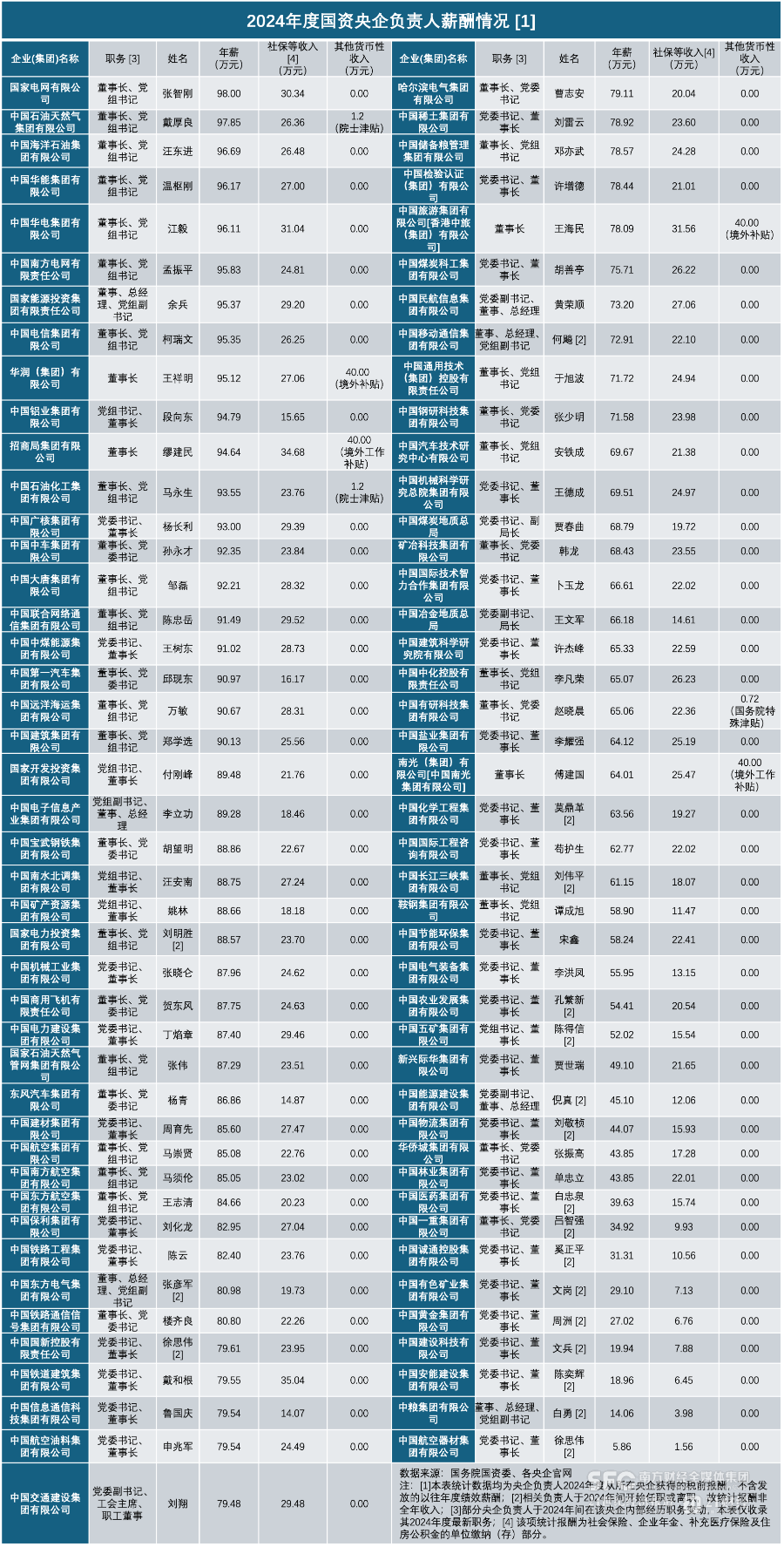
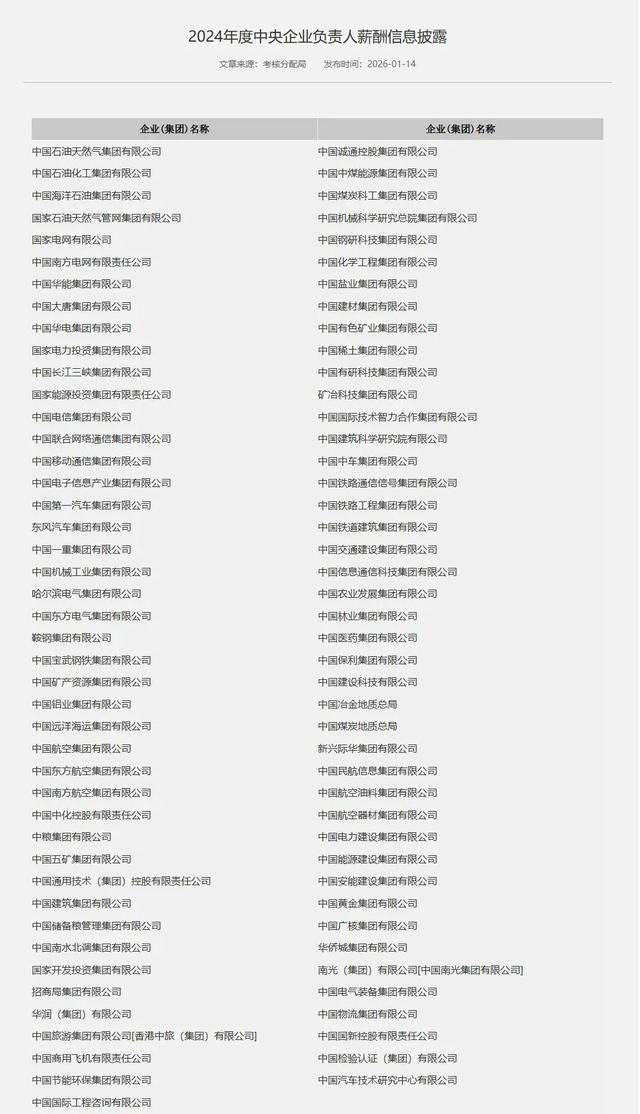
Core Viewpoint - The State-owned Assets Supervision and Administration Commission (SASAC) disclosed the 2024 salary information for 87 central enterprises, highlighting that 20 of these enterprises have executives earning over 900,000 yuan annually, primarily in the energy and power sectors [2][5]. Group 1: Salary Information - Among the 87 central enterprises, 20 executives have annual salaries exceeding 900,000 yuan, with 9 of them earning over 950,000 yuan [5][6]. - The highest reported salary is 980,000 yuan for Zhang Zhigang, Chairman of State Grid Corporation, reflecting his dual roles in 2024 [6][9]. - Other notable salaries include 978,500 yuan for Dai Houliang of China National Petroleum Corporation and 966,900 yuan for Wang Dongjin of China National Offshore Oil Corporation [9][10]. Group 2: Industry Focus - The energy and power sector dominates the high salary rankings, with major players like State Grid, China National Petroleum, and China Southern Power Grid leading the list [6][9]. - In the Guangdong-Hong Kong-Macau Greater Bay Area, four central enterprises have executives earning over 900,000 yuan, including China Southern Power Grid and China General Nuclear Power Group [11][12]. - The performance of these enterprises is strong, with State Grid reporting total revenue of 3.9459 trillion yuan and net profit of 77.298 billion yuan for 2024 [9][12]. Group 3: Performance Metrics - China Southern Power Grid achieved total assets of 1.3491 trillion yuan and revenue of 853.4 billion yuan in 2024, with a net profit of 19.7 billion yuan [11][12]. - China General Nuclear Power Group reported revenue of approximately 86.804 billion yuan, with a net profit of about 10.814 billion yuan [13]. - The overall performance of these enterprises indicates a robust financial health, contributing to their high executive compensation [9][10].




国资委公开80多家央企负责人薪酬
Sou Hu Cai Jing· 2026-01-17 13:14
Core Viewpoint - The State-owned Assets Supervision and Administration Commission (SASAC) disclosed the salary information of over 80 central enterprise leaders for the year 2024, indicating a stable salary range without extreme high salaries, showcasing significant industry differentiation [1][5]. Group 1: Salary Disclosure - The disclosure of salary information is part of SASAC's ongoing efforts to enhance transparency in key areas and respond to public concerns [2]. - The overall salary of central enterprise leaders in 2024 remains within a stable range, characterized by "top leaders leading, median concentration, and low compliance," with no extreme high salary phenomena observed [5]. Group 2: Salary Rankings - The top tier of salaries is dominated by leaders from telecommunications and energy central enterprises, with China Mobile's former chairman Yang Jie leading with a pre-tax salary of 1.2582 million yuan, followed by China Telecom and China Unicom chairmen with salaries of 1.2160 million yuan and 1.2101 million yuan respectively [6]. - In the energy sector, PetroChina's chairman Dai Houliang and general manager Hou Qijun both have an annual salary of 978,500 yuan, ranking first among energy central enterprises [7]. - Other notable salaries include China Huaneng Group's chairman Wen Shugang at 961,700 yuan and State Power Investment Corporation's chairman Yu Bing at 953,700 yuan, both of whom are also in the top tier [8]. Group 3: Salary Distribution - The second tier includes core central enterprises in electricity, construction, and automotive industries, with notable figures such as State Grid's chairman Zhang Zhigang earning 735,000 yuan and China National Nuclear Corporation's chairman Yang Changli earning 930,000 yuan [15]. - The third tier consists of central enterprises with strong public welfare attributes, such as China Forestry Group's chairman Shan Zhongli and Overseas Chinese Town Group's chairman Zhang Zhenggao, both earning 438,500 yuan, which is below the average level for central enterprises [16]. Group 4: Salary Variability - Within the same industry, the salary differences among central enterprise executives are manageable, with the highest annual salary for energy central enterprise chairmen (PetroChina at 978,500 yuan) and the lowest (National Pipeline Network at 872,900 yuan) showing a difference of about 100,000 yuan [20].



中国电信跌2.13%,成交额9.38亿元,主力资金净流出2.44亿元
Xin Lang Cai Jing· 2026-01-16 05:45
Core Viewpoint - China Telecom's stock has experienced a decline of 5.24% year-to-date, with significant drops over various trading periods, indicating potential challenges in the market [1]. Group 1: Stock Performance - As of January 16, China Telecom's stock price was 5.97 CNY per share, with a market capitalization of 546.298 billion CNY [1]. - The stock has seen a decline of 5.54% over the last five trading days, 10.63% over the last twenty days, and 12.97% over the last sixty days [1]. - The net outflow of main funds was 244 million CNY, with large orders showing a buy of 154 million CNY and a sell of 247 million CNY [1]. Group 2: Company Overview - China Telecom, established on September 10, 2002, and listed on August 20, 2021, is primarily engaged in telecommunications and related services [1]. - The company's revenue composition includes mobile communication services (39.56%), industrial digital services (27.78%), fixed-line and smart home services (23.80%), sales of goods and other income (7.54%), and other services (1.32%) [1]. Group 3: Financial Performance - For the period from January to September 2025, China Telecom reported a revenue of 394.27 billion CNY, reflecting a year-on-year growth of 0.59% [2]. - The net profit attributable to shareholders was 30.773 billion CNY, showing a year-on-year increase of 5.03% [2]. - Since its A-share listing, China Telecom has distributed a total of 95.186 billion CNY in dividends, with 68.649 billion CNY distributed over the last three years [3]. Group 4: Shareholder Information - As of September 30, 2025, the number of shareholders for China Telecom was 273,700, an increase of 22.83% from the previous period [2]. - The average circulating shares per person remained at 0 shares, unchanged from the previous period [2]. - Hong Kong Central Clearing Limited has exited the list of the top ten circulating shareholders [3].
吴晓军罗东川与柯瑞文一行座谈
Xin Lang Cai Jing· 2026-01-15 18:26
Group 1 - The provincial government of Qinghai signed a strategic cooperation framework agreement with China Telecom Group on January 14, aiming to enhance collaboration in various fields over the next five years and beyond [1][2] - The agreement aligns with the national strategy of "East Data West Computing" and focuses on transforming Qinghai's resource and energy advantages into new momentum for high-quality development [1] - China Telecom will position Qinghai as a key strategic node for future development, particularly in areas such as new digital infrastructure, quantum computing, low-altitude economy, and 5G technology applications [2] Group 2 - The provincial leaders expressed their commitment to achieving the goals set for 2025 and highlighted the significant progress made in economic and social development during the "14th Five-Year Plan" [1] - The cooperation aims to create benchmark demonstration projects that will contribute to the construction of a national green computing and energy collaboration demonstration zone [2] - Both parties emphasized the importance of practical cooperation to advance the construction of a digital Qinghai [2]
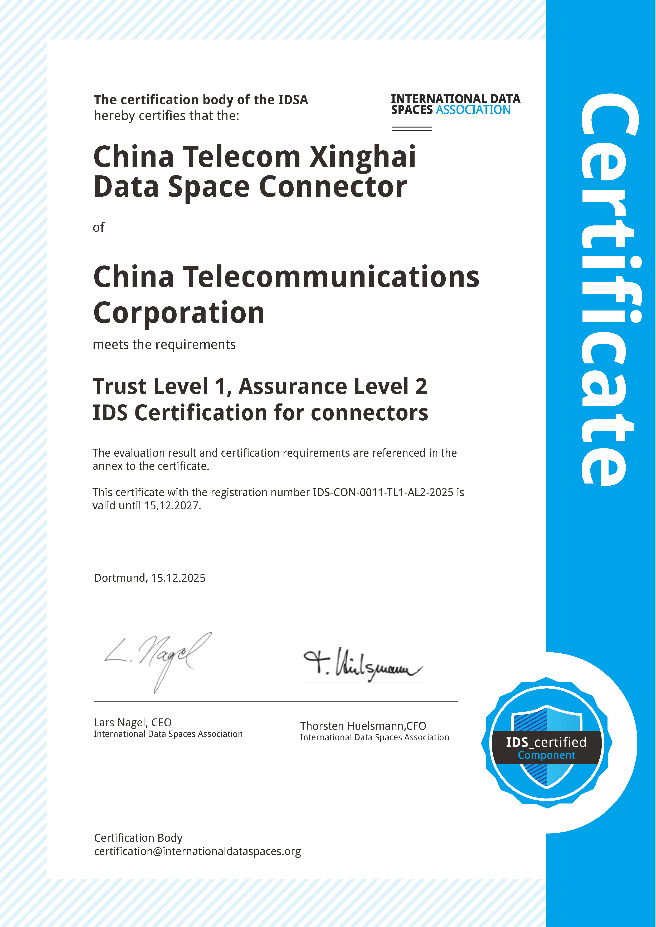
中国电信星海数据空间连接器获得国际数据空间(IDS)认证
Sou Hu Cai Jing· 2026-01-15 12:49
Core Viewpoint - China Telecom's Xinghai Data Space Connector has successfully passed evaluation and received certification from the International Data Spaces Association (IDSA), marking compliance with international standards in technology, security, and interoperability [1][2]. Group 1: Certification Details - The certification confirms that the China Telecom Xinghai Data Space Connector meets Trust Level 1 and Assurance Level 2 requirements, with the certificate valid until December 15, 2027 [2][3]. - The IDS certification system is essential for promoting high-quality development of data spaces and establishing a standardized foundation for international data interoperability [7]. Group 2: Product Features and Compliance - The China Telecom Xinghai Data Space Connector aligns with the international data space reference architecture (IDS-RAM) and complies with national and international standards, demonstrating strong security, compliance, and interoperability capabilities [8]. - The product has been validated for key capabilities such as unified identity collaboration, policy execution, data usage control, trusted computing, and cross-domain interoperability, ensuring controlled, traceable, and trustworthy data flow [8]. Group 3: Testing and Evaluation Infrastructure - The IDS Data Space Testing and Certification Laboratory, part of the National Engineering Center for Next Generation Internet, is the only institution in the Asia-Pacific region qualified for IDS certification evaluation [9]. - The laboratory offers a comprehensive certification evaluation service system, including component certification, environmental certification, and customized testing, supporting enterprises in technical compliance and ecological adaptation [9].
2025中国企业ESG“金责奖”最佳社会S责任奖揭晓
Xin Lang Cai Jing· 2026-01-15 07:31
Core Viewpoint - The 2025 China Enterprise ESG "Golden Responsibility Award" aims to recognize companies that have made significant contributions to ESG (Environmental, Social, and Governance) practices, with over 5,000 enterprises participating in the evaluation process [1][4]. Group 1: ESG Services and Initiatives - Sina Finance ESG Rating Center offers 14 ESG services, including information, reports, training, and consulting, to help listed companies promote ESG concepts and enhance their sustainable development performance [1][4]. - In 2025, many quality enterprises in China are actively practicing their responsibilities in environmental, social, and governance aspects, while domestic financial institutions are steadily integrating ESG investment concepts into their entire business processes [1][4]. Group 2: Award Selection and Winners - The award selection process involved over three months of competition, combining ESG performance, professional evaluation scores, and online voting results [1][4]. - The winners of the 2025 China Enterprise ESG "Golden Responsibility Award" for Best Social Responsibility include China Shenhua, China General Nuclear Power, China Resources Sanjiu, Sinopec, Shougang, Wuliangye, Yangtze Power, China Telecom, CNOOC Services, and LONGi Green Energy [2][5]. Group 3: ESG Rating Center Overview - The Sina Finance ESG Rating Center is the first Chinese ESG professional information and rating aggregation platform, dedicated to promoting sustainable development and responsible investment [3][6]. - The center aims to establish ESG evaluation standards suitable for China's characteristics and enhance corporate ratings, while also launching multiple ESG innovation indices for investors [3][6].


中国电信集团新任党组副书记唐珂上任 从集团副总一职提拔
Xin Lang Cai Jing· 2026-01-15 05:03
Group 1 - The core point of the article is the recent personnel change in China Telecom Group, where Tang Ke has been promoted to the position of Deputy Secretary of the Party Committee, effectively making him the third-highest official in the group [1][3] - The announcement of Tang Ke's promotion was unexpected as it was not preceded by an official appointment notice, but rather updated directly on the company's website [3] - Tang Ke's promotion is seen as a recognition of his capabilities, having served in various significant roles within the company for many years, including Vice General Manager of the Marketing Department and General Manager of Guangdong Telecom [3] Group 2 - The position of Deputy Secretary of the Party Committee had been vacant since Liu Guiqing was promoted to General Manager in March 2025, making Tang Ke's appointment timely [3] - Tang Ke has been with China Telecom for over four years since being promoted to Vice General Manager in May 2021, indicating a stable career progression within the organization [3]