
CHINA TELECOM(601728)

Search documents
中国电信(00728) - 截至2025年10月31日止股份发行人的证券变动月报表
2025-11-03 04:06
截至月份: 2025年10月31日 狀態: 新提交 致:香港交易及結算所有限公司 公司名稱: 中國電信股份有限公司 呈交日期: 2025年11月3日 I. 法定/註冊股本變動 | 1. 股份分類 | 普通股 | 股份類別 | H | | 於香港聯交所上市 (註1) | | 是 | | | --- | --- | --- | --- | --- | --- | --- | --- | --- | | 證券代號 (如上市) | 00728 | 說明 | H股 | | | | | | | | | 法定/註冊股份數目 | | | 面值 | | 法定/註冊股本 | | | 上月底結存 | | | 13,877,410,000 | RMB | | 1 RMB | | 13,877,410,000 | | 增加 / 減少 (-) | | | 0 | | | RMB | | 0 | | 本月底結存 | | | 13,877,410,000 | RMB | | 1 RMB | | 13,877,410,000 | | 2. 股份分類 | 普通股 | 股份類別 A | | | 於香港聯交所上市 (註1) | | 否 | | | ...
电信运营商增长逻辑已变!
Zhong Guo Jing Ying Bao· 2025-11-03 03:53
Core Insights - The financial performance of China's three major telecom operators shows a mixed outlook, with revenue growth slowing down while profit growth remains positive [2][3][4] Revenue Performance - For the first three quarters of 2025, China Mobile, China Telecom, and China Unicom reported revenues of 794.7 billion, 394.3 billion, and 293 billion yuan respectively, with growth rates declining from 2.0%, 2.9%, and 3.0% in 2024 to 0.4%, 0.6%, and 1.0% [2] - Only China Mobile achieved a 2.5% year-on-year revenue growth in Q3 2025, while China Unicom's revenue remained flat and China Telecom's revenue decreased by 0.91% [2] Profitability - Net profits for the three operators reached 115.4 billion, 30.8 billion, and 20 billion yuan respectively, with growth rates of 4.0%, 5.0%, and 5.1%, although these rates have slowed compared to the previous year's figures [2][3] - The telecom industry as a whole saw a 0.9% year-on-year increase in telecom business revenue, totaling 1,327 billion yuan for the first three quarters of 2025 [2] Traditional Business Challenges - The decline in revenue growth is attributed to the weakness in traditional business segments, which have seen their revenue share drop from 92% in 2020 to 78% in Q3 2025 [3][4] - China Mobile has 1.009 billion mobile users, but its average revenue per user (ARPU) fell to 48 yuan, a 3% decrease from 49.5 yuan in 2024 [3] Emerging Business Growth - AI-related emerging businesses have become a significant profit driver, with China Unicom's AI-related revenue contributing over 60% to its "smart network" business, and its cloud revenue reaching 52.9 billion yuan, a 20.6% increase [6][7] - China Telecom's smart revenue surged by 62.3%, significantly outpacing its overall revenue growth of 0.59% [7] Investment in AI and R&D - The three operators have shifted their focus from traditional "pipeline thinking" to "computing power and service thinking," with R&D expenditures exceeding 22 billion yuan in the first three quarters of 2025, of which over 40% is allocated to AI-related investments [10][11] - The operators are expected to see long-term returns from these investments, despite short-term pressures on cash flow and profitability [10] Industry Transformation - The growth logic of the telecom industry is changing, with AI and computing power becoming central to future growth strategies [10][11] - The operators are forming a sustainable payment loop around "bandwidth + computing power + data + models," indicating a significant shift in the industry's revenue generation model [11]




中国电信集团增资至约2140.5亿 新增多项人工智能业务
Xin Lang Cai Jing· 2025-11-03 03:38
Group 1 - The registered capital of China Telecom Group Co., Ltd. has increased from 213.1 billion RMB to approximately 214.05 billion RMB [1] - The business scope has been expanded to include artificial intelligence industry application system integration services, general application systems for artificial intelligence, and basic software development for artificial intelligence [1] - Several senior executives have undergone changes within the company [1]

天风证券晨会集萃-20251103
Tianfeng Securities· 2025-11-03 01:34
Group 1 - The report highlights that the stock-bond allocation value has retreated from historical extremes, with the equity risk premium (ERP) stabilizing below one standard deviation [1] - The overall A-share index PE valuation stands at 22.0, with most broad-based indices around the 60th percentile historically, indicating relatively low valuations [1][29] - Market trading indicators show a decline in trading heat, with turnover rates and transaction volumes decreasing compared to the previous month, suggesting a cooling market sentiment [1][29] Group 2 - The "15th Five-Year Plan" suggestions have been officially released, marking a new phase in China's modernization process, emphasizing the importance of building a modern industrial system and financial strength [2] - The report indicates that local governments are likely to draft their own five-year plans by the end of the year, following the central government's guidelines [2] - The AI infrastructure investment is expected to significantly increase, with companies like Microsoft planning to expand their global AI infrastructure spending to meet growing demand [2] Group 3 - The report identifies green methanol as a key alternative fuel, with a projected demand of approximately 6.79 million tons from new methanol-fueled vessels expected to launch in the coming years [5] - China's green methanol production capacity is anticipated to achieve scale ahead of other regions, with a significant portion of global projects being developed in China [5] - The report recommends focusing on green methanol producers and related equipment manufacturers, highlighting companies like Goldwind Technology and Donghua Technology [5] Group 4 - The report notes that the AI server and cloud computing business is experiencing rapid growth, with a significant increase in revenue and profitability for companies involved in AI infrastructure [4] - The demand for AI computing power continues to rise, with GPU server shipments increasing by over five times year-on-year [4] - The report emphasizes the importance of technological advancements and market demand in driving the performance of companies in the AI sector [4] Group 5 - The report discusses the transition from UPS to HVDC technology, with major companies like Meta and NVIDIA making significant advancements in this area [7] - The domestic market is expected to see sustained demand for HVDC technology driven by initiatives like "East Data West Computing" [7] - Investment recommendations include focusing on domestic leaders in HVDC technology and companies that can benefit from the transition from UPS to HVDC [7]


中国电信(601728):推动企业战略向云改数转智惠升级,经营业绩保持稳健
Tianfeng Securities· 2025-11-02 04:11
Investment Rating - The investment rating for the company is "Accumulate" [5] Core Views - The company reported a revenue of 394.3 billion yuan for the first three quarters of 2025, representing a year-on-year growth of 0.6%. Service revenue reached 366.3 billion yuan, up 0.9%, while net profit attributable to shareholders was 30.8 billion yuan, an increase of 5.0% year-on-year [1][3] - The company is focusing on transforming its strategy towards "cloud, data, and intelligent services," aiming to enhance its service capabilities and drive high-quality development [3] - The company has seen a significant increase in its new business segments, with IDC revenue reaching 27.5 billion yuan, up 9.1%, and intelligent revenue growing by 62.3% [2][3] Business Performance - The basic business is developing steadily, with 5G network users reaching 290 million, a penetration rate of 66.9%. Mobile internet traffic increased by 16.9%, and the average data usage per user reached 22.3GB, up 11.4% [2] - The company is expanding its new business segments, with notable growth in security revenue (up 12.4%), satellite communication revenue (up 23.5%), and quantum revenue (up 134.6%) [2] Cost Management and R&D - The company maintained effective cost control, with operating costs increasing by only 0.1% year-on-year. R&D expenses rose by 4.4% to 9.1 billion yuan, focusing on key technologies such as AI and quantum security [3] Financial Forecast and Investment Advice - The company is expected to achieve net profits of 34.87 billion yuan, 36.71 billion yuan, and 38.63 billion yuan for the years 2025, 2026, and 2027, respectively. The forecast has been slightly adjusted downwards due to uncertainties in new business developments [3] - The company is positioned to fully embrace AI and support the digital transformation of the economy and society, indicating a positive outlook for future growth [3]
千亿险资系私募基金,最新动向曝光
Zhong Guo Zheng Quan Bao· 2025-11-02 04:10
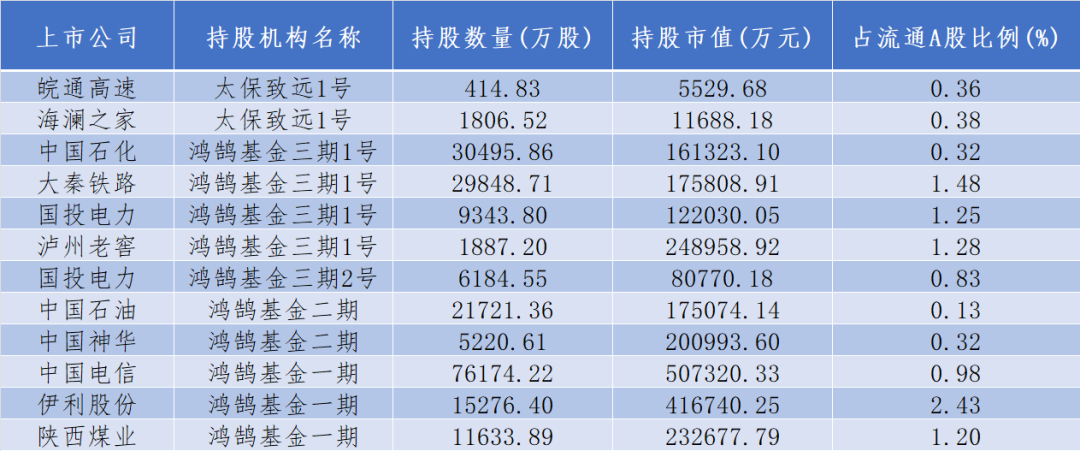
Core Insights - The trial reform for long-term investment of insurance funds has accelerated this year, with the latest holdings of insurance-related private equity funds revealed following the disclosure of listed companies' Q3 reports [1][9] - Five insurance-related private equity funds have disclosed their latest holdings, with significant investments in companies such as Sinopec, Daqin Railway, Guotou Power, Luzhou Laojiao, Anhui Expressway, and HLA [1][4] Holdings Summary - As of the end of Q3, Taibao Zhiyuan No. 1 Private Securities Investment Fund has appeared in the top ten circulating shareholders of Anhui Expressway and HLA, holding 4.1483 million shares and 18.0652 million shares respectively [3][6] - The holdings of five insurance-related private equity funds are detailed in a table, showing the number of shares, market value, and percentage of circulating A-shares for each listed company [5] - The Honghu Fund Phase III No. 1 has emerged as a major shareholder in Sinopec, Daqin Railway, Guotou Power, and Luzhou Laojiao, with holdings of 304.9586 million shares, 298.4871 million shares, 93.438 million shares, and 18.872 million shares respectively [6][7] Investment Focus - The insurance-related private equity funds are primarily concentrated in sectors such as petrochemicals, transportation, coal, public utilities, food and beverage, telecommunications, and textiles, with many holdings being industry leaders characterized by high dividends and low volatility [7][10] - The ongoing trial reform has seen the number of operational insurance-related private equity funds increase to seven, with a total approved scale of 222 billion yuan [9][10]



通信行业周报:海外AI财报总结:巨头加大资本开支,云业务表现亮眼,海外AI发展提速-20251102
KAIYUAN SECURITIES· 2025-11-02 02:27
Investment Rating - The industry investment rating is "Positive" (maintained) [1] Core Views - The report highlights that major overseas AI companies are continuously increasing capital expenditures, focusing on AI infrastructure development, with significant growth in cloud business performance [5][6][19] - The report emphasizes a strong outlook for the "optical, liquid cooling, and domestic computing power" sectors, recommending specific stocks within these areas [7][25] Summary by Sections 1. Overseas AI Financial Summary - Google raised its capital expenditure guidance for 2025 to $91-93 billion, with Q3 capital expenditure reaching $23.953 billion, a year-on-year increase of 83% [5][15] - Meta's Q3 revenue was $51.24 billion, exceeding expectations, with a projected annual expenditure of $70-72 billion for 2025 [16] - Microsoft's Q1 FY2026 revenue reached $77.67 billion, a year-on-year increase of 18%, with significant growth in its cloud segment [17][18] - Amazon's Q3 revenue was $180.2 billion, with AWS net sales of $33.006 billion, a 20% year-on-year increase [19][20] - Celestica's Q3 revenue was $3.19 billion, a 28% increase year-on-year, leading to an upward revision of its annual guidance [21] 2. Communication Data Tracking - As of August 2025, the total number of 5G base stations in China reached 4.646 million, with 5G mobile phone users totaling 1.154 billion, a year-on-year increase of 19.46% [34][12] - The report notes that 5G mobile phone shipments reached 19.992 million units in August 2025, accounting for 88.4% of total shipments, with a slight year-on-year increase of 1.2% [41] - The three major telecom operators showed strong growth in innovative business development, with significant revenue increases in their cloud services [45][50]




LP圈发生了什么
投资界· 2025-11-01 07:54
Core Insights - The article highlights the establishment of various investment funds across different regions in China, focusing on strategic industries and innovation-driven sectors. Group 1: Fund Establishments - A central enterprise strategic emerging industry development fund was launched in Beijing with an initial scale of 510 billion RMB, involving major state-owned enterprises as contributors [2] - The Zhejiang Social Security Science and Technology Innovation Fund was established with an initial scale of 500 billion RMB, aimed at supporting key areas of technological innovation [3] - The first biomanufacturing industry fund in Shanghai was initiated, combining resources from industry leaders and venture capital to drive technological breakthroughs [4] Group 2: Regional Funds - Chengdu established a high-level talent innovation and entrepreneurship fund, focusing on early-stage investments to support talent and technology transfer [5][6] - Dongguan's Songshan Lake completed the registration of a 100 billion RMB mother fund to promote technological finance and regional industrial upgrades [7] - Wuhan launched its first concept verification fund group with an annual funding pool of 112.5 million RMB to support startup projects [8] Group 3: Sector-Specific Funds - The Hebei Xiong'an concept verification fund was set up with a focus on aerospace information and biotechnology, with an initial scale of 20 million RMB [9] - The Jilin Province Ice and Snow Economy Fund was established with a total scale of 500 million RMB, targeting the ice and snow tourism and technology sectors [11] - The Zhuhai Zuguang New Intelligence Fund was launched to support high-end intelligent manufacturing, marking a significant step in the region's industrial investment [12] Group 4: Investment Strategies - The Chengdu fund emphasizes market-oriented operations to facilitate talent and technology commercialization [6] - The Dongguan fund aims to create a comprehensive fund system covering the entire lifecycle of enterprises through collaboration with various investment institutions [7] - The Jiangsu Yangzhou Aerospace Industry Fund focuses on strategic emerging industries, leveraging a significant capital structure to enhance investment capabilities [14]



无网通信重大突破!网友:曾经手忙脚乱如今从从容容
猿大侠· 2025-11-01 04:11
Core Viewpoint - The introduction of "Beidou Voice Message" service by China Telecom addresses the issue of unstable mobile signals in remote areas, providing a reliable communication method during emergencies [2][10]. Group 1: Technology Overview - "Beidou Voice Message" is not a traditional SMS or voice call; it utilizes China's Beidou satellite system and proprietary AI voice encoding algorithms to efficiently compress voice content into minimal data [3]. - The service employs a unique "voiceprint and semantic separation AI algorithm," which separates voiceprint features from semantic content for efficient transmission and restoration of voice messages [4]. - This technology can compress 20 Chinese characters into a 6-second voice message, eliminating the need for manual text input [5]. Group 2: Application and Benefits - In emergency situations, voice messages can convey emotions and surrounding sounds, enhancing communication efficiency compared to text messages [9]. - The service allows users to send voice location distress signals even in extreme environments without ground network signals, improving rescue efficiency [10]. - The service is particularly beneficial for outdoor adventurers, fishermen, and geological explorers, providing a critical communication tool in remote areas [11]. Group 3: Market Context and Future Developments - The launch of the Beidou Voice Message service is a significant enhancement to existing communication technologies, especially in areas with weak signal coverage [11]. - Huawei has introduced the first terminal device, WATCH Ultimate 2, supporting Beidou satellite voice messaging, enabling users to send 10-second voice messages in areas without mobile networks [12]. - Xiaomi's REDMI Note 15 Pro+ is set to upgrade to support Beidou "rich media communication," allowing the sending of images and voice messages, although it is limited to China Mobile networks [14]. - The industry is actively advancing satellite communication, with both mobile manufacturers and operators pushing for direct satellite connectivity for enhanced communication capabilities [17].

李毅:保障高效安全的赛事通信|十五运365天365人
2 1 Shi Ji Jing Ji Bao Dao· 2025-11-01 02:22
Core Points - China Telecom is the official partner for the upcoming 15th National Games and the Special Olympics in Guangzhou, providing comprehensive communication support through seven service projects [1][2] - The Guangdong Guangzhou branch of China Telecom is responsible for ensuring a "one system, seven networks" communication guarantee, focusing on a high-reliability, high-speed, and user-friendly 5G-A network [1] - The communication support team, led by Li Yi, is dedicated to meticulous planning and execution of communication architecture, emergency response mechanisms, and circuit activation plans [1] Service Projects - The seven service projects include cloud data centers, event internet services, fixed-line telephony, satellite communication services, network services in Guangzhou, 5G-A services for key venues, and major event support services [1] - The team has completed internet interconnection adjustments for 25 event venues and has developed rapid recovery emergency plans [1] Team Efforts - Li Yi and his team have established a comprehensive communication safety defense by conducting regular inspections and ensuring that personnel adhere to standard procedures [1] - A total of 27 groups comprising 81 personnel have been organized for line inspection to ensure effective communication support during the events [1]