CEB BANK(601818)
Search documents
光大银行10月27日大宗交易成交2591.84万元
Zheng Quan Shi Bao Wang· 2025-10-27 13:53
证券时报•数据宝统计显示,光大银行今日收盘价为3.53元,平盘报收,日换手率为0.96%,成交额为 15.67亿元,全天主力资金净流出3672.18万元,近5日该股累计上涨1.73%,近5日资金合计净流出 7732.68万元。 两融数据显示,该股最新融资余额为19.75亿元,近5日减少3307.14万元,降幅为1.65%。(数据宝) 10月27日光大银行大宗交易一览 | 成交量 | 成交金 | 成交价 | 相对当日 | | | | --- | --- | --- | --- | --- | --- | | (万 | 额 | 格 | 收盘折溢 | 买方营业部 | 卖方营业部 | | | (万 | | 价 | | | | 股) | 元) | (元) | (%) | | | | 668.00 | 2591.84 | 3.88 | 9.92 | 兴业证券股份有限公司青岛 | 国泰海通证券股份有限公司青岛南京路 | | | | | | 分公司 | 证券营业部 | 注:本文系新闻报道,不构成投资建议,股市有风险,投资需谨慎。 (原标题:光大银行10月27日大宗交易成交2591.84万元) 光大银行10月27日大宗交易平台 ...
光大银行10月27日现1笔大宗交易 总成交金额2591.84万元 溢价率为9.92%
Xin Lang Cai Jing· 2025-10-27 10:01
炒股就看金麒麟分析师研报,权威,专业,及时,全面,助您挖掘潜力主题机会! 进一步统计,近3个月内该股累计发生2笔大宗交易,合计成交金额为2917.9万元。该股近5个交易日累 计上涨1.73%,主力资金合计净流出2271.77万元。 责任编辑:小浪快报 第1笔成交价格为3.88元,成交668.00万股,成交金额2,591.84万元,溢价率为9.92%,买方营业部为兴 业证券股份有限公司青岛分公司,卖方营业部为国泰海通证券股份有限公司青岛南京路证券营业部。 10月27日,光大银行平收,收盘价为3.53元,发生1笔大宗交易,合计成交量668万股,成交金额2591.84 万元。 ...
股份制银行板块10月27日跌0.37%,中信银行领跌,主力资金净流出12.42亿元
Zheng Xing Xing Ye Ri Bao· 2025-10-27 08:25
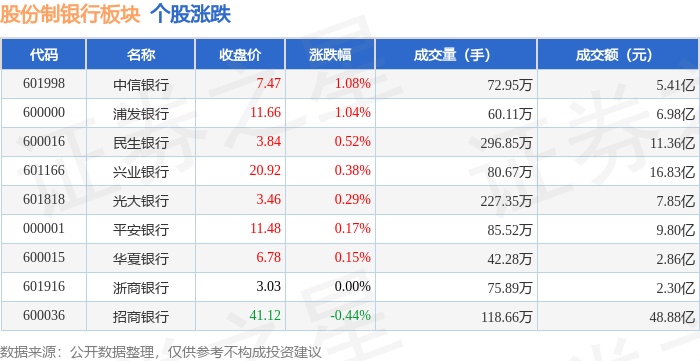
Market Overview - The share price of the joint-stock bank sector decreased by 0.37% compared to the previous trading day, with CITIC Bank leading the decline [1] - The Shanghai Composite Index closed at 3996.94, up 1.18%, while the Shenzhen Component Index closed at 13489.4, up 1.51% [1] Individual Bank Performance - The closing prices and performance of individual banks are as follows: - Everbright Bank: 3.53, unchanged - Pudong Development Bank: 12.97, down 0.08% - Zhejiang Commercial Bank: 3.09, down 0.32% - Ping An Bank: 11.52, down 0.35% - Huaxia Bank: 6.98, down 0.57% - Minsheng Bank: 4.09, down 0.73% - Industrial Bank: 20.43, down 0.83% - China Merchants Bank: 41.59, down 0.86% - CITIC Bank: 7.84, down 1.26% [1] Capital Flow Analysis - The joint-stock bank sector experienced a net outflow of 1.242 billion yuan from main funds, while speculative funds saw a net inflow of 673 million yuan, and retail investors had a net inflow of 568 million yuan [1] - Detailed capital flow for individual banks shows: - Minsheng Bank: Main funds net inflow of 74.6 million yuan, speculative funds net inflow of 50.8 million yuan, retail net outflow of 12.5 million yuan - Huaxia Bank: Main funds net outflow of 2.83 million yuan, speculative funds net inflow of 27.7 million yuan, retail net outflow of 24.9 million yuan - Zhejiang Commercial Bank: Main funds net outflow of 24.3 million yuan, speculative funds net inflow of 17.2 million yuan, retail net inflow of 7.1 million yuan - Everbright Bank: Main funds net outflow of 38.3 million yuan, speculative funds net inflow of 35.7 million yuan, retail net inflow of 2.6 million yuan - CITIC Bank: Main funds net outflow of 106 million yuan, speculative funds net inflow of 45.8 million yuan, retail net inflow of 60.4 million yuan - Ping An Bank: Main funds net outflow of 117 million yuan, speculative funds net inflow of 48.2 million yuan, retail net inflow of 69.3 million yuan - Industrial Bank: Main funds net outflow of 131 million yuan, speculative funds net inflow of 104 million yuan, retail net inflow of 26.7 million yuan - Pudong Development Bank: Main funds net outflow of 137 million yuan, speculative funds net outflow of 106 million yuan, retail net inflow of 24.3 million yuan - China Merchants Bank: Main funds net outflow of 759 million yuan, speculative funds net inflow of 450 million yuan, retail net outflow of 309 million yuan [2]
行业深度报告:零售风险及新规影响有限,兼论信贷去抵押化
KAIYUAN SECURITIES· 2025-10-27 05:44
Investment Rating - The investment rating for the industry is "Positive" (maintained) [1] Core Insights - The report highlights that retail non-performing loan (NPL) rates and generation rates are currently high, indicating ongoing pressure on bank profitability. Despite a low overall NPL rate, the retail sector shows signs of risk, with a marginal increase in the NPL rate to 1.28% [14][15] - The transition period for new risk regulations is nearing its end, with concerns about the impact on banks' provisioning levels. However, the report suggests that the actual impact may be less severe than market expectations [16] - The trend of de-collateralization in bank lending is evident, driven by both business characteristics and strategic choices made by banks to reduce reliance on collateralized loans [17] Summary by Sections 1. Retail NPL and Generation Rates - The retail NPL rate has increased to 1.28%, with a steepening curve indicating ongoing risk. The generation rate for retail loans remains high, with significant increases noted in certain banks [14][18] - The report indicates that while the overall NPL rate is low, the divergence between overdue and NPL indicators suggests underlying risks in the retail sector [19] 2. Impact of New Risk Regulations - The new risk regulations will require banks to classify impaired loans as NPLs, potentially increasing reported NPL rates. However, the report anticipates that the actual provisioning pressure may be manageable [16][17] 3. De-Collateralization in Lending - The report notes a significant decline in the proportion of collateralized loans, with banks shifting towards non-collateralized lending strategies. This shift is influenced by the need to manage risk more effectively [17][18] 4. Investment Recommendations - The report recommends certain state-owned banks due to their customer base advantages and manageable retail risk pressures. It also highlights specific banks such as CITIC Bank and Agricultural Bank of China as beneficiaries of this trend [6]
银行股三季报陆续披露 多家银行业绩均有改善 银行业净息差或企稳(附概念股)
Zhi Tong Cai Jing· 2025-10-27 02:12
Core Viewpoint - The A-share listed banks are expected to show overall revenue and net profit growth in the third quarter of 2025, with improvements in asset quality and a narrowing decline in net interest margins [1][2][3]. Group 1: Financial Performance - Huaxia Bank reported operating income of 64.881 billion yuan, a year-on-year decrease of 8.79%, and net profit attributable to shareholders of 17.982 billion yuan, down 2.86%, with a narrowing decline of 5.09 percentage points compared to the first half of the year [1]. - Chongqing Bank achieved operating income of 11.740 billion yuan, a year-on-year increase of 10.40%, and net profit of 5.196 billion yuan, up 10.42% [2]. - Ping An Bank reported operating income of 100.668 billion yuan, a year-on-year decrease of 9.8%, and net profit of 38.339 billion yuan, down 3.5%, with a narrowing decline compared to the first half of the year [2]. Group 2: Market Trends - Ten banks have seen shareholding increases from shareholders and executives this year, indicating a positive outlook for the banking sector amid macroeconomic stabilization and easing monetary policy [3]. - Analysts expect cumulative revenue and net profit for listed banks in the first three quarters of 2025 to grow by 0.4% and 1.1% year-on-year, respectively, driven by a narrowing decline in net interest margins and reduced credit costs [3]. Group 3: Interest Margin Outlook - Zhongtai Securities suggests that the net interest margin for banks may stabilize in the third quarter due to reduced re-pricing pressure on assets and a greater decline in deposit rates compared to the Loan Prime Rate (LPR) [4]. - The projected increase in net interest margin for the third and fourth quarters is 0.7 basis points and 0.3 basis points, respectively, indicating stability in the banking sector [4]. Group 4: Related Stocks - Goldman Sachs reported that the A-shares and H-shares of major banks have recorded absolute returns of 12% and 21% year-to-date, driven by improvements in asset quality and narrowing declines in net interest margins [5]. - Ping An Insurance increased its stake in Postal Savings Bank, acquiring 6.416 million shares at an average price of 5.3638 HKD per share [6].
本周在售部分纯固收产品近3月年化收益率逼近10%
2 1 Shi Ji Jing Ji Bao Dao· 2025-10-27 01:20
Core Insights - The article emphasizes the abundance of bank wealth management products with similar names and vague characteristics, urging investors to carefully select and differentiate among them [1] - The South Finance Wealth Management team focuses on pure fixed-income products issued by wealth management companies, providing a performance ranking of these products to assist investors in making informed choices [1] Summary by Category Product Performance - The ranking showcases annualized performance over the past month, three months, and six months, sorted by the three-month annualized yield to reflect multi-dimensional performance amid recent market fluctuations [1] - A total of 28 distribution institutions are involved in the ranking, including major banks such as Industrial and Commercial Bank of China, Bank of China, and Agricultural Bank of China [1] Product Availability - The ranking is based on the "on-sale" status of wealth management products, which may vary due to factors like sold-out quotas or differences in product listings for different customers [1] - Investors are advised to refer to the actual display on the distribution bank's app for the most accurate information regarding product availability [1]
银行渠道本周在售最低持有期产品榜单(10/27-11/2)
2 1 Shi Ji Jing Ji Bao Dao· 2025-10-27 01:20
Core Insights - The article emphasizes the abundance of bank wealth management products with similar names and vague characteristics, urging investors to carefully select and differentiate among them [1] - The South Finance Wealth Management team aims to reduce investors' selection costs by focusing weekly on the performance of wealth management products available through various distribution channels [1] Summary by Category Performance Rankings - The current focus is on the performance of public offering products with a minimum holding period in RMB, categorized by holding periods of 7 days, 14 days, 30 days, and 60 days, with annualized returns as the performance metric [1] - The ranking includes 28 distribution institutions such as Industrial and Commercial Bank of China, Bank of China, Agricultural Bank of China, and others [1] Product Availability - The list of products is based on their "on-sale" status, which is determined by their investment cycle; however, actual availability may vary due to factors like sold-out quotas or differences in product listings for different customers [1] - Investors are advised to refer to the actual display on the distribution bank's app for the most accurate information [1] Weekly Updates - The article provides a weekly update on the performance of wealth management products, with specific attention to the lowest holding period products for the week of October 27 to November 2 [5][8][11]
本周聚焦:黄金波动下的机遇与挑战:银行贵金属业务有望成重要增长极
GOLDEN SUN SECURITIES· 2025-10-27 00:58
Investment Rating - The report maintains an "Accumulate" rating for the banking sector, indicating a positive outlook despite challenges in the gold market in 2025 [1]. Core Insights - The gold market is expected to present both opportunities and challenges for banks, with a trend towards deepening precious metal business driven by central bank purchases [1][2]. - The demand for gold bars and coins has increased significantly, reflecting a growing need for gold as a hedge and store of value among residents [4]. - The establishment of a market-making system for gold trading is anticipated to enhance market liquidity and stability, positioning listed banks as key players [3][4]. Summary by Sections 1. Policy and Market Environment - As of September 2025, China's official gold reserves reached 74.06 million ounces, marking an increase for 11 consecutive months [2]. - In Q2 2025, global central banks added 166 tons of gold to their reserves, with 95% of surveyed central banks expecting further increases in the next 12 months [2]. - New policies allowing insurance funds to invest in gold are expected to create new opportunities for banks to provide services to insurance institutions, enhancing their intermediary income [2]. 2. Business Dynamics and Revenue Contribution - In the first half of 2025, China's gold consumption was 505.205 tons, a year-on-year decrease of 3.54%, with significant growth in gold bar and coin consumption by 23.69% [4]. - The decline in gold jewelry consumption is prompting banks to shift focus from traditional jewelry sales to investment-oriented precious metal businesses [4]. - The growth in investment demand for gold bars and coins is expected to stabilize income from investment-related businesses, enhancing the profitability of the precious metals segment for banks [4]. 3. Industry Trends - The report highlights a structural shift in gold consumption, with investment demand rising while jewelry demand declines, indicating a need for banks to adapt their business strategies [4]. - The performance of the banking sector is expected to benefit from expansionary policies aimed at stabilizing the economy, with specific banks like Ningbo Bank and Jiangsu Bank recommended for investment due to positive fundamental changes [8]. 4. Key Data Tracking - The report includes various financial metrics, such as average daily trading volume and margin financing balances, which are essential for assessing market conditions [9][10].
华瑞银行下调存款利率,各地小银行也在下调,零利率时代已到来?
Sou Hu Cai Jing· 2025-10-26 23:09
Core Viewpoint - The report from the Bank of China Research Institute indicates that more banks, particularly small and medium-sized banks, are expected to lower deposit interest rates in the last quarter of 2025, especially for medium- and long-term deposits [1] Group 1: Deposit Rate Changes - In the second quarter, the six major state-owned banks lowered their deposit rates, with the current deposit rate dropping to an unprecedented 0.05%, meaning a deposit of 10,000 yuan yields only 5 yuan in annual interest [3] - The one-year fixed deposit rate is now at 0.95%, while the three-year fixed deposit rate is only 1.25%, aligning with the zero-interest rate environment seen in developed economies [3] - Joint-stock banks have also joined the trend of lowering interest rates, with one-year fixed deposit rates around 1.15%, while some city commercial banks and provincial rural commercial banks have rates between 1% and 1.1% [4] Group 2: Comparison of Bank Rates - A table shows various banks' deposit rates, with state-owned banks offering rates of 0.95% for one-year fixed deposits and 1.25% for three-year fixed deposits, while some smaller banks still maintain higher rates [6] - Smaller banks like Shanghai Huari Bank have begun to lower their deposit rates, but their rates remain higher than those of the six major state-owned banks, with one-year fixed deposit rates at 1.5% and three-year rates at 2.3% [12] Group 3: Economic Context - The decline in deposit rates is attributed to banks' varying operational conditions and the need to lower costs in a competitive lending environment, particularly affecting smaller banks that rely heavily on interest rate spreads [7] - The People's Bank of China has not adjusted the benchmark deposit rates since July 2011, leading to a situation where the rates set by the six major banks effectively replace the central bank's rates [12] - The financial system's structural changes have resulted in deposit rates for major banks nearing zero, with current rates at 0.05% for current accounts and 0.9% for one-year fixed deposits [13]
信用卡债权腾挪背后
Bei Jing Shang Bao· 2025-10-26 15:50
Core Insights - The article discusses the ongoing trend of credit card debt transfer among banks in response to rising non-performing loans and capital pressure, indicating a strategic shift towards optimizing credit structures and managing risks [1][4]. Group 1: Credit Card Debt Transfer Activities - Multiple banks, including Ping An Bank, SPDB, Ningbo Bank, and Huaxia Bank, have been actively transferring credit card debts to local asset management companies (AMCs) to accelerate the clearing of non-performing loans [2][3]. - Ping An Bank has announced several batches of credit card debt transfers in October, emphasizing the legal obligation of debtors to repay the new creditors post-transfer [2][3]. - The trend is not isolated, as other banks like SPDB and Ningbo Bank have also engaged in similar debt transfer agreements with AMCs, highlighting a collective industry response to rising credit card defaults [3][4]. Group 2: Industry Trends and Data - The credit card non-performing loan transfer has become a common practice in the industry, driven by stricter regulations and increasing default rates [5][6]. - As of October 23, Everbright Bank listed seven personal non-performing loan transfer projects, involving a total of 20,516 borrowers with an outstanding principal and interest of 653 million yuan [5]. - Data from the first quarter indicates that the scale of personal non-performing loan transfers reached 37.04 billion yuan, a year-on-year increase of 7.6 times, with credit card overdrafts accounting for 5.19 billion yuan, or 14% of the total [6][7]. Group 3: Implications for Banks - Analysts suggest that the batch transfer of non-performing loans is a key strategy for banks to quickly reduce their non-performing asset scale and release occupied capital, thus meeting regulatory requirements [4][7]. - The transfer process improves asset quality metrics, directly lowering the non-performing loan ratio and enhancing capital adequacy ratios for banks [7][8]. - The shift towards batch transfers is seen as a more efficient and compliant method compared to traditional collection methods, which are often slow and costly [7][8]. Group 4: Challenges and Strategic Recommendations - The article highlights the dual challenge faced by banks, with both non-performing loan balances and rates increasing, necessitating a more nuanced approach to risk management [8][9]. - Large banks are encouraged to explore asset-backed securities (ABS) for non-performing asset management, while smaller banks should focus on batch transfers or revenue rights transfers to clear bad debts [9][10]. - Recommendations for improving risk management include enhancing credit models, leveraging technology for better risk assessment, and educating customers on responsible credit use [10].