
CZBANK(601916)

Search documents
上市股份银行半年净利2781亿增0.3% 总资产73.38万亿平均不良率1.3%
Chang Jiang Shang Bao· 2025-09-04 23:40
Core Insights - The overall performance of listed commercial banks remained stable in a complex external environment during the first half of 2025, with total operating income of 777.42 billion yuan, a year-on-year decrease of approximately 2%, and net profit of 278.125 billion yuan, a slight increase of 0.3% [1][2] Financial Performance - Among the 10 listed banks, only Shanghai Pudong Development Bank and Bohai Bank achieved both revenue and profit growth, indicating a polarized performance trend [2] - The highest operating income was recorded by China Merchants Bank at 169.969 billion yuan, with a net profit of 74.93 billion yuan, followed by Industrial Bank and CITIC Bank with net profits of 43.141 billion yuan and 36.478 billion yuan respectively [2] - Seven banks experienced a decline in operating income, while three banks, including Shanghai Pudong Development Bank, achieved positive growth rates of 2.62%, 7.83%, and 8.14% respectively [2] Interest Income and Fee-Based Income - In the context of declining market interest rates and intensified competition, seven banks reported a year-on-year decrease in net interest income, with only China Merchants Bank, Shanghai Pudong Development Bank, and Minsheng Bank showing growth [3] - The net interest margin for listed banks ranged from 1.32% to 1.88%, with Minsheng Bank being the only bank to see an increase in net interest margin, reaching 1.39% [3] - Four banks, including Industrial Bank and CITIC Bank, reported growth in fee and commission income, while Bohai Bank and Zhejiang Commercial Bank saw significant declines [3] Investment Income - Despite challenges in traditional business revenue growth, investment income showed a positive trend, with eight banks reporting increases, particularly Everbright Bank with a 33.41% year-on-year growth [4] Asset Quality - As of June 30, 2025, the total assets of the 10 listed banks reached 73.38 trillion yuan, with most banks achieving steady asset expansion [5] - The average non-performing loan (NPL) ratio for the listed banks was approximately 1.3%, with four banks showing a decrease compared to the end of 2024 [6] - The NPL ratios for major banks like China Merchants Bank and Ping An Bank improved slightly, while others like Minsheng Bank and Bohai Bank saw slight increases [6] Provision Coverage - Only China Merchants Bank had a provision coverage ratio exceeding 400%, at 410.93%, while several other banks maintained coverage ratios above 200% [7] - Plans for mid-year dividends have been announced by several banks, including China Merchants Bank and Minsheng Bank, with specific cash dividend amounts and payout ratios detailed [7]






7家上市银行私行管理资产余额均超万亿元
Zheng Quan Ri Bao· 2025-09-04 16:18
Core Insights - The private banking sector is identified as a key area for value extraction within retail banking, reflecting the strength of banks' wealth management capabilities [1] - As of mid-2023, most banks reported growth in both the number of private banking clients and assets under management (AUM), indicating a continuous expansion of the high-net-worth wealth management market [1][2] Client Growth - Among the 13 listed banks that disclosed private banking client data, Agricultural Bank, China Bank, and Construction Bank lead with over 200,000 clients each, with respective figures of 279,000, 265,500, and 216,900 [2] - Construction Bank saw a 14.69% increase in private banking clients compared to the end of 2022, while China Bank surpassed the 200,000 client mark [2] - Among national joint-stock banks, China Merchants Bank leads with 182,700 clients, followed by Ping An Bank and CITIC Bank, both exceeding 90,000 clients [2] AUM Performance - Of the 13 banks analyzed, 11 disclosed AUM data, with Agricultural Bank, China Bank, and Construction Bank each exceeding 3 trillion yuan in AUM, at 3.5 trillion, 3.4 trillion, and 3.18 trillion yuan respectively [3] - Traffic Bank's AUM reached 1.39 trillion yuan, reflecting a 7.20% growth since the end of 2022 [3] - Among national joint-stock banks, Ping An Bank, CITIC Bank, and Industrial Bank are part of the "trillion yuan club," with AUM figures of 1.97 trillion, 1.28 trillion, and 1.05 trillion yuan respectively [3] Service Optimization - Private banking has become a significant profit growth point for banks, especially as traditional retail banking growth slows [4] - The sector is evolving from a single financial advisory model to a comprehensive service ecosystem, incorporating diverse products such as family trusts and cross-border asset allocation [4] - Major banks are enhancing their private banking services through product optimization and resource integration, aiming to build a robust service ecosystem [4] Future Directions - The future of private banking is expected to focus on three main areas: deepening digitalization, creating service ecosystems, and expanding global investment options [6] - Digital transformation will leverage technologies like AI and blockchain to enhance client service processes and risk management [6] - The integration of external resources such as legal and tax services will be crucial in developing a comprehensive service framework, particularly for family office and legacy planning services [6]



“把脉”A股42家上市银行中期资产质量:对公贷款不良率持续向好,零售贷款仍处风险暴露期
Mei Ri Jing Ji Xin Wen· 2025-09-04 14:35
Group 1: Overall Asset Quality - As of August 31, 2023, the asset quality of 42 listed banks in A-shares shows a stable improvement, with some banks experiencing a slight increase in non-performing loan (NPL) ratios compared to the end of the previous year [1] - The overall NPL ratio for commercial banks was 1.49% at the end of Q2 2023, improving by 0.02 percentage points from the end of Q1 [3] - The provision coverage ratio for state-owned banks and rural commercial banks increased to 249.16% and 161.87%, respectively, while the ratios for joint-stock banks and city commercial banks decreased [4] Group 2: Non-Performing Loan Trends - The NPL ratio for corporate loans is improving, while the NPL ratio for retail loans is on the rise, indicating a structural change in asset quality [5][6] - For example, Industrial and Commercial Bank of China (ICBC) reported a decrease in corporate loan NPL ratio from 1.58% to 1.47%, while the personal loan NPL ratio increased from 1.15% to 1.35% [5] - The rise in retail loan NPLs is attributed to factors such as market conditions, increased flexible employment, and changes in industry environments affecting borrower income [6] Group 3: Real Estate Loan Performance - The real estate sector remains a significant source of NPLs, with some banks reporting an increase in real estate loan NPL ratios, while others have seen improvements [7][8] - For instance, Qingnong Commercial Bank's real estate NPL ratio rose to 21.32%, an increase of 14.15 percentage points from the end of the previous year [7] - The overall decline in real estate sales and the high leverage of real estate companies are fundamental reasons for the rising NPL ratios in this sector [8]



险资最新重仓股出炉!这一行业受青睐
Zhong Guo Zheng Quan Bao - Zhong Zheng Wang· 2025-09-04 12:17
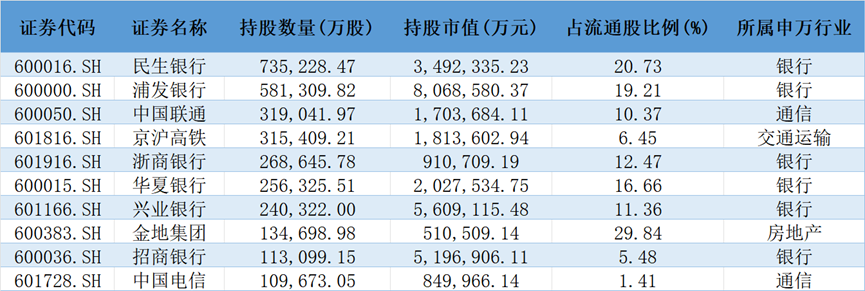
Group 1 - The core viewpoint of the articles indicates that insurance capital (险资) is increasingly favoring bank stocks, with significant holdings in various sectors, particularly banking, transportation, and telecommunications [1][3][5]. - As of the end of Q2 2025, insurance capital held a total of 730 stocks, with a combined holding of 61.919 billion shares valued at 628.985 billion yuan, showing an increase in both quantity and market value compared to Q1 [3][5]. - Among the top ten heavy holdings of insurance capital, six are bank stocks, including Minsheng Bank, Pudong Development Bank, and Zhejiang Bank, highlighting a strong preference for the banking sector [3][4]. Group 2 - Insurance capital is expected to continue optimizing its equity investment structure, focusing on high-dividend stocks and new productive forces in the upcoming quarters [2][8]. - In Q2, insurance capital increased its holdings in several key stocks, including CITIC Bank, Beijing-Shanghai High-Speed Railway, and China Telecom, with significant increases in share quantities [6][7]. - The insurance sector is actively seeking investment opportunities in high-dividend and innovative sectors, with a focus on technology innovation, advanced manufacturing, and new consumption [8].




浙商银行合肥分行力推“商转公”贷款 为职工“钱袋子”减负增效
Zhong Guo Jin Rong Xin Xi Wang· 2025-09-04 11:55
Core Viewpoint - Zhejiang Merchants Bank Hefei Branch is actively promoting the "Commercial to Public" loan business to expand the benefits of housing provident fund policies for employees and the public [1] Group 1: Policy Implementation - The bank is conducting outreach activities to provide policy services in various sectors, including government agencies, enterprises, communities, business circles, and parks [1] - The bank has issued a "Commercial to Public Loan Application Guide" and is providing face-to-face explanations and case analyses to clarify application conditions, processes, and required materials [1] - The bank aims to shift from a model where individuals seek policies to one where policies are delivered to the public, thereby increasing awareness of the policies [1] Group 2: Operational Improvements - A performance assessment method for the "Commercial to Public" loan business window has been established to enhance the motivation of staff [1] - The bank is strengthening collaboration with the housing fund center and real estate registration service center to address business risk prevention, operational processes, and mortgage rights transfer [1] - The bank offers pre-acceptance services for "Commercial to Public" loans for clients from non-original lending banks, allowing all commercial bank loans to apply for this service [1] Group 3: Future Plans - The bank plans to continue implementing stronger policies, more accessible promotional methods, and warmer service experiences to address public concerns effectively [1] - The goal is to make the housing provident fund policies easier to understand, services more convenient, and protections more robust [1]

工行稳居上半年投资收益冠军 中行、交行、兴业等下降
2 1 Shi Ji Jing Ji Bao Dao· 2025-09-04 09:27
Core Viewpoint - In the first half of 2025, A-share listed banks reported significant investment income growth, with non-interest income becoming a crucial revenue pillar amid weak credit demand [2][3]. Investment Income Performance - 42 listed banks achieved substantial investment income, with 13 banks exceeding 10 billion yuan in investment income [2]. - The Industrial and Commercial Bank of China (ICBC), China Construction Bank (CCB), Agricultural Bank of China (ABC), and China Merchants Bank (CMB) each reported over 20 billion yuan in investment income [2][3]. - CCB led with a remarkable 217.29% year-on-year increase in investment income, reaching 27.912 billion yuan [3][9]. Growth Rates - Several banks exhibited impressive growth rates, with CCB at 217.29%, followed by Changsha Bank at 118.82%, and Zhengzhou Bank at 111.10% [3]. - Other banks with notable growth include Qingdao Bank (93.93%) and Zijin Bank (95.41%) [3]. Contribution to Revenue - Investment income's contribution to total revenue varies significantly, with large state-owned banks focusing more on lending, while smaller banks rely heavily on investment income [6]. - For instance, investment income accounted for 39.14% of Shanghai Bank's revenue, while state-owned banks like ICBC and CCB had lower ratios below 10% [6]. Market Conditions and Strategies - The investment income surge is partly attributed to favorable conditions in the bond market last year, with banks capitalizing on market opportunities [4][10]. - Despite the current challenges in the bond market, banks like CCB have increased their holdings in government bonds and green bonds, reflecting a strategic shift [5][10]. Future Outlook - The sustainability of high investment income growth is under scrutiny, as banks may face challenges in maintaining high yields amid a potential "asset shortage" [7]. - Industry experts suggest that while the bond market may present opportunities, the overall investment landscape is becoming increasingly difficult [11].
银行研究框架及25H1业绩综述:营收及利润增速双双转正
GOLDEN SUN SECURITIES· 2025-09-04 06:14
Investment Rating - The report indicates a positive outlook for the banking industry, with overall revenue and net profit growth rates turning positive in the first half of 2025, at 1.0% and 0.8% respectively, showing improvements from the previous quarter [4]. Core Insights - The banking sector's net interest margin for the first half of 2025 is reported at 1.42%, a decrease of 10 basis points compared to the previous year, but the decline is narrowing due to improved cost management on the liability side [5]. - Non-interest income, particularly from fees and commissions, has increased by 3.1% year-on-year, driven by a recovery in wealth management and a more active market environment [5]. - The asset quality remains stable, with a non-performing loan ratio of 1.23% and a provision coverage ratio of 239%, indicating a solid credit environment [5]. Summary by Sections Financial Performance Overview - The overall revenue and net profit growth for listed banks in the first half of 2025 were 1.0% and 0.8%, respectively, with both metrics showing improvement from the first quarter [4][22]. - The total assets of listed banks reached 321.3 trillion yuan, growing by 6.35% year-to-date, with loans and advances totaling 179.4 trillion yuan, accounting for 55.84% of total assets [21][24]. Income Sources - Net interest income decreased by 1.3% year-on-year, but the decline rate has slowed, reflecting better management of funding costs [5]. - Fee and commission income grew by 3.1% year-on-year, benefiting from a recovering market and the gradual impact of regulatory changes [5]. - Other non-interest income saw a significant increase of 10.7%, primarily due to favorable market conditions in the bond market [5]. Asset Quality and Management - The non-performing loan ratio remained stable at 1.23%, with a provision coverage ratio of 239%, indicating a robust asset quality [5]. - The credit cost for the first half of 2025 was 0.81%, a decrease of 5 basis points year-on-year, suggesting manageable credit risks [5]. Loan Growth and Composition - Loan growth was primarily driven by corporate lending, with significant contributions from infrastructure and manufacturing sectors [20]. - Personal loan growth was weaker, with a year-on-year increase of only 3.6%, reflecting a cautious approach to consumer lending amid rising risks [20]. Investment and Market Conditions - The investment asset proportion decreased to 34% as banks adjusted their strategies in response to market volatility [20]. - The overall yield on bonds fluctuated significantly, prompting banks to engage in tactical trading to enhance returns [20].
商业银行“降成本”举措显效
Jin Rong Shi Bao· 2025-09-04 03:03
Core Insights - Major commercial banks in China have shown solid performance in managing costs and optimizing asset-liability structures, contributing to stable growth in operating results [1][4] - In the first half of 2025, 42 A-share listed banks achieved operating income exceeding 2.9 trillion yuan, a year-on-year increase of over 1%, and a net profit of 1.1 trillion yuan, up 0.8% year-on-year [1] - Several banks, including Industrial and Commercial Bank of China (ICBC), Agricultural Bank of China (ABC), China Construction Bank (CCB), and Postal Savings Bank of China (PSBC), reported net profits exceeding 100 billion yuan [1] Cost Management - Construction Bank reported a cost-to-income ratio of 23.72%, a decrease of 0.43 percentage points year-on-year, highlighting effective cost management [1] - PSBC achieved a significant reduction in its cost-to-income ratio by 5.15 percentage points through various cost control measures [1] - Bank of China reported a cost-to-income ratio of 25.11%, emphasizing its focus on reducing costs and improving efficiency [2] Asset-Liability Management - Agricultural Bank of China has focused on controlling key expenses and reducing flexible costs to save on expenditures [3] - Several banks, including ICBC and CCB, have successfully lowered their deposit interest rates, with ICBC's rate decreasing by 26 basis points and CCB's by 32 basis points [4] - Postal Savings Bank's self-operated deposit interest rate fell by 20 basis points to around 1.1%, indicating a trend of decreasing funding costs [4] Revenue Generation - Shanghai Pudong Development Bank reported a cost reduction of over 140 million yuan through effective management of rental costs and the disposal of idle properties [3] - China Everbright Bank has focused on optimizing its funding costs and increasing high-quality deposits, leading to stable profit growth [5][6] - Zhejiang Merchants Bank saw its deposit interest rate decrease by 31 basis points to 1.88%, while its total deposits grew by 7.47% year-on-year [4]
浙商银行济宁分行“房抵贷”,助力金乡水产龙头扩容升级
Qi Lu Wan Bao Wang· 2025-09-04 01:29
Core Insights - The article highlights the rapid response of Zhejiang Commercial Bank in providing a loan to a local seafood business, enabling its expansion during a peak sales season [1][2]. Group 1: Business Expansion - The seafood business, Xiaoyudian, has an annual sales revenue exceeding 50 million yuan and is expanding its operations by acquiring adjacent property to create a comprehensive wholesale and retail space [2]. - The business faced a funding gap of 1.6 million yuan for renovations, which was critical to complete before the peak sales season to avoid losing orders and to capitalize on a projected 30% sales growth [2]. Group 2: Financial Solutions - Traditional bank loans typically require at least two weeks for approval, which was a significant barrier for the business [2]. - The introduction of the "house collateral loan" product by Zhejiang Commercial Bank allowed for a rapid approval process, with funds disbursed within two days, significantly improving the business's cash flow situation [2][3]. Group 3: Government and Bank Collaboration - The collaboration between Zhejiang Commercial Bank and the local government facilitated a "green channel" for property registration, reducing the process from five days to under one day [3]. - The bank implemented a digital approval system that automated property valuation and data verification, streamlining the loan process for small businesses [3]. Group 4: Economic Impact - The bank has disbursed over 113 million yuan in "house collateral loans" in the Jining area, with an average approval time of 48 hours, demonstrating a commitment to supporting the local economy [4]. - The expansion of Xiaoyudian is expected to increase daily customer traffic by 40% during the National Day holiday, positively impacting local suppliers and the broader seafood market [4].
信用卡业务“跑马圈地”退潮后,转型创新路在何方?
Bei Jing Shang Bao· 2025-09-03 15:01
Core Insights - The credit card business in China's banking sector is undergoing a significant adjustment, shifting from an era of aggressive expansion to a focus on optimizing existing customer bases and asset quality [1][2][3] Group 1: Credit Card Business Performance - In the first half of 2025, 11 out of 15 listed banks reported a decline in credit card loan balances, with China Bank showing the most significant reduction of 13.89% to 510.97 billion yuan [2] - The total credit card loan balance for the 15 banks showed a mixed trend, with only four banks, including Industrial and Agricultural Banks, experiencing growth [2] - Credit card transaction volumes also declined, with a notable drop of 8.54% for China Merchants Bank, despite leading the sector with a transaction amount of 2.02 trillion yuan [3] Group 2: Bad Debt and Risk Management - The total bad credit card loans across 11 banks reached 162.69 billion yuan, an increase of 5.88 billion yuan from the beginning of the year, with notable increases in bad loans for banks like China Communications Bank and Industrial Bank [4] - Only three banks managed to improve their bad loan ratios, while eight banks, including China Merchants Bank and Industrial Bank, saw increases in their bad loan ratios [4] - The overall credit card market is experiencing a contraction, with the total number of credit cards decreasing to 715 million by Q2 2025, down from 727 million in Q4 2024 [5] Group 3: Strategic Adjustments and Future Directions - Banks are actively working to optimize asset quality and manage bad debts, with nearly a thousand bad loan transfer announcements made in 2025 [6] - The focus is shifting towards product innovation and differentiated competition, emphasizing quality over quantity in credit card offerings [6][7] - Strategies include targeting high-end customers and meeting basic customer needs, with an emphasis on enhancing customer experience and integrating credit cards with other retail banking services [7]
