CCB(601939)

Search documents
建设银行取得一种次索引转存方法、装置、设备及存储介质专利
Sou Hu Cai Jing· 2025-12-03 07:09
声明:市场有风险,投资需谨慎。本文为AI基于第三方数据生成,仅供参考,不构成个人投资建议。 来源:市场资讯 国家知识产权局信息显示,中国建设银行股份有限公司取得一项名为"一种次索引转存方法、装置、设 备及存储介质"的专利,授权公告号CN 114090622 B,申请日期为2021年11月。 天眼查资料显示,中国建设银行股份有限公司,成立于2004年,位于北京市,是一家以从事货币金融服 务为主的企业。企业注册资本25001097.7486万人民币。通过天眼查大数据分析,中国建设银行股份有 限公司共对外投资了1037家企业,参与招投标项目5000次,财产线索方面有商标信息1908条,专利信息 5000条,此外企业还拥有行政许可149个。 ...

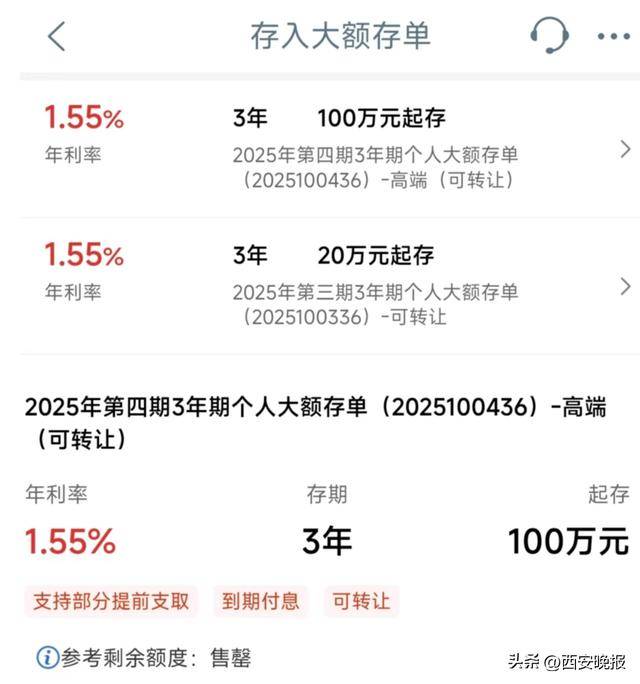
大额存单起存门槛升高,存100万与存20万利率相同
Sou Hu Cai Jing· 2025-12-03 06:44
Core Viewpoint - The latest issuance of 3-year large-denomination certificates of deposit (CDs) by Industrial and Commercial Bank of China (ICBC) has seen the minimum deposit requirement raised to 1 million yuan, with an interest rate of 1.55%, which is currently sold out [1][5]. Group 1: Large-Denomination CDs - The current 3-year large-denomination CDs from ICBC have a minimum deposit of 1 million yuan and an interest rate of 1.55% [1][2]. - Previously, ICBC offered a 3-year large-denomination CD with a minimum deposit of 200,000 yuan, also at an interest rate of 1.55% [1][2]. - Other banks, such as China Construction Bank, Agricultural Bank of China, and Bank of China, also offer 3-year large-denomination CDs with a minimum deposit of 200,000 yuan at the same interest rate of 1.55% [5]. Group 2: Market Dynamics and Strategies - The increase in the minimum deposit requirement for large-denomination CDs without a corresponding increase in interest rates reflects banks' proactive liability management strategies in a low-interest-rate environment [5][6]. - By raising the minimum deposit amount, banks are effectively tightening the supply of large-denomination CDs, aiming to optimize their liability structure and reduce reliance on high-cost deposits [5]. - The main advantages of large-denomination CDs over regular deposits include higher liquidity and flexibility, such as transfer and pledge capabilities, making them suitable for large depositors with short-term funding needs [6].



中国建设银行以实干担当书写内涵式高质量发展新篇章
Jin Rong Shi Bao· 2025-12-03 01:48
Core Viewpoint - The China Construction Bank (CCB) emphasizes high-quality development as its primary task during the "14th Five-Year Plan" period, focusing on enhancing its capabilities in serving national construction, preventing financial risks, and participating in international competition [1][11]. Group 1: Financial Performance - As of September 2025, CCB's total assets exceeded 45 trillion yuan, a 61% increase from the end of 2020, while total liabilities surpassed 41 trillion yuan, growing by 62% [1]. - The bank's technology loans reached a balance of 5.26 trillion yuan, serving over 300,000 enterprises, establishing itself as a reliable financial partner for technological innovation [7]. - CCB's inclusive finance loan balance reached 3.81 trillion yuan, 2.63 times higher than at the end of 2020, serving 3.7 million loan customers [8]. Group 2: Governance and Leadership - CCB integrates the leadership of the Communist Party into its management processes, ensuring that political advantages are transformed into effective financial governance [2]. - The bank has improved its corporate governance structure, enhancing decision-making quality and efficiency through a dual-entry and cross-appointment leadership system [2]. Group 3: Risk Management - CCB has established a comprehensive risk management system to prevent systemic financial risks, focusing on early identification and resolution of risks in key areas such as real estate and local government debt [12]. - The bank has implemented the "Blue Core" project, a self-developed risk management system, to enhance its risk control capabilities across all business processes [12]. Group 4: Talent Development - CCB has made significant progress in talent development, adhering to the principle of party leadership in talent management and implementing a mechanism for selecting and appointing cadres [4]. - The bank has launched a program to cultivate outstanding young and middle-aged cadres, fostering a high-quality professional talent pool [4]. Group 5: Innovation and Services - CCB is advancing its "Five Major Articles" strategy, focusing on technology finance, green finance, inclusive finance, pension finance, and digital finance to provide high-quality financial services [7][8][9]. - The bank has developed a diversified service system for green finance, with a green loan balance of 5.89 trillion yuan and over 250 billion yuan invested in green projects [7]. Group 6: International Competitiveness - CCB is enhancing its international competitiveness by supporting the Belt and Road Initiative and providing comprehensive financial services for cross-border projects [12]. - The bank has organized over 440 cross-border matchmaking events, serving more than 27,000 domestic and foreign enterprises [12]. Group 7: Reform and Development - CCB is committed to deepening reforms to enhance its operational efficiency and service quality, aligning with national development strategies [15][16]. - The bank has established a unified management framework to optimize its internal systems and improve customer service [16][17]. Group 8: Future Outlook - CCB plans to align its strategies with the "15th Five-Year Plan," focusing on high-quality development and contributing to the modernization of China's economy [18].

中法跨境资本市场交流活动在巴黎举行
Xin Hua Cai Jing· 2025-12-03 00:45
Core Insights - The event celebrating the 10th anniversary of China Construction Bank's Paris branch highlighted the deepening Sino-French financial cooperation and the potential for collaboration in green development and technological innovation [1][2][3] Group 1: Financial Cooperation - The Chinese Embassy in France emphasized the importance of financial institutions like China Construction Bank in enhancing Sino-French trade and investment [1] - The Paris branch has integrated into the local financial ecosystem, showcasing China's large financial institutions as stable and professional [2] - The bank aims to facilitate the "going out" of Chinese enterprises and the "bringing in" of French enterprises, optimizing resource allocation and promoting efficient flow of factors [2][3] Group 2: Market Opportunities - The event featured discussions on new opportunities in green finance, digital economy, and cross-border investment, indicating a new cycle of capital cooperation between China and France [2] - The bank presented its capabilities in panda bond issuance, RMB asset allocation, and cross-border financing, which garnered significant interest from attendees [3] - Participants expressed confidence in China's market openness and the transparency of its policies, which enhances certainty in business collaborations [3]
华夏沪深300指数量化增强型证券投资基金基金份额发售公告
Shang Hai Zheng Quan Bao· 2025-12-02 18:13
Group 1 - The fund is named "Huaxia CSI 300 Index Quantitative Enhanced Securities Investment Fund" and has been approved for registration by the China Securities Regulatory Commission [1] - The fund is an open-ended stock fund with a total fundraising cap of RMB 8 billion, using a "last day proportion confirmation" method for scale control [6][12] - The fund will be publicly offered from December 8, 2025, to December 26, 2025, with a maximum fundraising period of three months [20] Group 2 - The fund offers two classes of shares: Class A shares, which charge a front-end subscription fee, and Class C shares, which do not charge subscription fees but deduct sales service fees from the fund's assets [9][11] - The initial value of each share for both Class A and Class C is set at RMB 1.00 [17] - Investors can subscribe for shares with a minimum amount of RMB 1.00 through direct sales or designated agents, with specific rules for each sales institution [21][22] Group 3 - The fund's subscription applications will be accepted by sales institutions, but acceptance does not guarantee successful confirmation; confirmation is subject to the registration institution's verification [5][51] - If a single investor's subscription exceeds 50% of the fund's shares, the fund manager has the right to reject the application to ensure compliance with the limit [21] - Investors must ensure that their subscription funds are legally sourced and comply with anti-money laundering requirements [8] Group 4 - The fund's assets may be invested in various financial instruments, including stocks, depositary receipts, and derivatives, which may expose it to various risks [9][8] - The fund aims to achieve returns that exceed the benchmark index while controlling tracking error, but there is a risk of underperformance [7] - The fund's performance and net asset value are not guaranteed, and past performance does not predict future results [9][63]
多家银行陆续调整代销基金风险等级
Zheng Quan Ri Bao Zhi Sheng· 2025-12-02 16:12
Core Viewpoint - Several banks, including China Construction Bank, have raised the risk levels of their distributed public funds, driven by stricter regulations and changing market conditions [1][2]. Group 1: Risk Level Adjustments - China Construction Bank announced an increase in risk levels for 87 public fund products, with 32 products moving from R2 (low to medium risk) to R3 (medium risk) and 55 products from R3 to R4 (medium to high risk) [2]. - Other banks, such as Minsheng Bank, have also adjusted risk levels for their distributed funds multiple times this year, indicating a broader trend across the banking sector [2][3]. Group 2: Market Environment Impact - The increase in risk levels is linked to rising volatility in the bond market, which affects the stability of bond fund net values, and the upward movement in equity markets, which increases the volatility of mixed funds [3]. Group 3: Implications for Wealth Management - More accurate risk ratings help banks fulfill their suitability management obligations, reduce future complaints and litigation risks, and enhance their brand reputation [4]. - However, the short-term challenge includes potential mismatches between the new risk levels and existing customer risk tolerances, which may lead to increased redemption rates and pressure on sales commissions [4]. Group 4: Investor Considerations - The adjustment in risk levels directly impacts ordinary investors, who may face decisions regarding redemption or reallocation of their investments due to mismatches in risk tolerance [4]. - Long-term, these adjustments are seen as a protective measure for investor rights, promoting transparency in risk disclosure and helping investors set realistic expectations [4]. Group 5: Recommendations for Investors - Investors are advised to reassess their risk tolerance, review their current holdings against new risk levels, and diversify their portfolios to mitigate risks [5]. - It is also recommended that investors focus on understanding product details beyond just risk ratings and maintain patience with quality products aligned with long-term goals [5].

建设银行全国首笔“集群快贷”业务落地冠县支行
Qi Lu Wan Bao· 2025-12-02 14:36
Group 1 - The core point of the article highlights the successful implementation of the "Cluster Quick Loan" business by China Construction Bank, marking a new path for financial services in industrial clusters [1][4] - The "Cluster Quick Loan" addresses the financing challenges faced by small and medium-sized enterprises (SMEs) in the coated steel plate industry cluster, which is the largest national characteristic industrial base in the local economy [2][4] - The innovative financing model combines "Cluster Quick Loan + collateral + supervision," leveraging government data and inventory pledges to create a comprehensive risk control system covering the entire production process [3][4] Group 2 - The successful loan of 6 million yuan to a local coated steel plate manufacturing company demonstrates the effectiveness of the new financing model in alleviating urgent procurement needs [1][4] - The collaboration between the local government and financial institutions has led to the establishment of the "Crown Chain" supply chain financial service platform, providing reliable transaction data and risk management support [3] - The implementation of this financing model serves as a replicable and promotable "Crown County model," enhancing the efficiency of the industrial chain and stability of the supply chain [4]
建行吉林省分行:适老服务暖桑榆 反诈科普筑防线
Zhong Guo Jin Rong Xin Xi Wang· 2025-12-02 12:18
Core Viewpoint - China Construction Bank's Jilin Branch is enhancing financial services for the elderly by focusing on community engagement, risk prevention, and personalized service delivery, creating a warm and comprehensive pension financial service system [1][4]. Group 1: Community Engagement - The Jilin Branch has mobilized various service teams to extend financial services to communities, addressing the needs of elderly clients who may have mobility issues or live alone [1][2]. - Specific initiatives include on-site services for urgent issues such as Medicare card password resets and pension withdrawals, significantly reducing the time and effort required for elderly clients to access services [2]. Group 2: Financial Education and Fraud Prevention - The bank has implemented innovative financial education programs tailored for the elderly, utilizing relatable language and local dialects to explain banking operations and fraud prevention techniques [3]. - Activities include the establishment of financial awareness stations and the use of engaging formats like "talk shows" to make learning about financial safety enjoyable and memorable for older adults [3]. Group 3: Integration of Financial and Community Services - The Jilin Branch is exploring a "finance + community" service model, breaking down barriers between financial institutions and residents, and actively engaging in community events to foster relationships [4]. - By offering bundled services such as social security card processing and financial consultations directly in communities, the bank enhances accessibility and builds trust with local populations [4]. Group 4: Future Plans - The Jilin Branch plans to continuously optimize service processes and expand coverage for elderly financial services, aiming for a more refined and professional approach to ensure a secure and harmonious financial environment for seniors [5].
六大行已全面停售5年期大额存单
Jin Rong Shi Bao· 2025-12-02 12:10
Core Viewpoint - Major state-owned banks in China have completely stopped offering 5-year large denomination certificates of deposit (CDs), with some joint-stock banks and city commercial banks also following suit by reducing long-term deposit products [1][9]. Group 1: Changes in Deposit Products - The six major state-owned banks have significantly shortened the maturity structure of their large denomination CDs, now only offering products with maturities of 1 month, 3 months, 6 months, 1 year, 2 years, and 3 years [3][9]. - The interest rates for the 3-year large denomination CD is 1.55%, while the 1-year and 2-year products have interest rates of 1.20% [3]. Group 2: Withdrawal of 5-Year CDs - The 5-year large denomination CDs have been removed from the product offerings of several banks, including China Bank, Construction Bank, and Postal Savings Bank, with no trace of 5-year products in Agricultural Bank's catalog from 2018 to 2025 [9][10]. - The withdrawal of 5-year large denomination CDs has been a gradual process, as evidenced by China Bank's earlier announcement in May 2023, which included 5-year products but was limited to specific customers [9][10]. Group 3: Availability of Other Maturities - The 3-year large denomination CDs have also become scarce this year, with banks like China Merchants Bank confirming that both 3-year and 5-year options are no longer available [11]. - The longest available term for large denomination CDs is now 2 years, with an interest rate of 1.40% [11].



银行直供房批量上架,还是没人买
Xin Lang Cai Jing· 2025-12-02 11:45
Core Insights - The rise of "bank direct supply housing" has garnered attention due to its price advantages, but complexities and risks associated with certain properties deter ordinary buyers [2][18] - Major banks are accelerating asset liquidation as year-end approaches, with significant volumes of properties being auctioned through platforms like Alibaba and JD [4][20] - Despite attractive pricing, many properties are facing high rates of unsold listings and repeated auctions, indicating a lack of buyer interest [9][25] Group 1: Definition and Market Dynamics - "Bank direct supply housing" refers to properties obtained by banks through judicial processes after borrower defaults, allowing banks to sell with complete ownership [6][22] - The volume of properties listed for sale has surged, with banks like Lanzhou Bank and Jilin Bank significantly increasing their offerings, indicating a shift in asset disposal strategies [7][23] - The recovery rate for non-performing assets through direct sales is reported to be 15%-20% higher than traditional debt transfer methods, enhancing banks' efficiency in asset management [7][23] Group 2: Pricing and Market Response - "Bank direct supply housing" typically offers prices 20%-30% lower than market evaluations, with some properties discounted by over 50% [8][24] - Despite these discounts, many properties remain unsold, with over 9,000 listings entering second auction phases, highlighting a disconnect between pricing and buyer demand [9][25] - Specific examples illustrate the challenges, such as properties that failed to attract bids even after price reductions, indicating potential issues with property desirability [11][27] Group 3: Risks and Considerations - Buyers are cautioned to scrutinize the reasons behind low pricing, as properties may have underlying issues such as lack of liquidity or legal complications [30][32] - The cleanliness of the asset is a critical factor, as buyers must ensure that properties are legally compliant and free from outstanding debts or occupancy issues [30][32] - The expansion of bank direct sales poses both risks and opportunities for real estate agents, as banks may require professional assistance in property sales despite not traditionally being in the real estate business [30][32]