CCB(601939)

Search documents
建行吉林省分行:适老服务暖桑榆 反诈科普筑防线
Zhong Guo Jin Rong Xin Xi Wang· 2025-12-02 12:18
Core Viewpoint - China Construction Bank's Jilin Branch is enhancing financial services for the elderly by focusing on community engagement, risk prevention, and personalized service delivery, creating a warm and comprehensive pension financial service system [1][4]. Group 1: Community Engagement - The Jilin Branch has mobilized various service teams to extend financial services to communities, addressing the needs of elderly clients who may have mobility issues or live alone [1][2]. - Specific initiatives include on-site services for urgent issues such as Medicare card password resets and pension withdrawals, significantly reducing the time and effort required for elderly clients to access services [2]. Group 2: Financial Education and Fraud Prevention - The bank has implemented innovative financial education programs tailored for the elderly, utilizing relatable language and local dialects to explain banking operations and fraud prevention techniques [3]. - Activities include the establishment of financial awareness stations and the use of engaging formats like "talk shows" to make learning about financial safety enjoyable and memorable for older adults [3]. Group 3: Integration of Financial and Community Services - The Jilin Branch is exploring a "finance + community" service model, breaking down barriers between financial institutions and residents, and actively engaging in community events to foster relationships [4]. - By offering bundled services such as social security card processing and financial consultations directly in communities, the bank enhances accessibility and builds trust with local populations [4]. Group 4: Future Plans - The Jilin Branch plans to continuously optimize service processes and expand coverage for elderly financial services, aiming for a more refined and professional approach to ensure a secure and harmonious financial environment for seniors [5].
六大行已全面停售5年期大额存单
Jin Rong Shi Bao· 2025-12-02 12:10
Core Viewpoint - Major state-owned banks in China have completely stopped offering 5-year large denomination certificates of deposit (CDs), with some joint-stock banks and city commercial banks also following suit by reducing long-term deposit products [1][9]. Group 1: Changes in Deposit Products - The six major state-owned banks have significantly shortened the maturity structure of their large denomination CDs, now only offering products with maturities of 1 month, 3 months, 6 months, 1 year, 2 years, and 3 years [3][9]. - The interest rates for the 3-year large denomination CD is 1.55%, while the 1-year and 2-year products have interest rates of 1.20% [3]. Group 2: Withdrawal of 5-Year CDs - The 5-year large denomination CDs have been removed from the product offerings of several banks, including China Bank, Construction Bank, and Postal Savings Bank, with no trace of 5-year products in Agricultural Bank's catalog from 2018 to 2025 [9][10]. - The withdrawal of 5-year large denomination CDs has been a gradual process, as evidenced by China Bank's earlier announcement in May 2023, which included 5-year products but was limited to specific customers [9][10]. Group 3: Availability of Other Maturities - The 3-year large denomination CDs have also become scarce this year, with banks like China Merchants Bank confirming that both 3-year and 5-year options are no longer available [11]. - The longest available term for large denomination CDs is now 2 years, with an interest rate of 1.40% [11].







银行直供房批量上架,还是没人买
Xin Lang Cai Jing· 2025-12-02 11:45
Core Insights - The rise of "bank direct supply housing" has garnered attention due to its price advantages, but complexities and risks associated with certain properties deter ordinary buyers [2][18] - Major banks are accelerating asset liquidation as year-end approaches, with significant volumes of properties being auctioned through platforms like Alibaba and JD [4][20] - Despite attractive pricing, many properties are facing high rates of unsold listings and repeated auctions, indicating a lack of buyer interest [9][25] Group 1: Definition and Market Dynamics - "Bank direct supply housing" refers to properties obtained by banks through judicial processes after borrower defaults, allowing banks to sell with complete ownership [6][22] - The volume of properties listed for sale has surged, with banks like Lanzhou Bank and Jilin Bank significantly increasing their offerings, indicating a shift in asset disposal strategies [7][23] - The recovery rate for non-performing assets through direct sales is reported to be 15%-20% higher than traditional debt transfer methods, enhancing banks' efficiency in asset management [7][23] Group 2: Pricing and Market Response - "Bank direct supply housing" typically offers prices 20%-30% lower than market evaluations, with some properties discounted by over 50% [8][24] - Despite these discounts, many properties remain unsold, with over 9,000 listings entering second auction phases, highlighting a disconnect between pricing and buyer demand [9][25] - Specific examples illustrate the challenges, such as properties that failed to attract bids even after price reductions, indicating potential issues with property desirability [11][27] Group 3: Risks and Considerations - Buyers are cautioned to scrutinize the reasons behind low pricing, as properties may have underlying issues such as lack of liquidity or legal complications [30][32] - The cleanliness of the asset is a critical factor, as buyers must ensure that properties are legally compliant and free from outstanding debts or occupancy issues [30][32] - The expansion of bank direct sales poses both risks and opportunities for real estate agents, as banks may require professional assistance in property sales despite not traditionally being in the real estate business [30][32]

再见了,5年期大额存单!
Xin Lang Cai Jing· 2025-12-02 11:44
Core Viewpoint - The recent collective withdrawal of 5-year large deposits by six major state-owned banks has raised concerns among ordinary depositors regarding asset allocation [2][13]. Group 1: Withdrawal of Long-term Deposit Products - Six major state-owned banks, including Industrial and Commercial Bank of China, Agricultural Bank of China, Bank of China, China Construction Bank, Bank of Communications, and Postal Savings Bank of China, have completely stopped offering 5-year large deposits [2][13]. - The exit of 5-year large deposits is not sudden; for instance, Bank of China had previously announced the sale of various deposit terms, including 5-year deposits, but limited them to specific customers [8][19]. - The availability of 3-year large deposits has also become scarce, with some banks indicating that the longest available term is now 2 years at a rate of 1.40% [10][21]. Group 2: Impact on Depositors - The reduction of long-term deposit products has left ordinary depositors in a dilemma regarding asset allocation, as many are uncertain about where to place their funds [11][22]. - A representative case is highlighted where a depositor with 1 million yuan intended to invest in a 5-year large deposit for stable returns but found no available options [11][22]. Group 3: Industry Response and Trends - The trend of withdrawing long-term deposit products reflects banks' reluctance to absorb higher-cost long-term liabilities due to pressure on interest margins, leading them to lower rates or reduce the supply of long-term products [11][22]. - The industry is being compelled to accelerate transformation, with suggestions for banks to expand non-interest income through wealth management and custodial services while stabilizing net interest margins [11][22].

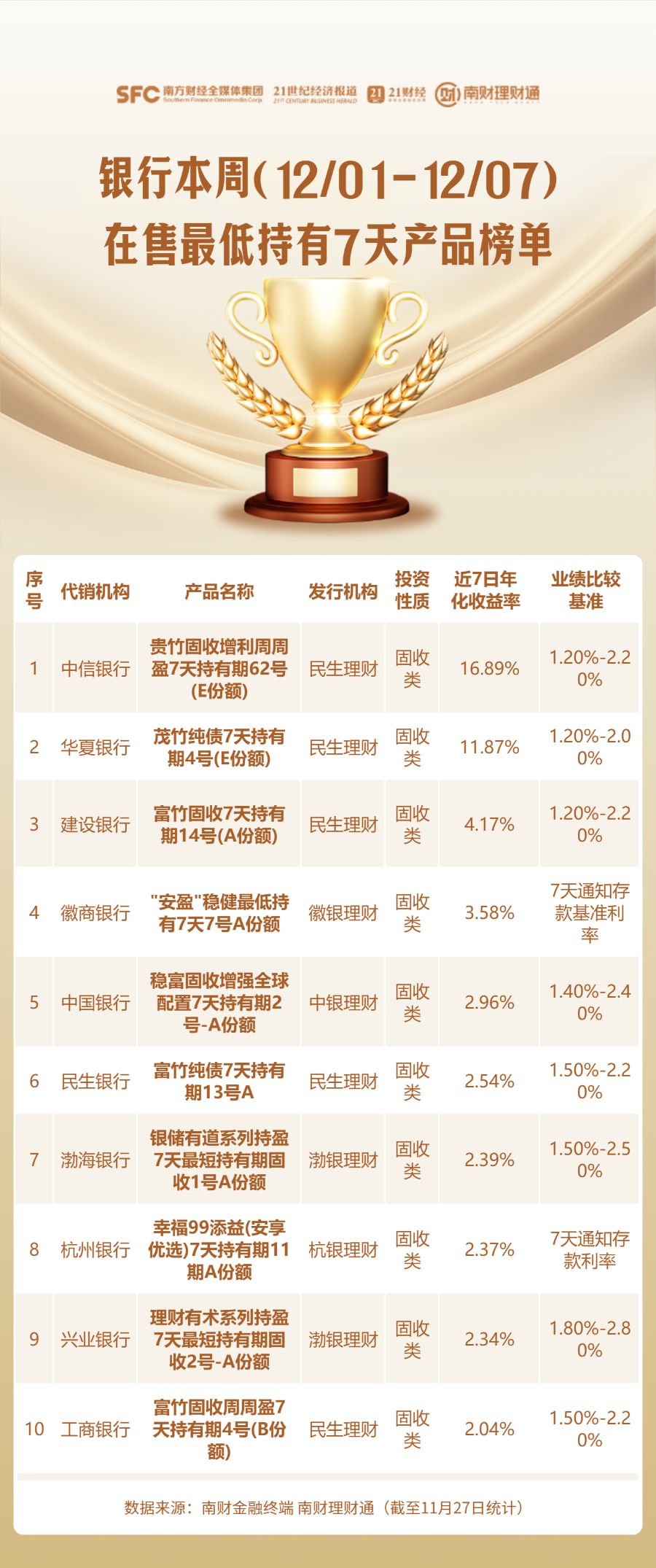
哪家商业银行最低持有期理财产品收益更高?
2 1 Shi Ji Jing Ji Bao Dao· 2025-12-02 10:37
Core Insights - The article focuses on the performance of minimum holding period RMB public offering products, ranking them based on annualized returns for holding periods of 7, 14, 30, and 60 days [1][4][12] Group 1: 7-Day Holding Period Products - The top-performing product is from Minsheng Bank with an annualized return of 4.17% [3] - Other notable products include: - Huishang Bank with 3.58% [3] - Bank of China with 2.96% [3] - Minsheng Bank's Fuzhu Pure Bond with 2.54% [3] - Bohai Bank with 2.39% [3] Group 2: 14-Day Holding Period Products - Minsheng Bank's product "Jingxiang Fixed Income Incremental Dual-Week" leads with a return of 34.68% [5] - Other significant products include: - Minsheng Bank's Fuzhu Pure Bond with 5.66% [5] - WeBank's "Anying" Stable Income with 4.47% [5] - SPDB's "Wealth Management Series" with 2.33% [5] Group 3: 30-Day Holding Period Products - Minsheng Bank's "Guizhu Fixed Income Incremental Monthly" tops the list with a return of 21.23% [9] - Other key products include: - Minsheng Bank's Fuzhu Fixed Income with 13.53% [9] - Bank of China with 7.64% [9] - Huishang Bank's "Happiness 99" with 6.07% [9] Group 4: 60-Day Holding Period Products - The leading product is from Minsheng Bank with a return of 15.12% [13] - Other notable products include: - CITIC Bank's Fuzhu Pure Bond with 8.94% [14] - Bank of China with 4.57% [14] - Huishang Bank's product with 3.46% [14]




多家银行上调近100只基金风险等级
21世纪经济报道· 2025-12-02 09:45
记者丨叶麦穗 编辑|曾芳 股市出现波动,部分基金开始亏钱,银行紧急上调代销基金的风险等级。 近期, 包括建设银行、民生银行、邮储银行、中信银行在内的多家银行纷纷上调部分代销公募基金产品风险等级,有些银行年内甚至 7次上调基金的风险等级。 有分析师认为银行集中上调代销公募基金风险等级,是产品、市场与监管三方因素共振的结果。 今年前三季度市场出现明显的上涨。特别是上证指数冲上4000点之后,市场热情高涨,"日光基"再现,风险偏好大幅提升,资金涌入 市场。 日前,建设银行发布公告称,批量上调87只代销公募基金产品的风险等级。这也是该行年内第4次调整代销公募产品风险等级。 一旦市场波动,将会给投资人带来损失,因此银行上调代销基金风险等级,也是给投资人提醒,避免盲目入市遭遇亏损。 多家银行上调公募基金风险等级 展望未来,此举将趋于常态化。 这要求投资者理性看待:短期或引发部分保守投资者调整持仓,但长期看,动态评级能提升风险透明 度,减少错配。 建议投资者: 一是 养成定期检视产品风险等级的习惯; 二是 坚持分散配置,避免过度集中; 三是 主动寻求专业建议,确保自身风 险偏好与产品相匹配。 | 图/建行公告 | | -- ...


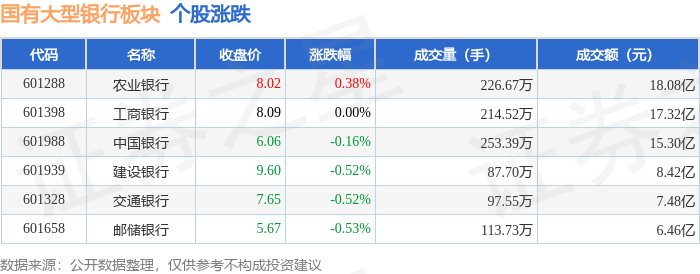
国有大型银行板块12月2日涨0.06%,农业银行领涨,主力资金净流出4.49亿元
Zheng Xing Xing Ye Ri Bao· 2025-12-02 09:05
Group 1 - The core viewpoint of the news is that the state-owned large banks sector experienced a slight increase of 0.06% on December 2, with Agricultural Bank leading the gains, while the overall stock market indices showed declines [1] - The Shanghai Composite Index closed at 3897.71, down 0.42%, and the Shenzhen Component Index closed at 13056.7, down 0.68% [1] - The trading performance of individual state-owned banks showed mixed results, with Agricultural Bank's stock price at 8.02, up 0.38%, while other banks like China Bank and Construction Bank saw declines [1] Group 2 - The net capital flow for the state-owned large banks sector showed a net outflow of 449 million yuan from institutional investors, while retail investors contributed a net inflow of 327 million yuan [1] - Detailed capital flow data indicated that Agricultural Bank had a significant retail net inflow of 930.61 million yuan, despite a net outflow of 819.22 million yuan from institutional investors [2] - The data also revealed that Industrial and Commercial Bank experienced a net outflow of 136 million yuan from institutional investors, with a smaller net inflow from retail investors of 11.5 million yuan [2]
股市高位震荡 银行上调近100只基金风险等级
2 1 Shi Ji Jing Ji Bao Dao· 2025-12-02 08:45
Core Viewpoint - Recent fluctuations in the stock market have led several banks to raise the risk levels of their distributed public funds, indicating a response to market volatility and regulatory requirements [1][2][3]. Group 1: Bank Actions - Multiple banks, including China Construction Bank and Minsheng Bank, have raised the risk levels of various public fund products, with some banks adjusting risk levels up to seven times this year [1][3]. - China Construction Bank announced an adjustment of 87 public fund products, with 32 moving from medium-low risk (R2) to medium risk (R3) and 55 from medium risk (R3) to medium-high risk (R4) [3]. - Minsheng Bank also raised the risk levels of eight funds from low to medium risk, marking its fourth adjustment in October alone [4]. Group 2: Market and Regulatory Context - Analysts suggest that the banks' actions are a result of a combination of product, market, and regulatory factors, particularly after a significant market rally that saw the Shanghai Composite Index exceed 4000 points [2][4]. - The adjustments are seen as a precautionary measure to protect investors from potential losses due to market volatility [2][4]. - Regulatory frameworks, such as the "Commercial Banks' Agency Sales Business Management Measures," emphasize the need for banks to independently assess and adjust risk ratings for the products they sell [5]. Group 3: Compliance and Regulatory Actions - Several banks have faced regulatory penalties for inadequate risk assessment and compliance failures in their fund sales operations, highlighting the importance of proper risk management practices [6][7]. - Regulatory bodies have issued corrective measures against banks like Zhejiang Chouzhou Bank and Huaxia Bank for failing to meet compliance standards in fund sales [6][7]. - The ongoing regulatory scrutiny is expected to lead to more frequent adjustments in risk ratings as banks strive to align with compliance requirements and protect investor interests [4][6].
六大行,全面停售5年期大额存单
财联社· 2025-12-02 08:25
"我跑了两家大行网点,5年期大额存单都停售了,就连3年期的都得靠'抢',额度一出来很快就没了,关键利率还比去年降了不少。"家住北京市的王 女士告诉记者,她手中的50万元闲置资金本想配置长期大额存单以求稳健收益,如今却陷入了"无处可放"的困境。 王女士的遭遇并非个例。记者近期调研发现,工商银行、农业银行、中国银行、建设银行、交通银行、邮储银行六家国有大行已全面停售5年期大额 存单产品,部分股份制银行及城商行也紧随其后收缩长期存款业务。 六大行全面停售5年期大额存单 记者登录六大行官方APP及手机银行查询时发现,目前各银行大额存单期限结构已明显"短期化"。工商银行"大额存单"栏目下仅剩余1个月、3个月、 6个月、1年、2年、3年六个期限产品。其中,3年期大额存单产品利率为1.55%,1年期、2年期产品利率均为1.20%。 此外,中国银行、建设银行、交通银行及邮储银行的产品矩阵呈现相似特征,5年期产品均已从在售列表中移除。在农业银行2018年至2025年的人民 币个人大额存单产品目录中,也并未出现5年期大额存单产品的"踪影"。 回溯来看,5年期大额存单的退出并非突然之举。以中国银行为例,今年5月20日,中国银行曾在 ...

银行5年期存款全面停售?
清华金融评论· 2025-12-02 08:23
Core Viewpoint - The article highlights a significant shift in the structure of bank deposit products in China, with a notable decline in long-term large-denomination certificates of deposit (CDs) due to multiple operational pressures and policy directions faced by banks [2]. Group 1: Changes in Deposit Products - Major banks in China have removed 5-year large-denomination CDs from their offerings, indicating a trend towards shorter-term deposit products [2]. - The current available terms for large-denomination CDs at Industrial and Commercial Bank of China are limited to 1 month, 3 months, 6 months, 1 year, 2 years, and 3 years [2]. - Several banks, including joint-stock banks and city commercial banks, have discontinued their 3-5 year large-denomination CD products this year [2]. Group 2: Reasons for the Shift - The primary reason for this shift is the continuous narrowing of net interest margins, which has created survival pressure for banks [2]. - As of Q3 2025, the net interest margin for commercial banks remains low at 1.42%, with private banks experiencing a further decline [2]. - The reduction in loan rates has led to shrinking asset-side returns for banks, making long-term large-denomination CDs, which are high-cost liabilities, less viable as the interest expense approaches the breakeven point [2]. Group 3: Future Outlook - The trend of pressure on net interest margins is expected to persist, leading to further adjustments in long-term deposit products by more banks [2]. - The deposit market is likely to normalize with characteristics of short-term, low-interest rates, and strict controls [2].