
CCB(601939)

Search documents
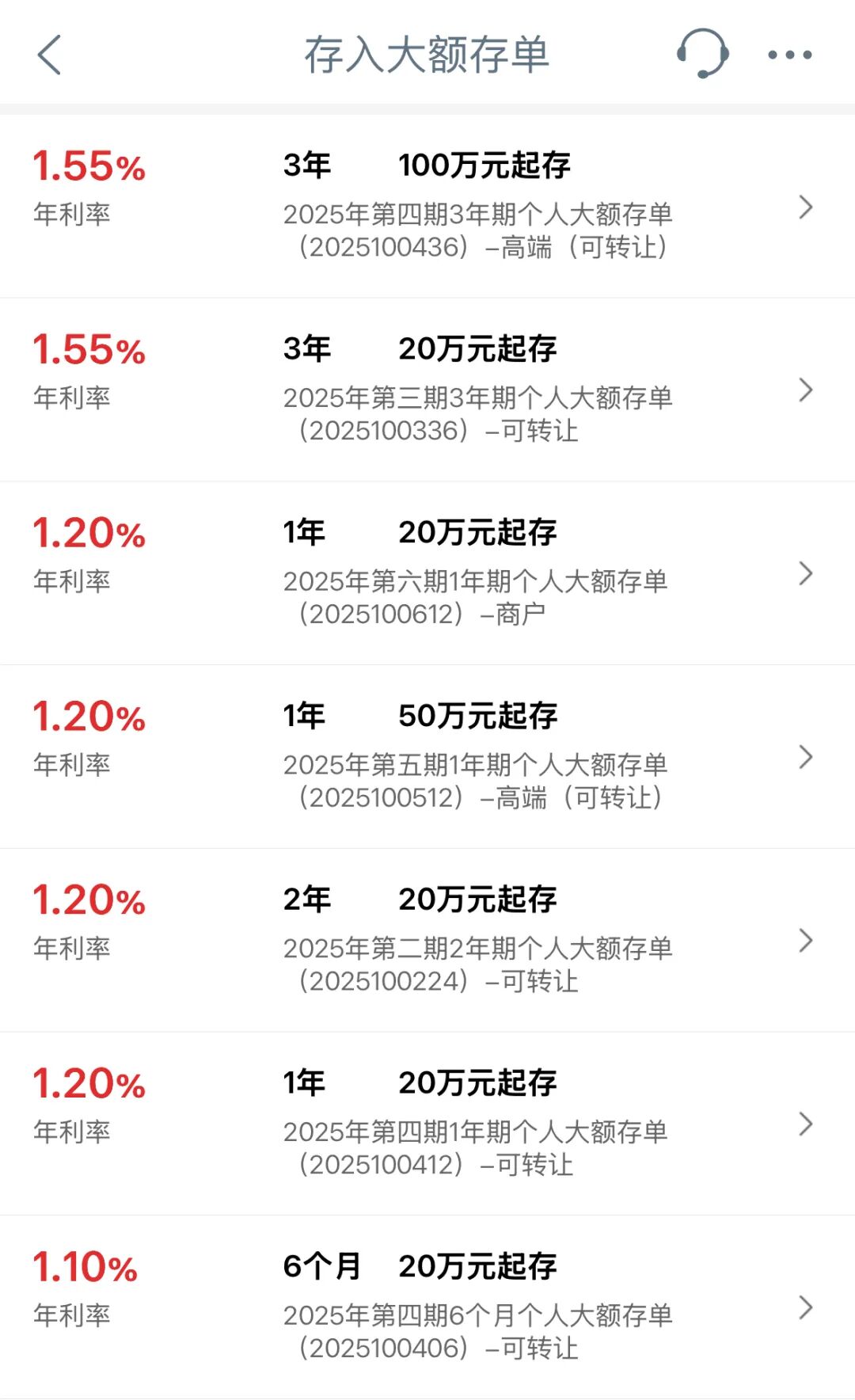
六大行,集体停售!
Jin Rong Shi Bao· 2025-12-02 07:16
Core Viewpoint - The major state-owned banks in China have completely stopped offering 5-year large denomination certificates of deposit (CDs), leading to a significant reduction in the availability of long-term deposit products in the market [1][2][6]. Group 1: Bank Actions - Six major state-owned banks, including Industrial and Commercial Bank of China, Agricultural Bank of China, Bank of China, China Construction Bank, Bank of Communications, and Postal Savings Bank of China, have ceased the sale of 5-year large denomination CDs [1][2]. - The remaining available terms for large denomination CDs have shifted to shorter durations, with the longest being 3 years, which has a rate of 1.55% [2][6]. - The trend of discontinuing long-term deposit products is not limited to national banks; local commercial banks and private banks are also following suit, as seen with the announcements from banks in Inner Mongolia [10][11]. Group 2: Market Dynamics - The withdrawal of 5-year CDs is attributed to the current downward trend in interest rates, which discourages banks from offering higher rates for long-term deposits [10]. - There is a notable increase in the overall deposit scale due to high savings enthusiasm among residents, while the demand for loans remains weak, leading banks to be less inclined to attract long-term deposits [10]. - Many banks are also reducing deposit rates, with some institutions cutting rates by as much as 65 basis points, reflecting a broader strategy to optimize their liability structure under pressure from interest margins [10][11]. Group 3: Investor Sentiment - The reduction in long-term deposit products has created a dilemma for ordinary depositors, as they struggle to find stable investment options [11]. - A survey indicates a slight decline in the proportion of depositors preferring to save more, suggesting a shift in asset allocation strategies among investors in a low-interest-rate environment [11]. - Financial experts recommend that investors adjust their expectations for returns and consider diversifying their asset allocation to include cash management products, money market funds, and government bonds [11]. Group 4: Industry Implications - The decline of long-term deposit products is prompting banks to accelerate their transformation efforts, focusing on wealth management and custodial services to stabilize non-interest income [11]. - Banks are encouraged to enhance their strategies on both asset and liability sides to maintain net interest margins amidst changing market conditions [11].







潍坊市滨海区深化“社银合作” 助力“15分钟服务圈”建设
Zhong Guo Fa Zhan Wang· 2025-12-02 07:11
Core Viewpoint - The "Social Insurance and Banking Integration" service point in Binhai District, Weifang City, Shandong Province has been officially launched, aiming to enhance public awareness and accessibility of social insurance and medical insurance policies [1] Group 1: Service Launch and Objectives - The new service point is a collaboration between the Social Security and Medical Insurance Center and China Construction Bank, focusing on promoting social insurance policies and benefits to the public [1] - Activities at the launch included policy explanations and distribution of promotional materials to help residents understand insurance registration, qualification verification, and other related services [1] Group 2: Service Features and Benefits - The initiative aims to bridge the gap in social security services in urban and rural areas by leveraging the extensive network and advanced facilities of bank branches [1] - A total of 22 high-frequency social insurance services, including registration, information changes, and card activation, are now available for convenient access [1] Group 3: Future Plans - The district plans to further deepen the cooperation between social insurance services and financial services, expanding the range of services and standardizing service quality [1] - The goal is to enhance the efficiency of service delivery, ensuring that residents experience a streamlined process for accessing social insurance benefits [1]
【高端访谈】在金融强国建设中扛起使命担当——专访建行上海市分行行长刘军
Zhong Guo Jin Rong Xin Xi Wang· 2025-12-02 06:38
服务协同,助力企业竞速全球化浪潮 企业"走出去"正迎来黄金时代,跨境金融服务的提质增效也进入新发展期。在跨境金融创新的浪潮中,建行上海市分行是先行者也是主力军。 2025年6月,作为首批试点银行,建行上海市分行在跨境金融服务平台上为多家企业完成了新型离岸贸易业务信息登记、海运提单核验及入账签注,进一步 将《上海国际金融中心进一步提升跨境金融服务便利化行动方案》落到实处。 这是建行上海市分行服务企业"走出去"的一个缩影。刘军介绍,聚焦上海国际金融中心建设,"建设银行上海全球金融服务中心"2024年揭牌成立,以此作为 跨境金融服务窗口和全球金融服务网络支点,搭建全球金融服务协调机制,统筹总分行、境内外金融服务协同,构建"一点接入,全球响应"的标准化服务体 系。 新华财经上海12月2日电(记者 王淑娟)迭代推出"技术流""价值流"科创评价体系,落地全国首笔"区块链+数字人民币"数据贷,打造"跨境金融服务"的样板 窗口,创新打造《流金岁月》养老金融手册,推出上海市首个面向中小微企业的碳服务普惠金融项目"碳数贷"……近几年来,建行上海市分行服务上海"五 个中心"建设,在浦江之畔奋力绘就金融高质量发展的新篇章。 近期,记 ...

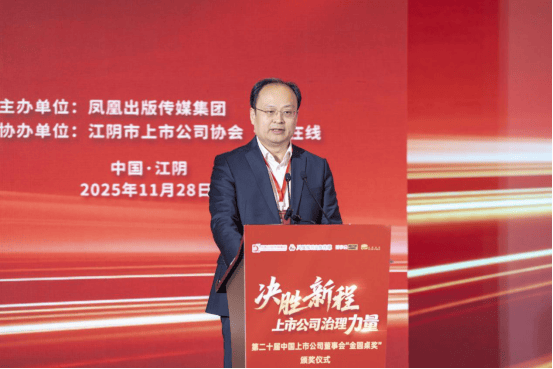
决胜新程——第二十届中国上市公司董事会“金圆桌奖”颁奖仪式在江阴成功举办
Sou Hu Cai Jing· 2025-12-02 06:29
Core Points - The 20th "Golden Roundtable Award" ceremony for Chinese listed companies was held in Jiangyin, attended by over 200 guests including executives, scholars, and media representatives, highlighting achievements in corporate governance [1][2][3] - The event recognized over 100 listed companies with a total market value exceeding 10 trillion, including 16 companies with market values over 100 billion [1][2] Group 1 - The opening speech by Li Zhenqiang emphasized the importance of the "Golden Roundtable Award" as a platform for consensus and wisdom, aiming to support the transformation and upgrading of Chinese listed companies [2][3] - Jiangyin's Vice Mayor Ji Zhen highlighted the city's achievements as a manufacturing hub, with 66 listed companies and a total market value exceeding 300 billion, positioning Jiangyin as a leader among county-level cities [5][6] Group 2 - Liu Yunhong, a professor, discussed the development of corporate governance rules in China, identifying six key issues in current practices and advocating for a shift from "formal compliance" to "substantive effectiveness" [12] - Zhu Zhengyi shared insights from Longji Technology's acquisition of Xingke Jinpeng, emphasizing the strategic role of corporate secretaries in governance [12][13] - Su Mei analyzed the trends in the A-share market under the registration system, stressing the importance of value management for high-quality development [15] Group 3 - The award ceremony recognized outstanding companies and individuals in various categories, including "Most Influential Independent Director" and "Excellent Board of Directors," showcasing achievements in governance and value creation [18][20][33] - The "Best Board of Directors" award was presented to leading companies such as Weichai Power and China Ping An, reflecting their exemplary governance practices and strategic foresight [33][36]





抚州金融监管分局核准舒颖偲建设银行抚州市分行行长任职资格
Jin Tou Wang· 2025-12-02 03:27
2025年11月26日,抚州金融监管分局发布批复称,建设银行《建设银行江西省分行关于舒颖偲任职资格 核准的请示》(建赣报〔2025〕136号)收悉。经审核,现批复如下: 二、建设银行应要求上述核准任职资格人员严格遵守金融监管总局有关监管规定,自建设银行政许可决 定作出之日起3个月内到任,并按要求及时报告到任情况。未在上述规定期限内到任的,本批复文件失 效,由抚州金融监管分局办理行政许可注销手续。 三、建设银行应督促上述核准任职资格人员持续学习和掌握经济金融相关法律法规,牢固树立风险合规 意识,熟悉任职岗位职责,忠实勤勉履职。 一、核准舒颖偲建设银行抚州市分行行长的任职资格。 ...
建设银行广东省分行赋能金融强省建设系列调研
2 1 Shi Ji Jing Ji Bao Dao· 2025-12-02 02:59
Core Insights - The article highlights the progress made by Guangdong in financial reform and innovation over the past five years, emphasizing the role of the China Construction Bank Guangdong Branch in supporting the province's economic development [1] Group 1: Financial Empowerment - The China Construction Bank Guangdong Branch is actively fulfilling its responsibilities as a state-owned bank by contributing to the construction of a financially strong province [1] - The bank's efforts are guided by the "Five Major Articles" of finance, which aim to inject financial momentum into the high-quality development of the regional economy [1] Group 2: Innovation Practices - A series of research initiatives titled "New Intelligence Guangdong Financial Empowerment" has been launched in collaboration with the Southern Finance and Economics Media Group and the 21st Century Economic Report to showcase the bank's innovative practices in various fields [1] - The focus areas of innovation include technological advancement, industrial upgrading, and rural revitalization [1]
中国金融板块-追踪工业风险:制造业固定资产投资增速显著放缓,助力更快管控风险-China Financials-Tracking industrial risks further notable slowdown in manufacturing FAI growth to help contain risks more quickly
2025-12-02 02:08
Summary of Key Points from the Conference Call Industry Overview - **Industry**: China Financials, specifically focusing on manufacturing and infrastructure investments in China [1][5][7] Core Insights and Arguments - **Manufacturing FAI Growth**: There has been a notable slowdown in manufacturing Fixed Asset Investment (FAI) growth, dropping to 2.7% year-over-year (yoy) from 4.0% yoy in the previous month, indicating steady progress on capital expenditure (capex) slowdown [7] - **Liability Growth**: Total liability growth for industrial firms moderated to 5.0% yoy, while manufacturing firms saw a slight increase to 5.9% yoy. This moderation is expected to lead to more rational capacity expansion [2][7] - **Revenue Decline**: Manufacturing revenue declined by 4.3% yoy, attributed to lower production levels due to overcapacity control efforts. The Value-Added Industrial (VAI) growth also slowed to 4.9% yoy from 6.5% yoy in September [3][10] - **Profit Growth**: Manufacturing profit growth moderated to 7.7% yoy from 9.9% yoy in September, influenced by higher financing costs and lower production [10] Future Outlook - **Infrastructure Investment**: A potential increase in infrastructure investments, supported by a new RMB 500 billion fund from the China Development Bank, is expected to bolster demand in 2026 and aid in the digestion of overcapacity risks [8][3] - **Sector Performance**: 77.1% of sectors experienced a slowdown in capex in October 2025 compared to the first half of 2025, while 39.3% of sectors showed profit improvement [9][7] Additional Important Information - **PPI Trends**: The Producer Price Index (PPI) rebounded month-over-month for the first time since December 2024, with the year-over-year decline narrowing to 2.1% [7] - **Investment Sentiment**: The overall sentiment towards the China Financials sector remains attractive, with ongoing efforts in financial tightening contributing to anti-involution measures [5][4] This summary encapsulates the critical insights from the conference call, highlighting the current state and future expectations of the manufacturing and financial sectors in China.




风向变了!银行集体下架5年期定存!对普通人的钱包有啥影响?
Sou Hu Cai Jing· 2025-12-02 01:43
Group 1 - Recent months have seen a trend of banks, including small and medium-sized banks as well as major state-owned banks, reducing their 5-year fixed deposit and large certificate of deposit products, with small banks leading the way with cuts of up to 80 basis points [1][2] - The current round of deposit rate cuts is primarily a decentralized adjustment by small banks and does not yet reflect a comprehensive reduction led by major state-owned banks [2] - The People's Bank of China (PBOC) is expected to lower interest rates in January to support the 2026 growth target, with indications that deposit rates may decrease before the Loan Prime Rate (LPR) [5][6] Group 2 - As deposit rates decline, some funds are likely to shift from low-yield deposits to equity markets, indicating a potential change in investment behavior [7] - The government is showing unprecedented support for the stock market, with the approval of the first batch of seven dual-innovation artificial intelligence ETFs set to launch on November 28 [8] - The reduction in deposit rates, with current rates at 0.95% for 1-year and 1.05% for 2-year deposits, is expected to encourage residents to invest in the stock market and index funds [10] Group 3 - The dual inflow of resident and institutional funds into the market signifies a significant shift in investment patterns, moving away from traditional bank deposits and real estate towards equity markets [11]

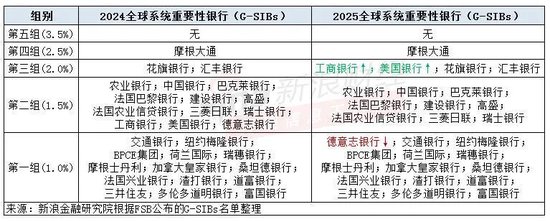
2025全球系统重要性银行公布!五家大行评分齐涨,工行升至第三组
Xin Lang Cai Jing· 2025-12-02 00:50
Core Points - The Financial Stability Board (FSB) released the 2025 Global Systemically Important Banks (G-SIBs) list, maintaining the number of Chinese banks at five, with the Industrial and Commercial Bank of China (ICBC) moving up to the third group, marking it as the first Chinese bank in this category [1][4][3] - The other four Chinese banks, namely Agricultural Bank of China, Bank of China, and China Construction Bank, remain in the second group, while Bank of Communications stays in the first group [4][5] Group Summaries - **G-SIB Group Rankings**: The 2025 G-SIB list includes five groups, with ICBC in the third group, requiring an additional capital requirement increase from 1.5% to 2.0%. The fourth group remains occupied by JPMorgan Chase, while the second group includes nine institutions, and the first group consists of 15 banks [4][5][12] - **Score Changes**: ICBC's score increased significantly by 33 points to 332, while Bank of China rose by 32 points to 314, Agricultural Bank by 15 points to 272, Construction Bank by 10 points to 259, and Bank of Communications by 9 points to 138 [8][10] - **Impact of Exchange Rates**: Analysts noted that exchange rate factors may have influenced the scoring of Chinese G-SIBs, with potential implications for their 2026 ratings. The historical context suggests that exchange rates have previously alleviated pressure on scores [10][7] - **TLAC Bond Issuance**: To meet the total loss-absorbing capacity (TLAC) requirements, major state-owned banks have been actively issuing TLAC bonds. For instance, Agricultural Bank issued TLAC bonds worth 20 billion yuan, and Bank of Communications issued bonds worth 30 billion yuan [13][12]
肖宏伟:协同联动彰显财政贴息成效
Zhong Guo Jing Ji Wang· 2025-12-01 23:38
Core Viewpoint - The personal consumption loan interest subsidy policy aims to stimulate domestic demand and support economic recovery in China, marking a shift from broad financial support to targeted measures [1][2]. Group 1: Policy Implementation and Impact - The interest subsidy policy has shown positive results, with over 1.1 million clients served by Agricultural Bank and an additional 117.7 billion yuan in loans from China Construction Bank by the end of September [1]. - The policy is designed to support two types of consumption: daily expenses under 50,000 yuan and key areas such as household vehicles, education, and elderly care, with a subsidy cap of 3,000 yuan [1][2]. - The collaboration between the Ministry of Finance, the People's Bank of China, and financial regulators emphasizes a "precise drip irrigation" approach, enhancing the efficiency of fiscal funds and targeting consumer needs [1][2]. Group 2: Consumer and Supply Side Effects - The policy effectively reduces consumer credit costs, with a 500 yuan subsidy covering nearly 30% of interest for a 50,000 yuan loan at a 3.5% annual rate, significantly easing the burden on families [2]. - Major state-owned banks and financial institutions have established a comprehensive service network, with Agricultural Bank's consumer loan balance increasing by 126.1 billion yuan and China Construction Bank surpassing 645.8 billion yuan [2]. - The policy creates a virtuous cycle of "fiscal guidance, financial support, and consumption stimulation," leveraging fiscal funds to encourage financial institutions to serve real consumption [2]. Group 3: Long-term Market Confidence and Structural Changes - The subsidy policy aligns with the trend of rising service consumption, with per capita service expenditure reaching 46.8% in the first three quarters of this year, driving consumption growth [3]. - The policy not only aims for short-term consumption boosts but also focuses on cultivating long-term market confidence and optimizing the consumption environment [3]. - Future efforts should enhance policy implementation mechanisms, strengthen inter-departmental collaboration, and improve data sharing to ensure the sustainability and precision of the policy [3].