CCB(601939)

Search documents
泰禾黄其森如何搞定建行?巨额“安家费”给了这位女高管
第一财经· 2025-11-30 14:11
2025.11. 30 本文字数:1835,阅读时长大约3分钟 作者 | 第一财经 亓宁 金融监管人员退休前后"两段"贪,为河南某公司等单位和个人入股/控股某村镇银行提供帮助;一银 行支行行长伙同他人为22家单位出具虚假理财和存款资料,将本应存入银行的钱挪用给多家公司收 取高额利息,为获得资金不惜向"理财"和"存款"出资方行贿…… 这些令人瞠目结舌的违法违规细节,都出现在最高人民法院、最高人民检察院近期联合发布的金融领 域职务犯罪典型案例中。 近年来,金融领域反腐持续深入推进。在上述案例中,既有金融监管领域的腐败案件,也有银行、信 托等机构人员的职务犯罪案件,业务层面涉及违法放贷、违规出具金融票证、以虚拟理财手段挪用公 款等违法违规行为,最终均已受到严惩,为从业人员敲响了警钟。 值得注意的是, 某国有大行部门负责人与某企业之间的新型受贿政商"旋转门"案件 也被纳入典型。 第一财经记者根据公开信息对比发现,该案 两大"主角"正是 建设银行机构业务部原总经理黄曦 (女),以及深处债务危机中的泰禾集团董事长黄其森 。 据中央纪委国家监委2022年5月消息,黄曦涉嫌严重违纪违法,正接受中央纪委国家监委驻建设银行 纪检 ...



最新全球系统重要性银行名单出炉,中资机构首次进入第三组
第一财经· 2025-11-30 13:06
Core Viewpoint - The 2025 Global Systemically Important Banks (G-SIBs) list has been released, with five Chinese banks maintaining their status. The Industrial and Commercial Bank of China (ICBC) has moved up to the third group, marking a significant achievement for Chinese financial institutions [3][5]. Group 1: G-SIBs List and Rankings - The latest G-SIBs list includes 29 institutions, consistent with 2024, but with changes in scores and groupings for some banks [5]. - ICBC has advanced from the second group to the third group, becoming the first Chinese bank in this category. Other Chinese banks, including Bank of China, Agricultural Bank of China, and China Construction Bank, remain in the second group, while Bank of Communications stays in the first group [5][6]. - The G-SIBs list is divided into five groups, with the highest group (fifth) having no institutions, and the fourth group containing only JPMorgan Chase [5]. Group 2: Scoring Changes and Influencing Factors - This year, the scoring changes for Chinese G-SIBs show two main characteristics: scale is no longer the primary driver for score increases, and exchange rate fluctuations have had a positive impact [6][7]. - For instance, ICBC and Bank of China saw significant score increases of 33 and 32 points, respectively, due to various contributing factors [6]. - Despite these changes, Chinese G-SIBs still outperform global peers in terms of scale and interconnectedness [6]. Group 3: TLAC Compliance and Issuance - Following the successful achievement of the first phase of Total Loss-Absorbing Capacity (TLAC) requirements, the pressure for compliance in the next phase remains a concern [10][11]. - The five major banks have issued over 300 billion yuan in TLAC non-capital bonds this year, with a cumulative issuance of 540 billion yuan [11][12]. - The TLAC non-capital bonds are crucial for meeting international G-SIBs requirements, and the regulatory capital remains the primary component of total loss-absorbing capacity [12]. Group 4: Future Compliance Outlook - Some banks are currently able to meet the next phase of TLAC requirements, while others may need government support to achieve compliance [13]. - The assessment indicates that if risk-weighted asset growth remains stable, all five major banks are expected to meet the upcoming TLAC requirements on schedule [13].





泰禾黄其森如何搞定建行?巨额“安家费”给了这位女高管
Di Yi Cai Jing· 2025-11-30 12:54
建设银行机构业务部原总经理黄曦获刑14年。 金融监管人员退休前后"两段"贪,为河南某公司等单位和个人入股/控股某村镇银行提供帮助;一银行 支行行长伙同他人为22家单位出具虚假理财和存款资料,将本应存入银行的钱挪用给多家公司收取高额 利息,为获得资金不惜向"理财"和"存款"出资方行贿…… 这些令人瞠目结舌的违法违规细节,都出现在最高人民法院、最高人民检察院近期联合发布的金融领域 职务犯罪典型案例中。 近年来,金融领域反腐持续深入推进。在上述案例中,既有金融监管领域的腐败案件,也有银行、信托 等机构人员的职务犯罪案件,业务层面涉及违法放贷、违规出具金融票证、以虚拟理财手段挪用公款等 违法违规行为,最终均已受到严惩,为从业人员敲响了警钟。 值得注意的是,某国有大行部门负责人与某企业之间的新型受贿政商"旋转门"案件也被纳入典型。第一 财经记者根据公开信息对比发现,该案两大"主角"正是建设银行机构业务部原总经理黄曦(女),以及 深处债务危机中的泰禾集团董事长黄其森。 据中央纪委国家监委2022年5月消息,黄曦涉嫌严重违纪违法,正接受中央纪委国家监委驻建设银行纪 检监察组纪律审查和吉林省监察委员会监察调查。同年11月,黄 ...
金融行业周报(2025、11、30):保险开门红展望积极,坚持银行板块配置策略-20251130
Western Securities· 2025-11-30 12:49
Core Conclusions - The financial industry experienced a weekly increase of +0.68% in the non-bank financial index, underperforming the CSI 300 index by 0.96 percentage points [1] - The banking sector saw a decline of -0.59%, lagging behind the CSI 300 index by 2.23 percentage points, with state-owned banks, joint-stock banks, city commercial banks, and rural commercial banks showing varied performance [1][9] Insurance Sector Insights - The insurance sector's index rose by +0.20%, underperforming the CSI 300 index by 1.44 percentage points, driven by strong demand for dividend insurance products that align with residents' needs for stable returns and value appreciation [2][12] - Major insurance companies are focusing on dividend insurance as a strategic core, with product offerings expanding significantly ahead of the 2026 "opening red" period [2][12] - The growth of new single premiums is expected to be strong in 2026, supported by improved net present value margins (NBVM) and a favorable regulatory environment for dividend insurance [2][17] Brokerage Sector Insights - The brokerage sector index increased by +0.74%, underperforming the CSI 300 index by 0.90 percentage points, with recent developments in refinancing for two brokerages indicating a cautious approach to capital raising [2][18] - The current environment presents a mismatch between profitability and valuation in the brokerage sector, suggesting potential for valuation recovery [2][19] - Recommendations include strong mid-to-large brokerages with low valuations and those involved in mergers or restructuring [2][19] Banking Sector Insights - The banking sector's index decreased by -0.59%, underperforming the CSI 300 index by 2.23 percentage points, with a focus on high dividend strategies remaining viable [3][20] - The average dividend yield for banks is approximately 4.1%, which is attractive compared to other sectors, particularly in the context of a stable earnings outlook [3][21] - Recommendations include state-owned banks and resilient city commercial banks, with specific attention to banks with strong fundamentals and low volatility [3][22]



金融助农新模式 信贷嵌入“保险+期货”
Jing Ji Guan Cha Bao· 2025-11-30 09:36
Core Viewpoint - The "Bank + Insurance + Futures" model is emerging as a new breakthrough for banks to increase credit support for agriculture, addressing the challenges faced by farmers in terms of crop yield, market prices, and sales [3][7]. Group 1: Project Overview - The "Yinqi Bao" crop insurance project was launched by the Dalian Commodity Exchange in 2023 to meet the diverse needs of large-scale grain producers, providing both agricultural income insurance and enhanced credit support from banks [2][4]. - As of now, 22 such projects have been established, providing a total of 91 million yuan in loans to 55 cooperatives [2]. Group 2: Challenges and Solutions - The promotion of the "Bank + Insurance + Futures" model faces three main challenges: the need for increased government subsidies for insurance premiums, the integration of various agricultural data to improve loan efficiency, and the provision of personalized financial services for different farmers [3][12]. - Financial institutions are working with experts to encourage policymakers to include this model in official documents as a key strategy for supporting agriculture [3]. Group 3: Financial Mechanism - The "Insurance + Futures" model allows agricultural operators to purchase price or income insurance, which is then hedged in the futures market to mitigate price volatility risks [4][5]. - This model has proven effective in various regions, such as in Guangxi, where pig farmers received over 18 million yuan in insurance payouts due to price fluctuations [5]. Group 4: Impact on Farmers - Farmers participating in the "Yinqi Bao" project can significantly increase their loan limits, with one farmer reporting an increase from 500,000 yuan to over 1 million yuan, allowing for expansion of planting areas and potential income increases of at least 100,000 yuan [6][7]. - The project also includes mechanisms for guaranteed sales through contracts with leading enterprises and a secondary pricing option that allows farmers to benefit from price increases in the futures market [6][7]. Group 5: Data Integration and Customization - Banks are facing challenges in creating a closed-loop system for loans and repayments, as well as in providing customized credit solutions based on the diverse financial situations of farmers [10][12]. - Efforts are being made to integrate various agricultural data to enhance credit assessment and provide higher loan limits, with some banks offering up to 3 million yuan in credit support [12][13]. Group 6: Premium Subsidies - The cost of agricultural income insurance can be significant, with premiums accounting for 5%-6% of the insured amount, leading to financial strain on farmers [14]. - Government and financial institutions are working to increase premium subsidies to alleviate the financial burden on farmers and encourage participation in the "Bank + Insurance + Futures" model [15][17].
6400亿元!绿色金融债发行翻倍,中小银行加速入场
券商中国· 2025-11-30 07:29
Core Viewpoint - The issuance of green financial bonds in China has significantly increased in 2023, driven by supportive policies and a diverse range of issuing institutions, including small and medium-sized banks, which have become new growth points in the market [2][3][9]. Group 1: Green Bond Issuance - On November 27, the National Development Bank successfully issued 9 billion yuan of 3-year green financial bonds with an interest rate of 1.52%, achieving a subscription multiple of 2.46 times [1]. - Since the implementation of the "Green Bond Support Project Directory (2025 Edition)" in October, financial institutions have entered a "fast track" for green bond issuance, with 14 bank green bonds issued in November alone, marking the highest issuance density of the year [2]. - In November, various banks issued a total of 110.7 billion yuan in green financial bonds, setting a new monthly record for 2023 [3]. Group 2: Diverse Issuers - The issuance of green bonds has expanded beyond state-owned banks to include small and medium-sized banks and non-bank financial institutions, indicating a diversification of issuers [4][9]. - In November, several small banks issued green bonds ranging from 700 million yuan to 3.5 billion yuan, with specific examples including Tangshan Bank and Chongqing Three Gorges Bank [5][6][7]. Group 3: Policy Support and Market Growth - The explosive growth in green bond issuance is attributed to continuous policy support, particularly following the launch of the new project directory, which has unified various green financial products and reduced identification costs for financial institutions [9]. - As of November 28, over 240 green bonds have been issued by financial institutions, with a total issuance scale exceeding 640 billion yuan, doubling the issuance scale from 2024 [9]. Group 4: Cost Optimization and Innovation - The average issuance cost of bank green bonds has improved, decreasing from 1.94% in 2024 to 1.74% in 2023, enhancing the financing cost-effectiveness [3]. - There has been a notable increase in product innovation within the green bond market, with various financial institutions exploring new mechanisms, including floating rate bonds and thematic bonds focused on specific sectors like green manufacturing [11][13].


信用债周度观察(20251124-20251128):信用债发行量环比增加,各行业信用利差整体上行-20251129
EBSCN· 2025-11-29 11:32
Group 1: Report Industry Investment Rating - No information provided in the report Group 2: Core Viewpoints of the Report - From November 24 to November 28, 2025, the issuance volume of credit bonds increased month - on - month, and the credit spreads of various industries generally rose [1] - The total trading volume of credit bonds in the secondary market increased month - on - month, with commercial bank bonds, corporate bonds, and medium - term notes ranking in the top three in terms of trading volume [4] Group 3: Summary by Directory 1. Primary Market 1.1 Issuance Statistics - From November 24 to November 28, 2025, a total of 433 credit bonds were issued, with a total issuance scale of 589.011 billion yuan, a month - on - month increase of 1.34%. Among them, industrial bonds accounted for 52.37%, urban investment bonds accounted for 20.08%, and financial bonds accounted for 27.55% [1][11] - The average issuance term of credit bonds was 2.80 years, with industrial bonds at 2.56 years, urban investment bonds at 3.19 years, and financial bonds at 2.41 years [1][13] - The average issuance coupon rate of credit bonds was 2.16%, with industrial bonds at 2.09%, urban investment bonds at 2.29%, and financial bonds at 1.95% [2][18] 1.2 Cancellation of Issuance Statistics - Five credit bonds were cancelled for issuance this week, including 25ShaanxiJiaotongMTN012, 25JinnengMeiyeMTN019, etc. [22][23] 2. Secondary Market 2.1 Credit Spread Tracking - The industry credit spreads generally rose this week. For example, among the Shenwan primary industries, the AAA - rated real estate industry's credit spread increased by 8.1BP, and the AA + - rated textile and clothing industry's credit spread increased by 15.4BP [3][24] - The credit spreads of coal showed mixed trends, while those of steel generally rose. The credit spreads of coal at the AAA, AA +, and AA levels increased by 3.3BP, 5.1BP, and decreased by 1.4BP respectively; the credit spreads of steel at the AAA and AA + levels increased by 5.5BP and 2.3BP respectively [24] - The credit spreads of urban investment and non - urban investment bonds at all levels generally rose. The credit spreads of urban investment bonds at three levels increased by 2.4BP, 5.3BP, and 6.8BP respectively; the credit spreads of non - urban investment bonds at three levels increased by 4.4BP, 5.4BP, and 4.9BP respectively [24] - The credit spreads of state - owned enterprises generally rose, while those of private enterprises showed mixed trends. The credit spreads of central state - owned enterprises at three levels increased by 4BP, 5.1BP, and 4.2BP respectively; the credit spreads of local state - owned enterprises at three levels increased by 3.3BP, 4.6BP, and 5.6BP respectively; the credit spreads of private enterprises at the AAA and AA + levels increased by 7BP and decreased by 0.1BP respectively [25] - The regional urban investment credit spreads showed mixed trends. The regions with the highest credit spreads at the AAA, AA +, and AA levels were Shaanxi, Qinghai, and Guangxi respectively. In terms of month - on - month changes, Gansu, Ningxia, and Xinjiang had the largest increases, while Yunnan had the largest decrease [26] 2.2 Trading Volume Statistics - The total trading volume of credit bonds was 1499.033 billion yuan, a month - on - month increase of 4.12%. The top three in terms of trading volume were commercial bank bonds, corporate bonds, and medium - term notes [4][27] 2.3 Actively Traded Bonds This Week - The report lists the top 20 actively traded urban investment bonds, industrial bonds, and financial bonds this week, including information such as bond codes, names, trading volumes, yields, and issuers [30][31][32]
逾3.7亿港元!近50家金融机构捐款捐物驰援香港大埔火灾
Guo Ji Jin Rong Bao· 2025-11-29 10:06
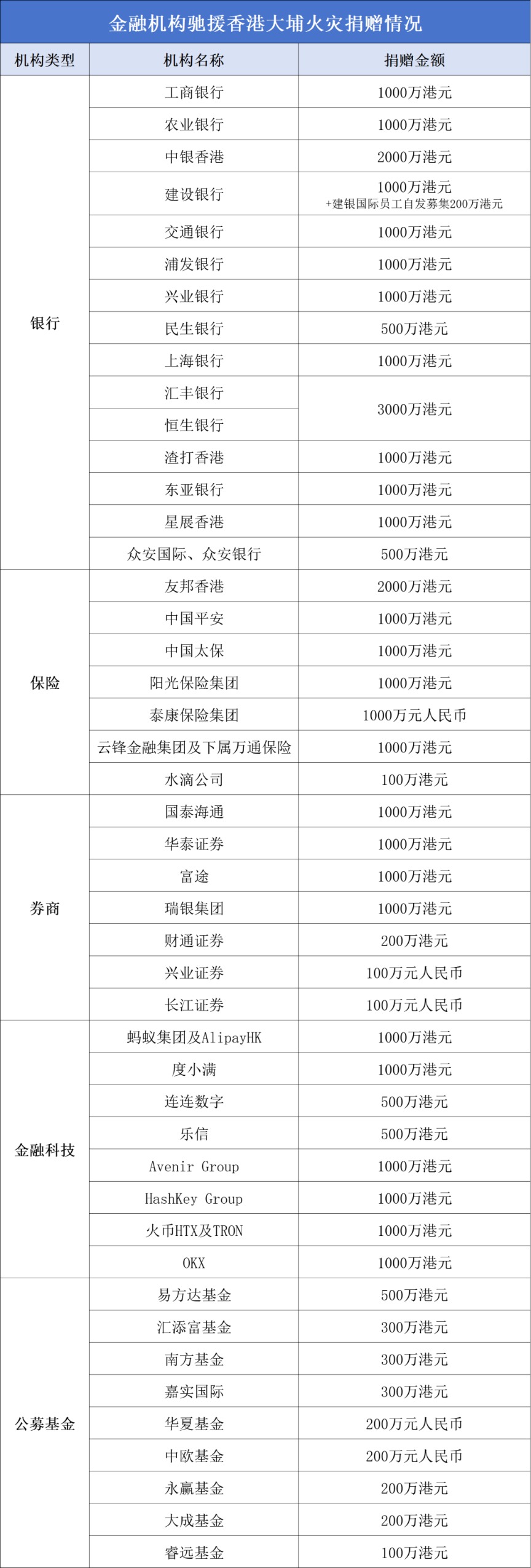
Core Viewpoint - The fire at Hong Kong's Tai Po Wang Fuk Court resulted in significant casualties, with 128 confirmed dead and around 200 individuals unaccounted for, prompting a swift response from the financial sector to support relief efforts [1][2]. Financial Institutions' Donations - Nearly 50 financial institutions have contributed over 370 million HKD to aid in disaster relief, including major banks, insurance companies, and fintech firms [1][2]. - Notable contributions include: - Bank of China Hong Kong: 20 million HKD - HSBC: 30 million HKD - Agricultural Bank of China: 10 million HKD [2][3][6]. Emergency Support Measures - The Hong Kong Monetary Authority and the Hong Kong Association of Banks urged banks to provide flexible support to affected individuals, including expedited cash withdrawals and waiving fees [6][7]. - Major state-owned banks, including ICBC and Agricultural Bank of China, quickly mobilized to assist in relief and reconstruction efforts [6][7]. Insurance Companies' Response - Insurance firms activated emergency plans, offering streamlined claims processes and immediate financial support to affected clients [9][10]. - AIA Hong Kong pledged 20 million HKD for community support and initiated contact with potentially affected clients [9][10]. Securities Firms' Contributions - Several securities firms, including Guotai Junan and Huatai Securities, donated funds to support emergency relief and reconstruction efforts [12][13]. - UBS announced a donation of 10 million HKD through its charitable foundation for community support [13][14]. Fintech Sector Involvement - Fintech companies, such as Ant Group and Du Xiaoman, contributed 10 million HKD each to assist with emergency relief and recovery efforts [17][18]. - Various digital asset platforms also pledged significant donations to support affected communities [19]. Public Fund Contributions - Public fund companies collectively donated over 20 million HKD to support disaster relief and recovery initiatives [20][21]. - Notable contributions include: - E Fund: 5 million HKD - Huatai Fund: 3 million HKD [21][22][23]. Overall Impact - The financial sector's rapid response and substantial contributions highlight its role as a stabilizing force in times of crisis, providing essential support to affected communities [27][28].


超百家企业捐赠总额超12亿港元,企业驰援香港大埔火灾救援


第一财经· 2025-11-29 07:06
Core Points - A significant fire occurred in Hong Kong's Tai Po district, resulting in major casualties and prompting over 100 companies and foundations to donate for emergency relief and community recovery efforts, with total donations exceeding HKD 1.2 billion [2][4]. Donation Summary - Major companies such as Yuexiu Group donated HKD 10 million, while China Overseas and China State Construction contributed HKD 20 million [3]. - Tencent donated HKD 30 million, and Alibaba made an initial donation of HKD 20 million [3]. - Other notable contributions include HKD 30 million from the Li Ka Shing Foundation and HKD 12 million from the Chaozhou Association [4]. - The total amount of donations has surpassed HKD 1.2 billion as of the latest reports [4].

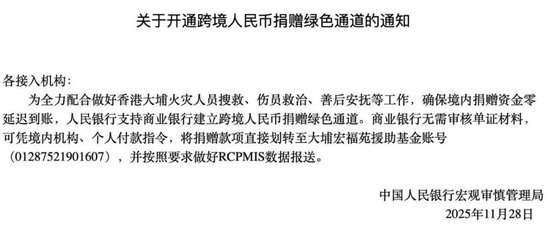
央行、工行、农行、中行、建行、交行等集体出手,全力支持救灾及灾后重建工作
2 1 Shi Ji Jing Ji Bao Dao· 2025-11-29 07:04
Core Viewpoint - Several major banks in China, including Industrial and Commercial Bank of China (ICBC), Agricultural Bank of China (ABC), Bank of China (BOC), China Construction Bank (CCB), and others, have collectively mobilized to provide financial support and aid for disaster relief following a significant fire incident in Hong Kong's Tai Po district, demonstrating a strong commitment to corporate social responsibility and community support [1][3][6][9][12][14][17][18]. Group 1: Donations and Financial Support - ICBC announced a donation of HKD 10 million to support disaster relief and reconstruction efforts, coordinating with its Hong Kong branches to provide emergency financial services and support for affected customers [3][12]. - ABC pledged HKD 10 million for fire rescue and post-disaster recovery, organizing volunteer teams and financial support for affected families [6][12]. - BOC committed HKD 20 million, establishing a dedicated donation account for public contributions and offering expedited banking services for affected clients [9][12]. - CCB also donated HKD 10 million, facilitating cross-border donations and providing emergency services for affected residents [12][14]. - Bank of Communications announced a donation of HKD 10 million, setting up emergency service stations and providing immediate cash support for affected customers [14][18]. Group 2: Collective Efforts from Other Banks - Other banks, including Shanghai Bank, Spdb Bank, and Minsheng Bank, collectively donated nearly HKD 100 million, with Spdb Bank and Minsheng Bank each contributing HKD 10 million and HKD 5 million respectively for emergency aid [17][18]. - Foreign banks such as HSBC and Hang Seng Bank jointly donated HKD 30 million, while Standard Chartered and DBS Bank each contributed HKD 10 million to support the affected residents [18].