
CCB(601939)

Search documents
“银行直供房”卷席市场,低于市价!释放了什么信号?
Sou Hu Cai Jing· 2025-11-17 14:12
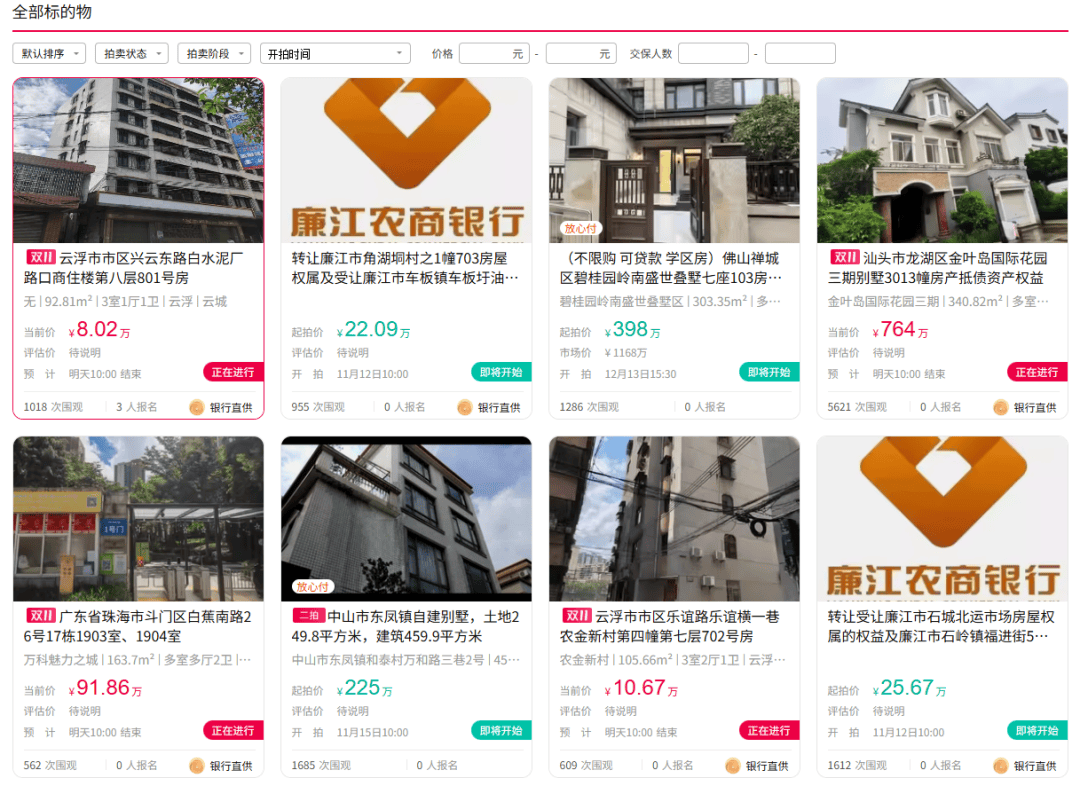
Core Viewpoint - A wave of property asset disposals led by banks is emerging, with "bank direct supply housing" being sold through online platforms like Alibaba and JD.com, indicating a shift in asset management strategies within the banking sector [1][3]. Group 1: Market Dynamics - Banks are accelerating property disposals primarily to enhance debt recovery rates during the real estate market adjustment period, with direct sales becoming a new choice for quickly revitalizing assets [3][4]. - "Bank direct supply housing" offers significant price advantages, often priced below market rates compared to regular second-hand and auctioned properties [4][5]. - As of November 10, 2023, JD.com’s asset trading platform lists 414 residential and 957 commercial properties for auction, significantly exceeding the same period last year [5]. Group 2: Pricing and Sales Strategy - For example, a 125 square meter property auctioned by Lanzhou Rural Commercial Bank sold for 1.51 million yuan, while similar properties in the area were listed between 1.8 million and 2.2 million yuan [4]. - The auction platforms are promoting these properties with slogans like "bank direct supply, sold at no cost," highlighting the aggressive pricing strategy [4][5]. Group 3: Bank Participation and Trends - City commercial banks and rural credit cooperatives are the main players in this direct sale trend, with significant numbers of properties listed for sale, such as over 2,000 by Jilin Bank and nearly 1,300 by Tianjin Bank [9]. - Large state-owned and joint-stock banks are also increasing their direct sales, with Agricultural Bank of China listing 3,436 properties and China Construction Bank 1,571 properties [9][10]. Group 4: Operational Efficiency and Cost Reduction - The direct sale process allows banks to recover funds faster, reducing the time from six months in judicial auctions to about three months [14]. - By bypassing traditional auction costs, banks can retain more revenue from sales, creating a beneficial cycle of "discounting to sell quickly" [15]. Group 5: Strategic Insights and Future Directions - This direct sale trend serves as a market research tool for banks to understand pricing dynamics and property values, which can inform future lending policies [15][16]. - Banks are also exploring partnerships with asset management companies to bundle these properties into real estate investment trusts, transitioning from a "heavy asset" to a "light asset" model [16]. Group 6: Risk Assessment and Market Impact - There are differing opinions on the impact of these direct sales on the real estate market, with some analysts suggesting potential pressure on prices in certain cities, while others believe the scale is too small to significantly affect overall market prices [18][19]. - The risk associated with bank-held properties is considered manageable, particularly in first and second-tier cities, where property values are more stable [18].




迈向“十五五”:金融机构如何精准赋能实体经济与雄安未来之城
Xin Hua Cai Jing· 2025-11-17 13:29
Core Insights - The article discusses the need for financial institutions to enhance their services to support the high-quality development of the real economy during the "14th Five-Year Plan" and the beginning of the "15th Five-Year Plan" [1] Group 1: Financial Institutions' Role - Financial institutions are urged to improve the precision, adaptability, and accessibility of their services, focusing on key areas and weak links in the real economy [2] - Regional banks should adjust their credit and customer strategies towards intelligent, green, and integrated directions, accelerating digital transformation to create competitive advantages [2] - The futures and securities industries are presented with development opportunities, with the futures sector encouraged to implement scenario-based services to enhance price discovery and risk management [2] Group 2: Risk Management - Financial institutions must maintain a risk baseline while serving the real economy, employing early identification and warning systems for risk management [3] - City commercial banks should respect risks but not fear development, balancing risk and return through technology empowerment and compliance culture [3] - The futures industry should establish integrated risk warning mechanisms to preemptively address systemic risks [3] Group 3: Innovative Financial Products and Services - The "five major articles" of financial work emphasize technology finance, green finance, inclusive finance, pension finance, and digital finance as core strategies for financial institutions [4] - Construction Bank has developed a comprehensive technology finance service system, including products that cater to different growth stages of enterprises [4] - Regional banks are launching tailored products to address local needs, such as order financing and pollution rights pledge loans, to support small and micro enterprises [4][5] Group 4: Industry Empowerment - Financial institutions are transitioning from traditional credit providers to industry enablers, particularly in the context of the Xiong'an New Area's development [4] - Supply chain financial products are being utilized to extend services to upstream and downstream SMEs, integrating various financial services [5] - Futures and securities firms are playing a crucial role in managing risks within the industrial chain, responding to the increasing demand for risk management from enterprises [6]

百万级项目频现!银行业密集启动科技招标,数字化转型驶入深水区
Xin Lang Cai Jing· 2025-11-17 12:24
Core Insights - Recent trends show multiple banks accelerating their technology procurement efforts, with significant budgets allocated for projects in areas such as large model development, computing infrastructure, and intelligent risk control [1][3][6] - The banking industry's IT investment is projected to reach 169.315 billion yuan in 2024, marking a 3.6% increase from 2023, and is expected to exceed 266.227 billion yuan by 2028 [7] Group 1: Technology Procurement Trends - Major banks are shifting from fragmented IT equipment purchases to systematic and ecological strategic layouts, with policy banks leading through large-scale tenders and framework agreements [3][4] - State-owned banks and national joint-stock banks dominate the technology procurement market, focusing on high-budget, long-cycle projects [3][4] - Smaller banks are adopting a more targeted approach, focusing on regional needs and core requirements with flexible budget scales [4] Group 2: Drivers of Technology Investment - The narrowing net interest margin and pressure on traditional lending businesses are pushing banks to leverage technology for competitive differentiation and cost control [6] - Regulatory policies are also driving technology projects, with over 30 "one-table" related projects initiated or completed across the industry since October [6][9] - External competition from fintech companies and internet platforms is compelling banks to accelerate their transformation efforts [6][9] Group 3: Challenges and Risks - The rapid pace of technology procurement presents challenges such as unclear risk responsibilities in outsourcing partnerships and compliance with regulatory requirements [9][10] - A notable case involving Guizhou Bank highlights issues with contract clarity and risk assessment in technology procurement [9] - The fast iteration of technology poses adaptation risks, as banks may face additional costs for upgrades if algorithms become outdated [10] Group 4: Future Considerations - The banking industry needs to establish a more systematic technology governance framework, including lifecycle management of suppliers and risk assessment mechanisms [10] - Balancing technological innovation with risk management will be crucial for banks to transform technology investments into core competitive advantages [10]



银行三季度净息差环比持平,股份行回升1BP!三类银行机构利润下滑
Xin Lang Cai Jing· 2025-11-17 12:24
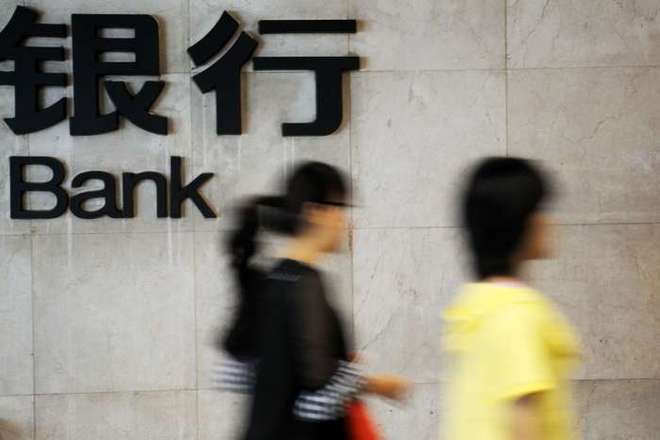
Core Insights - The banking sector in China reported a slight decline in net profit for the first three quarters of 2025, with a total of 1.87 trillion yuan, representing a year-on-year decrease of 0.02%, although the decline has narrowed compared to the first half of the year [1][6] Profitability - State-owned banks, city commercial banks, and private banks saw an increase in net profit, with private banks leading at a growth rate of 7.09% [1][3] - The net profit for state-owned banks was 1.00 trillion yuan, while city commercial banks and private banks reported 252.3 billion yuan and 15.1 billion yuan, respectively [3] - In contrast, joint-stock banks, rural commercial banks, and foreign banks experienced declines in net profit, with decreases of 2.1%, 7.36%, and 19.34%, respectively [1][3] Net Interest Margin - The net interest margin (NIM) for commercial banks remained stable at 1.42% in Q3, with private banks having the highest NIM at 3.83% [1][8] - State-owned banks had the lowest NIM at 1.31%, while joint-stock banks saw a slight increase of 0.01 percentage points to 1.56% [8][9] - Year-on-year, all types of banks experienced a decline in NIM, with state-owned and rural commercial banks both down by 0.14 percentage points [9][10] Asset Quality - As of the end of Q3 2025, the non-performing loan (NPL) balance for commercial banks was 3.5 trillion yuan, with an NPL ratio of 1.52%, reflecting a slight increase of 0.03 percentage points from the previous quarter [13][14] - Foreign banks had the lowest NPL ratio at 1.06%, while rural commercial banks had the highest at 2.82% [14] - Only state-owned banks saw a decrease in NPL ratios compared to the end of the previous year, while other types of banks experienced varying degrees of increase [14] Provision Coverage - The loan loss provision balance for commercial banks was 7.3 trillion yuan, with a provision coverage ratio of 207.15%, both showing a decrease from the previous quarter [16]



国有大型银行板块11月17日跌1.51%,邮储银行领跌,主力资金净流出8.86亿元
Zheng Xing Xing Ye Ri Bao· 2025-11-17 08:49
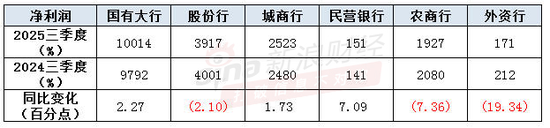
Core Points - The state-owned large bank sector experienced a decline of 1.51% on November 17, with Postal Savings Bank leading the drop [1] - The Shanghai Composite Index closed at 3972.03, down 0.46%, while the Shenzhen Component Index closed at 13202.0, down 0.11% [1] Group 1: Market Performance - The closing prices and percentage changes for major state-owned banks are as follows: - Bank of China: 5.77, -0.86% - Industrial and Commercial Bank of China: 8.17, -0.97% - China Construction Bank: 9.44, -1.26% - Bank of Communications: 7.39, -1.73% - Agricultural Bank of China: 8.32, -2.12% - Postal Savings Bank: 5.69, -2.40% [1] Group 2: Fund Flow Analysis - The net outflow of main funds from the state-owned large bank sector was 8.86 billion yuan, while retail funds saw a net inflow of 3.06 billion yuan [1] - The detailed fund flow for individual banks shows significant net outflows for major banks, with Postal Savings Bank experiencing a net outflow of 219 million yuan [2]
银行业发展图景:在复杂环境中蓄势突围,于转型攻坚中彰显韧性
2 1 Shi Ji Jing Ji Bao Dao· 2025-11-17 05:40
Core Insights - The global economic recovery in 2025 is characterized by increasing divergence and intertwined risks, impacting the stability of the global financial system [1] - The Chinese banking industry is experiencing a period of transformation, focusing on quality improvement and efficiency enhancement as core strategic anchors [1][3] - The overall resilience and risk resistance of the banking sector have been further highlighted through structural adjustments and precise support for the real economy [1][3] Financial Performance - In the first half of 2025, A-share listed banks reported stable growth in revenue and net profit, with total revenue reaching 2.92 trillion yuan, a 1% year-on-year increase, and net profit of 1.1 trillion yuan, up 0.8% [3][4] - The net interest margin for A-share listed banks was 1.53%, down 8 basis points from the beginning of the year, but the decline was less severe compared to the previous year [5][6] - The six major state-owned banks contributed significantly to the industry's stability, with total revenue of 1.83 trillion yuan and net profit of 682.52 billion yuan, accounting for over 60% of the total for A-share listed banks [4] Industry Trends - The banking sector is shifting from a focus on scale and speed to a differentiated development path emphasizing quality and effectiveness, as highlighted by the central government's call to prevent "involution" [7][8] - Non-interest income for listed banks grew by 6.97% year-on-year in the first half of 2025, indicating a move towards a diversified income structure [10][11] - The integration and restructuring of small and medium-sized banks have accelerated, with 326 banks exiting the market by mid-October 2025, reflecting a significant optimization of the industry structure [14][15] Strategic Initiatives - Banks are increasingly focusing on non-credit services and high-quality development, with many emphasizing the importance of non-interest income and cost management [9][10] - The trend of "merging and restructuring" among small and medium-sized banks is seen as a key measure for risk prevention and enhancing local financial ecosystems [14][16] - State-owned banks are leading the way in acquiring village banks, enhancing regional financial stability and providing a model for smaller banks [15]
大行评级丨高盛:建行料明年净息差将持续面临下行压力 予其“买入”评级
Ge Long Hui· 2025-11-17 02:25
Core Insights - The report from Goldman Sachs indicates that China Construction Bank (CCB) will face continued downward pressure on net interest margin until 2026, primarily due to loan repricing, although the pace of decline is expected to slow as loan pricing stabilizes and deposit cost savings materialize [1] - CCB anticipates steady growth in fee income by 2026, supported by consumer stimulus policies, and plans to offset the decline in mutual fund fees through increased sales volume [1] - Asset quality is expected to remain stable, but there is an upward trend in non-performing loan ratios in the retail sector, which will depend on the macroeconomic environment [1] - Without further interest rate cuts and with positive growth in fee income, CCB expects improvements in revenue and profit in 2026 compared to 2025, while maintaining a 30% dividend payout ratio and semi-annual dividend frequency [1] - Goldman Sachs has assigned a "Buy" rating to CCB, with a target price of HKD 8.39 for H-shares and CNY 11.18 for A-shares [1] Related Events - Zhongyin International has raised the target price for CCB's H-shares to HKD 10.44 while maintaining a "Buy" rating, following a positive review of CCB's Q3 2025 results, which highlighted the deepening of the "three major strategies" and a return to positive growth in performance [2]
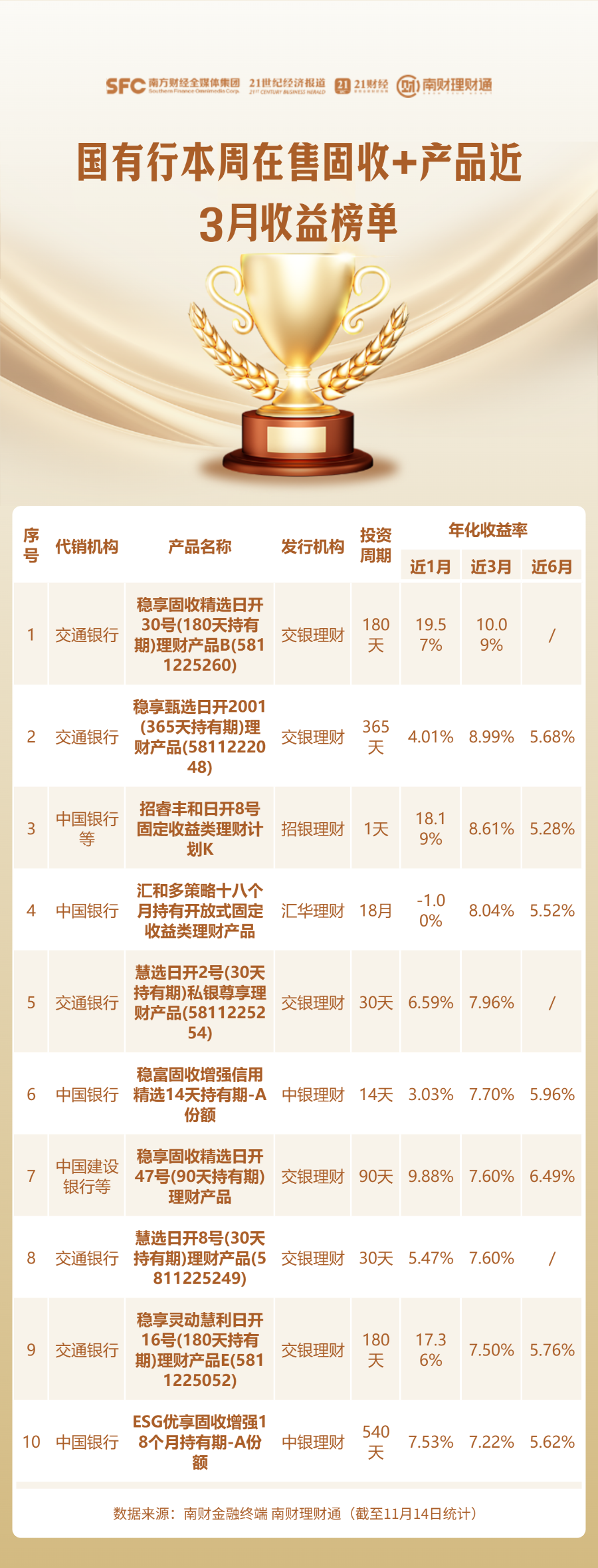
本周各银行在售“固收+”产品哪家强?
2 1 Shi Ji Jing Ji Bao Dao· 2025-11-17 01:20
Core Viewpoint - The article emphasizes the importance of selecting suitable wealth management products, particularly "fixed income+" products, from various banks, highlighting the need for investors to discern among numerous similar offerings [1][5]. Summary by Category Performance Ranking - The article presents a performance ranking of wealth management products based on their annualized returns over the past month, three months, and six months, with a focus on the three-month annualized yield for recent market performance [1][5]. Institutions Involved - A total of 28 banks are involved in the distribution of these wealth management products, including major institutions such as Industrial and Commercial Bank of China, Bank of China, Agricultural Bank of China, and others [1]. Product Selection - The ranking aims to assist investors in identifying high-performing products, with specific attention to the "fixed income+" category, which has gained popularity among investors seeking stable returns [1][5]. Market Dynamics - The article notes that the availability of these products may vary due to factors such as sold-out quotas or differences in product listings across banks, suggesting that investors should verify product availability through the respective bank's app [1].


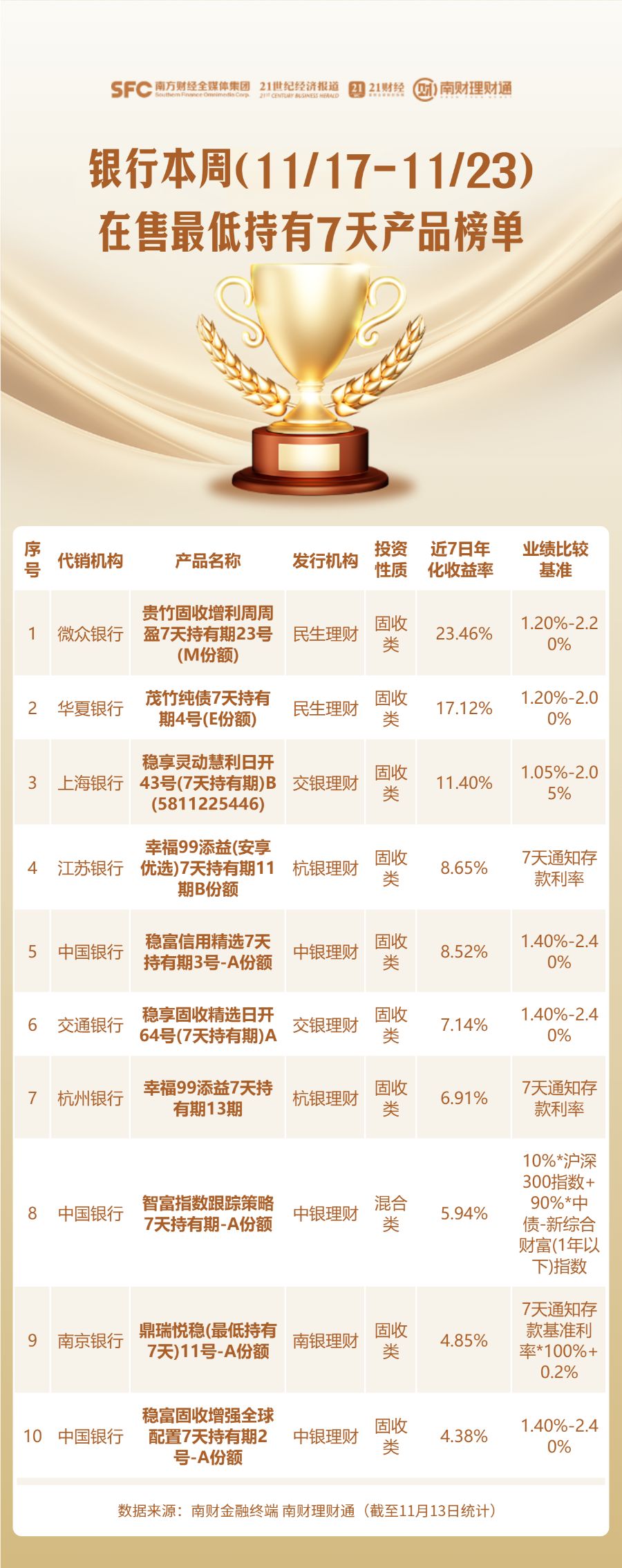
最低持有期榜单出炉!互联网银行7天持有期代销产品收益最高
2 1 Shi Ji Jing Ji Bao Dao· 2025-11-17 01:20
Core Insights - The article focuses on the performance of bank wealth management products with varying minimum holding periods, aiming to help investors identify and select high-performing products [1][5][12] Summary by Category Performance Rankings - The article provides a ranking of wealth management products based on their annualized returns for different holding periods: 7 days, 14 days, 30 days, and 60 days [1][5][12] - For the 7-day holding period, the top-performing product is from Minsheng Bank with an annualized return of 17.12% [4] - For the 14-day holding period, Minsheng Bank's product also leads with a return of 19.88% [6] - In the 30-day category, Minsheng Bank again tops the list with a return of 21.98% [10] - The 60-day holding period shows a leading return of 9.74% from Minsheng Bank [13] Product Categories - The products are categorized into fixed income and mixed types, with specific focus on their respective annualized returns and performance benchmarks [4][10][13] - The rankings are based on data from 28 distribution institutions, including major banks like ICBC, Bank of China, and Agricultural Bank of China [1] Investor Guidance - The article emphasizes the importance of checking the actual availability of products on bank apps, as some may be sold out or not displayed uniformly across different clients [1] - It aims to reduce the selection cost for investors by providing a clear performance overview of available products [1][5]
国际金价反复震荡 银行积存金投资门槛升至千元以上
Di Yi Cai Jing· 2025-11-17 00:32
随着金价持续攀升并伴随剧烈波动,银行端的黄金积存业务正在经历快速调整。中信银行、建设银行最 新公告显示,自11月15日起,两家银行均将积存金业务的月度起存金额明显上调,门槛普遍进入"千元 时代"。 11月14日,国际金价跳水,截至当天收盘,现货黄金报4082.159美元/盎司;沪金跟随下跌,当天收盘报 934.86元/克。 在国际金价高位震荡的大背景下,银行端正迎来新一轮黄金积存业务的集体调整。10月以来,多家大型 银行相继上调积存金起购门槛或调整相关交易规则,以应对价格快速波动带来的风险压力。 与此同时,国际金价近日在连续大涨后出现明显回调,市场对后续走势的判断出现分化,在机构普遍认 可黄金中长期逻辑的同时,2026年前后的短期路径仍存在较大不确定性。 银行再度抬高积存金门槛 建设银行公告称,为保护投资者权益、优化交易结构,该行修订了黄金积存业务规则,新增涉及报价机 制、巨额赎回等内容。其中,月积存金额起点由此前的较低水平提升至1200元,并按10元整数倍递增; 新规将自11月15日起正式执行。 值得注意的是,建行此次调整的核心,是将积存金买卖价差改为"动态调整模式",允许银行依据市场行 情、头寸状况及流动 ...