CCB(601939)

Search documents
建设银行(601939) - 建设银行关于召开2025年第二次临时股东会会议的通知
2025-11-07 10:15
证券代码:601939 证券简称:建设银行 公告编号:2025-064 中国建设银行股份有限公司 关于召开2025年第二次临时股东会会议的通知 本行董事会及全体董事保证本公告内容不存在任何虚假记载、误导性陈述或 者重大遗漏,并对其内容的真实性、准确性和完整性承担法律责任。 重要内容提示: 一、召开会议的基本情况 (一) 股东会会议类型和届次 2025年第二次临时股东会会议 日期时间:2025 年 11 月 27 日 14:50 地点:北京市西城区金融大街 25 号 (五) 网络投票的系统、起止日期和投票时间 股东会会议召开日期:2025年11月27日 本次股东会会议采用的网络投票系统:上海证券交易所股东会网络投票系统 (二) 股东会会议召集人:董事会 (三) 投票方式:本次股东会会议所采用的表决方式是现场投票和网络投票相结 合的方式 (四) 现场会议召开的日期、时间和地点 网络投票系统:上海证券交易所股东会网络投票系统 (一) 本次股东会会议审议议案及投票股东类型 网络投票起止时间:自2025 年 11 月 27 日 至2025 年 11 月 27 日 采用上海证券交易所网络投票系统,通过交易系统投票平台的投 ...
建设银行(00939) - 2025年第二次临时股东会会议通告
2025-11-07 10:11
香港交易及結算所有限公司及香港聯合交易所有限公司對本通告之內容概不負責,對其準確性 或完整性亦不發表任何聲明,並明確表示,概不對因本通告全部或任何部分內容而產生或因依 賴該等內容而引致之任何損失承擔任何責任。 2025年第二次臨時股東會會議通告 茲通告中國建設銀行股份有限公司(「本行」)謹訂於2025年11月27日14:50於北京市 西城區金融大街25號舉行2025年第二次臨時股東會會議,以審議並酌情通過下列 決議案: 作為普通決議案 1. 2025年中期利潤分配方案 作為特別決議案 2. 發行資本工具和總損失吸收能力非資本債務工具 上述議案的詳情載於本行日期為2025年11月7日的有關召開2025年第二次臨時股東 會會議的通函。除另有指明外,通函已界定詞語與本通告中具有相同涵義。 00939 中國建設銀行股份有限公司 董事會 2025年11月7日 於本通告日期,本行的執行董事為張金良先生、張毅先生和紀志宏先生,本行的 非執行董事為辛曉岱女士、劉芳女士、李璐女士、李莉女士和竇洪權先生,本行 的獨立非執行董事為威廉•科恩先生、梁錦松先生、詹誠信勛爵、林志軍先生和張 為國先生。 - 1 - 附註: - 2 - 1 ...
建设银行(00939) - 2025年第二次临时股东会会议通函
2025-11-07 10:04
此乃要件 請即處理 閣下如對本通函任何方面或應採取之行動有任何疑問,應諮詢 閣下之股票經紀或其他註冊證 券商、銀行經理、律師、專業會計師或其他專業顧問。 閣下如已將名下之中國建設銀行股份有限公司股份全部售出或轉讓,應立即將本通函連同隨附 的代理人委任表格及回執交予買主或承讓人,或經手買賣或轉讓之銀行、股票經紀或其他代理 商,以便轉交買主或承讓人。 香港交易及結算所有限公司及香港聯合交易所有限公司對本通函的內容概不負責,對其準確性 或完整性亦不發表任何聲明,並明確表示,概不對因本通函全部或任何部分內容而產生或因依 賴該等內容而引致之任何損失承擔任何責任。 00939 2025年中期利潤分配方案 | 釋義 | 1 | | --- | --- | | 董事會函件 | 2 | | 緒言 | 2 | | 2025年中期利潤分配方案 | 3 | | 發行資本工具和總損失吸收能力非資本債務工具 | 4 | | 2025年第二次臨時股東會會議 | 5 | | 2025年第二次臨時股東會會議的表決方式 | 5 | | 推薦意見 | 6 | | 2025年第二次臨時股東會會議通告 | 7 | 釋 義 發行資本工具和總損失吸收能力 ...
恒生银行与中国建设银行携手在港推出数字人民币商户收款服务
Zheng Quan Shi Bao Wang· 2025-11-07 09:39
Core Viewpoint - Hang Seng Bank has announced the launch of a digital renminbi merchant payment service in Hong Kong, in collaboration with its wholly-owned subsidiary Hang Seng China and China Construction Bank, aiming to expand the application of digital renminbi in retail consumption in Hong Kong [1] Group 1 - Hang Seng Bank is partnering with Hang Seng China and China Construction Bank to introduce a new payment service [1] - The initiative focuses on enhancing the use of digital renminbi for retail transactions in Hong Kong [1]

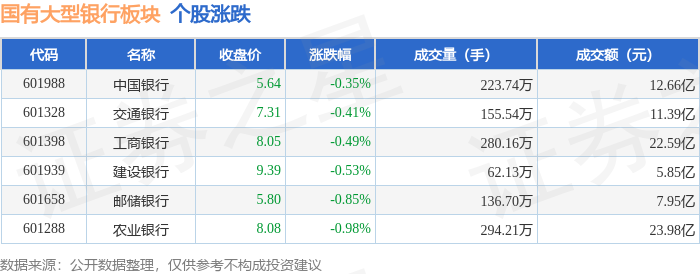
国有大型银行板块11月7日跌0.68%,农业银行领跌,主力资金净流出2.55亿元
Zheng Xing Xing Ye Ri Bao· 2025-11-07 08:37
Core Insights - The state-owned large bank sector experienced a decline of 0.68% on November 7, with Agricultural Bank leading the drop [1] - The Shanghai Composite Index closed at 3997.56, down 0.25%, while the Shenzhen Component Index closed at 13404.06, down 0.36% [1] Market Performance - The closing prices and changes for major state-owned banks are as follows: - Bank of China: 5.64, down 0.35% - Bank of Communications: 7.31, down 0.41% - Industrial and Commercial Bank of China: 8.05, down 0.49% - China Construction Bank: 9.39, down 0.53% - Postal Savings Bank: 5.80, down 0.85% - Agricultural Bank: 8.08, down 0.98% [1] Capital Flow - The state-owned large bank sector saw a net outflow of 255 million yuan from main funds, while retail investors contributed a net inflow of 251 million yuan [1] - The detailed capital flow for individual banks is as follows: - Bank of Communications: Main funds net inflow of 52.52 million yuan, retail net inflow of 34.41 million yuan - Industrial and Commercial Bank: Main funds net outflow of 22.51 million yuan, retail net inflow of 72.97 million yuan - Bank of China: Main funds net outflow of 36.09 million yuan, retail net inflow of 46.71 million yuan - China Construction Bank: Main funds net outflow of 44.38 million yuan, retail net inflow of 16.83 million yuan - Postal Savings Bank: Main funds net outflow of 53.25 million yuan, retail net inflow of 31.40 million yuan - Agricultural Bank: Main funds net outflow of 15.17 million yuan, retail net inflow of 48.80 million yuan [2]





上市银行大类资产配置跟踪:信贷投放稳健,债券配置灵活性提升
Ping An Securities· 2025-11-07 08:10
Industry Investment Rating - The investment rating for the banking sector is "Outperform" [1] Core Insights - The proportion of corporate loans has increased, while retail demand recovery is being monitored. As of mid-2025, the proportion of corporate loans among listed banks rose by 1.65 percentage points from the end of 2024 to 60.2%. The manufacturing sector's loans accounted for 18.5% of corporate loans, reflecting a recovery in the operations of manufacturing enterprises [3][12] - The flexibility in bond allocation has increased, with bond trading helping to stabilize market fluctuations. In the first half of 2025, listed banks saw a significant decline in other comprehensive income and fair value changes due to interest rate fluctuations. Some banks, primarily state-owned, increased bond trading to enhance investment returns and stabilize net profit growth [3][6] - Asset quality pressure is manageable, with a focus on risks in the retail sector. The overall asset quality remains stable, with the non-performing loan (NPL) ratio for A-share listed banks holding steady at 1.15% as of Q3 2025. However, the average NPL ratio for retail loans increased by 15 basis points to 1.58% compared to the end of 2024 [3][6] Summary by Sections Corporate Loan Structure - The overall asset structure of listed banks shows an increase in loan allocation, with the loan proportion rising by 0.1 percentage points from the end of 2024. State-owned banks increased interbank asset allocation, while small and medium-sized banks focused more on loan issuance [12][19] - Corporate loans remain the primary focus of credit allocation, with corporate loans accounting for 91.1% of all new loans in the first nine months of 2025. Short-term corporate loans made up 33.7% of new corporate loans [17][18] Bond Investment Preferences - The preference for flexible bond allocation has increased, with banks primarily investing in government bonds and central bank bills. The proportion of OCI accounts has risen, indicating a shift towards more flexible investment strategies [6][3] Asset Quality and Risk Monitoring - The asset quality of the banking sector is stable, with a non-performing loan ratio of 1.15% as of Q3 2025. The retail loan sector has shown slight increases in NPL ratios, necessitating ongoing monitoring of risks in this area [3][6]


黄金税收新规落地!普通人买金卖金将迎哪些变化?一文读懂
Sou Hu Cai Jing· 2025-11-07 06:43
Group 1 - The new tax policy on gold, effective from November 1, 2025, has caused significant changes in the gold market, affecting both banking operations and gold jewelry prices [1] - Banks have adjusted their gold accumulation services, with some halting the withdrawal of physical gold bars, while account-based services remain largely unaffected [3] - Despite the temporary suspension of certain services, demand for physical gold bars remains high, leading to rapid sales on banking apps [3] Group 2 - Individuals selling used gold jewelry are generally exempt from value-added tax, but frequent and large-scale sales may be classified as business activities, incurring a 3% tax [4] - Retail prices for gold jewelry are expected to rise due to the new regulations, with brands like Chow Tai Fook and Lao Feng Xiang already increasing prices [4] - The new tax policy will reduce input tax deductions for non-investment gold jewelry companies, potentially increasing their costs [5] Group 3 - Consumers are advised to purchase gold bars from Shanghai Gold Exchange member units to avoid the impacts of the new policy, as these transactions are less affected and offer more transparent pricing [7] - For gold jewelry purchases, consumers should compare price increases across brands to avoid overpaying due to policy-induced price hikes [7] - Individuals should be cautious when selling large amounts of used gold jewelry to assess potential tax risks [7]



辉煌“十四五” 壮美新答卷丨金融“新打法”破解铁路物流“老难题”
Guang Xi Ri Bao· 2025-11-07 02:52
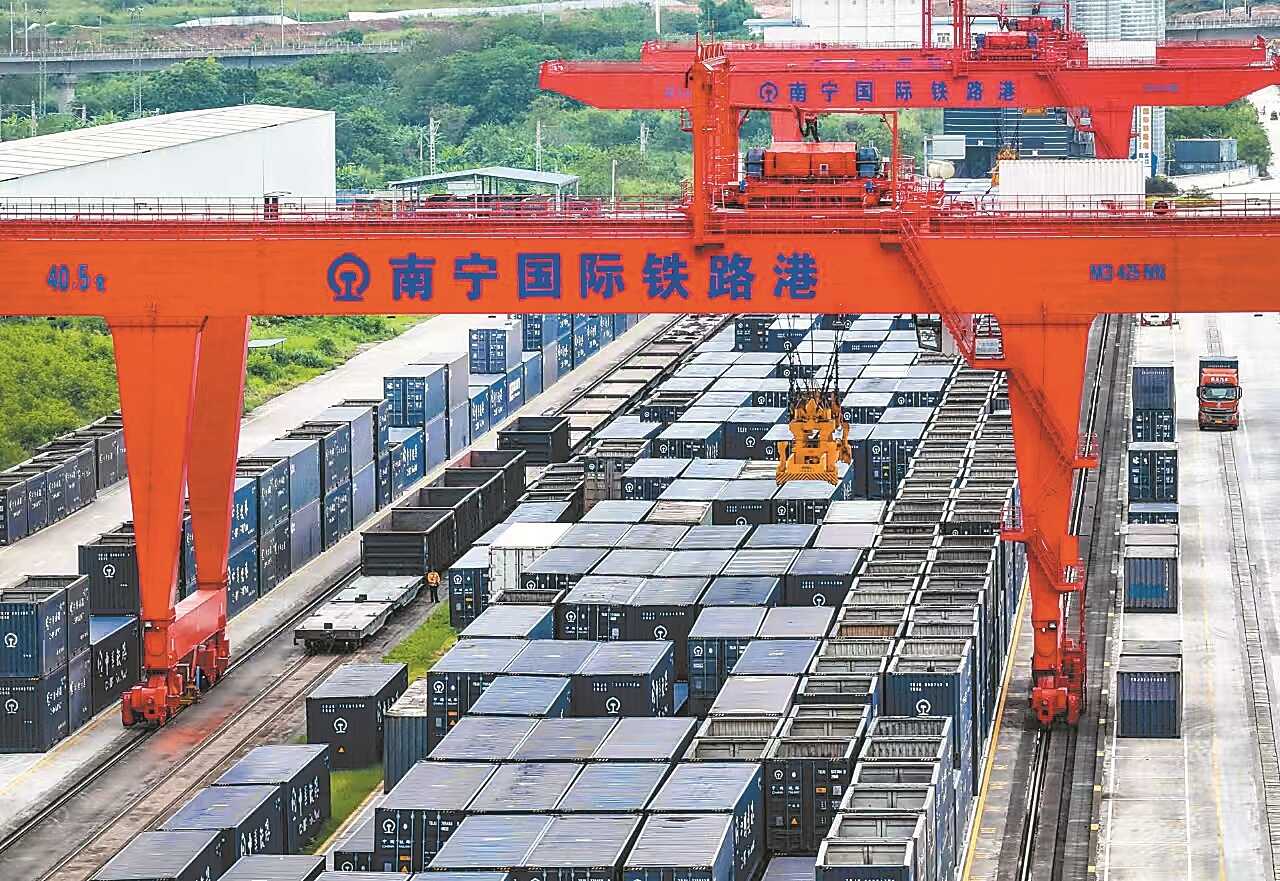
Core Insights - The article highlights the significant growth and innovation in the railway logistics sector, particularly through the West Land-Sea New Corridor, which has seen a 63.2% year-on-year increase in container shipments, surpassing 1.2 million TEUs in 2023 [2][6]. Group 1: Industry Growth and Opportunities - The opening of the West Land-Sea New Corridor has created more development opportunities for railway freight logistics companies, facilitating smoother operations and increased cargo movement [2][3]. - The financial strain on logistics companies due to traditional funding methods has been alleviated by new financial products introduced by China Construction Bank and China Railway Group, aimed at reducing logistics costs [3][5]. Group 2: Financial Innovations - The introduction of innovative financial products such as "Railway Freight Loan," "Letter of Credit Settlement," and "Railway Document Financing" has provided comprehensive financial services to the railway freight ecosystem, promoting cost reduction and efficiency [3][5]. - The integration of AI technology with logistics and finance has transformed historical data into valuable resources for companies, enabling better credit ratings and lower financing costs [5][6]. Group 3: Impact on Logistics Companies - Companies like Jicheng Logistics have benefited from these financial innovations, receiving credit lines that allow them to pay railway freight without the burden of upfront costs, thus improving cash flow and operational confidence [5][7]. - Over 150 small and micro enterprises in the railway logistics industry have received inclusive credit support, saving over 400 million yuan in logistics costs [6].
中国银行业(HA 股)_ 2025 年第三季度表现分化,上行空间有限但下行支撑稳固-Banks - China (H_A)_ 3Q25 mixed, upside limited but good for downside support
2025-11-07 01:28
Summary of Key Points from the Conference Call Industry Overview - **Industry**: Chinese Banking Sector (H-share banks) - **Period**: 3Q25 results and 9M25 performance Earnings Review - **Net Profit Growth**: Increased from +0.4% YoY in 1H25 to +0.5% in 9M25, with all big six state banks reporting positive YoY growth [1][11] - **Core Earnings Growth**: Slowed from +1.6% YoY in 1H to +0.8% by 9M25 [1] - **Performance Comparison**: H-share bank sector rose 19.9% YTD, underperforming MSCI China and HSI by 16ppt and 9ppt, respectively [1][11] - **Dividend Yield**: Sector's dividend yield at 5.3% is considered unattractive [1][11] - **Stock Recommendations**: Downgraded CCB-H/ABC-H from Buy to Neutral; upgraded BoComm-H from Underperform to Neutral; ICBC is the top pick among large banks [1][11] Loan Growth and Deposit Trends - **Loan Growth**: Average loan growth decelerated from 6.8%/6.9% YoY in FY24/1H25 to 6.3% in 9M25; big six state banks led with 7.5-10.0% YoY growth [2] - **Small Banks**: Experienced loan size contraction of 0.3-1.4% QoQ, raising concerns [2] - **Deposit Growth**: Seasonally low at 0.2% QoQ in 3Q, but YoY growth at 6.8% exceeded loan growth [2] Net Interest Margin (NIM) - **NIM Trends**: Average NIM edged down 1bp QoQ to 1.42% in 3Q; some banks reported NIM increases due to reduced funding costs [3] - **Future Outlook**: Potential stabilization of margins expected if no further policy rate cuts occur [3] Non-Interest Income - **Fee Income Growth**: Improved from +3.3% YoY in 1H to +4.8% in 9M25, attributed to a lower base and strong capital markets [4] - **Trading Gains**: Weakened from 29% YoY in 1H25 to 16% in 9M25, with some banks experiencing significant QoQ drops [4] Credit Quality and Provisions - **NPL Ratio**: Stable at 1.22% QoQ/YTD; average credit cost fell 5bp YoY to 67bp in 9M25 [5] - **Provisions**: Total provisions rose by +0.5% YoY in 9M, down from +3.5% in 1H [5] - **Coverage Ratios**: NPL and loan reserve coverage edged down QoQ to 232% and 2.75%, respectively [5] Valuation and Market Performance - **Valuation Metrics**: H-share banks currently trade at 0.55x P/B, 3.5x P/PPOP, and 6.0x P/E; dividend yield has declined from nearly 10% in Jan-2024 to 5.3% [11][21][23] - **Market Performance**: H-share banks underperformed the MSCI China index YTD; A-H share premium narrowed from 34% to 21% [31][11] Conclusion - The Chinese banking sector is showing mixed signals with modest profit growth and declining loan growth. While larger banks provide some stability, the overall market performance and valuation metrics suggest caution for investors. The focus remains on key players like ICBC, with recommendations adjusted based on recent performance.

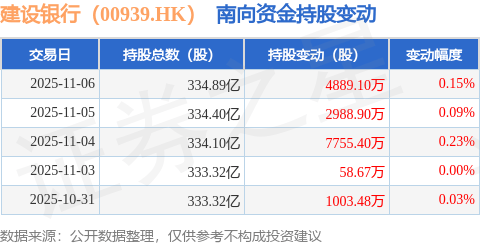
建设银行(00939.HK):11月6日南向资金增持4889.1万股
Sou Hu Cai Jing· 2025-11-07 01:09
Core Insights - Southbound funds increased their holdings in China Construction Bank (00939.HK) by 48.891 million shares on November 6, 2025, marking a continuous increase over the past five trading days with a total net increase of 167 million shares [1] - Over the last 20 trading days, there have been 16 days of net increases in holdings, totaling 217 million shares [1] - As of now, southbound funds hold 33.489 billion shares of China Construction Bank, accounting for 13.92% of the company's total issued ordinary shares [1] Summary by Category Trading Activity - On November 6, 2025, total shares held reached 33.489 billion, with a change of 48.891 million shares, reflecting a 0.15% increase [2] - On November 5, 2025, total shares held were 33.440 billion, with a change of 29.889 million shares, reflecting a 0.09% increase [2] - On November 4, 2025, total shares held were 33.410 billion, with a change of 77.554 million shares, reflecting a 0.23% increase [2] - On November 3, 2025, total shares held were 33.332 billion, with a change of 586,700 shares, reflecting no significant change [2] - On October 31, 2025, total shares held were 33.332 billion, with a change of 10.034 million shares, reflecting a 0.03% increase [2] Company Overview - China Construction Bank is a commercial bank with main business segments including corporate banking, personal banking, and fund operations [2]