BANK OF CHINA(601988)

Search documents
中国银行:黄金延期合约客户保证金比例将由44.88%调整为47.52%
Bei Jing Shang Bao· 2026-02-06 13:09
Core Viewpoint - The Bank of China announced adjustments to margin levels and trading limits for gold and silver futures contracts in response to market volatility and to protect investor interests [1] Group 1: Margin Adjustments - Starting from the close on February 9, 2026, the margin ratio for gold futures contracts on the Shanghai Gold Exchange will increase from 17% to 18% [1] - The margin ratio for Bank of China's gold futures clients will rise from 44.88% to 47.52% [1] - The price fluctuation limit for gold futures will be adjusted from 16% to 17% effective February 9, 2026 [1] Group 2: Silver Futures Adjustments - The margin ratio for silver futures contracts on the Shanghai Gold Exchange will increase from 23% to 24% starting February 9, 2026 [1] - The margin ratio for Bank of China's silver futures clients will rise from 66.01% to 68.88% [1] - The price fluctuation limit for silver futures will be adjusted from 22% to 23% effective February 9, 2026 [1] Group 3: Market Conditions - The Bank of China highlighted the increased uncertainty in the precious metals market, leading to significant price fluctuations [1] - Investors are advised to manage their trading activities based on their financial situation and risk tolerance [1] - The bank emphasizes the importance of controlling the scale of precious metal holdings to mitigate potential financial losses from price volatility [1]
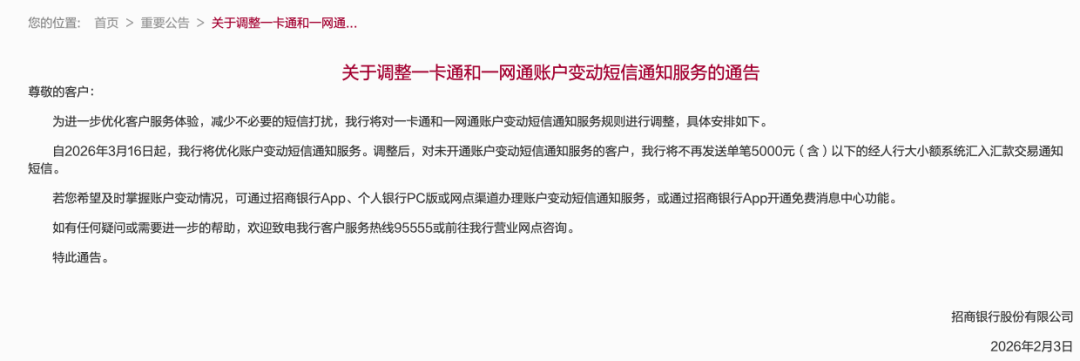
多家银行上调短信通知起点,最高至5000元
2 1 Shi Ji Jing Ji Bao Dao· 2026-02-06 13:00
Core Viewpoint - The banking industry is tightening cost control measures by increasing the threshold for transaction notification SMS services, with some banks raising the limit to 5000 yuan, marking the beginning of a paid SMS notification era for small transactions [1][2]. Group 1: Changes in SMS Notification Services - Multiple banks, including China Merchants Bank, have announced adjustments to their SMS notification services, with a new threshold of 5000 yuan for free notifications, which is among the highest in the industry [2][3]. - Other banks, such as Minsheng Bank and Bank of China, have also raised their SMS notification thresholds to 300 yuan and 100 yuan respectively, indicating a trend across the banking sector [3][4]. - The adjustments reflect a broader movement among banks to manage operational costs more effectively, particularly in light of the expenses associated with SMS notifications [6][13]. Group 2: Cost Savings and Digital Transition - Banks are expected to save significant costs by reducing the number of SMS notifications sent, as each message incurs a fee from telecom operators [6][9]. - The average cost for SMS services varies, with larger banks typically securing lower rates due to their scale, while smaller banks face higher costs [8][9]. - The shift towards digital notification methods, such as mobile banking apps and WeChat services, is becoming more prevalent, reducing reliance on traditional SMS notifications [12][14]. Group 3: Financial Implications - The banking sector's net interest margin remains stable at 1.42%, with expectations of continued optimization in asset-liability structures and a gradual decline in interest margins [14][15]. - The cost structure for SMS notifications suggests that charging customers around 3 yuan per month can cover operational costs, especially if the average customer receives fewer than 100 notifications monthly [11][10].



多家银行上调短信通知起点,最高至5000元
21世纪经济报道· 2026-02-06 12:58
Core Viewpoint - The banking industry is tightening cost control by increasing the threshold for transaction SMS notifications, with some banks raising it to 5000 yuan, marking the beginning of a paid SMS notification era [1][3]. Group 1: Changes in SMS Notification Policies - Several banks have raised the threshold for free SMS notifications, with China Merchants Bank setting the highest threshold at 5000 yuan for single transactions [3][4]. - Other banks, including Minsheng Bank and Bank of China, have also adjusted their SMS notification thresholds to 300 yuan and 100 yuan respectively [4]. - The trend of increasing the threshold for free SMS notifications has been observed since the second half of last year, with over ten banks making similar adjustments [3][4]. Group 2: Cost Savings from SMS Notifications - Banks incur costs for each SMS sent, and the adjustments in notification policies are aimed at reducing these expenses [8]. - Estimates suggest that a bank with 1 million personal customers could save approximately 300 million yuan monthly if they stop sending free SMS notifications for small transactions [9]. - The procurement prices for SMS services vary, with larger banks generally securing lower rates than smaller banks due to their scale advantages [8]. Group 3: Shift to Digital Notification Channels - Banks are increasingly shifting towards digital notification methods, such as mobile banking apps and WeChat service accounts, which are more cost-effective than SMS [11]. - For example, Bank of China encourages customers to use its mobile banking app for free transaction notifications instead of relying on SMS [11]. - The overall trend indicates a decline in the necessity of SMS notifications as banks enhance their digital service offerings [11].

正元智慧(300645):中标中国银行股份有限公司采购项目,中标金额为132.06万元
Xin Lang Cai Jing· 2026-02-06 11:25
Group 1 - The core point of the news is that Zhengyuan Zhihui Group Co., Ltd. won a procurement project from Bank of China with a bid amount of 1.3206 million yuan [1][2][3] Group 2 - Zhengyuan Zhihui (300645.SZ) reported a revenue of 1.195 billion yuan for 2024, with a revenue growth rate of -2.43% [2][3] - The net profit attributable to the parent company for 2024 was 12 million yuan, showing a significant decline with a growth rate of -71.35% [2][3] - The return on equity (ROE) for the company was 1.12% [2][3] - In the first half of 2025, the company reported a revenue of 460 million yuan, with a revenue growth rate of 0.03% [2][3] - The net profit attributable to the parent company for the first half of 2025 was -1.9 million yuan, reflecting a drastic decline with a growth rate of -118.03% [2][3] - The company operates in the information technology industry, with main product types including operational platform systems, specialized equipment, and components [2][3] - The revenue composition for 2024 was as follows: system construction 57.04%, operations and services 33.45%, intelligent control 7.94%, and others 1.57% [2][3]

中国银行贵州省分行原副行长张文明被开除党籍
Xin Lang Cai Jing· 2026-02-06 10:14
中央纪委国家监委网站2月6日通报,据中央纪委国家监委驻中国银行纪检监察组、广西壮族自治区纪委 监委消息:日前,经中央纪委国家监委批准,中央纪委国家监委驻中国银行纪检监察组、南宁市监委对 中国银行贵州省分行原党委委员、副行长张文明严重违纪违法问题进行了立案审查调查。 经查,张文明丧失理想信念,背弃初心使命,伪造证据对抗组织审查;无视中央八项规定精神,接受管 理服务对象旅游活动安排;违反组织原则,不按规定如实报告个人有关事项;廉洁底线失守,利用职务 上的影响为家人谋取利益、长期收受可能影响公正执行公务的礼品礼金、将应当由本人支付的费用交由 他人支付、违规在外部单位兼职取酬;插手干预授信项目;利用职务便利为他人在贷款审批等方面谋取 利益,非法收受巨额财物;违反国家规定发放贷款,造成国有资产重大损失。 张文明严重违反党的政治纪律、组织纪律、廉洁纪律、工作纪律和生活纪律,并涉嫌受贿、违法发放贷 款犯罪,且在党的十八大后不收敛、不收手,性质严重,影响恶劣,应予严肃处理。依据《中国共产党 纪律处分条例》《中华人民共和国监察法》等有关规定,经中国银行党委研究,决定给予张文明开除党 籍处分;收缴其违纪违法所得;经南宁市监委研究 ...
中国银行贵州省分行原党委委员、副行长张文明被开除党籍
Zhong Yang Ji Wei Guo Jia Jian Wei Wang Zhan· 2026-02-06 10:06
经查,张文明丧失理想信念,背弃初心使命,伪造证据对抗组织审查;无视中央八项规定精神,接受管 理服务对象旅游活动安排;违反组织原则,不按规定如实报告个人有关事项;廉洁底线失守,利用职务 上的影响为家人谋取利益、长期收受可能影响公正执行公务的礼品礼金、将应当由本人支付的费用交由 他人支付、违规在外部单位兼职取酬;插手干预授信项目;利用职务便利为他人在贷款审批等方面谋取 利益,非法收受巨额财物;违反国家规定发放贷款,造成国有资产重大损失。 张文明严重违反党的政治纪律、组织纪律、廉洁纪律、工作纪律和生活纪律,并涉嫌受贿、违法发放贷 款犯罪,且在党的十八大后不收敛、不收手,性质严重,影响恶劣,应予严肃处理。依据《中国共产党 纪律处分条例》《中华人民共和国监察法》等有关规定,经中国银行党委研究,决定给予张文明开除党 籍处分;收缴其违纪违法所得;经南宁市监委研究,决定将张文明涉嫌犯罪问题移送检察机关依法审查 起诉,所涉财物一并移送。 中央纪委国家监委网站讯 据中央纪委国家监委驻中国银行纪检监察组、广西壮族自治区纪委监委消 息:日前,经中央纪委国家监委批准,中央纪委国家监委驻中国银行纪检监察组、南宁市监委对中国银 行贵州省分 ...
你的年终奖,银行已备好专属理财方案
Jin Rong Shi Bao· 2026-02-06 09:41
Group 1 - The core viewpoint of the articles highlights the increasing focus of banks on year-end bonus wealth management products, reflecting a shift towards providing comprehensive asset allocation services to meet the evolving needs of investors [1][2][3] - Major banks, including Industrial and Commercial Bank of China and Bank of Communications, are launching specialized products for year-end bonuses, emphasizing low investment thresholds and diverse strategies to cater to different investor needs [1][2] - The year-end bonus wealth management market is experiencing growth, driven by banks' proactive strategies and a rising awareness among residents regarding rational financial management [2][3] Group 2 - The annual report from the China Banking Association indicates that by the end of 2025, the total scale of the wealth management market in China is expected to reach 33.29 trillion yuan, reflecting an 11.15% increase from the beginning of the year [3][4] - The number of individual investors holding wealth management products has reached 143 million, marking a year-on-year growth of 14.37%, indicating a growing trend in wealth management participation among residents [3][4] - The wealth management market is transitioning towards a phase of structural deepening and quality growth, with a focus on optimizing internal structures rather than just expanding absolute scale [4][5]



官方连打四“虎” 中国银行原副行长林景臻被开除党籍
Zhong Guo Xin Wen Wang· 2026-02-06 06:49
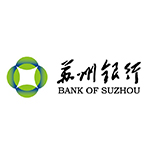
韩松生于1965年6月,山东临沂人。去年7月,官方通报其任上被查。 官方连打四"虎" 中国银行原副行长林景臻被开除党籍 中新社北京2月6日电 中国官方6日通报连打四"虎"。其中,中国银行原党委委员、副行长林景臻被开除 党籍;陕西省西安市人大常委会原党组书记、主任韩松,浙江省人大常委会原党组副书记、副主任高兴 夫,海南省委原常委、秘书长倪强,分别被开除党籍和公职。 公开资料显示,林景臻1987年进入中国银行,在该行工作多年。去年9月,官方通报其被查。 此次发布的党纪政务处分通报称,经查,林景臻丧失理想信念,背弃初心使命,私藏、阅看、寄递有严 重政治问题的书籍;无视中央八项规定精神,违规收受礼品,接受可能影响公正执行公务的宴请、旅游 活动安排,违规接受他人提供的出行服务安排,违规出入私人会所;不按规定报告个人有关事项,在职 工录用等工作中为他人谋取利益并收受财物;廉洁底线失守,违规拥有非上市公司股份,由他人支付应 由本人支付的费用;毫无纪法底线,将信贷权力异化为谋取个人私利的工具,大搞权钱交易,利用职务 便利为他人在贷款融资等方面谋利,并非法收受巨额财物。 依据《中国共产党纪律处分条例》等有关规定,经中央纪委常委 ...
林景臻,被开除党籍、取消待遇!
Zhong Guo Ji Jin Bao· 2026-02-06 06:39
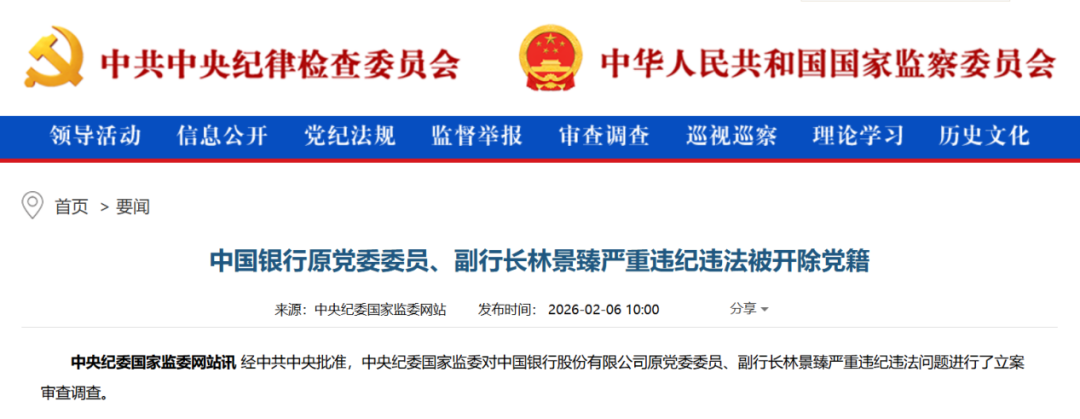
Core Viewpoint - The former Vice President of China Bank, Lin Jingzhen, has been expelled from the Party due to serious violations of discipline and law, highlighting ongoing issues of corruption within state-owned banks in China [1][2]. Summary by Relevant Sections Investigation and Findings - The Central Commission for Discipline Inspection and the National Supervisory Commission have initiated an investigation into Lin Jingzhen, revealing multiple serious violations including the possession of politically problematic materials and accepting gifts and services that could influence his official duties [2]. - Lin was found to have violated the central eight-point regulations, accepted gifts, and engaged in activities that compromised his integrity, including using his position for personal gain through loan financing [2]. Disciplinary Actions - Lin Jingzhen has been expelled from the Party, stripped of his benefits, and his case has been referred to the judicial authorities for prosecution [2]. - The investigation concluded that Lin's actions constituted severe violations of political, organizational, and integrity disciplines, with a significant negative impact [2]. Background Information - Lin Jingzhen, born in May 1965, has a long history with China Bank, having held various senior positions since joining in 1987, including Vice President since March 2018 [2]. - Recent reports indicate a pattern of disciplinary actions against other officials within China Bank, suggesting a broader crackdown on corruption within the institution [2]. Broader Context - The head of the disciplinary inspection team at China Bank emphasized the evolving nature of corruption in the financial sector, which often hides behind complex financial transactions and market behaviors [2]. - There is a call for enhanced analytical methods to identify corrupt practices and improve the effectiveness of oversight in the banking sector [2].
中国银行原副行长林景臻,被开除党籍
Xin Lang Cai Jing· 2026-02-06 03:42
智通财经2026-02-06 10:24:52 中央纪委国家监委网站 林景臻严重违反党的政治纪律、组织纪律和廉洁纪律,构成严重职务违法并涉嫌受贿犯罪,且在党的十 八大后不收敛、不收手,性质严重,影响恶劣,应予严肃处理。依据《中国共产党纪律处分条例》《中 华人民共和国监察法》《中华人民共和国公职人员政务处分法》等有关规定,经中央纪委常委会会议研 究并报中共中央批准,决定给予林景臻开除党籍处分;按规定取消其享受的待遇;收缴其违纪违法所 得;将其涉嫌犯罪问题移送检察机关依法审查起诉,所涉财物一并移送。 本 期资深 编 辑 周玉华 经中共中央批准,中央纪委国家监委对中国银行股份有限公司原党委委员、副行长林景臻严重违纪违法 问题进行了立案审查调查。 经查,林景臻丧失理想信念,背弃初心使命,私藏、阅看、寄递有严重政治问题的书籍;无视中央八项 规定精神,违规收受礼品,接受可能影响公正执行公务的宴请、旅游活动安排,违规接受他人提供的出 行服务安排,违规出入私人会所;不按规定报告个人有关事项,在职工录用等工作中为他人谋取利益并 收受财物;廉洁底线失守,违规拥有非上市公司股份,由他人支付应由本人支付的费用;毫无纪法底 线,将信贷 ...