
Sugon(603019)

Search documents
习近平在北京考察科技创新工作,雷军唐杰等企业家接受会见
Xin Lang Cai Jing· 2026-02-09 10:32
Core Insights - The National Innovation Center in Beijing has gathered over 700 enterprises, covering key sectors such as CPU, operating systems, databases, complete machines, network security, and application software [5][21]. Group 1: Key Enterprises - Loongson Technology (龙芯中科, 688047) is a leader in domestic CPU with its LoongArch instruction set and has a strong market share in government and terminal markets [6][22]. - Phytium Technology (飞腾信息, 000066) leads in the integration of servers and terminals with its FT series CPUs and has a well-adapted ecosystem [6][22]. - Haiguang Information (海光信息, 688041) focuses on general-purpose CPUs and DCU chips, being a major player in high-performance computing and data center chips [7][22]. - Tongxin Software is a core manufacturer of domestic desktop and server operating systems with a rich adaptation ecosystem [8][23]. - Kylin Software (麒麟软件, 600536) is a key supplier for critical industries such as government and finance with its Galaxy Kylin OS [9][24]. - DM Database (达梦数据库) is recognized as a benchmark for domestic databases with leading transaction processing performance [10][25]. - Renmin University of China Database (人大金仓) has a high penetration rate in government and central enterprise markets with its KingbaseES database [11][26]. - Sugon (中科曙光, 603019) is a leader in server and supercomputing infrastructure with advanced liquid cooling technology [12][27]. - China Great Wall Technology (中国长城, 000066) is a core enterprise in the domestic closed-loop for innovation with its Feiteng platform and terminals [13][28]. - Aisino (亚信安全, 688225) leads in security solutions for innovation environments with strong adaptation capabilities [14][29]. - Sangfor Technologies (深信服, 300454) is a leader in enterprise security and cloud computing solutions [15][29]. - Kingsoft Office (金山办公, 688111) is a leading domestic office software provider with extensive adaptation in innovation [15][29]. - Yonyou Network (用友网络, 600588) is a core manufacturer for enterprise management software transformation in innovation [16][30]. - SMIC (中芯国际) supports domestic chip manufacturing with its advanced 12-inch wafer fabrication capabilities [16][30]. - Unisoc (紫光汉图) provides adaptation and solutions for innovation [16][30].


量子科技相关利好汇总!技术突破政策加码齐落地,产业国产化与商业化双轨加速前行
Xin Lang Cai Jing· 2026-02-09 10:09
Group 1 - Zhongke Shuguang, based in Beijing, is a leading enterprise in high-performance computing, cloud computing, and big data, with a comprehensive self-developed technology system in computing infrastructure [1][29] - The company collaborates with top research institutions to develop quantum computing supporting technologies and has launched dedicated computing infrastructure for quantum computing [1][29] - Future prospects include becoming a core service provider for quantum computing industrialization, leveraging national computing network construction and quantum technology policies [1][29] Group 2 - iFlytek, located in Hefei, is a leader in intelligent voice and AI, focusing on the integration of quantum computing and AI applications [2][30] - The company aims to optimize AI model training efficiency using quantum computing's parallel processing advantages and explores quantum algorithms in various fields [2][30] - Future developments may lead to differentiated advantages in quantum intelligent interaction and optimization algorithms [2][30] Group 3 - Hengtong Optic-Electric, based in Suzhou, is a global leader in optical communication and energy interconnection, with a significant market share in quantum communication [3][31] - The company has developed quantum key distribution (QKD) equipment and has a market share of over 40% in quantum optical cables [3][31] - Future strategies include enhancing core devices and exploring the integration of quantum communication with marine communication [3][31] Group 4 - Aerospace Electronics, located in Beijing, is a core enterprise in aerospace electronic information, focusing on quantum sensing and navigation technologies [4][32] - The company develops high-precision aerospace sensors based on quantum effects and supports the construction of space-based quantum communication networks [4][32] - Future advancements may position the company as a key supplier in aerospace quantum technology applications [4][32] Group 5 - Zhongtian Technology, based in Nantong, specializes in optical cables and renewable energy, focusing on the infrastructure for quantum key distribution networks [5][34] - The company collaborates with other quantum technology firms to provide supporting equipment for quantum communication systems [5][34] - Future efforts may include the development of specialized optical devices and solutions for quantum communication [5][34] Group 6 - Huagong Technology, located in Wuhan, is a leader in laser processing and optoelectronic devices, focusing on core optical devices needed for quantum communication [6][35] - The company aims to become a key supplier of quantum communication components and explore quantum sensing technology applications [6][35] - Future developments may enhance the company's position in the quantum communication market [6][35] Group 7 - China West Electric, based in Xi'an, focuses on quantum sensing technology applications in power systems, developing high-precision monitoring sensors [7][36] - The company aims to enhance the stability and intelligence of power systems through quantum sensing technology [7][36] - Future strategies may solidify the company's core advantages in quantum monitoring and precision measurement [7][36] Group 8 - AVIC Optoelectronics, located in Luoyang, specializes in high-precision connectors and optoelectronic components for quantum communication and computing [8][37] - The company aims to support the miniaturization and integration of quantum devices through its advanced manufacturing capabilities [8][37] - Future developments may expand the company's role in the quantum technology supply chain [8][37] Group 9 - Southern Power Grid Digital, based in Guangzhou, focuses on digital power grid solutions and quantum key distribution technology in power systems [9][38] - The company aims to establish a quantum security protection system for critical power infrastructure [9][38] - Future initiatives may position the company as a benchmark in quantum security applications within the power industry [9][38] Group 10 - China Great Wall, located in Beijing, is a leader in self-controlled computing and information security, focusing on post-quantum cryptography [10][39] - The company develops solutions to ensure information system security in the quantum computing era [10][39] - Future advancements may enhance the company's offerings in quantum security solutions [10][39] Group 11 - Kehua Data, based in Xiamen, specializes in data center infrastructure and energy management, providing power solutions for quantum computing facilities [11][41] - The company aims to become a core supplier for quantum computing infrastructure as the industry grows [11][41] - Future developments may optimize energy solutions for quantum computing centers [11][41] Group 12 - State Grid Information Communication, located in Beijing, focuses on digital power and information communication, exploring quantum key distribution in power networks [12][42] - The company aims to enhance the security of power communication networks through quantum technology [12][42] - Future strategies may solidify the company's role in promoting quantum communication applications in the power sector [12][42] Group 13 - Tiantong Co., based in Haining, specializes in magnetic materials and sapphire crystals, focusing on high-performance sapphire substrates for quantum computing [13][43] - The company aims to become a key supplier of materials essential for quantum chip manufacturing [13][43] - Future developments may expand the application of quantum materials in various quantum devices [13][43] Group 14 - Shenzhou Information, a leader in financial technology, focuses on quantum key distribution in the financial sector [14][44] - The company aims to build a quantum security financial service system to protect financial data [14][44] - Future initiatives may enhance the integration of quantum technology in financial services [14][44] Group 15 - Qiming Star, located in Beijing, is a leader in network security, focusing on the development of post-quantum cryptography technologies [15][45] - The company aims to provide comprehensive network security solutions to protect against quantum computing threats [15][45] - Future advancements may position the company as a core service provider in post-quantum security [15][45] Group 16 - Electric Science Network Security, based in Chengdu, focuses on quantum security technologies, including quantum key distribution and post-quantum cryptography [16][47] - The company aims to become a key player in quantum security for critical information infrastructure [16][47] - Future developments may enhance the company's capabilities in quantum security solutions [16][47] Group 17 - Keda Guokai, located in Hefei, focuses on the intersection of quantum computing and big data, developing algorithms for quantum data processing [17][48] - The company aims to accelerate the industrialization of quantum computing technologies [17][48] - Future initiatives may open new growth opportunities in the intelligent software industry [17][48] Group 18 - Guangdong Measurement, based in Guangzhou, specializes in calibration and testing services for quantum technology products [18][49] - The company aims to ensure the measurement accuracy and stability of quantum devices [18][49] - Future developments may position the company as a core calibration service provider in the quantum technology sector [18][49] Group 19 - Dongxin Peace, located in Zhuhai, focuses on quantum key distribution technology for IoT security applications [19][50] - The company aims to enhance the security of IoT devices and data transmission through quantum technology [19][50] - Future initiatives may solidify the company's position in the quantum security market for IoT [19][50] Group 20 - Hengbao Co., based in Zhenjiang, specializes in smart cards and financial technology, focusing on quantum security in financial transactions [20][51] - The company aims to develop quantum secure payment systems to protect financial data [20][51] - Future developments may enhance the company's offerings in quantum security applications within the financial sector [20][51] Group 21 - Datang Telecom, located in Beijing, focuses on integrated circuit design and quantum communication chip development [21][52] - The company aims to support the miniaturization and integration of quantum devices through specialized chips [21][52] - Future advancements may position the company as a key supplier in the quantum chip market [21][52] Group 22 - Guomin Technology, based in Shenzhen, focuses on post-quantum cryptography for security chips in various industries [22][54] - The company aims to ensure the security of devices and data in the quantum computing era [22][54] - Future developments may enhance the company's capabilities in the quantum security chip market [22][54]


万卡集群点亮中原:国家级“智算样板间”的落地与远见
Xin Lang Cai Jing· 2026-02-09 01:21
Core Insights - Zhengzhou has become a strategic hub for AI computing infrastructure in China with the launch of the first domestic AI computing pool featuring 30,000 AI acceleration cards [1][12] - The deployment of the scaleX supercluster systems marks a significant milestone in the evolution of national supercomputing infrastructure, facilitating AI innovation and ecosystem empowerment [1][12] Infrastructure Development - The transition to the AI era necessitates a profound transformation in infrastructure, driven by explosive growth in demand for AI models and applications [3][14] - The national supercomputing internet aims to create a leading national-level computing facility and service platform, akin to an e-commerce marketplace for computing resources [5][16] Technical Specifications - The scaleX supercluster can provide over 30,000 AI cards for various applications, including AI model training and high-throughput inference [6][16] - The system features advanced technologies such as high-density blade servers and immersion cooling, achieving a power usage effectiveness (PUE) of 1.04 and a 20-fold increase in computing density [7][16] Innovation and Ecosystem - The scaleX supercluster represents a comprehensive innovation in system architecture and engineering, having been operationally deployed just two months after its initial reveal [8][17] - The open architecture of the scaleX supercluster supports compatibility with mainstream software ecosystems and mixed deployments of various AI acceleration cards, fostering collaboration and innovation across the AI industry [10][19] Future Implications - The open architecture approach is expected to lower barriers for users, stimulate innovation, and enable widespread application of AI across various sectors [10][19] - The deployment of the scaleX supercluster is a clear expression of China's path in developing AI infrastructure, balancing self-innovation with openness and inclusivity [12][20]
ClaudeOpus4.6开启多Agent协作模式
Soochow Securities· 2026-02-08 10:26
证券研究报告·策略报告·策略周评 策略周评 20260208 Claude Opus 4.6 开启多 Agent 协作模式 2026 年 02 月 08 日 [Table_Tag] [Table_Summary] 本周 AI 要闻 (信息来源:第一财经、财联社、AI daily 等) 周度观点 ◼ Claude Opus 4.6 开启多 Agent 协作模式,AI 向生活场景渗透 (1)本周全球 AI 产业延续算力、模型与应用协同推进的演进趋势,基础 设施加码与应用场景扩展两条主线持续延展。算力端,头部云厂商持续加 大资本开支并通过融资扩容云基础设施,国内中科曙光万卡超集群上线试 运行,显示算力资源正加速向具备资金与技术优势的主体集中,行业门槛 持续抬升。模型端,随着大模型能力向复杂任务拆解与现实执行延伸,海 外厂商通过多 Agent 协作与企业级工作流,推动 AI 向"AI 员工"形态演 进,国内厂商则通过开源完善具身智能技术体系,推动模型能力向物理世 界延伸。应用端,AI 一方面通过人形机器人加速进入现实执行场景,另一 方面借助消费与开发等高频数字场景培育用户使用习惯。整体来看,AI 产 业正在算力集中与 ...
未来智造局|国家超算互联网核心节点上线试运行 3万卡国产AI算力随取随用
Xin Hua Cai Jing· 2026-02-08 07:11
Core Insights - The launch of the national supercomputing internet core node marks a significant milestone in the deployment and practical application of domestic AI computing resources, alleviating the imbalance between supply and demand in computing power [1][2][5] - The core node is part of a major infrastructure initiative aimed at creating a leading national computing infrastructure and service platform to support various fields, including artificial intelligence and digital economy [2][5] - The deployment of the core node, supported by three sets of "Wanka" supercluster systems from Sugon, can provide over 30,000 domestic AI accelerator cards, facilitating large-scale AI computing applications [2][6] Industry Context - The increasing demand for AI-driven innovations has highlighted the shortage of computing resources, which has become a critical bottleneck for industry upgrades [2][8] - The national supercomputing internet aims to address issues such as resource underutilization and inefficiencies in computing resource allocation, enhancing the overall efficiency of computing power distribution [2][5] - The project is expected to create a nationwide integrated computing network, connecting over 30 backbone computing centers and offering nearly 70 types of domestic super-intelligent computing services [5][8] Technological Advancements - Sugon's "Wanka" supercluster systems have achieved significant innovations in performance and efficiency, enabling the support of trillion-parameter AI models and various application scenarios [6][7] - The core node's architecture is designed to be compatible with mainstream software ecosystems, allowing for mixed deployment of various domestic accelerator cards [7] - The supercomputing internet platform is evolving into a marketplace for computing applications, aiming to lower the barriers to access and enhance usability for a wide range of users [8][9] Application and Impact - The core node has already served over 1 million users and processed nearly 196 million jobs, significantly reducing computing costs and facilitating AI innovation [8][9] - The platform is actively engaging with various industries to promote the integration of AI computing resources, with initiatives like the invitation for testing plans to attract diverse applications [9][12] - The first batch of application validation results has been released, showcasing the potential of the supercomputing internet to empower various sectors and drive innovation [12]

计算机行业 2025Q4 基金持仓分析:重仓超配比例行至底部,静待板块修复
Changjiang Securities· 2026-02-08 05:57
Investment Rating - The investment rating for the computer industry is "Positive" and maintained [10] Core Insights - The total market value of heavy holdings in the computer sector for Q4 2025 is approximately 23.27 billion, down from 37.36 billion in Q3 2025, reflecting a decrease of about 14.09 billion. The concentration of holdings has further increased, with a higher proportion in storage and vertical applications. Overall, the allocation ratio for the computer industry has reached a historically low level, indicating limited downside potential. With the acceleration of AI application commercialization, the sector is expected to see a recovery [2][5][6][35]. Summary by Sections Heavy Holdings and Allocation - The heavy allocation ratio for the computer sector has continued to decline, reaching a historical low of 1.6% in Q4 2025, down 0.7 percentage points from Q3 2025. The heavy allocation ratios over the past year have been -2.8%, -3.4%, -3.6%, and -3.8%, indicating a deepening decline [19][20]. Sector Performance and Fund Flow - The absolute value of holdings in various sub-sectors has generally decreased, with increased pressure from fund outflows. The top five sub-sectors by market value in Q4 2025 are IT infrastructure (2.8%), government IT (2.3%), industrial software (2.1%), cybersecurity (1.7%), and automotive IT (1.7%). The government IT sector saw a significant increase of 0.6%, while energy IT experienced a notable decline of 1.3% [6][34]. Concentration of Holdings - The concentration of holdings in the computer sector has significantly increased, reaching a new high. The CR10 and CR5 concentration ratios rose from 65.9% to 69.8% and from 49.1% to 57.8%, respectively, indicating a trend towards increased concentration of fund holdings [7][43]. Future Outlook - The application and computing power chains are expected to continue attracting institutional investments, with a focus on structural opportunities amid sector rotation. The current optimistic narrative surrounding AI is expected to drive demand for computing power, particularly as AI applications begin to materialize in various high-value scenarios [8][27][28]. Valuation Metrics - As of February 3, 2026, the latest PE-TTM for the Jiangsu computer index is 68.5 times, which is at the 91st percentile since 2016. In comparison, the latest PE-TTM for the CSI 300 is 13.3 times, at the 78th percentile [48][50].


天津滨海高新区“十五五”打造两个千亿级产业集群
Sou Hu Cai Jing· 2026-02-08 02:41
Core Insights - The Tianjin Binhai High-tech Zone reported a revenue growth of 11.6% year-on-year for its five major industries last year, with a focus on developing two trillion-yuan industrial clusters in the fields of trusted computing and platform economy services [1] Industry Overview - The five major industries in the high-tech zone include trusted computing, new economic services, biomedicine, new energy, and high-end equipment manufacturing, with trusted computing and new economic services achieving double-digit revenue growth last year [1] - The high-tech zone is also prioritizing cutting-edge fields such as core chips, brain-computer interaction, and cell and gene therapy, becoming one of the first four future industry pilot zones in Tianjin [1] Company Developments - Zhongke Shuguang has established an annual production capacity of one million high-end servers and terminal products in the high-tech zone, positioning it as a hub for digital and intelligent technology [1] - The company plans to collaborate with upstream and downstream enterprises, universities, and research institutions to build a comprehensive innovation system covering core components, complete systems, software ecosystems, and application services [1] Future Plans - Over the next five years, the high-tech zone aims to upgrade its leading industries and accelerate the construction of a modern industrial system, targeting the establishment of two trillion-yuan industrial clusters [1] - This year, the zone aims to launch one landmark project and 16 high-quality projects to attract premium projects and strengthen the industrial chain [1]
算力抢滩,万卡集群站上AI风口
Di Yi Cai Jing Zi Xun· 2026-02-06 15:46
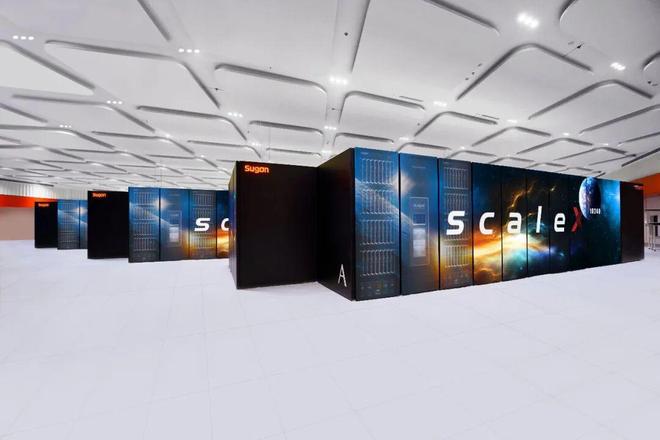
Core Insights - The article highlights the launch of the scaleX 30,000-card supercluster by Zhongke Shuguang, marking the establishment of the largest domestic AI computing power pool in China, which supports advanced AI computing scenarios such as trillion-parameter model training and AI for Science [1][5]. Group 1: Technological Breakthrough - The scaleX supercluster was deployed in less than two months after its first appearance at the HAIC conference in December 2025, showcasing China's rapid integration capabilities in large-scale intelligent computing systems [2]. - Zhongke Shuguang overcame several key technical challenges, including high-speed interconnection, tight coupling design of storage and computing, and efficient resource scheduling, through systematic innovation [4]. Group 2: Practical Value - The scaleX supercluster has demonstrated its application value across various fields, including supporting trillion-parameter model training and enhancing inference efficiency for major internet companies [5]. - It has also contributed to significant advancements in scientific research, such as improving protein research efficiency by 3 to 6 orders of magnitude for top domestic research teams [5]. Group 3: Regional Empowerment - The simultaneous deployment of three superclusters is expected to significantly impact regional development, particularly in Zhengzhou, enhancing its capabilities in computing power and digital infrastructure [6]. - The establishment of this core node is anticipated to elevate Zhengzhou's development level and strengthen its role in computing power scheduling and multi-domain applications [6].
算力抢滩,万卡集群站上AI风口
第一财经· 2026-02-06 15:35
Core Viewpoint - The article highlights the launch of the scaleX 30,000-card supercluster by Zhongke Shuguang, marking a significant advancement in domestic AI computing power, supporting large-scale model training and high-throughput inference, and promoting a new phase of accessible and user-friendly intelligent computing [1][6]. Technological Breakthrough - The scaleX supercluster transitioned from demonstration to deployment in less than two months, showcasing China's rapid integration capabilities in large-scale intelligent computing systems [2]. - Zhongke Shuguang overcame key technical challenges such as high-speed interconnection, tight coupling of storage and computing, and efficient resource scheduling through systematic innovation [4]. Practical Value - The scaleX supercluster has demonstrated its application value across various fields, including training trillion-parameter models and enhancing inference efficiency for major internet companies [6]. - It has supported significant advancements in scientific research, such as improving protein research efficiency by 3-6 orders of magnitude, and has completed optimization for over 400 mainstream models [6]. Regional Empowerment - The deployment of three superclusters not only provides core computing support but also has a profound impact on regional development, particularly in Zhengzhou, enhancing its capabilities in computing resource scheduling and digital construction [8]. - The establishment of this core node is expected to elevate Zhengzhou's development and strengthen its role in various applications, contributing to a complete and innovative industrial ecosystem [8].
国家数据局局长刘烈宏主持召开系列专家企业代表座谈会听取对“十五五”时期数字中国规划和建设的意见建议
Mei Ri Jing Ji Xin Wen· 2026-02-06 14:08
Group 1 - The National Bureau of Statistics held four symposiums to gather opinions from industry experts and company representatives on advancing the construction of Digital China [1] - Experts and representatives from major companies such as Huawei, Tencent, Alibaba, and Baidu participated, discussing the challenges and trends in the industry during the 14th Five-Year Plan period [1] - There was a consensus among participants that the planning is systematic and leading, effectively addressing social concerns and enhancing development confidence [1]