
Proya(603605)

Search documents
刚刚过去的618,抖音美妆大洗牌
Xin Lang Cai Jing· 2025-07-02 03:59
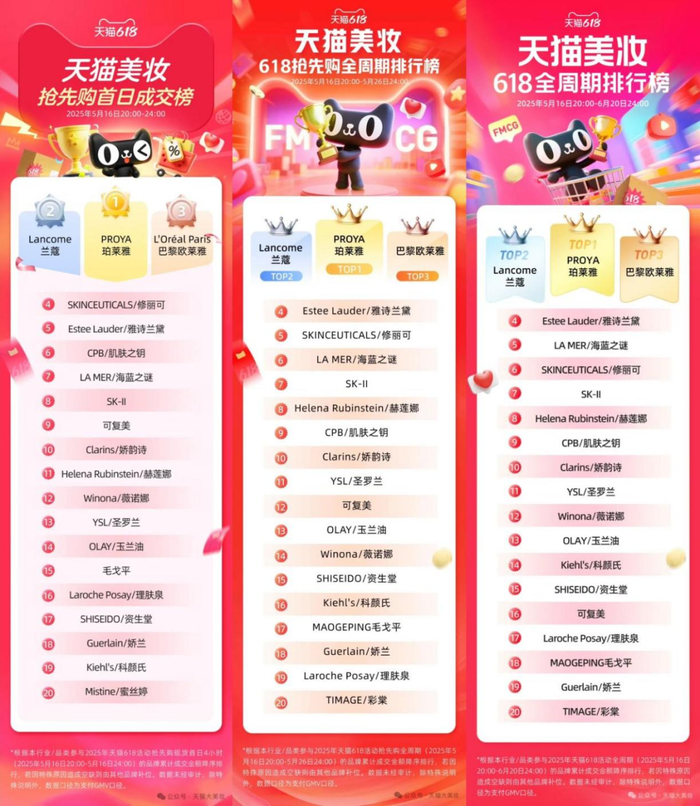
Core Insights - The beauty and skincare sales during the 618 shopping festival reached 57.5 billion yuan, marking a year-on-year growth of over 60%, setting a new record [1] - Tmall and Douyin exhibited contrasting strategies in the beauty sector, with Tmall focusing on brand strength and supply chain management, while Douyin emphasized content-driven marketing and rapid product launches [1][9] Tmall Insights - Proya emerged as the standout winner, securing the top position in Tmall's beauty rankings for three consecutive periods [4] - L'Oréal and Lancôme consistently held the second and third positions, indicating a stable top-tier brand concentration [6] - The top 10 brands on Tmall are dominated by Proya and L'Oréal's brands, reflecting a trend towards brand group consolidation [6][8] - Skincare brands dominate the Tmall beauty rankings, with consumers showing a higher preference for essential products like serums and sunscreens over color cosmetics [6] Douyin Insights - Douyin's beauty rankings are characterized by rapid changes, driven by content and marketing strategies rather than traditional brand loyalty [9] - The skincare and makeup categories on Douyin have seen significant shifts, with brands like HBN and Colanri rising rapidly in the rankings [12][14] - The emergence of new brands like Tilo Wei, which topped the Douyin makeup rankings, highlights the importance of content and visual appeal in driving consumer interest [14][16] - The competition among domestic brands is intensifying, with established players like Huaxizi and AKF struggling to maintain their positions [16] Comparative Analysis - The comparison between Tmall and Douyin reveals a dual dynamic in the beauty retail ecosystem, where Tmall emphasizes supply stability and brand accumulation, while Douyin prioritizes rapid content updates and explosive marketing strategies [17] - The structural differences in brand representation on both platforms indicate that international brands still dominate Tmall, while Douyin sees a more diverse mix of domestic brands [8][13]


珀莱雅化妆品股份有限公司可转债转股结果暨股份变动公告
Shang Hai Zheng Quan Bao· 2025-07-01 20:35
Core Points - The announcement details the conversion results of the convertible bonds issued by Proya Cosmetics Co., Ltd. and the changes in share capital [1] Group 1: Convertible Bond Conversion Status - As of June 30, 2025, a total of RMB 969,000 of Proya's convertible bonds have been converted into A-shares, resulting in 7,092 shares, which accounts for 0.0025% of the company's total shares before conversion [2][7] - The amount of convertible bonds that have not been converted as of June 30, 2025, is RMB 750,744,000, representing 99.8711% of the total issuance [2][7] - During the quarter from April 1, 2025, to June 30, 2025, RMB 4,000 of convertible bonds were converted, resulting in 40 shares, which is 0.00001% of the total shares before conversion [2][7] Group 2: Convertible Bond Issuance Overview - Proya issued 7,517,130 convertible bonds on December 8, 2021, with a total value of RMB 75,171.30 million and a maturity of 6 years [3] - The initial conversion price was set at RMB 195.98 per share, which has been adjusted multiple times, with the latest conversion price being RMB 98.24 per share effective from October 23, 2023 [3][5][6] - The bond has a tiered interest rate structure, starting from 0.30% in the first year and increasing to 2.00% in the sixth year [3] Group 3: Share Capital Changes - The announcement includes details on the changes in share capital due to the conversion of convertible bonds, although specific figures for share capital changes are not provided [8]
化妆品医美行业25Q2业绩前瞻:新消费长坡厚雪,美护板块强者恒强
Shenwan Hongyuan Securities· 2025-07-01 14:55
Investment Rating - The report rates the cosmetics and medical beauty industry as "Positive" [2][3] Core Viewpoints - The cosmetics retail sales growth for January to May 2025 is 4.1%, an increase of 2 percentage points compared to the same period last year, indicating a steady recovery in demand [3] - The performance of leading brands remains strong, with double-digit growth, supported by the theme of self-care in new consumption trends, leading to a positive outlook for the first half of 2025 [3] - The 618 shopping festival saw strong performances from domestic brands, with notable rankings on platforms like Tmall and Douyin [3] Summary by Sections Cosmetics Industry Outlook - The report anticipates significant revenue and net profit growth for major companies in Q2 and H1 2025, with specific forecasts: - Up Beauty Co. is expected to see a revenue increase of 16% and a net profit increase of 25% [3] - Marubi is projected to grow revenue by 22% and net profit by 28% in Q2 2025 [3] - Proya is expected to achieve a revenue growth of 10% and net profit growth of 15% in Q2 2025 [3] Key Companies Performance - Notable companies and their expected performance include: - Mao Geping is projected to have a revenue increase of 38% and net profit increase of 35% in H1 2025 [3] - Ruibin is expected to see a revenue increase of 15% and net profit increase of 15% in Q2 2025 [3] - Huaxi Biological is expected to maintain stable performance with a 0% revenue growth and a 10% net profit increase in Q2 2025 [3] Investment Recommendations - The report recommends focusing on companies with strong brand matrices and comprehensive product layouts, such as Up Beauty Co., Marubi, and Proya, which are expected to benefit from the live e-commerce traffic [3] - It also highlights the importance of niche market players like Ruibin and Mao Geping, who are positioned to capitalize on the rise of personal care and domestic beauty trends [3] - For the medical beauty sector, the report suggests focusing on companies with high R&D barriers and strong profitability, recommending companies like Aimeike and Langzi [3] E-commerce and Other Segments - The report suggests monitoring e-commerce companies like Ruibin, which is expected to see significant growth in revenue and net profit [3] - In the maternal and infant sector, Kid King is projected to exceed market expectations with a revenue increase of 10% and a net profit increase of 70% in Q2 2025 [3]




美护商社行业周报:锦波生物引入养生堂战略投资,老铺黄金加密上海布局-20250701
Guoyuan Securities· 2025-07-01 13:11
Investment Rating - The report maintains an "Overweight" rating for the industry, with a focus on new consumption sectors such as beauty care, IP derivatives, and gold jewelry [5][29]. Core Insights - The report highlights significant market performance for the week of June 23-27, 2025, with retail, social services, and beauty care sectors increasing by 4.56%, 4.61%, and 1.04% respectively, outperforming the Shanghai Composite Index which rose by 1.91% [14][17]. - Key events include the strategic investment of 3.4 billion yuan by Jianbo Biological into Yangshengtang, and the successful IPO of Yingtong Holdings on the Hong Kong Stock Exchange [3][28]. Summary by Sections Market Performance - The retail, social services, and beauty care sectors ranked 9th, 8th, and 24th among 31 primary industries, with notable increases in sub-sectors such as education, professional chains, and trade, which rose by 7.47%, 7.42%, and 5.2% respectively [14][17]. Key Industry Data and News - In the beauty care sector, significant developments include the entry of Kefu Mei into Malaysia's Watsons, becoming the first Chinese efficacy skincare brand in the region, and the announcement by the National Medical Products Administration regarding the management of cosmetic raw materials [23][24]. - Jianbo Biological's restructuring of its collagen product to a medical device category and the successful listing of Yingtong Holdings are also noteworthy [3][24]. Investment Recommendations - The report recommends focusing on companies such as Shangmei Co., Ltd., Juzhi Biological, Marubi Biological, Runben Co., Ltd., Proya, Chaohongji, Blukoo, and Furuida as potential investment targets within the highlighted sectors [5][29].


珀莱雅(603605) - 珀莱雅化妆品股份有限公司可转债转股结果暨股份变动公告
2025-07-01 08:17
重要内容提示: 累计转股情况:珀莱转债自 2022 年 6 月 14 日开始转股,截至 2025 年 6 月 30 日,累计共有人民币 969,000 元珀莱转债转换为珀莱雅化妆品股份有限公司 (以下简称"公司")A 股股票,因转股形成的股份数量为 7,092 股,占可转债 转股前公司已发行股份总额的 0.0025%。 未转股可转债情况:截至 2025 年 6 月 30 日,尚未转股的珀莱转债金额为人 民币 750,744,000 元,占珀莱转债发行总量的 99.8711%。 本季度转股情况:自 2025 年 4 月 1 日至 2025 年 6 月 30 日期间,珀莱转债 转股的金额为人民币 4,000 元,因转股形成的股份数量为 40 股,占可转债转股 前公司已发行股份总额的 0.00001%。 一、可转债发行上市概况 | 证券代码:603605 | 证券简称:珀莱雅 | 公告编号:2025-036 | | --- | --- | --- | | 债券代码:113634 | 债券简称:珀莱转债 | | 珀莱雅化妆品股份有限公司 可转债转股结果暨股份变动公告 本公司董事会及全体董事保证本公告内容不存在任何虚假 ...
珀莱雅热销精华面霜宣称“抗老”,林清轩曾因违规宣称被罚
Nan Fang Du Shi Bao· 2025-06-28 05:11
Core Viewpoint - The article highlights that Proya's products are marketed with "anti-aging" claims, but official registrations only support "anti-wrinkle" claims, indicating potential regulatory non-compliance [2][3][11]. Product Claims - Proya's flagship store lists multiple products, including "Early C Late A Dual Anti-aging Essence" and "Ruby Cream 3.0," with "anti-aging" claims in their promotional materials [3][10]. - The "Ruby Essence 3.0" is described as based on "cross-field anti-aging core concepts," while another platform refers to it as "anti-wrinkle" [3][5]. - The "Ruby Cream 3.0" claims to lead a new era of anti-aging based on 17 years of peptide research, but the same product is marketed as "anti-wrinkle" on different platforms [3][5]. Regulatory Compliance - The National Medical Products Administration (NMPA) only recognizes "anti-wrinkle" as a valid claim for the mentioned Proya products, with no mention of "anti-aging" [5][11]. - The NMPA's guidelines specify that any new claims must undergo evaluation by registered testing institutions and comply with national standards [11][14]. Market Performance - The "Ruby Cream 3.0" was launched in 2023 and has sold over 700,000 units on Tmall, while the "Ruby Essence 3.0" has sold over 100,000 units [10]. - The "Early C Late A Dual Anti-aging Essence" was first introduced in 2020 and currently ranks first in Tmall's A-retinol liquid essence repurchase list [10]. Industry Context - The article references a previous case involving Lin Qingxuan, which faced penalties for using "anti-aging" claims in advertising, emphasizing the regulatory scrutiny in this sector [11][14]. - Experts indicate that claims like "anti-aging" are considered violations, and companies should adhere strictly to the NMPA's defined categories for cosmetic claims [14].
深度 | 大宝SOD蜜没想到,“酶”类居然翻红了?
FBeauty未来迹· 2025-06-26 14:11
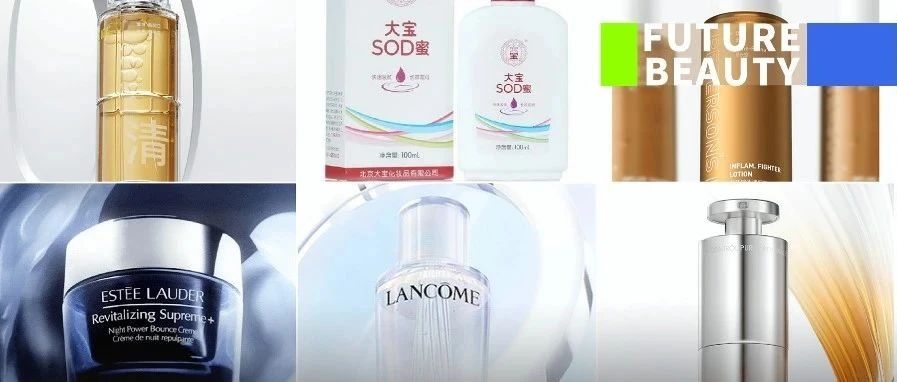
Core Viewpoint - The beauty industry is experiencing an "enzyme ingredient revolution" with domestic brands innovating and focusing on enzyme-based skincare products, indicating a shift in consumer preferences towards gentler and more effective solutions [4][14][25]. Group 1: Enzyme Ingredients in Skincare - Enzymes have been a "silent hero" in cosmetic formulations, with 31 types of enzyme ingredients already used in effective registered cosmetics, with superoxide dismutase (SOD) leading with 15,285 registrations [6][12]. - Major brands like Proya and Marubi are incorporating SOD and other enzymes like coenzyme Q10 and papain into their products, highlighting the growing trend of enzyme usage in skincare [11][21]. - The focus on composite enzymes, such as Proya's "3X Smart Enzyme," aims to provide a dual benefit of effective exfoliation and gentle repair, catering to consumer demands for non-irritating skincare solutions [15][23]. Group 2: Market Trends and Consumer Insights - The demand for enzyme-based products is driven by consumers seeking effective yet gentle solutions for skin concerns, particularly for oily skin types and sensitive skin [23][25]. - The global enzyme preparation market is projected to grow to $15 billion by 2035, with a compound annual growth rate (CAGR) of approximately 3.61% from 2025 to 2035, indicating a stable growth trajectory for enzyme-based products [39]. - The enzyme market is highly concentrated, with five companies, including Novozymes and DuPont, holding about 75% of the global market share, reflecting the competitive landscape [40]. Group 3: Technological Advancements and Challenges - Advances in biotechnology are enhancing the stability and efficacy of enzyme ingredients, with companies employing gene editing and nanotechnology to improve product performance [41][43]. - Despite the potential, challenges remain in enzyme application due to their large molecular size and sensitivity to environmental factors, which complicates their formulation in cosmetics [36][37]. - The industry is facing a dual bottleneck: insufficient technical conversion in production and a lack of consumer awareness regarding enzyme benefits, which hinders market penetration [44][45]. Group 4: Future Outlook - The trend of "using enzymes instead of acids" is emerging, suggesting a potential coexistence of enzyme and acid products in the market, each serving different consumer needs [46][47]. - The establishment of standards for enzyme-based skincare products is underway, which may enhance product credibility and consumer trust in enzyme efficacy [47].

珀莱雅(603605) - 珀莱雅化妆品股份有限公司关于回购注销部分限制性股票通知债权人的公告
2025-06-26 08:32
珀莱雅化妆品股份有限公司(以下简称"公司")第四届董事会第五次会议、 第四届监事会第四次会议于 2025 年 6 月 26 日审议通过了《关于回购注销部分股 权激励限制性股票的议案》。鉴于公司 2022 年限制性股票激励计划授予的 14 名 激励对象已离职而不再符合激励条件,同意将对其已获授但尚未解除限售的 242,424 股限制性股票进行回购注销。 | | | 珀莱雅化妆品股份有限公司 关于回购注销部分限制性股票通知债权人的公告 本公司董事会及全体董事保证本公告内容不存在任何虚假记载、误导性陈述 或者重大遗漏,并对其内容的真实性、准确性和完整性承担法律责任。 一、通知债权人的原由 本次回购注销完成后,公司总股本将由 396,247,606 股减少至 396,005,182 股,注册资本由人民币 396,247,606 元减少至人民币 396,005,182 元。 二、需债权人知晓的相关情况 由于公司本次回购注销部分限制性股票将导致注册资本减少,根据《中华人 民共和国公司法》等相关法律法规的规定,公司特此通知债权人,公司债权人自 接到公司通知起30日内、未接到通知者自本公告披露之日起45日内,均有权凭有 效债 ...
珀莱雅(603605) - 珀莱雅化妆品股份有限公司关于回购注销部分股权激励限制性股票的公告
2025-06-26 08:32
| | | 年7月20日,公司披露了《监事会关于2022年限制性股票激励计划激励对象名单 的核查意见及公示情况说明》。 珀莱雅化妆品股份有限公司 关于回购注销部分股权激励限制性股票的公告 本公司董事会及全体董事保证本公告内容不存在任何虚假记载、误导性陈述 或者重大遗漏,并对其内容的真实性、准确性和完整性承担法律责任。 珀莱雅化妆品股份有限公司(以下简称"公司")第四届董事会第五次会议、 第四届监事会第四次会议于 2025 年 6 月 26 日审议通过了《关于回购注销部分股 权激励限制性股票的议案》。鉴于公司 2022 年限制性股票激励计划(以下简称 "《激励计划》"或"本激励计划")授予的 14 名激励对象已离职而不再符合激励 条件,同意将对其已获授但尚未解除限售的 242,424 股限制性股票进行回购注 销。现将相关情况公告如下: 一、本激励计划已履行的决策程序和信息披露情况 1、2022年7月8日,公司召开第三届董事会第六次会议,审议通过《关于公 司<2022年限制性股票激励计划(草案)>及其摘要的议案》、《关于制定<2022年 限制性股票激励计划实施考核管理办法>的议案》及《关于提请股东大会授权董 事会 ...
珀莱雅(603605) - 珀莱雅化妆品股份有限公司关于调整2022年限制性股票激励计划回购价格的公告
2025-06-26 08:32
本公司董事会及全体董事保证本公告内容不存在任何虚假记载、误导性陈述 或者重大遗漏,并对其内容的真实性、准确性和完整性承担法律责任。 2、2022年7月9日至2022年7月18日,公司对本激励计划拟授予激励对象的姓 名和职务进行了公示,在公示期内,公司监事会未接到任何异议的反馈。2022 年7月20日,公司披露了《监事会关于2022年限制性股票激励计划激励对象名单 的核查意见及公示情况说明》。 3、2022年7月25日,公司召开2022年第一次临时股东大会审议通过《关于公 司<2022年限制性股票激励计划(草案)>及其摘要的议案》、《关于制定<2022年 限制性股票激励计划实施考核管理办法>的议案》及《关于提请股东大会授权董 事会办理公司2022年限制性股票激励计划相关事宜的议案》。公司实施本激励计 划获得批准,董事会被授权确定授予日、在激励对象符合条件时向激励对象授予 限制性股票,并办理授予所必需的全部事宜。2022年7月26日,公司披露了《关 于2022年限制性股票激励计划内幕信息知情人买卖公司股票情况的自查报告》。 4、2022年7月25日,公司召开第三届董事会第七次会议和第三届监事会第七 次会议,审议通 ...