Proya(603605)

Search documents
深度|美妆巨头为摆脱“大企业病”,有多拼?
FBeauty未来迹· 2025-07-18 12:32
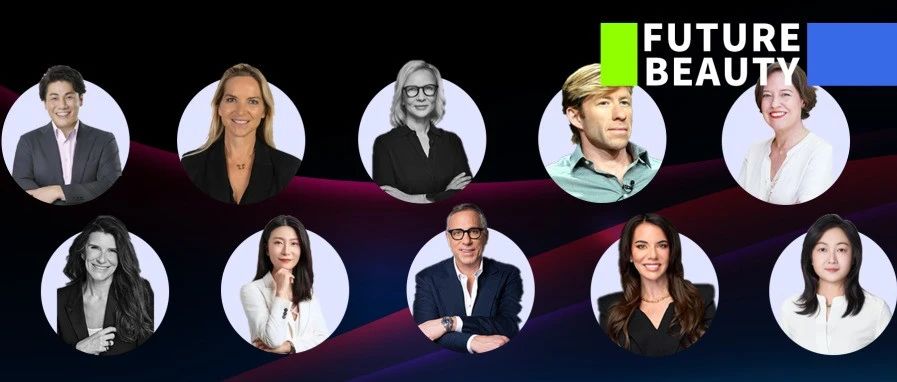
Core Viewpoint - The article highlights significant personnel changes in the beauty industry, indicating a shift towards a research-driven, globalized, and organizationally transformed competitive landscape, with three main focal points: the emergence of new roles, expanded responsibilities for foreign beauty giants in the Chinese market, and widespread organizational restructuring [2][3][26]. Group 1: Emergence of New Roles - Over 75 key positions have changed among 25 leading beauty companies in the first half of 2025, with a notable rise in roles focused on digitalization, research, innovation, and marketing communication, reflecting the industry's future direction [2][6]. - Estee Lauder has created three new positions, including Chief Digital and Marketing Officer, Global Scientific Sleep Advisor, and President of the Makeup Brand Group, indicating a strategic shift towards integrating scientific expertise into product development [8][10]. - L'Oreal has appointed a Chief Innovation and Strategic Outlook Officer to oversee innovation teams and strategic foresight, emphasizing the importance of future-oriented innovation in the beauty sector [12]. Group 2: Expanded Responsibilities in the Chinese Market - International beauty companies are elevating their China market leaders to global decision-making roles, marking a significant shift in strategic positioning [14][24]. - Estee Lauder's new CEO has made substantial adjustments, including promoting the China President to the global management team, breaking previous decision-making chains [15][16]. - Shiseido has appointed a dual-role CEO for China and travel retail, merging management of these two growth engines to maximize synergies [17][19]. Group 3: Organizational Restructuring - The beauty industry is undergoing a deep transformation, moving from high growth to high-quality growth, as evidenced by widespread organizational changes [3][26]. - Companies are restructuring their organizational frameworks to enhance the integration of research and market strategies, with a focus on consumer needs [36][37]. - Estee Lauder's new strategy involves a significant operational transformation, restructuring brands by categories for better management and growth [31][34].



欣旺达又做LP
FOFWEEKLY· 2025-07-18 10:10
Group 1 - The average scale of funds contributed by listed companies in June decreased compared to May, but the number of contributions increased. Investment is concentrated in information technology, industrial, and consumer discretionary sectors [3] - Zhongwei Company plans to invest no more than RMB 735 million through its subsidiary in a semiconductor fund, making it one of the largest single contributions this month [3] - XWANDA has also made a limited partner investment in Xinghang Capital, while Proya has exited by transferring fund shares [4]



215个品牌GMV破亿!上半年美妆电商战事揭榜
Sou Hu Cai Jing· 2025-07-17 11:48
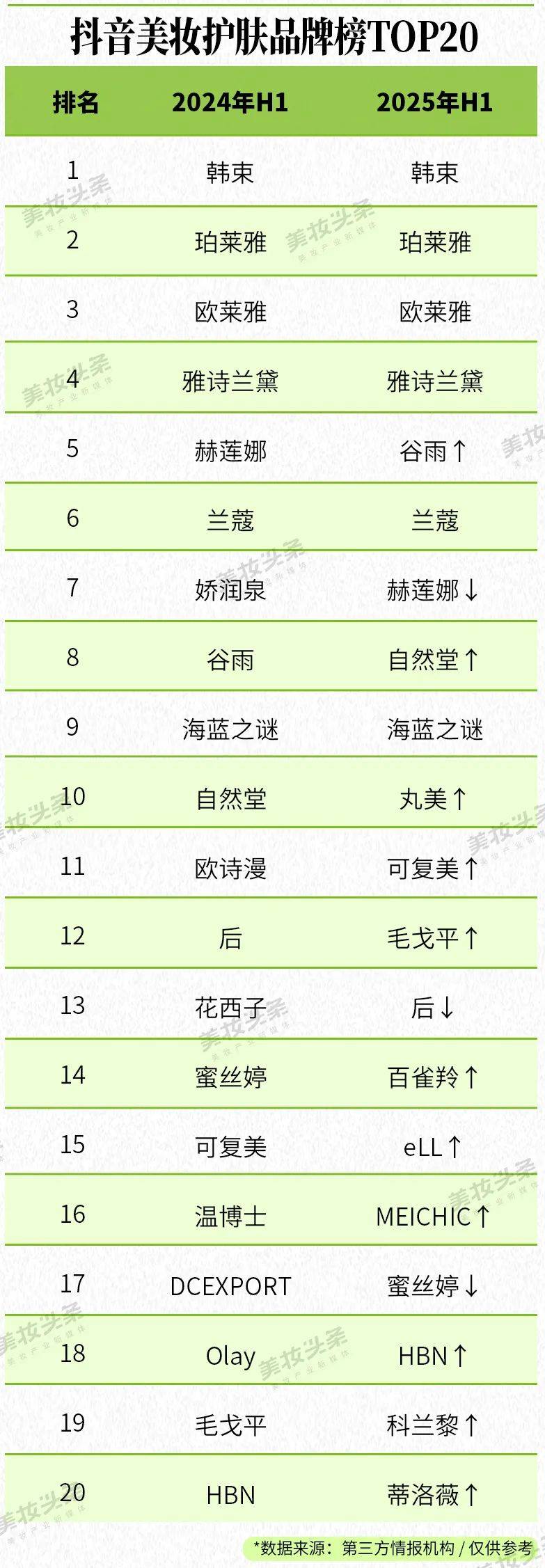
Core Insights - The beauty brand competition on various platforms has intensified, with brands needing to adapt to changing consumer preferences and marketing strategies to survive in the market [1][21][29] Group 1: Douyin Platform Insights - 215 beauty and skincare brands achieved a GMV of over 100 million yuan on Douyin in the first half of 2025 [1] - The top 10 brands in terms of sales include both domestic and international brands, with notable names like 韩束 (Hanshu), 珀莱雅 (Proya), and 欧莱雅 (L'Oreal) [1][5] - Domestic brands such as 谷雨 (Guyu), 自然堂 (Naturally), and 丸美 (Marubi) have shown steady sales growth due to precise product positioning and marketing strategies [5][15] Group 2: Tmall Platform Insights - The top 20 skincare brands on Tmall accounted for 46.2% of the total category GMV, while the top 20 makeup and perfume brands accounted for 39.53% [10] - The presence of domestic brands in the top 20 has decreased compared to the previous year, with brands like 珀莱雅 (Proya) and 自然堂 (Naturally) losing their positions [10][11] - International brands such as 欧莱雅 (L'Oreal), 兰蔻 (Lancôme), and 雅诗兰黛 (Estée Lauder) have maintained strong positions, with some showing upward trends in rankings [11][14] Group 3: JD Platform Insights - JD's beauty sales exceeded 13.32 billion yuan in the first four months of 2025, with a projected total sales of over 30 billion yuan for the first half of the year [21][27] - International beauty brands dominate the rankings on JD, with no domestic brands appearing in the top five during major promotional events [25][27] - The growth of beauty products on JD has been significant, with some categories seeing sales increases of over 500% during promotional events [27][28] Group 4: Market Trends and Strategies - The competition among beauty brands is characterized by the need for tailored strategies that align with the unique ecosystems and user preferences of each platform [29] - Brands like MEICHIC and 蒂洛薇 (Tilowei) have achieved explosive growth on Douyin through innovative marketing strategies involving influencers and live streaming [29] - The overall beauty market in 2025 is expected to continue evolving, with brands needing to understand platform-specific dynamics to thrive [29]
聚势越南,“2025越南消费类品牌投资峰会”7月17日圆满落幕
Zhong Guo Jin Rong Xin Xi Wang· 2025-07-17 09:34
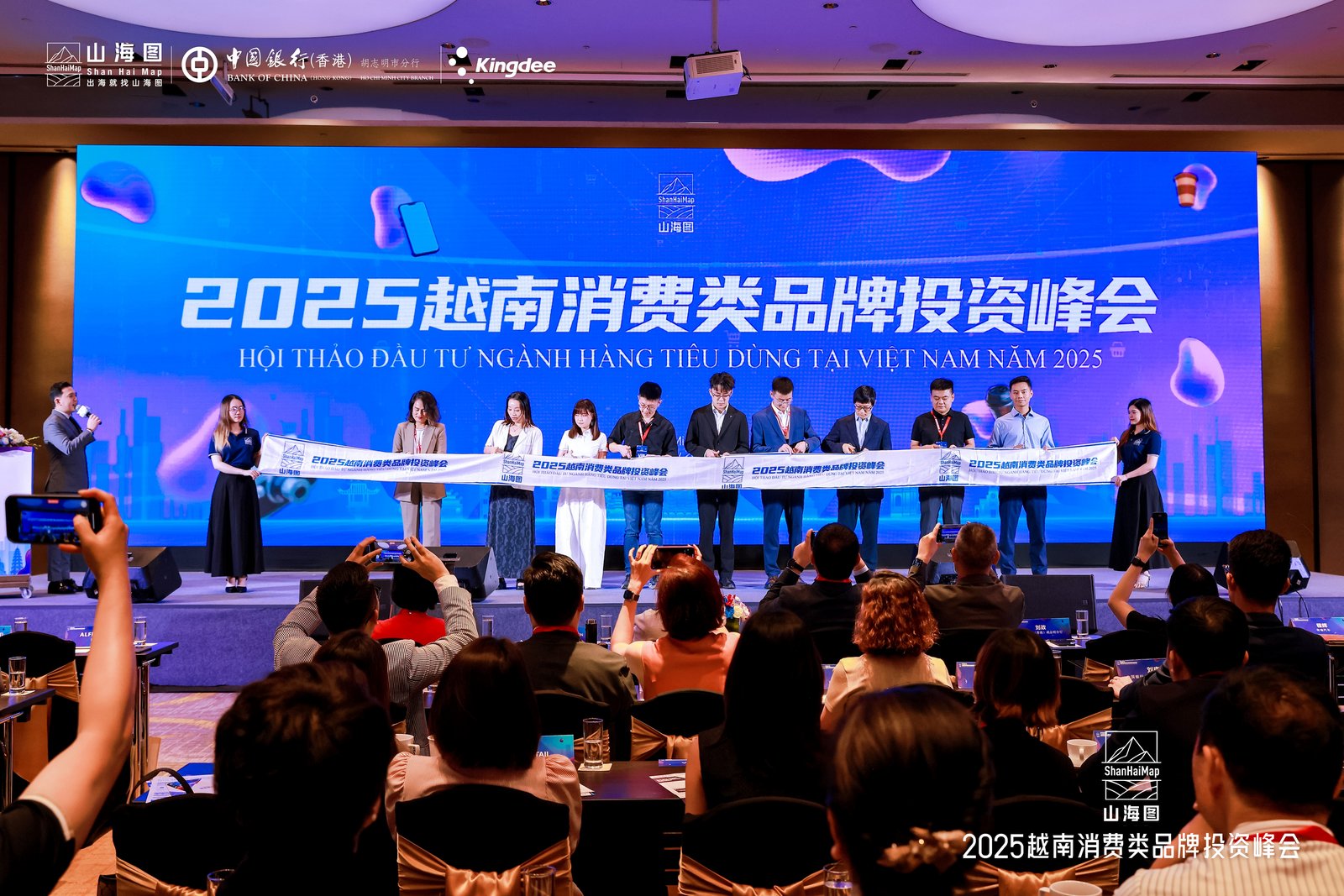
Group 1 - The "2025 Vietnam Consumer Brand Investment Summit" was held in Ho Chi Minh City, attracting over 500 representatives from Chinese and Vietnamese companies, highlighting the strategic value of Vietnam as a consumption growth hub in Southeast Asia [1][8] - The summit focused on the theme "Insights into Vietnam's New Consumption Wave, Building New Growth Momentum for Brands," with key insights shared on the characteristics and opportunities within the Vietnamese consumer market [3][8] - Keynote speakers emphasized the importance of digital transformation and IT support for consumer goods companies, as well as the need for innovative product development to enhance customer experiences [4][6] Group 2 - Vietnam's economy is projected to reach a GDP of $476.3 billion in 2024, maintaining a growth rate of 7.09%, positioning it as the fourth largest economy in ASEAN [3] - The consumer market is characterized by a young population, strong consumer desire, the rise of the female economy, and an expanding middle class, which are seen as significant advantages for investment [3] - The summit provided a platform for cross-border investment dialogue, encouraging more Chinese companies to engage in the Vietnamese consumer ecosystem and capitalize on historical opportunities [8]


珀莱雅20250519
2025-07-16 06:13
Summary of Conference Call Records Company and Industry Involved - The discussion revolves around a company that has undergone significant changes in its sales structure, transitioning from offline to online business, with a focus on sales expenses and accounts receivable management [1][4]. Core Points and Arguments 1. **Sales Expenses Growth**: In 2024, the company's revenue grew by 21.04%, while sales expenses increased by 29.93%, indicating a significant rise in costs compared to revenue growth. This raises concerns about the return on investment for sales expenses [1]. 2. **Historical Context**: Over the past decade, the company's sales expenses have increased from 620 million in 2016 to the current levels, suggesting a trend of rising costs that may not be sustainable if revenue growth slows down [1]. 3. **Potential Risks**: There is a risk that if the company's growth stagnates or declines, reducing sales expenses could lead to a downward spiral in revenue and net profit. Conversely, increasing sales expenses without corresponding revenue growth could also negatively impact net profit [1]. 4. **Accounts Receivable Management**: The company’s accounts receivable is influenced by its business model with JD.com, which operates on a consignment basis. The accounts receivable period is 30 days, which is longer than typical direct sales models [2]. 5. **Impact of Timing on Financials**: The timing of sales and invoicing has created discrepancies in financial reporting, particularly between 2023 and 2024, affecting perceived performance due to the timing of transactions [2][3]. 6. **Shift to Online Business**: The company has shifted from 70% offline business before going public to 95% online business by 2024. This transition has led to increased costs, particularly in traffic acquisition, which is a major component of sales expenses [4]. Other Important but Possibly Overlooked Content - The company’s management has not explicitly addressed the return on investment for sales expenses, which could be a critical area for future strategic planning [1]. - The financial implications of the timing of cash flows and accounts payable are crucial for understanding the company's liquidity and operational efficiency [3].
化妆品医美行业周报:再生药械再添两员,轻医美概念方兴未艾-20250713
Shenwan Hongyuan Securities· 2025-07-13 07:12
Investment Rating - The report maintains a positive outlook on the cosmetics and medical beauty industry, indicating a "Buy" recommendation for several companies within the sector [2][14]. Core Insights - The cosmetics and medical beauty sector has shown weaker performance compared to the market, with the Shenwan Beauty Care Index rising by 1.5% from July 4 to July 11, 2025, which is below the market average [3][5]. - The introduction of new products in the regenerative medicine sector, particularly in the "童颜针" (youthful needle) category, is expected to enhance consumer interest and expand the market [2][8]. - The report highlights strong anticipated earnings growth for several key companies in the cosmetics sector for the second quarter of 2025, with notable increases in revenue and net profit for brands like 上美股份 (Shangmei), 丸美股份 (Marubi), and 珀莱雅 (Proya) [9][10][11]. Summary by Sections Industry Performance - The cosmetics and medical beauty sector has underperformed the market, with specific indices showing varied performance, such as the Shenwan Cosmetics Index increasing by 2.6% [3][5]. - The report notes that the demand for cosmetics is recovering, with a 4.1% year-on-year increase in retail sales for the first five months of 2025 [19][20]. Company Performance - 上美股份 (Shangmei) is expected to see a revenue increase of 16% and a net profit increase of 25% in the first half of 2025 [10]. - 丸美股份 (Marubi) anticipates a 22% revenue growth and a 28% increase in net profit for the second quarter of 2025 [10]. - 珀莱雅 (Proya) is projected to achieve a 10% revenue growth and a 15% increase in net profit for the second quarter of 2025 [10]. - 毛戈平 (Mao Geping) expects a significant revenue increase of 38% and a net profit increase of 35% in the first half of 2025 [10]. - 若羽臣 (Ruoyuchen) forecasts a remarkable 70% revenue growth and a 75% increase in net profit for the second quarter of 2025 [10]. Market Trends - The report emphasizes the ongoing trend of domestic brands gaining market share, with national brands occupying five of the top ten positions in the skincare market [32]. - The regenerative medicine sector is expanding, with new products enhancing consumer engagement and market growth potential [2][8]. Investment Recommendations - The report recommends focusing on companies with strong brand matrices and high growth potential, such as 上美股份 (Shangmei), 珀莱雅 (Proya), and 丸美股份 (Marubi) [14]. - It suggests monitoring companies that leverage e-commerce and social media platforms effectively, such as 若羽臣 (Ruoyuchen) and 毛戈平 (Mao Geping) [14].



抖音又杀出一个次抛黑马?
3 6 Ke· 2025-07-12 01:34
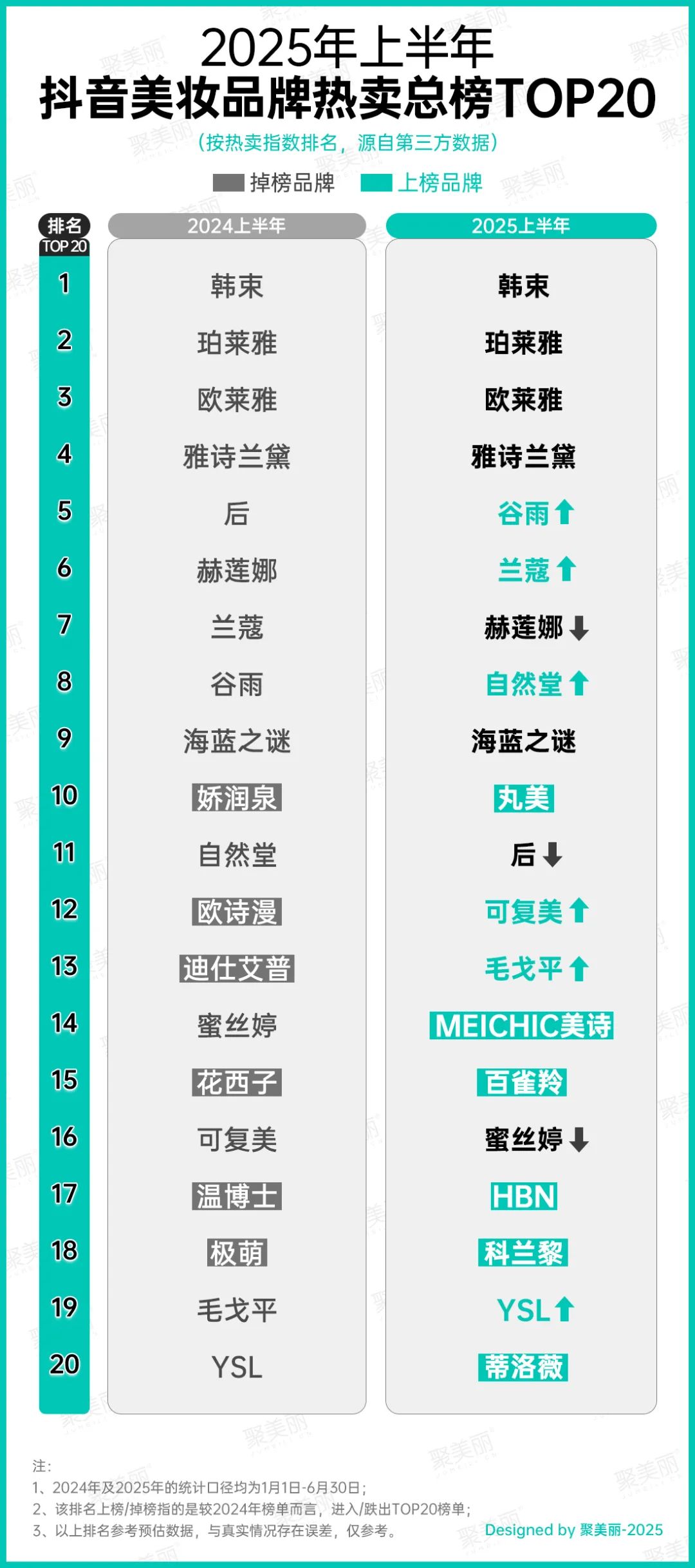
Core Insights - The beauty industry is experiencing significant shifts, with a competitive landscape characterized by the rise of domestic brands and the stability of international brands [1][2][4] - The top beauty brands on Douyin are dominated by domestic players, with 韩束, 珀莱雅, and 欧莱雅 leading the rankings [2][9] - New entrants like 百雀羚 and 丸美 have made their way into the top 20, indicating a resurgence of domestic brands [9][11] Brand Performance - 韩束 has maintained its position as the top brand, followed by 珀莱雅 and 欧莱雅, while international brands like YSL and 兰蔻 have shown mixed results [2][9] - The emergence of brands like MEICHIC美诗 and 蒂洛薇 highlights the competitive nature of the market, with 蒂洛薇 recently achieving the top spot in the color cosmetics category [9][27] - The performance of brands such as 花西子 and 极萌 has declined, indicating a shift in consumer preferences [7][9] Influencer Ecosystem - The influencer landscape is shifting towards entertainment-oriented and comprehensive content creators, with traditional beauty influencers losing ground [1][44] - Influencers like 韦雪 have gained prominence, showcasing the changing dynamics in the beauty influencer market [44][48] - Brands are increasingly relying on a mix of influencer marketing and self-operated accounts to drive sales [41][42] Market Trends - The beauty market is seeing a trend towards self-operated models and direct-to-consumer strategies, with brands like 林清轩 and 百雀羚 successfully leveraging these approaches [14][20] - The reliance on heavy investment in advertising and low pricing strategies by brands like ELL and 三资堂 raises questions about long-term sustainability [37][39] - The competitive landscape is expected to evolve as brands focus on product development and brand strength to navigate market fluctuations [49]
夏日营销的温度计:品牌如何在梗文化、人物共鸣与场景体验中赢得年轻人
Jing Ji Guan Cha Bao· 2025-07-07 09:52
Core Insights - The marketing landscape in the first week of summer 2025 showcases a diverse and dynamic approach, with brands like Meituan, Lululemon, Xianyu, and Proya engaging users through empathetic and relatable strategies [2][5][6][12][15] Group 1: Innovative Marketing Strategies - Meituan's new advertisement creatively uses "small lobsters as tools," effectively compressing and communicating the core value of the product as "sufficient, full, and cost-effective" through humor and metaphor [5] - Xianyu's appointment of Liu Yuning as its first brand ambassador emphasizes a "immersive identity binding," where the celebrity actively engages with the community rather than merely serving as a symbolic face [8][10] - Lululemon's "Summer Fun Challenge" promotes participation over performance, encouraging users to find their own movement style rather than adhering to traditional fitness standards [10][11] Group 2: Emotional Connection and Brand Identity - Proya's collaboration with actress Kwang Lingling focuses on the theme of "the secret of youth," redefining anti-aging and self-worth through storytelling and emotional resonance rather than just product promotion [14] - The overarching trend in marketing is shifting towards rebuilding relationships, where emotional engagement, rhythm, and participation are prioritized over mere technical execution or budget allocation [15][16] - Brands are increasingly striving to become entities that users want to connect with, share, and remember, reflecting a collective identity rather than a singular brand image [18]


2025年中期商贸零售行业投资策略报告:情绪消费兴起,关注潮玩、黄金珠宝、美妆赛道-20250707
Wanlian Securities· 2025-07-07 06:04
Group 1: Industry Overview - The rise of emotional consumption is driving the development of related industries, as China transitions from "consumption upgrade" to "consumption stratification" [1][12][23] - Consumers are increasingly seeking cost-effectiveness in traditional products while being willing to pay a premium for innovative and emotionally valuable products [12][23] - The retail sales of gold and jewelry, cosmetics, and sports and entertainment products have shown positive growth, with gold and jewelry retail sales up by 12.3% and cosmetics by 4.1% in early 2025 [12][19] Group 2: Trend in Emotional Consumption - Emotional consumption is gaining traction due to fast-paced lifestyles and information overload, leading to increased demand for products that provide emotional comfort [23][25] - Young consumers, particularly those born in the 1990s and 2000s, are the main drivers of emotional consumption, accounting for 78% of the market [25][29] - Female consumers represent a larger share of emotional consumption, with preferences differing from male consumers in product categories [25][30] Group 3: Trend in Toy Industry - The Chinese toy market is rapidly expanding, with the market size projected to grow from 229 billion to 763 billion yuan from 2020 to 2024, reflecting a CAGR of 35.11% [2][31] - Factors driving this growth include rising disposable income, the emergence of emotional value in purchases, and the popularity of quality IPs [31][32] - The market remains fragmented, with significant room for consolidation as the top three companies hold only 23.7% of the market share [2][39] Group 4: Gold and Jewelry Sector - The gold and jewelry sector is shifting from channel-driven to product-driven, with high dividend yields providing defensive attributes [3][19] - Despite a slowdown in store expansion due to rising gold prices, some companies are achieving rapid growth through superior craftsmanship and marketing [3][19] - The demand for gold as a safe-haven asset is expected to continue, driven by geopolitical risks and economic uncertainties [3][19] Group 5: Cosmetics Industry - The domestic cosmetics market is witnessing a rise of local brands, with strong performance during promotional events like "618" [4][19] - Local brands are focusing on R&D and marketing to differentiate themselves, capturing market share from international brands [4][19] - The acceptance of domestic beauty brands among younger consumers is increasing, indicating potential for further market penetration [4][19]



化妆品医美行业周报:25H1收官国货表现分化,毛戈平等领衔增长-20250706
Shenwan Hongyuan Securities· 2025-07-06 11:44
Investment Rating - The report maintains a "Positive" outlook on the cosmetics and medical beauty industry [2]. Core Insights - The cosmetics and medical beauty sector underperformed the market during the week of June 27 to July 4, 2025, with the Shenwan Beauty Care Index declining by 0.6% and the Shenwan Cosmetics Index down by 1.5% [3][4]. - Domestic brands such as Maogeping and others showed significant growth, with some achieving over 50% growth in June, which is expected to positively impact Q2 performance [3][9]. - The report highlights a strong performance from leading domestic brands during the 618 shopping festival, with a notable increase in sales momentum post-event [9][10]. Summary by Sections Industry Performance - The Shenwan Beauty Care Index decreased by 0.6%, while the Shenwan Cosmetics Index fell by 1.5%, indicating weaker performance compared to the Shenwan A Index [4]. - The personal care products index saw a slight increase of 0.7%, but still lagged behind the Shenwan A Index by 0.4% [4]. Key Company Performance - Expected performance for major companies in Q2 includes: - Upbeauty: Revenue and net profit expected to grow by 16% and 25% respectively [11]. - Marubi: Anticipated revenue and net profit growth of 22% and 28% [11]. - Proya: Projected revenue and net profit growth of 10% and 15% [11]. - Maogeping: Expected revenue and net profit growth of 38% and 35% [11]. - Ruifeng: Anticipated growth of 70% and 75% in revenue and net profit respectively [11]. - Juzhibio: Expected growth of 25% and 20% in revenue and net profit [11]. Market Trends - The report notes a robust recovery in consumer demand, with a 4.1% year-on-year increase in retail sales for cosmetics in the first five months of 2025 [20]. - The domestic market is seeing a shift with local brands gaining market share, as evidenced by the performance of brands like Proya and Maogeping during major shopping events [34]. Investment Recommendations - Recommended stocks include: - Upbeauty, Proya, and Marubi for their comprehensive brand matrices and growth potential [15]. - Maogeping and Juzhibio for their strong positioning in niche markets [15]. - Attention is advised for Shanghai Jahwa, Betaini, and Huaxi Biological for potential growth [15]. E-commerce Insights - Data from Douyin indicates significant growth for domestic brands, with Han Shu achieving a GMV of 7.2 billion yuan, reflecting a 53% year-on-year increase [16]. - The overall GMV for domestic brands in June reached over 50% growth, indicating a strong market presence [9][16].