
ZHONGYIN BABI FOOD CO.(605338)

Search documents
罗永浩称赞老乡鸡:餐饮企业用预制菜是合法的,老乡鸡就是表率
Xin Lang Ke Ji· 2025-09-12 13:24
Group 1 - The core viewpoint of the article revolves around the public dispute between Luo Yonghao and Xibei regarding the transparency of pre-made dishes in the restaurant industry [1] - Luo Yonghao emphasizes that using pre-made dishes is legal for restaurant businesses, citing Laoxiangji as an industry benchmark for clear labeling of dishes as either freshly made or pre-made [1] Group 2 - The controversy has gained significant attention, particularly due to Luo Yonghao's public comments and his offer of a reward of 100,000 yuan for further discussion on the matter [1]

罗永浩展示老乡鸡菜品划分公示牌 称以后准备去试试
Xin Lang Ke Ji· 2025-09-12 13:24
Core Viewpoint - Luo Yonghao has publicly criticized the lack of transparency in the pre-made food industry, specifically targeting the practices of Xibei, while promoting the example set by Laoxiangji in clearly labeling their food products [1] Group 1: Industry Practices - Luo Yonghao highlighted that Laoxiangji provides clear indications of whether dishes are freshly made or pre-made, setting a standard for transparency in the industry [1] - He emphasized that while pre-made food is not inherently negative, it is essential for businesses to disclose the nature of their food products to consumers [1] Group 2: Public Engagement - Luo Yonghao conducted a live stream on multiple platforms to address the ongoing debate regarding pre-made food, showcasing his commitment to engaging with the public on this issue [1] - During the live stream, he mentioned his intention to try Laoxiangji's offerings, indicating a personal interest in the quality and transparency of their food [1]
宋向前——头号玩家的从容和笃定,消费产业的价值守望者
投中网· 2025-09-10 06:33
Core Viewpoint - The article emphasizes the need for finance to return to its essence of serving the real economy, advocating for a "real industry over capital" approach in investment strategies [4][5]. Group 1: Resource Allocation - Capital should flow towards efficient sectors rather than short-term arbitrage opportunities, with a focus on consumer-driven economic growth as a stabilizing force [6][7]. - The investment landscape has been distorted by excessive capital inflow, leading to a focus on rapid expansion and market capture rather than sustainable business practices [8][9]. Group 2: Governance and Empowerment - The investment philosophy of the company is characterized by deep involvement in the operational aspects of the businesses it invests in, moving beyond mere financial support to strategic partnership [10][11]. - Successful case studies, such as the investment in Xiaocaiyuan, demonstrate the effectiveness of this approach, resulting in significant market achievements and returns [12][13]. Group 3: Brand Behind the Brand - The company seeks to invest in businesses with "real industry genes," focusing on consumer sectors that exhibit high-frequency demand and scalability [19][20]. - Notable investments include brands like Qiaqia Foods and Babimantou, which have become industry leaders due to their alignment with the company's investment philosophy [21][23]. Group 4: Capital's Mission - The company is positioned to play a crucial role in transitioning society towards a consumption-driven economy, emphasizing the importance of enhancing disposable income and improving living standards [28][30]. - The investment strategy aims to create social value that translates into stable economic returns, highlighting the need for a shift from being mere investors to becoming co-creators in the industries they support [31][33].



包子第一股”股价较低点翻倍,董事高管增持与员工持股平台减持“撞车
Mei Ri Jing Ji Xin Wen· 2025-09-03 11:26
Core Viewpoint - Babai Food (605338), known as the "first stock of steamed buns," reported a net profit growth of 18.08% year-on-year for the first half of 2025, showcasing resilience amid increasing competition in the restaurant industry [1] Financial Performance - The company's net profit increased by 18.08% compared to the previous year, indicating a positive trend in financial performance despite industry challenges [1] - The stock price of Babai Food has shown a significant recovery, rising from a low of 11.63 yuan in August 2024 to a high of 24.80 yuan by September 2, 2025, effectively doubling from its lowest point [1] Stock Activity - Following the announcement of the positive financial results, the stock price of Babai Food has been on a steady upward trajectory [1] - There was a notable divergence in stock activity, with board members and executives increasing their holdings while the employee stock ownership platform opted to reduce its holdings [1] - The company explained that employees had held their shares for 8 to 10 years prior to the IPO and had personal financial needs, which influenced their decision to sell [1]
“包子第一股”股价较低点翻倍,董事高管增持与员工持股平台减持“撞车”
Mei Ri Jing Ji Xin Wen· 2025-09-03 09:44
Core Viewpoint - Baba Food, known as the "first stock of buns," reported a net profit growth of 18.08% year-on-year in its 2025 semi-annual report, showcasing resilience amid intensified competition in the restaurant industry [2] Financial Performance - The net profit of Baba Food increased by 18.08% compared to the previous year, indicating a positive trend in financial performance despite market challenges [2] - The company's stock price experienced significant fluctuations, reaching a low of 11.63 yuan in August 2024 and rebounding to a high of 24.80 yuan by September 2, 2025, effectively doubling from its lowest point [2] Stock Activity - Following the announcement of the semi-annual report, Baba Food's board members and executives increased their holdings, which contributed to a sustained rise in the stock price [2] - In contrast, the employee stock ownership platform opted to reduce its holdings, suggesting differing perspectives on stock retention among management and employees [2] Employee Insights - A representative from Baba Food's securities department explained that employees had held their shares for 8 to 10 years prior to the IPO and had personal financial needs, which influenced their decision to sell [2]
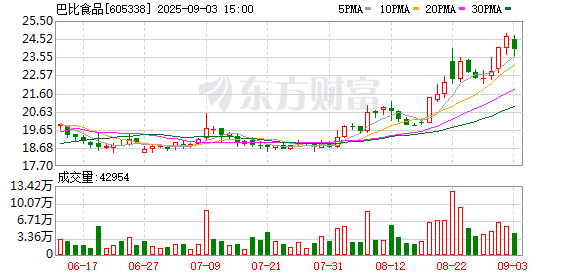
巴比食品(605338):BC双轨发展稳龙头 “研发+并购”实现双维扩张
Xin Lang Cai Jing· 2025-09-02 10:35
Group 1 - The company has established a strong competitive moat through low franchise fees and R&D-driven strategies, leading to steady growth in both C-end and B-end businesses [1] - The breakfast market is expanding, and the company, as a leading player, is expected to increase its market share due to its franchise model and health-oriented product offerings [2] - The company is enhancing its market penetration through a digital supply chain and acquisition strategies, establishing a nationwide supply network [3] Group 2 - Continuous R&D efforts are broadening the product matrix, with the B-end group meal business becoming a significant growth pillar [4] - The company is projected to maintain its industry-leading position with a diversified product layout and a "central kitchen + cold chain distribution" model, expecting revenue growth from 1.843 billion to 2.313 billion yuan from 2025 to 2027 [5]
食品加工板块9月2日跌0.3%,仙乐健康领跌,主力资金净流出7753.76万元
Zheng Xing Xing Ye Ri Bao· 2025-09-02 08:55
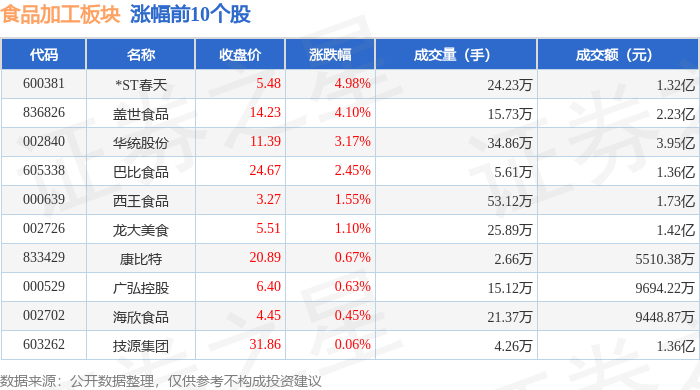
Market Overview - On September 2, the food processing sector declined by 0.3% compared to the previous trading day, with Xianle Health leading the decline [1] - The Shanghai Composite Index closed at 3858.13, down 0.45%, while the Shenzhen Component Index closed at 12553.84, down 2.14% [1] Stock Performance - The following stocks in the food processing sector showed notable performance: - ST Chuntian (600381) closed at 5.48, up 4.98% with a trading volume of 242,300 shares and a turnover of 132 million yuan [1] - Gai Shi Food (836826) closed at 14.23, up 4.10% with a trading volume of 157,300 shares and a turnover of 223 million yuan [1] - Huadong Co. (002840) closed at 11.39, up 3.17% with a trading volume of 348,600 shares and a turnover of 395 million yuan [1] - Xianle Health (300791) closed at 24.77, down 2.94% with a trading volume of 49,100 shares and a turnover of 123 million yuan [2] Capital Flow - The food processing sector experienced a net outflow of 77.54 million yuan from institutional funds, while retail investors saw a net inflow of 127 million yuan [2]




食品加工板块9月1日涨1.73%,千味央厨领涨,主力资金净流出918.54万元
Zheng Xing Xing Ye Ri Bao· 2025-09-01 08:39
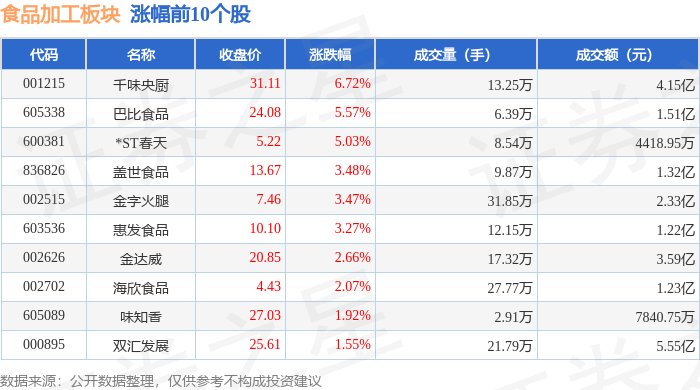
Market Performance - On September 1, the food processing sector rose by 1.73%, with Qianwei Yangchu leading the gains [1] - The Shanghai Composite Index closed at 3875.53, up 0.46%, while the Shenzhen Component Index closed at 12828.95, up 1.05% [1] Stock Performance - Qianwei Yangchu (001215) closed at 31.11, up 6.72% with a trading volume of 132,500 shares and a transaction value of 415 million [1] - Other notable gainers included Baba Foods (605338) at 24.08, up 5.57%, and ST Chuntian (600381) at 5.22, up 5.03% [1] - Conversely, Xianle Health (300791) fell by 2.60% to 25.52, and Guangming Meat Industry (600073) decreased by 2.39% to 7.34 [2] Capital Flow - The food processing sector experienced a net outflow of 9.1854 million from institutional investors, while retail investors saw a net inflow of 37.4901 million [2] - Major stocks like Shuanghui Development (000895) had a net inflow of 39.5093 million from institutional investors, but a net outflow of 46.5160 million from retail investors [3] - Qianwei Yangchu (001215) also saw a net inflow of 29.5527 million from institutional investors, with a net outflow of 36.6445 million from retail investors [3]

机构:切入低估值消费与周期板块,食品饮料ETF天弘(159736)上周累计“吸金”近1亿元,中秋&国庆旺销窗口期成重要观察拐点
2 1 Shi Ji Jing Ji Bao Dao· 2025-09-01 02:53
Group 1 - A-shares opened higher on the first trading day of September, with active sectors including catering, tourism, and pharmaceuticals [1] - The Tianhong Food and Beverage ETF (159736) showed a gain of 0.66% and a premium trading rate of 0.16%, with significant price increases in constituent stocks such as COFCO Sugar Industry rising over 8% and others like Qiaqia Food, Kweichow Moutai, and others increasing by over 4% [1] - The Tianhong Food and Beverage ETF has seen a net inflow of funds totaling 98.3 million yuan over the last five trading days, with 9 out of the last 10 trading days experiencing net inflows [1] Group 2 - The white liquor sector's semi-annual reports indicate that companies are expected to accelerate performance recovery by Q2 2025, with market sentiment improving due to reduced uncertainty in the industry [2] - Analysts suggest that upcoming consumption policies may catalyze a fundamental turnaround in traditional consumer goods, particularly in the catering supply chain and dairy sectors [2] - The TMT sector is nearing a warning line in terms of market crowding, while consumer and cyclical sectors may offer better value in the next market phase, with a shift in market funds towards stable and growth-oriented assets [2]




巴比食品(605338):单店收入企稳回升,Q2增长提速
EBSCN· 2025-08-28 09:22
Investment Rating - The report maintains a "Buy" rating for the company [6] Core Views - The company achieved total revenue of 835 million yuan in H1 2025, representing a year-on-year growth of 9.31%, with a net profit attributable to the parent company of 132 million yuan, up 18.08% year-on-year [1] - In Q2 2025, total revenue reached 465 million yuan, growing 13.5% year-on-year, and net profit attributable to the parent company was 94 million yuan, reflecting a significant increase of 31.42% year-on-year [1] - The company is focusing on "efficiency improvement and volume expansion," with a dual approach of internal development and external mergers and acquisitions, leading to continued revenue growth [2] Revenue and Business Performance - In Q2 2025, revenue from franchise stores, direct stores, and group meal channels was 348 million yuan, 5 million yuan, and 106 million yuan, respectively, with year-on-year growth rates of 10.5%, 14.1%, and 26.2% [2] - The number of franchise stores reached 5,685 by the end of Q2 2025, with a net increase of 542 stores in H1 and 41 stores in Q2, aligning with the annual store opening plan [2] - The average revenue per franchise store increased by 2.7% year-on-year, indicating a stabilization in single-store revenue [2] Profitability and Cost Management - In Q2 2025, the gross profit margin improved to 28.23%, an increase of 1.85 percentage points year-on-year, primarily due to low raw material costs and ongoing cost reduction efforts in production [3] - The sales expense ratio decreased to 3.88%, down 0.53 percentage points year-on-year, attributed to reduced store renovation subsidies, employee compensation, and rental costs [3] - The net profit margin for Q2 2025 was 20.45%, up 2.7 percentage points year-on-year, while the non-GAAP net profit margin was 13.4%, an increase of 1.2 percentage points [3] Earnings Forecast and Valuation - The company’s net profit forecasts for 2025-2027 have been raised by 8% each, now projected at 281 million yuan, 306 million yuan, and 331 million yuan, respectively [4] - The estimated earnings per share (EPS) for 2025-2027 are 1.17 yuan, 1.28 yuan, and 1.38 yuan, with current stock prices corresponding to price-to-earnings (P/E) ratios of 19, 18, and 16 times [4] - The report indicates that the company is on track to meet its annual store opening goals, with improvements in single-store operations expected to alleviate the number of store closures in the second half of the year [4]