
ZHONGYIN BABI FOOD CO.(605338)

Search documents
品牌星球《小内容趋势报告2025》
Sou Hu Cai Jing· 2026-01-12 10:16
Core Insights - The report emphasizes the rise of "small content" as a key trend to address brand anxiety in the context of media transformation and rational consumer values [1][3] - Small content is characterized by its social engagement, rapid dissemination, and relatability to consumer life scenarios, moving away from traditional advertising [1][2] Group 1: Necessity of Small Content - Traditional large-scale advertising is becoming less effective as consumers seek authenticity and real connections, leading to a decline in trust towards overtly promotional content [11] - The shift towards small content is driven by changing consumer values, budget constraints, and the need for brands to adapt to new media forms while maintaining effective communication [12][14] Group 2: Characteristics and Definition of Small Content - Small content is defined as lightweight, human-centric, highly interactive, and easily shareable, facilitating dialogue between brands and users [18] - It emphasizes the importance of specific, relatable moments over grand narratives, allowing brands to connect more deeply with consumers [26][45] Group 3: Insights and Strategies for Brands - Brands are encouraged to adopt a friend-like approach in their interactions with consumers, focusing on long-term content IP management and value co-creation to build sustainable brand influence [3][39] - The transition from promotional messaging to user dialogue is crucial, as brands can embed their values into everyday scenarios, achieving efficient communication with lower costs [2][12] Group 4: Case Studies and Practical Applications - Procter & Gamble's emotional storytelling across 12 countries illustrates the effectiveness of small content in conveying brand warmth [2] - McDonald's creation of engaging IPs like "McNugget Hero" demonstrates how familiar language can build brand memory [2] - The use of localized dialects in outdoor advertising by STACCATO shows how small content can resonate with diverse audiences [24]





食品加工板块1月12日涨0.28%,海欣食品领涨,主力资金净流出1.31亿元
Zheng Xing Xing Ye Ri Bao· 2026-01-12 09:04
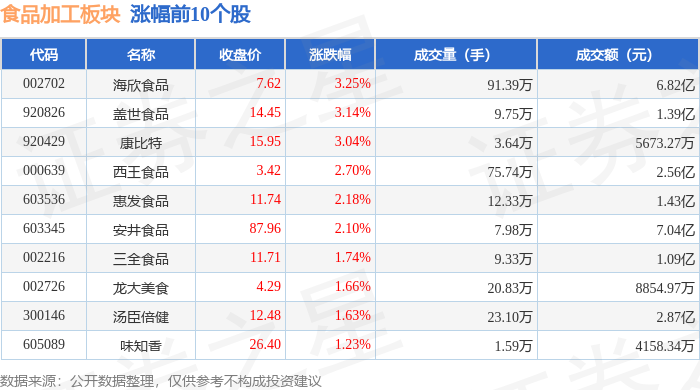
Market Overview - The food processing sector increased by 0.28% on January 12, with Hai Xin Food leading the gains [1] - The Shanghai Composite Index closed at 4165.29, up by 1.09%, while the Shenzhen Component Index closed at 14366.91, up by 1.75% [1] Top Performers - Hai Xin Food (002702) closed at 7.62, up by 3.25% with a trading volume of 913,900 shares and a transaction value of 682 million [1] - Other notable gainers include: - Gai Shi Food (920826) at 14.45, up by 3.14% [1] - Kang Bi Te (920429) at 15.95, up by 3.04% [1] - Xi Wang Food (000639) at 3.42, up by 2.70% [1] - Hui Fa Food (603536) at 11.74, up by 2.18% [1] Underperformers - Qian Wei Yang Chu (001215) closed at 45.60, down by 3.33% with a trading volume of 62,200 shares and a transaction value of 286 million [2] - Other notable decliners include: - Ba Bi Food (605338) at 31.39, down by 2.52% [2] - Xian Le Health (300791) at 24.39, down by 1.45% [2] Capital Flow - The food processing sector experienced a net outflow of 131 million from institutional investors, while retail investors saw a net inflow of 111 million [2] - Notable capital flows include: - Anjiu Food (603345) had a net inflow of 62.62 million from institutional investors [3] - Gai Shi Food (920826) saw a net inflow of 24.97 million from institutional investors [3] - Tang Chen Bei Jian (300146) had a net inflow of 14.78 million from institutional investors [3]


食品加工板块1月8日涨0.71%,千味央厨领涨,主力资金净流出2094.03万元
Zheng Xing Xing Ye Ri Bao· 2026-01-08 08:51
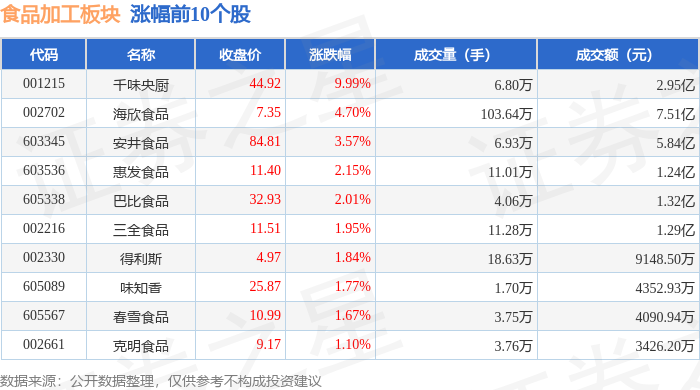
Group 1 - The food processing sector increased by 0.71% on January 8, with Qianwei Yangchu leading the gains [1] - The Shanghai Composite Index closed at 4082.98, down 0.07%, while the Shenzhen Component Index closed at 13959.48, down 0.51% [1] - Qianwei Yangchu's stock price rose by 9.99% to 44.92, with a trading volume of 68,000 shares and a transaction value of 295 million [1] Group 2 - The food processing sector experienced a net outflow of 20.94 million from institutional investors, while retail investors saw a net inflow of 17.72 million [2] - The stock of Anjifen experienced a significant net outflow of 32.99 million from institutional investors, while it had a net inflow of 30.40 million from retail investors [3] - The stock of Delisi had a net inflow of 12.69 million from institutional investors, indicating positive interest from this group [3]


A股食品饮料股普涨,养元饮品逼近涨停
Ge Long Hui· 2026-01-07 05:20
Group 1 - The A-share market saw a broad increase in the food and beverage sector, with notable stocks such as Ziyan Food hitting the daily limit up [1] - Yangyuan Beverage approached the daily limit up, indicating strong investor interest and potential growth in the sector [1] - Other companies like Huanlejia and Qianwei Yangchu rose over 5%, while Baihe Co., Babi Food, and others increased by over 4%, reflecting a positive trend across multiple stocks in the industry [1]


巴比食品涨2.03%,成交额3911.28万元,主力资金净流出561.32万元
Xin Lang Cai Jing· 2026-01-07 02:08
1月7日,巴比食品盘中上涨2.03%,截至09:48,报31.70元/股,成交3911.28万元,换手率0.53%,总市 值75.94亿元。 巴比食品所属申万行业为:食品饮料-食品加工-预加工食品。所属概念板块包括:养老金概念、电子商 务、增持回购、小盘、首发经济等。 巴比食品今年以来股价涨1.21%,近5个交易日涨8.45%,近20日涨19.08%,近60日涨24.31%。 分红方面,巴比食品A股上市后累计派现4.76亿元。近三年,累计派现3.72亿元。 资料显示,中饮巴比食品股份有限公司位于上海市松江区车墩镇茸江路785号,成立日期2010年7月8 日,上市日期2020年10月12日,公司主营业务涉及中式面点速冻食品的研发、生产与销售。主营业务收 入构成为:食品类90.39%,包装物及辅料6.17%,服务类3.34%,其他(补充)0.10%。 责任编辑:小浪快报 截至10月31日,巴比食品股东户数1.20万,较上期减少2.87%;人均流通股19963股,较上期增加 2.96%。2025年1月-9月,巴比食品实现营业收入13.56亿元,同比增长12.05%;归母净利润2.01亿元,同 比增长3.51%。 资 ...
食品加工板块1月6日涨0.15%,盖世食品领涨,主力资金净流入2284.36万元
Zheng Xing Xing Ye Ri Bao· 2026-01-06 08:56
Core Viewpoint - The food processing sector experienced a slight increase of 0.15% on January 6, with Gai Shi Food leading the gains. The Shanghai Composite Index rose by 1.5%, while the Shenzhen Component Index increased by 1.4% [1]. Group 1: Market Performance - Gai Shi Food closed at 13.85, up by 2.82%, with a trading volume of 59,000 shares and a transaction value of 81.20 million yuan [1]. - Other notable performers included Jiao Da Ang Li, which rose by 2.17% to close at 6.58, and De Li Si, which increased by 1.65% to close at 4.94 [1]. - The overall trading volume in the food processing sector showed varied performance, with significant transactions recorded for companies like Anjiu Food and Xiwang Food [1]. Group 2: Capital Flow - The food processing sector saw a net inflow of 22.84 million yuan from institutional investors, while retail investors experienced a net outflow of 15.49 million yuan [2]. - The main capital inflows were observed in companies like Anjiu Food, which had a net inflow of 39.28 million yuan, and Sanquan Food, with a net inflow of 10.55 million yuan [3]. - Conversely, companies like Xiwang Food and Tang Chen Bei Jian faced significant net outflows from retail investors, indicating a shift in investor sentiment [3].


巴比食品20260104
2026-01-04 15:35
Summary of the Conference Call for Babi Foods Company Overview - **Company**: Babi Foods - **Industry**: Food and Beverage, specifically focusing on dumplings and buns Key Developments - Babi Foods has made significant progress in the past year, particularly in promoting its new handmade dumpling store model, which began trials in the second half of 2025, achieving daily sales exceeding 10,000 yuan per store [3][4] - The company currently operates three business segments: traditional bun shops, group meals, and the new handmade dumpling stores [3] - Traditional bun shop sales turned positive in the second half of 2025, while the handmade dumpling stores are expected to become a new growth engine [3][4] Growth Potential - Market expectations suggest that Babi Foods could open around 100 new stores in Q1 2025, with total new store openings for the year potentially reaching hundreds to over a thousand [3][4] - Even if daily sales per store decrease to 6,000-7,000 yuan, annual revenue could still reach approximately 2 million yuan per store, contributing about 600,000 yuan to Babi's revenue [3][4] - The new dumpling stores are larger, offer more dining options, and have a richer product structure, leading to a faster return on investment despite higher initial costs [3][5] Market Positioning - Babi Foods entered the dumpling market due to its large potential and lack of leading chain brands, with over 30,000 dumpling shops nationwide but no dominant players [6] - The dumpling product line is versatile and suitable for various dining occasions, enhancing its market appeal [6] Financial Projections - Babi Foods is projected to achieve a profit of approximately 340 million yuan in 2026, with a target market capitalization exceeding 10 billion yuan, indicating a potential upside of 30%-50% [4][14] - Each new or remodeled dumpling store is expected to generate an additional revenue increment of about 160 million yuan for every 200 stores, contributing around 20 million yuan in profit [12] Operational Advantages - The company has established five major factories nationwide, providing significant supply chain advantages and strong management capabilities [9] - Babi Foods is focused on ensuring the replicability of its new store model, with plans to promote successful outcomes at the 2026 franchisee conference [10] Investment Recommendations - Given the successful achievement of 2025 goals and the validated replicability of its business model, Babi Foods is expected to enter an accelerated growth phase in 2026 [14] - The company is recommended as a strong investment opportunity within the food and beverage sector, characterized by high growth potential and clear industry logic [14]
巴比食品(605338):公司跟踪报告:新店型、新周期
GUOTAI HAITONG SECURITIES· 2026-01-04 11:33
新店型、新周期 巴比食品(605338) ——公司跟踪报告 | [姓名table_Authors] | 电话 | 邮箱 | 登记编号 | | --- | --- | --- | --- | | 訾猛(分析师) | 021-38676442 | zimeng@gtht.com | S0880513120002 | | 颜慧菁(分析师) | 021-23183952 | yanhuijing@gtht.com | S0880525040022 | | 程碧升(分析师) | 021-23185685 | chengbisheng@gtht.com | S0880525040031 | | 陈力宇(分析师) | 021-38677618 | chenliyu@gtht.com | S0880522090005 | 本报告导读: 小笼包新店型的开店速度有望超预期,竞争担忧短期无虞,打开成长新周期。 投资要点: | [Table_Finance] 财务摘要(百万元) | 2023A | 2024A | 2025E | 2026E | 2027E | | --- | --- | --- | --- | --- | --- ...
食品加工板块12月31日跌0.16%,海欣食品领跌,主力资金净流出4312.57万元
Zheng Xing Xing Ye Ri Bao· 2025-12-31 08:59
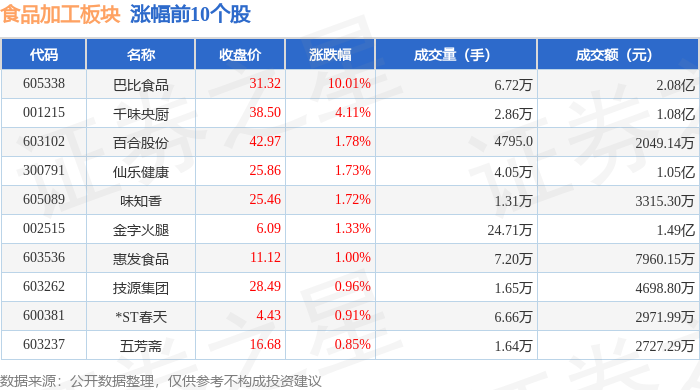
Market Overview - The food processing sector experienced a decline of 0.16% on December 31, with Hai Xin Food leading the drop [1] - The Shanghai Composite Index closed at 3968.84, up 0.09%, while the Shenzhen Component Index closed at 13525.02, down 0.58% [1] Stock Performance - Notable gainers in the food processing sector included: - Baba Food (605338) with a closing price of 31.32, up 10.01% on a trading volume of 67,200 shares and a transaction value of 208 million yuan [1] - Qianwei Yangchu (001215) closed at 38.50, up 4.11% with a trading volume of 28,600 shares and a transaction value of 108 million yuan [1] - Conversely, Hai Xin Food (002702) saw a significant decline of 3.52%, closing at 7.12 with a trading volume of 605,300 shares and a transaction value of 43.6 million yuan [2] Capital Flow - The food processing sector saw a net outflow of 43.13 million yuan from institutional investors, while retail investors contributed a net inflow of 71.14 million yuan [2] - The capital flow for specific stocks indicated: - Baba Food had a net inflow of 38.48 million yuan from institutional investors, while retail investors had a net outflow of 25.79 million yuan [3] - Qianwei Yangchu experienced a net inflow of 5.29 million yuan from institutional investors and a net outflow of 11.23 million yuan from retail investors [3]

巴比食品:选举李俊为职工代表董事
Bei Jing Shang Bao· 2025-12-30 11:55
Group 1 - The core announcement is that Babbi Food has elected Li Jun as the employee representative director for the fourth board of directors during the employee representative assembly held on December 30 [1] - Li Jun will join two non-independent directors and two independent directors elected at the first extraordinary shareholders' meeting in 2025 to form the fourth board of directors [1] - The term of the newly elected board members will last from the approval date of the employee representative assembly until the end of the fourth board's term [1]