ZHONGYIN BABI FOOD CO.(605338)

Search documents
巴比食品(605338):开店加速在即,打开成长上限:巴比食品(605338):跟踪分析报告
Huachuang Securities· 2025-12-26 08:43
Investment Rating - The report maintains a "Strong Buy" rating for the company with a target price of 35.6 yuan [1]. Core Insights - The company is set to accelerate its store openings, which will enhance its growth potential. The new store model has been validated, and the company aims to achieve its 2025 store opening targets. The report outlines a three-phase growth strategy: "from 0 to 1," "from 1 to 10," and "from 10 to 100," indicating a clear operational turning point and the beginning of a new growth cycle [6][7]. Financial Summary - Total revenue is projected to grow from 1,671 million yuan in 2024 to 2,540 million yuan in 2027, with a compound annual growth rate (CAGR) of 20.6% in 2027 [2]. - Net profit attributable to the parent company is expected to increase from 277 million yuan in 2024 to 408 million yuan in 2027, reflecting a growth rate of 25.7% in 2027 [2]. - Earnings per share (EPS) are forecasted to rise from 1.15 yuan in 2024 to 1.70 yuan in 2027, with corresponding price-to-earnings (P/E) ratios decreasing from 25 times in 2024 to 17 times in 2027 [2][7]. Store Expansion Strategy - The company has successfully opened new stores in various regions, including Jiangsu, Zhejiang, Shanghai, Guangdong, and Hubei, validating the replicability of its new store model. The upcoming franchisee conferences and the peak opening season after the Spring Festival are expected to catalyze further growth [6][7]. - The report anticipates that the company will reach a mid-term target of 1,500 to 2,000 new stores, with potential for even greater expansion in the long term [6][7]. Market Position and Competitive Advantage - The company is positioned as a leader in the steamed bun industry, with a focus on continuous innovation and operational efficiency. The report emphasizes the attractiveness of the business model to franchisees, which is expected to drive further expansion and enhance brand strength [6][7].

东吴证券晨会纪要-20251225
Soochow Securities· 2025-12-25 01:39
Macro Strategy - The core viewpoint of the report indicates that the Q3 2025 US GDP grew at an annualized rate of +4.3%, significantly exceeding Bloomberg analysts' consensus expectation of +3.3% and the Atlanta Fed's GDPNow estimate of +3.5% [1][7] - The main contributors to this growth were strong consumer spending and a reduction in inventory drag, with inventory changes being the largest marginal contributor to the acceleration in GDP growth [1][7] - Despite the strong GDP data, the market initially reacted with concerns of economic overheating, leading to a temporary cooling of interest rate cut expectations, which later reversed as asset prices adjusted [1][8] - Looking ahead, the report anticipates a significant cooling in Q4 2025 GDP growth due to the impact of government shutdowns, with short-term interest rate cut expectations largely dependent on upcoming employment and inflation data [1][8] Fixed Income - The report notes that during the week of December 15-19, 2025, the yield on the 10-year government bond rose slightly from 1.8425% to 1.835% [2][9] - It highlights that the bond market's response to economic data has been muted, with sentiment remaining weak despite the release of disappointing economic indicators [9] - The report suggests that the bond market may face challenges in the first half of 2026, but there are potential opportunities for recovery due to expected policy easing and adjustments in fund redemption rates [9][11] Industry Analysis - The report focuses on Baba Foods (605338), emphasizing its multi-faceted growth strategy and the successful performance of its new store formats, particularly the hand-made soup dumplings [19][20] - The company has seen significant sales increases in both dine-in and takeout formats, with some trial stores achieving daily sales of over 10,000 yuan, indicating a strong market validation of its new store types [19][20] - The report projects that the company's net profit attributable to shareholders will reach 290 million yuan in 2025, 330 million yuan in 2026, and 400 million yuan in 2027, reflecting year-on-year growth rates of +4%, +13%, and +22% respectively [19][20] - The report maintains a "buy" rating for the company, suggesting that the growth potential of its new store formats has not yet been fully reflected in its market valuation [19][20]
华源证券:重视ROA企稳的消费板块 寻找价或量仍景气的细分赛道
智通财经网· 2025-12-24 13:01
Core Viewpoint - Different consumer sectors exhibit both differences and commonalities in recovery rhythms, with ROA being a leading indicator for operational recovery in consumer enterprises [1][2] Group 1: Recovery Rhythm Analysis - The recovery rhythm of various consumer sectors is influenced by industry supply and demand, as well as supply chain structures, with a focus on stock market competition as a mainstream phenomenon [2] - The stages of enterprise and channel adjustments are outlined, starting from oversupply to a new balance in supply and demand, with ROA serving as a key indicator throughout these stages [2] - Current recovery sequences indicate that soft drinks and snacks are leading, followed by food supply chains, condiments, dairy products, beer, and finally, liquor [2][3] Group 2: Investment Strategy - Emphasis on sectors where ROA stabilizes, indicating potential valuation recovery opportunities, with a preference for sectors that still show price or volume growth [3] - Price logic suggests that rising CPI may drive valuation recovery in traditional industries with high penetration rates, such as liquor, beer, and dairy products, which are likely to attract incremental capital [3][4] - Recommended companies in the liquor sector include Kweichow Moutai, Luzhou Laojiao, and Shanxi Fenjiu, while in dairy, focus on Yili and Mengniu [3] Group 3: Volume Logic - In the context of cost-effective consumption, companies with high supply chain efficiency are expected to gain volume, with specific recommendations for companies in the food supply chain and soft drinks [4] - Industries with low penetration rates may withstand economic cycles, with recommendations for low-alcohol beverages and functional foods that can enhance brand premium through specialization [4] - Companies benefiting from overseas market expansion include Angel Yeast and Bailong Chuangyuan [4]




食品饮料2026年投资策略报告:曙光渐显,在分化中前行-20251224
Hua Yuan Zheng Quan· 2025-12-24 12:13
Group 1: Core Insights - The report emphasizes the recovery stage of consumer spending, highlighting that different sectors exhibit both commonalities and differences in their recovery rhythms, driven by supply-demand dynamics and industry structure [4][5] - ROA (Return on Assets) is identified as a leading indicator for the operational recovery of consumer companies, with a focus on analyzing various sub-sectors [4][13] Group 2: Sector Performance - The current recovery sequence indicates that soft drinks and snacks are leading, followed by the catering supply chain, condiments, dairy products, beer, and finally, liquor [5][25] - The report draws parallels with Japan's 1990s consumption differentiation, noting that sectors addressing consumer pain points and with low penetration rates are likely to succeed [5][6] Group 3: Investment Strategy - The report suggests focusing on sectors where ROA is stabilizing, indicating potential valuation recovery opportunities, particularly in traditional sectors like liquor, beer, and dairy [6][8] - It recommends identifying sub-sectors with either price or volume growth, with a preference for price-driven strategies [6][8] Group 4: Detailed Sector Analysis - The frozen food sector is showing signs of marginal improvement, with leading companies enhancing operational efficiency through product innovation and channel reforms [27][28] - The snack sector is experiencing high demand, driven by new channel developments, although competition is intensifying [33][35] - The beer industry is under pressure, with a focus on high-end products, but overall growth is slowing due to external economic factors [39][41] - The dairy sector is nearing the end of its adjustment phase, with expectations of improved performance as raw milk prices rise [41][42] - The liquor sector is currently in a phase of inventory reduction, with performance risks gradually clearing as channels stabilize [43][48]




研报掘金丨东吴证券:维持巴比食品“买入”评级,手工小笼包新店型表现亮眼
Ge Long Hui A P P· 2025-12-24 05:42
Core Viewpoint - Dongwu Securities report highlights the strong performance of Baba Food's handmade soup dumpling new store model, with continued franchise enthusiasm and traditional stores showing signs of recovery [1] Company Performance - The new store model has been validated by the market, showing significant effectiveness and potential for expansion through franchising [1] - The company is leveraging mergers and acquisitions to support its mid-term goal of reaching 10,000 stores [1] Financial Projections - The company’s net profit forecasts for 2025-2027 are adjusted to 290 million, 330 million, and 400 million yuan respectively, reflecting year-on-year growth of 4%, 13%, and 22% [1] - The price-to-earnings (PE) ratios are projected to be 24, 21, and 18 times for 2025, 2026, and 2027 respectively [1] Investment Recommendation - The company is recommended as a "buy," with a focus on 2026 as a foundational year for the new store model and 2027 expected to see acceleration in growth [1]

巴比食品(605338) - 2025年第一次临时股东会会议资料
2025-12-23 10:15
中饮巴比食品股份有限公司 2025 年第一次临时股东会会议资料 | 会议须知 | 1 | | --- | --- | | 会议议程 | 3 | | 会议议案 | 4 | | 议案一:关于取消监事会并修订《公司章程》的议案 | 4 | | 议案二:关于修订《股东会议事规则》的议案 | 5 | | 议案三:关于修订《董事会议事规则》的议案 | 14 | | 议案四:关于修订《募集资金管理制度》的议案 | 24 | | 议案五:关于修订《独立董事工作制度》的议案 | 35 | | 议案六:关于修订《关联交易管理制度》的议案 | 39 | | 议案七:关于修订《对外担保管理制度》的议案 | 47 | | 议案八:关于修订《对外投资管理制度》的议案 | 48 | | 议案九:关于修订《防范控股股东及关联方资金占用制度》的议案 | 52 | | 议案十:关于修订《累积投票制实施细则》的议案 | 54 | | 议案十一:关于修订《会计师事务所选聘制度》的议案 | 56 | | 议案十二:关于制定《董事和高级管理人员离职管理制度》的议案 | 57 | | 议案十三:关于制定《董事和高级管理人员薪酬管理制度》的议案 | 58 ...
食品饮料周报(25年第47周):把握成本红利与效率提升主线,关注创新与困境反转机会-20251221
Guoxin Securities· 2025-12-21 08:22
Investment Rating - The report maintains an "Outperform the Market" rating for the food and beverage sector [4][5][69]. Core Views - The food and beverage sector is expected to benefit from cost advantages and efficiency improvements, with a focus on innovation and opportunities for turnaround [3][5]. - The report highlights a positive outlook for 2026, emphasizing four main investment themes: cost benefits, efficiency improvements, innovation-driven growth, and turnaround opportunities in the liquor segment [3][5]. Summary by Relevant Sections Market Performance - The food and beverage sector (A-shares and H-shares) rose by 1.97% this week, with A-shares outperforming the CSI 300 by approximately 2.29 percentage points [1]. - The top five gainers in the food and beverage sector this week were: Huanlejia (44.42%), Zhuangyuan Ranch (35.96%), Huangshi Group (21.16%), Junyao Health (17.02%), and Sunshine Dairy (14.72%) [1]. Subsector Insights - **Liquor**: Demand remains weak, with premium liquor companies focusing on supply-side optimization. Recommended stocks include Luzhou Laojiao, Shanxi Fenjiu, and Kweichow Moutai [2][10]. - **Beverages**: The beverage sector shows continued prosperity, with leading companies outperforming. Recommended stocks include Nongfu Spring and Dongpeng Beverage [2][14]. - **Food**: The snack segment is highlighted for its strong growth potential, particularly in konjac snacks, with key recommendations being Weidong and Yanjinpuzi [2][11]. Key Company Earnings Forecasts - Kweichow Moutai: EPS forecast for 2025E is 72.12, with a PE ratio of 19.6 [4]. - Shanxi Fenjiu: EPS forecast for 2025E is 9.73, with a PE ratio of 18.4 [4]. - Dongpeng Beverage: EPS forecast for 2025E is 8.85, with a PE ratio of 30.8 [4]. - Wuliangye: EPS forecast for 2025E is 6.61, with a PE ratio of 16.7 [4]. - Babi Food: EPS forecast for 2025E is 1.14, with a PE ratio of 25.6 [4]. - Weidong: EPS forecast for 2025E is 0.61, with a PE ratio of 18.4 [4]. Investment Recommendations - The recommended investment portfolio includes Babi Food, Dongpeng Beverage, Weidong, and Shanxi Fenjiu, which have shown an average increase of 3.55%, outperforming the food and beverage sector by 1.54 percentage points [15].


食品饮料周报(25年第47周):手握成本红利与效率提升主线,关注创新与困境反转机会-20251221
Guoxin Securities· 2025-12-21 07:53
Investment Rating - The report maintains an "Outperform the Market" rating for the food and beverage sector [4][5]. Core Views - The food and beverage sector is expected to benefit from cost advantages and efficiency improvements, with a focus on innovation and opportunities for turnaround [3][5]. - The report highlights a positive outlook for 2026, emphasizing four main investment themes: cost benefits from low raw material prices, efficiency improvements through supply chain optimization, innovation-driven growth, and potential recovery in the liquor sector [3][5]. Summary by Sections Market Performance - The food and beverage sector (A-shares and H-shares) rose by 1.97% this week, with A-shares outperforming the CSI 300 by approximately 2.29 percentage points [1]. - The top five gainers in the food and beverage sector this week were: Huanlejia (44.42%), Zhuangyuan Ranch (35.96%), Huangshi Group (21.16%), Junyao Health (17.02%), and Sunshine Dairy (14.72%) [1]. Subsector Analysis - **Liquor**: Demand remains weak, with premium liquor companies focusing on supply-side optimization. Recommended stocks include Luzhou Laojiao, Shanxi Fenjiu, and Kweichow Moutai [2][10]. - **Beverages**: The beverage sector shows continued growth, with strong performance from leading companies like Nongfu Spring and Dongpeng Beverage. The report recommends these companies for their market expansion and innovation capabilities [2][14]. - **Food**: The snack segment is highlighted for its strong growth potential, particularly in konjac snacks, with leading companies like Weidong and Yanjinpuzi recommended for their competitive advantages [2][11]. Key Companies and Earnings Forecasts - **Kweichow Moutai**: Rated "Outperform the Market" with an estimated EPS of 72.12 CNY for 2025 and 75.79 CNY for 2026 [4]. - **Shanxi Fenjiu**: Also rated "Outperform the Market," with an estimated EPS of 9.73 CNY for 2025 and 10.22 CNY for 2026 [4]. - **Dongpeng Beverage**: Rated "Outperform the Market," with an estimated EPS of 8.85 CNY for 2025 and 11.21 CNY for 2026 [4]. - **Weidong**: Rated "Outperform the Market," with an estimated EPS of 0.61 CNY for 2025 and 0.74 CNY for 2026 [4]. Investment Recommendations - The recommended investment portfolio includes Baba Foods, Dongpeng Beverage, Weidong, and Shanxi Fenjiu, which have shown strong performance and growth potential [15].
巴比食品涨2.28%,成交额5970.25万元,主力资金净流出72.10万元
Xin Lang Cai Jing· 2025-12-19 05:22
Group 1 - The core viewpoint of the news is that Babi Food has shown significant stock performance, with a year-to-date increase of 76.87% and a market capitalization of 6.979 billion yuan as of December 19 [1] - Babi Food's main business involves the research, production, and sales of Chinese-style frozen pastries, with revenue composition being 90.39% from food, 6.17% from packaging materials, and 3.34% from services [1] - The company is categorized under the food and beverage industry, specifically in food processing and pre-processed foods, and is associated with concepts such as prepared dishes and e-commerce [1] Group 2 - As of October 31, Babi Food had 12,000 shareholders, a decrease of 2.87% from the previous period, while the average circulating shares per person increased by 2.96% to 19,963 shares [2] - For the period from January to September 2025, Babi Food achieved operating revenue of 1.356 billion yuan, representing a year-on-year growth of 12.05%, and a net profit attributable to shareholders of 201 million yuan, up 3.51% year-on-year [2] - Since its A-share listing, Babi Food has distributed a total of 476 million yuan in dividends, with 372 million yuan distributed over the past three years [2]
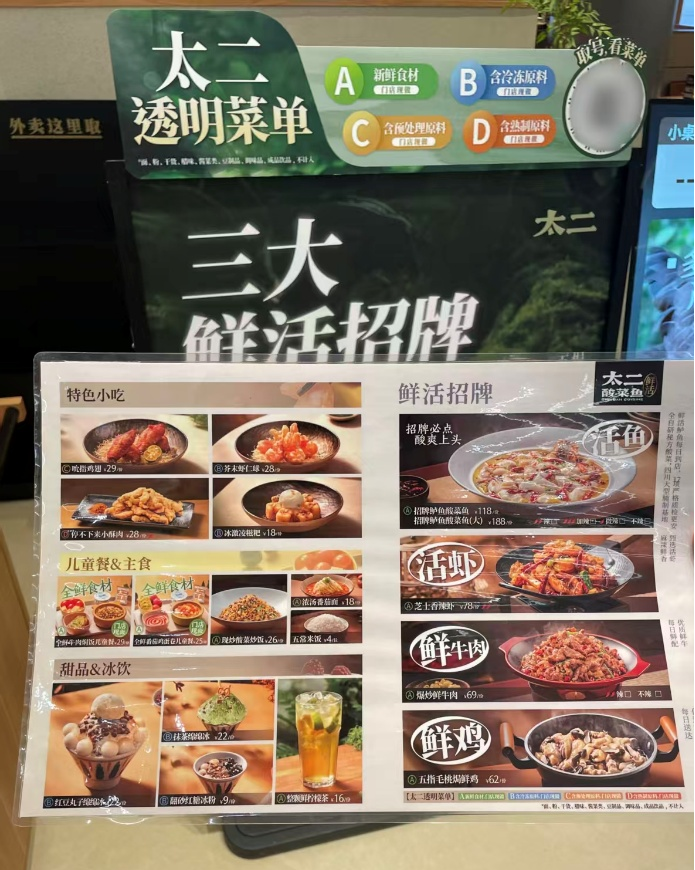
有餐企以新鲜度将菜品分“ABCD级”,餐饮透明化是趋势
Di Yi Cai Jing· 2025-12-18 10:26
Core Viewpoint - The recent focus on pre-prepared meals in China has prompted significant actions from both the government and restaurant brands to enhance transparency regarding food ingredients and preparation processes [1][4]. Group 1: Company Initiatives - Chain restaurant brand Tai Er has launched a full menu transparency classification system, categorizing dishes based on the freshness of ingredients [1]. - Tai Er's transparent menu divides dishes into four categories, with A class representing the freshest ingredients, including live fish and fresh vegetables, while B, C, and D classes indicate varying levels of processing [3]. - Fast food brand Lao Xiang Ji has implemented a similar system with a "three-color label" to indicate the processing level of dishes, enhancing consumer awareness [4]. Group 2: Industry Trends - The food industry analyst Zhu Danpeng emphasizes the need for a balance between taste and industrialization, as well as the importance of establishing national standards for pre-prepared meals [3]. - The State Council's Food Safety Office has recognized the growing public concern over pre-prepared meals and is working with various departments to expedite the formulation of national standards [4]. - The push for transparency in the restaurant industry is driven by consumer demand for fresh ingredients and visible processes, alongside regulatory pressures [4].