Cathay Biotech (688065)

Search documents
凯赛生物:将人工智能与生物技术深度融合,是公司构筑核心竞争力的关键战略方向
Zheng Quan Ri Bao Wang· 2026-01-22 12:13
Core Viewpoint - The integration of artificial intelligence (AI) with biotechnology (BT) is identified as a key strategic direction for the company to build its core competitiveness [1] Group 1: Strategic Direction - The company aims to deepen the integration of AI and BT to enhance its technological framework [1] - Internal platform development and external ecosystem collaboration, including partnerships with entities like Molecular Heart, are part of the strategy to improve the technology system [1] Group 2: Competitive Advantage - The company seeks to establish a differentiated technological moat for future growth [1] - The goal is to solidify and expand the company's leading position in the biomanufacturing sector [1]

凯赛生物:在生物基复合材料领域的各项合作与市场拓展工作均在稳步推进中
Zheng Quan Ri Bao Wang· 2026-01-22 11:41
Core Viewpoint - The company is making steady progress in its collaborations and market expansion in the field of bio-based composite materials [1] Group 1: Collaborations and Market Development - The company is actively communicating with relevant partners regarding building templates [1] - The focus is on addressing various specific issues in the industrialization process [1] - The goal is to provide the market with mature, reliable, and competitive solutions [1]
免费领取!《2025中国合成生物制造产业发展白皮书》
synbio新材料· 2026-01-20 08:47
Core Insights - The article emphasizes the rising importance of biomanufacturing as a strategic and innovative sector, which is seen as a new growth point that can help optimize industrial structures and transform economic models [1]. Group 1: Current State and Trends - The "2025 China Synthetic Biomanufacturing Industry Development White Paper" was officially released on August 1, highlighting the current status and trends in biomanufacturing [1]. - The report analyzes the global biomanufacturing industry, including key platform facilities and a comparative study of the US and China in this field [5]. Group 2: Policy Landscape - The white paper discusses major policies affecting biomanufacturing both domestically and internationally for the years 2024-2025 [5]. Group 3: Industry Map and Applications - It provides a comprehensive map of the Chinese biomanufacturing industry and analyzes the industry chain along with key application directions, including biomanufacturing in pharmaceuticals, food, personal care, agriculture, chemicals, materials, and energy [5]. Group 4: Key Enterprises - The report identifies ten leading enterprises in the Chinese biomanufacturing sector, detailing their contributions and roles within the industry [5][6]. Group 5: Company Strategies - It outlines the synthetic biology strategies of 15 listed companies, summarizing their development approaches and corresponding popular products [5][6]. Group 6: Investment and Challenges - The white paper reviews the investment and financing situation in domestic synthetic biology from 2024 to mid-2025 and discusses the challenges faced by the biomanufacturing industry in China, along with proposed countermeasures [5][6].





167股连续5日或5日以上获融资净买入
Zheng Quan Shi Bao Wang· 2026-01-19 03:34
Core Viewpoint - As of January 16, a total of 167 stocks in the Shanghai and Shenzhen markets have experienced net financing inflows for five consecutive days or more, indicating strong investor interest in these stocks [1] Group 1: Stocks with Notable Financing Inflows - The stock with the longest consecutive net financing inflow is Shenwan Hongyuan, which has seen net inflows for 14 consecutive trading days [1] - Other stocks with significant consecutive net financing inflows include China Merchants Bank, Jiayuan Technology, Lens Technology, Songsheng Co., Kaisa Bio, Gansu Expressway, New Asia Electronics, and Huaten Hotel [1]




新材料产业周报:三星显示正式启动第8.6代OLED面板量产,力鸿一号圆满完成亚轨道飞行试验-20260118
Guohai Securities· 2026-01-18 12:21
Investment Rating - The report maintains a "Recommended" rating for the new materials industry [1] Core Insights - The new materials sector is positioned as a crucial direction for the chemical industry, currently experiencing rapid growth in downstream demand. With policy support and technological breakthroughs, domestic new materials are expected to accelerate into a long-term growth phase. The report emphasizes that "one generation of materials leads to one generation of industry," highlighting the foundational nature of the new materials industry as the material basis for other sectors [3][4]. Summary by Sections 1. Electronic Information Sector - Focus areas include semiconductor materials, display materials, and 5G materials. Samsung Display has officially launched mass production of the 8.6 generation OLED panels, which will be used in new laptops this year [5][20]. 2. Aerospace Sector - Key materials of interest are PI films, precision ceramics, and carbon fibers. The successful suborbital flight test of the Lihong No. 1 vehicle demonstrates advancements in low-cost and flexible launch capabilities [7]. 3. New Energy Sector - Focus on photovoltaic materials, lithium-ion batteries, proton exchange membranes, and hydrogen storage materials. India is projected to become the second-largest solar market globally by 2026, driven by steady installation growth [9]. 4. Biotechnology Sector - Key areas include synthetic biology and scientific services. A team from Tsinghua University in Shenzhen has developed a 3D-printed "mini heart" that mimics the rhythmic beating of a real heart, with future applications in organ printing anticipated [11]. 5. Energy Conservation and Environmental Protection Sector - Focus on adsorbent resins, membrane materials, and biodegradable plastics. The Ministry of Industry and Information Technology has launched an action plan to promote high-quality development of industrial internet platforms, aiming for over 450 influential platforms by 2028 [13]. 6. Key Companies and Earnings Forecast - The report highlights several companies with their respective stock prices and earnings per share (EPS) forecasts for 2024A, 2025E, and 2026E, along with their price-to-earnings (PE) ratios and investment ratings. Notable companies include: - Ruihua Tai (688323.SH): EPS forecast of 0.26 for 2026E, rated as "Increase" [14] - Guangwei Composite (300699.SZ): EPS forecast of 0.97 for 2026E, rated as "Buy" [14] - Zhongfu Shenying (688295.SH): EPS forecast of 0.23 for 2026E, rated as "Buy" [14] - Wanrun Co., Ltd. (002643.SZ): EPS forecast of 0.53 for 2026E, rated as "Buy" [14] - Dinglong Co., Ltd. (300054.SZ): EPS forecast of 0.96 for 2026E, rated as "Buy" [14]




凯赛生物跌3.6% 2020年上市即巅峰2度募资合计115亿
Zhong Guo Jing Ji Wang· 2026-01-15 08:28
Core Viewpoint - Kaisa Bio (688065.SH) is currently trading at 57.62 yuan, reflecting a decline of 3.60% and is in a state of breaking its initial public offering price [1] Group 1: Company Overview - Kaisa Bio was listed on the Shanghai Stock Exchange's Sci-Tech Innovation Board on August 12, 2020, with a total public offering of 41,668,198 shares, accounting for 10.00% of the total shares post-issuance, at an issuance price of 133.45 yuan per share [1] - On its first trading day, Kaisa Bio reached a peak price of 198 yuan, marking the highest price since its listing [2] - The total funds raised by Kaisa Bio amounted to 556.06 million yuan, with a net amount of 528.00 million yuan, exceeding the original plan by 58.11 million yuan [2] Group 2: Fund Utilization - The funds raised were intended for several projects, including a 40,000 tons/year bio-based dodecanedioic acid project, a bio-based polyamide engineering research center, and a 30,000 tons/year long-chain dicarboxylic acid project, as well as for working capital [2] - Kaisa Bio's total fundraising from two rounds amounts to 11.487 billion yuan [4] Group 3: Shareholder Information - The actual controllers of Kaisa Bio are Xiucai Liu, Xiaowen Ma, and Charlie Chi Liu, who are American citizens of Chinese descent [2] - On March 28, 2025, Kaisa Bio disclosed a report on the issuance of A-shares to specific entities, with the controlling shareholder Shanghai Yaoxiu being a company controlled by Xiucai Liu's family [3] - The issuance involved 137,911,755 shares at a price of 42.97 yuan per share, raising a total of approximately 5.93 billion yuan, which is intended for working capital and loan repayment [3]
化学制品板块1月14日跌0.55%,呈和科技领跌,主力资金净流出17.57亿元
Zheng Xing Xing Ye Ri Bao· 2026-01-14 08:44
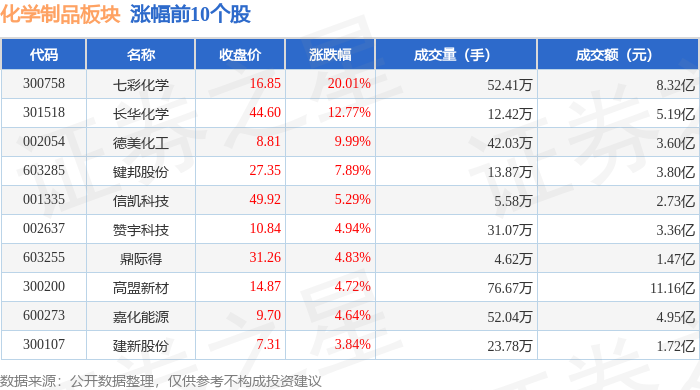
Market Overview - The chemical products sector experienced a decline of 0.55% on January 14, with Chenghe Technology leading the losses [1] - The Shanghai Composite Index closed at 4126.09, down 0.31%, while the Shenzhen Component Index rose to 14248.6, up 0.56% [1] Top Gainers in Chemical Sector - Qicai Chemical (300758) saw a significant increase of 20.01%, closing at 16.85 with a trading volume of 524,100 shares and a turnover of 832 million [1] - Changhua Chemical (301518) rose by 12.77%, closing at 44.60 with a trading volume of 124,200 shares and a turnover of 519 million [1] - Demei Chemical (002054) increased by 9.99%, closing at 8.81 with a trading volume of 420,300 shares and a turnover of 360 million [1] Top Losers in Chemical Sector - Chenghe Technology (688625) declined by 5.79%, closing at 58.71 with a trading volume of 88,500 shares and a turnover of 525 million [2] - Duofuduo (002407) fell by 4.31%, closing at 31.55 with a trading volume of 1,265,100 shares and a turnover of 404.6 million [2] - Kaisa Bio (688065) decreased by 3.97%, closing at 59.77 with a trading volume of 158,000 shares and a turnover of 965 million [2] Capital Flow Analysis - The chemical products sector experienced a net outflow of 1.757 billion from institutional investors, while retail investors saw a net inflow of 1.333 billion [2] - The top stocks with significant net inflows from retail investors include Qicai Chemical (300758) with a net inflow of 256 million [3] - Demei Chemical (002054) also had a notable net inflow of 108 million from retail investors [3]


生物制造的底层逻辑与产业链分析(附100佳核心企业)
材料汇· 2026-01-13 11:56
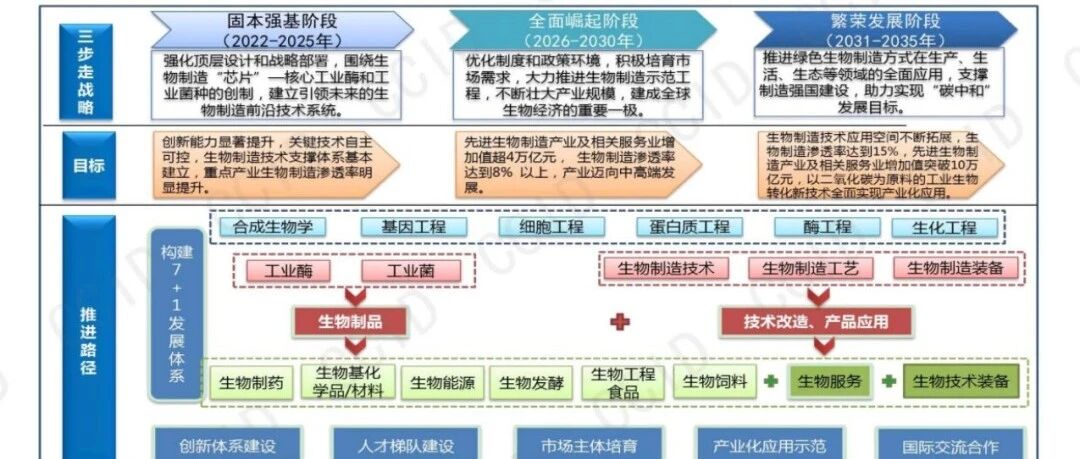
Core Viewpoint - Biomanufacturing is identified as a key future industry in China's 14th Five-Year Plan, expected to create a market worth trillions in the next decade, driven by advancements in technology and policy support [2][5]. Group 1: Industry Overview - The biomanufacturing industry in China is nearing a total scale of 1 trillion yuan, with fermentation capacity accounting for over 70% of the global total [2][4]. - Shenzhen has become a hub for biomanufacturing, with 40% of newly established companies in this sector located there in the past three years, showcasing a significant industry clustering effect [4]. - The industry is supported by a comprehensive system of policy, funding, and technological advancements as outlined in the 14th Five-Year Plan [5]. Group 2: Key Enterprises - The article identifies 100 core enterprises in biomanufacturing, spanning the entire industry chain from upstream technology development to downstream commercial applications [7]. - Notable companies include: - Huada Technology, a leader in gene sequencing technology [17]. - Kaisa Biotech, which has achieved over 80% market share in the global long-chain dicarboxylic acid market [21]. - WuXi Biologics, representing China's capabilities in the global biopharmaceutical industry [27]. Group 3: Upstream Innovations - The upstream sector focuses on providing essential tools and technologies for research and production, with a shift towards domestic innovation and smart integration [16]. - Key trends include the localization of critical tools and the rise of AI-driven platform companies that enhance research efficiency [16][17]. - Over 75% of the 20 identified upstream enterprises are private, indicating a vibrant innovation landscape [16]. Group 4: Midstream Developments - The midstream sector is characterized by a dual structure of "upgraders" and "disruptors," with companies like Meihua Biotech and Chuaning Biotech leading in traditional fermentation while others like Kaisa Biotech innovate with new bioproducts [20][21]. - This segment contains the highest number of enterprises, with 40 out of the 100 identified companies, emphasizing the importance of production capacity and cost control [20]. Group 5: Downstream Applications - The downstream sector serves as a critical market for biomanufacturing, focusing on medical, consumer, and agricultural applications [25]. - Companies like Muyuan Foods exemplify the cost-saving potential of biomanufacturing in agriculture, while WuXi Biologics and Kelaiying represent the pharmaceutical sector's output capabilities [26][27]. - Future trends indicate a broadening of applications into new areas such as biobased textiles and environmental remediation [27].


化学制品板块1月13日跌0.29%,侨源股份领跌,主力资金净流出6.42亿元
Zheng Xing Xing Ye Ri Bao· 2026-01-13 08:56
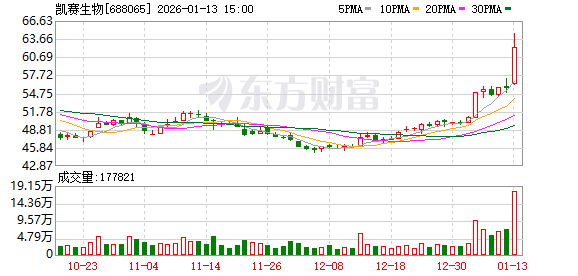
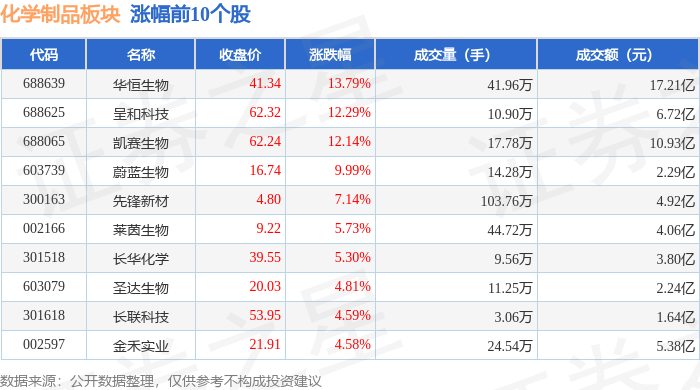
Market Overview - The chemical products sector experienced a decline of 0.29% on January 13, with Qiaoyuan Co. leading the drop [1] - The Shanghai Composite Index closed at 4138.76, down 0.64%, while the Shenzhen Component Index closed at 14169.4, down 1.37% [1] Top Performers - Huaheng Biological (688639) saw a significant increase of 13.79%, closing at 41.34 with a trading volume of 419,600 shares and a transaction value of 1.721 billion [1] - Chenghe Technology (688625) rose by 12.29%, closing at 62.32 with a trading volume of 109,000 shares and a transaction value of 672 million [1] - Kaisa Biological (688065) increased by 12.14%, closing at 62.24 with a trading volume of 177,800 shares [1] Underperformers - Qiaoyuan Co. (301286) fell by 8.67%, closing at 47.41 with a trading volume of 53,000 shares and a transaction value of 258 million [2] - Hangqing Co. (002430) decreased by 6.99%, closing at 32.06 with a trading volume of 311,600 shares [2] - Taihe Technology (300801) dropped by 6.72%, closing at 30.39 with a trading volume of 173,200 shares [2] Capital Flow - The chemical products sector saw a net outflow of 642 million from institutional investors and 357 million from retail investors, while retail investors had a net inflow of 999 million [2] - The capital flow data indicates a mixed sentiment among different investor types within the sector [2] Individual Stock Capital Flow - Duoliangduo (002407) had a net inflow of 224 million from institutional investors, while it experienced a net outflow of 1.09 billion from retail investors [3] - Wanhu Chemical (600309) saw a net inflow of 189 million from institutional investors, with a net outflow of 76.596 million from retail investors [3] - Yahua Group (002497) had a net inflow of 154 million from institutional investors, while retail investors experienced a net outflow of 17.488 million [3]

凯赛生物成交额创2020年8月14日以来新高
Zheng Quan Shi Bao Wang· 2026-01-13 07:00
数据宝统计,截至14:32,凯赛生物成交额10.01亿元,创2020年8月14日以来新高。最新股价上涨 12.36%,换手率2.80%。上一交易日该股全天成交额为3.99亿元。 (文章来源:证券时报网) 据天眼查APP显示,上海凯赛生物技术股份有限公司成立于2000年11月24日,注册资本72128.9794万人 民币。(数据宝) ...