Cathay Biotech (688065)

Search documents
ETF午盘资讯|攻势又起!化工ETF(516020)开盘猛拉1.56%,机构高呼“行业重估”在即!
Sou Hu Cai Jing· 2026-01-13 03:53
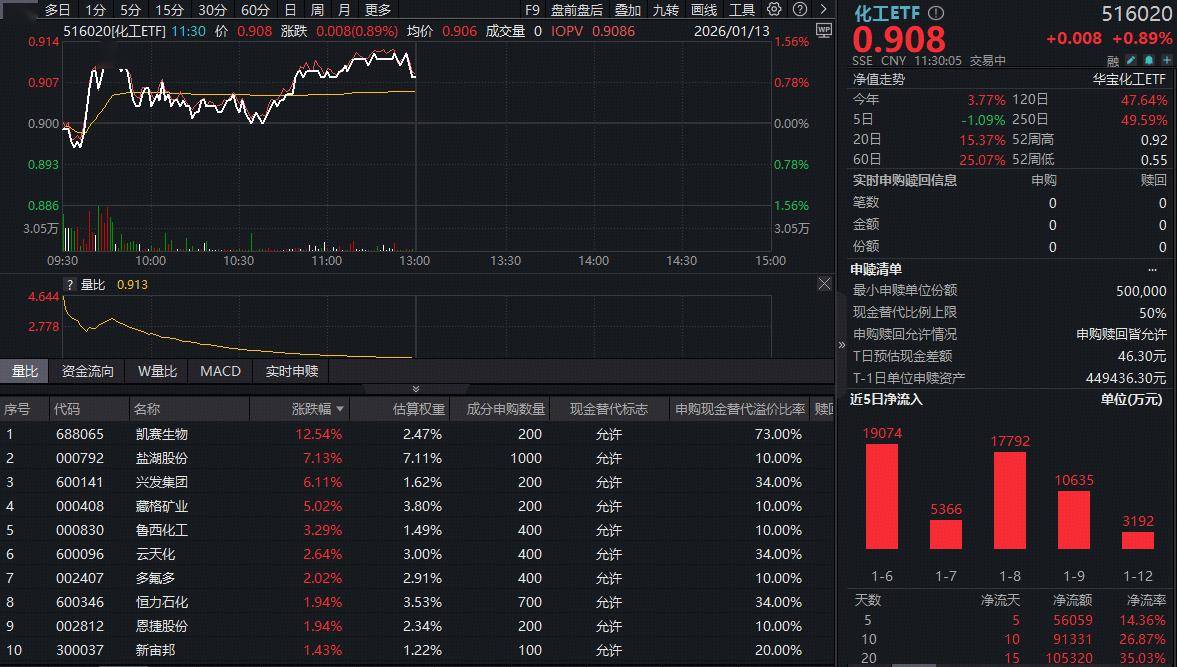
Group 1 - The chemical sector is experiencing a rebound, with the chemical ETF (516020) showing a significant increase, reaching a maximum intraday gain of 1.56% and closing up by 0.89% [1] - Key stocks in the sector include Kasei Bio, which surged by 12.54%, and Salt Lake Co., which rose by 7.13%, among others [1][2] - Recent capital inflow into the chemical sector has been strong, with the chemical ETF accumulating a net subscription of 560 million yuan over the last five trading days and over 910 million yuan in the last ten days [2] Group 2 - The Producer Price Index (PPI) for industrial products decreased by 1.9% year-on-year in December 2025, with a month-on-month increase of 0.2%, indicating a narrowing decline compared to the previous month [3] - The chemical industry is expected to undergo a revaluation, as its industry position and profit levels do not align, with potential recovery in profitability anticipated [3] - The chemical sector is at a new starting point of supply-demand rebalancing, influenced by policies aimed at reshaping competition and advancements in new production capabilities [3] Group 3 - The chemical ETF (516020) tracks the CSI segmented chemical industry theme index, with nearly 50% of its holdings concentrated in large-cap leading stocks, providing an opportunity for investors to capitalize on strong performers [4] - Investors can also access the chemical ETF through linked funds, enhancing investment efficiency in the chemical sector [4]





新材料产业周报:英伟达AI超级计算平台Vera Rubin全面投产,AS700取得国产载人飞艇生产许可证-20260111
Guohai Securities· 2026-01-11 14:57
Investment Rating - The industry investment rating is "Recommended" (maintained) [1] Core Insights - The new materials sector is a crucial direction for the chemical industry, currently experiencing rapid growth in downstream demand. With policy support and technological breakthroughs, domestic new materials are expected to accelerate their long-term growth. The report emphasizes that "one generation of materials leads to one generation of industries," highlighting the foundational nature of the new materials industry as the material basis for other industries [5][15]. Summary by Relevant Sections 1. Electronic Information Sector - Focus on semiconductor materials, display materials, and 5G materials [6] - Recent developments include NVIDIA's announcement of its new AI supercomputing platform, Vera Rubin, which has entered full production. The platform features six independent chips, with the Rubin GPU achieving a peak computing power of 50 Petaflops and a training performance 3.5 times that of its predecessor [7][37]. 2. Aerospace Sector - Focus on PI films, precision ceramics, and carbon fiber [8] - The successful acquisition of a production license for the AS700 manned airship marks a significant milestone for China's aerospace industry, indicating a shift towards standardized and commercialized production [9][10]. 3. New Energy Sector - Focus on photovoltaics, lithium-ion batteries, proton exchange membranes, and hydrogen storage materials [10] - A notable development is the introduction of the world's first all-solid-state battery by a Finnish startup, set to enter OEM mass production [11]. 4. Biotechnology Sector - Focus on synthetic biology and scientific services [12] - Beijing's economic development zone has announced measures to support the innovation and development of the synthetic biology manufacturing industry, aiming to establish a globally influential industry cluster by 2028 [13]. 5. Energy Conservation and Environmental Protection Sector - Focus on adsorbent resins, membrane materials, and biodegradable plastics [14] - The Guangxi government has issued a plan for green mine construction, aiming for over 90% of large and medium-sized mines to meet green standards by the end of 2028 [15]. 6. Industry Rating and Investment Strategy - The new materials sector is expected to benefit from the catalytic effects of downstream application sectors, gradually entering a prosperous cycle, thus maintaining a "Recommended" rating for the new materials industry [15].




PVC价格大涨!化工板块暴力拉升,化工ETF(516020)摸高3.83%,近5日吸金超3.5亿元!
Xin Lang Cai Jing· 2026-01-06 11:22
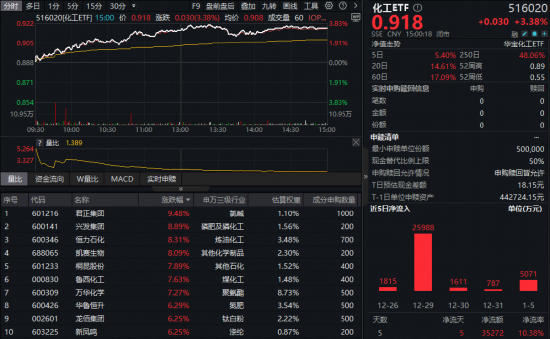
Group 1 - The chemical sector continues to show strong performance, with the Chemical ETF (516020) experiencing a maximum intraday increase of 3.83% and closing up 3.38% [1][8] - Key stocks in the sector include Junzheng Group, which surged by 9.48%, and other notable performers such as Xingfa Group and Hengli Petrochemical, both rising over 8% [1][8] - The basic chemical sector attracted significant capital inflow, with a net inflow of 12.4 billion yuan on the day, ranking second among 30 CITIC primary industries [11][12] Group 2 - The Chemical ETF (516020) has seen a total net subscription of 352 million yuan over the past five trading days, indicating strong investor interest [3][9] - PVC futures contracts rose over 3% in a single day, with a cumulative increase of over 15% since mid-December [10] - Analysts predict that by 2026, the petrochemical industry will undergo a supply-side clearing, leading to a recovery in demand for specific segments like PX and PTA [10] Group 3 - The valuation of the chemical sector remains reasonable, with the Chemical ETF's underlying index price-to-book ratio at 2.65, positioned at the 52.45 percentile over the past decade [10] - The chemical industry is currently at a cyclical bottom, with potential for recovery driven by demand stimulation policies and ongoing export growth [12] - The Chemical ETF (516020) provides an efficient way to invest in the sector, with nearly 50% of its holdings in large-cap leading stocks, allowing investors to capitalize on strong market trends [12]


ETF盘中资讯|PX价格大涨引爆盈利预期,化工ETF(516020)暴力拉升3.83%!百亿资金疯狂涌入!
Sou Hu Cai Jing· 2026-01-06 06:16
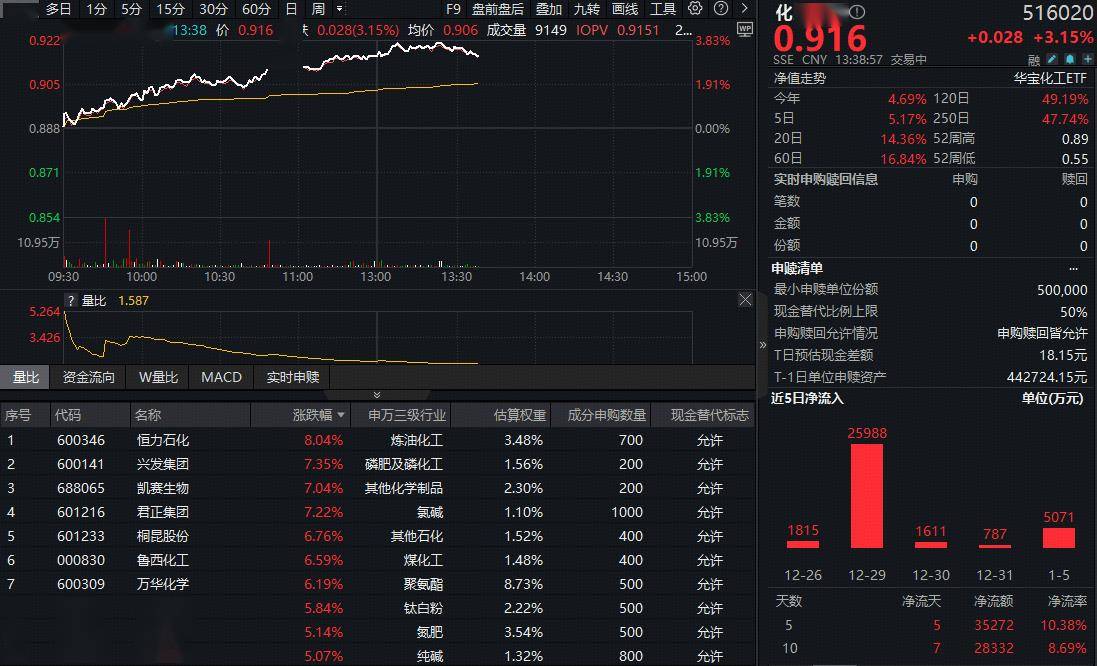
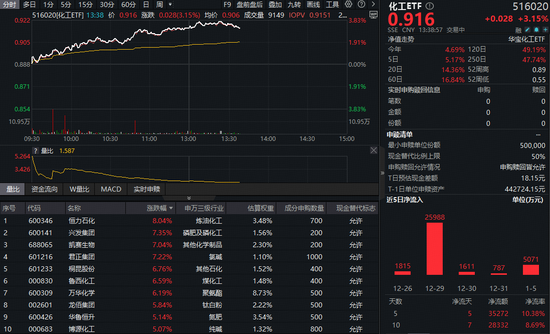
Core Viewpoint - The chemical sector is experiencing a significant rally, with the chemical ETF (516020) showing strong performance and individual stocks within the sector also seeing substantial gains [1][3]. Group 1: Market Performance - The chemical ETF (516020) opened with a rise and maintained high volatility, reaching a maximum intraday increase of 3.83% and closing up by 3.15% [1]. - Key stocks in the sector, such as Hengli Petrochemical, surged over 8%, while others like Xingfa Group, Kaisa Bio, and Junzheng Group increased by more than 7% [1]. - The basic chemical sector attracted significant capital, with a net inflow of 12.4 billion yuan on the day, ranking second among 30 major sectors [3]. Group 2: Price Movements and Profit Expectations - In late December, the price of paraxylene (PX) rose significantly, with futures increasing by over 800 yuan/ton and spot prices up by approximately 340 yuan/ton [3]. - The rise in PX prices is expected to enhance profit expectations for refining companies, leading to a bullish sentiment in the stock market [3]. - Major changes among leading companies during a period of industry downturn may present opportunities for recovery [3]. Group 3: Future Outlook - China Galaxy Securities forecasts a negative growth in capital expenditure for the chemical industry in 2024, with supply-side contraction expected due to the "anti-involution" trend and the acceleration of the elimination of outdated capacity [3]. - The "14th Five-Year Plan" emphasizes expanding domestic demand, which, combined with the onset of a U.S. interest rate cut cycle, is anticipated to open up demand for chemical products [3]. - A dual bottom in supply and demand is expected to be established, with strong policy catalysts potentially leading to a cyclical upturn in the chemical industry by 2026, marking a transition from valuation recovery to earnings growth [3]. Group 4: Investment Opportunities - Investors may consider the chemical ETF (516020) for efficient exposure to the sector, as it tracks the CSI sub-industry index and covers various segments of the chemical industry [4]. - Nearly 50% of the ETF's holdings are concentrated in large-cap leading stocks, such as Wanhua Chemical and Salt Lake Industry, providing opportunities for strong performance [4]. - The remaining 50% of the ETF's holdings include leading stocks in segments like phosphate fertilizers, fluorine chemicals, and nitrogen fertilizers, allowing for comprehensive investment in the chemical sector [4].
PX价格大涨引爆盈利预期,化工ETF(516020)暴力拉升3.83%!百亿资金疯狂涌入!
Xin Lang Cai Jing· 2026-01-06 05:55
Core Viewpoint - The chemical sector is experiencing significant gains, with the chemical ETF (516020) showing a price increase of 3.15% as of the latest report, following a peak increase of 3.83% during the trading session [1][7]. Group 1: Market Performance - The chemical ETF (516020) opened with a strong upward trend and has maintained high volatility, reflecting the overall positive performance of the chemical sector [1][7]. - Key stocks in the sector, such as Hengli Petrochemical, surged over 8%, while others like Xingfa Group, Kasei Biotech, and Junzheng Group saw increases exceeding 7% [1][7]. Group 2: Capital Inflows - The basic chemical sector attracted substantial capital, with a net inflow of 12.469 billion yuan on the day, ranking second among 30 major sectors [9][10]. - Over the past 60 days, the basic chemical sector has accumulated a total net inflow of 236.9 billion yuan, placing it third among the 30 major sectors [9][10]. Group 3: Price Movements and Market Sentiment - In late December, the price of paraxylene (PX) increased significantly, with futures rising over 800 yuan per ton and spot prices up approximately 340 yuan per ton [10]. - Analysts from Dongfang Securities noted that the price increase of PX, a key product in integrated refining projects, has led to improved profit expectations for refining companies, thereby stimulating stock market activity [10]. Group 4: Future Outlook - China Galaxy Securities predicts a negative growth in capital expenditure for the chemical industry in 2024, with supply expected to contract due to the "anti-involution" trend and the accelerated elimination of outdated overseas capacities [11]. - The "14th Five-Year Plan" emphasizes expanding domestic demand, which, combined with the onset of a U.S. interest rate cut cycle, is expected to open up demand space for chemical products [11]. - The firm anticipates that the chemical industry may reach a cyclical turning point by 2026, transitioning from valuation recovery to earnings growth, referred to as a "Davis double play" [11].
政策加力,激发民间投资新活力
Ren Min Ri Bao· 2026-01-05 06:17
Group 1 - The core viewpoint of the articles emphasizes the continuous optimization of private investment structure, showcasing a trend towards practical and innovative investments, particularly in infrastructure [1] - Private investment in infrastructure steadily increased, with a year-on-year growth of 3.5% from January to November 2025, including significant growth in water management (34.2%) and air transport (25.1%) [1] - The scale of special long-term government bonds is projected to reach 1.3 trillion yuan in 2025, a substantial increase of 800 billion yuan compared to 2024, with funds allocated to support major projects and policies [1] Group 2 - By the end of November 2025, the total social financing scale reached 440.07 trillion yuan, with a year-on-year increase of 6.3% in loans to the real economy [2] - The banking sector saw a year-on-year growth of 2.1% in loans to small and micro enterprises, indicating a supportive financial environment for private investment [2] - The implementation of a moderately loose monetary policy in 2026 aims to accelerate financial supply-side structural reforms [2] Group 3 - Private investment is identified as a crucial support for stabilizing growth, adjusting structure, and promoting employment, with expectations for more proactive macro policies to stimulate private investment vitality [3] - The dialogue with private entrepreneurs and financial professionals highlights the need for macro policies to better support private enterprises in expanding investments [3] Group 4 - A case study of a small motorcycle export enterprise illustrates the effectiveness of tailored financial services, resulting in a 30% year-on-year increase in sales due to timely financing support [4] - The establishment of a coordinated financial service mechanism has led to significant credit support for small and micro enterprises, with a total of 7.68189 trillion yuan in loans disbursed by November 2025 [5] Group 5 - Financial institutions are encouraged to develop financing products that meet the needs of private investments, enhancing the resilience of the industrial system by supporting key industry chains [6] - The focus on modern industrial system construction aims to direct financial resources towards weak links in industry chains, promoting overall industrial development [6] Group 6 - Companies are increasingly recognizing the importance of government policies in supporting private investment, with examples of successful collaborations between enterprises and financial institutions leading to significant growth [8][10] - The emphasis on long-term stable financial support is crucial for small and micro enterprises to focus on quality control and investment [18]

光伏硅片价格回升,出光兴产、三井化学整合千叶乙烯业务 | 投研报告
Zhong Guo Neng Yuan Wang· 2025-12-30 02:02
Industry Overview - The chemical sector's overall performance ranked 7th this week (2025/12/22-2025/12/26) with a fluctuation of 4.23%, outperforming the Shanghai Composite Index by 2.35 percentage points and the ChiNext Index by 0.34 percentage points [1] - The chemical industry is expected to continue its differentiated trend in 2025, with a focus on synthetic biology, pesticides, chromatography media, sweeteners, vitamins, light hydrocarbon chemicals, COC polymers, and MDI [1] Synthetic Biology - The arrival of a pivotal moment in synthetic biology is anticipated, driven by the adjustment of energy structures, which may disrupt fossil-based materials and favor low-energy products [1] - Traditional chemical companies are expected to compete based on energy consumption and carbon tax costs, with successful firms leveraging green energy alternatives and integrated advantages to reduce costs [1] - The demand for bio-based materials is projected to surge, leading to potential profitability and valuation increases for leading companies in the synthetic biology sector, such as Kasei Bio and Huaheng Bio [1] Refrigerants - The implementation of quota policies is expected to usher in a high-growth cycle for third-generation refrigerants, with supply entering a "quota + continuous reduction" phase starting in 2024 [2] - The demand for refrigerants is anticipated to grow steadily due to the development of heat pumps, cold chain markets, and the expansion of the air conditioning market in Southeast Asia [2] - Companies with a high quota share, such as Juhua Co., Sanmei Co., Haohua Technology, and Yonghe Co., are expected to benefit significantly from this trend [2] Electronic Specialty Gases - Electronic specialty gases are critical to the electronics industry and represent a core component of domestic industrial chain localization [2] - The domestic market faces a contradiction between rapid upgrades in wafer manufacturing and insufficient high-end electronic specialty gas capacity, presenting significant domestic substitution opportunities [2] - Key players like Jinhong Gas, Huate Gas, and China Shipbuilding Gas are positioned to capitalize on the growing demand driven by integrated circuits, panels, and photovoltaics [2] Light Hydrocarbon Chemicals - The trend towards light raw materials in the global olefin industry is becoming increasingly significant, with a shift from heavy naphtha to lighter low-carbon alkanes like ethane and propane [3] - Light hydrocarbon chemicals are characterized by low carbon emissions, low energy consumption, and low water usage, aligning with global carbon neutrality goals [3] - Companies in the light hydrocarbon sector, such as Satellite Chemical, are expected to see a revaluation of their value as this trend continues [3] COC Polymers - The industrialization process of COC/COP (cyclic olefin copolymer) is accelerating in China, driven by domestic companies achieving breakthroughs and the shift of downstream industries to domestic sources [4] - COC/COP materials are increasingly used in various applications, including mobile camera lenses and medical packaging, with a focus on high-end applications [4] - Companies like Acolyte are recommended for their potential in the COC polymer production segment [4] Potash Fertilizers - Potash fertilizer prices are expected to rebound as the industry enters a destocking cycle, with supply constraints due to Canpotex withdrawing new quotes and Nutrien announcing production cuts [5] - The demand for potash fertilizers is likely to increase as farmers respond to rising grain prices, leading to a potential reversal in potash prices [5] - Leading companies in the potash sector, such as Yara International, Salt Lake Potash, and Zangge Mining, are recommended for investment [5] MDI Market - The MDI market is characterized by oligopoly, with demand steadily improving due to the expansion of polyurethane applications [6] - The global MDI production capacity is concentrated among five major chemical giants, which control approximately 90.85% of the market [6] - Companies like Wanhua Chemical are expected to benefit from the favorable supply dynamics and demand recovery in the MDI sector [6] Chemical Price Tracking - The top five price increases this week included NYMEX natural gas (9.59%), PTA (8.95%), and butadiene (6.83%) [6] - The top five price decreases included pure MDI (-4.23%) and acrylic fiber (-3.45%) [6] - A total of 170 chemical companies reported production capacity impacts this week, with 6 new repairs and 10 restarts [6]


凯赛生物(688065) - 招商证券股份有限公司关于上海凯赛生物技术股份有限公司2025年持续督导定期现场检查报告
2025-12-29 11:17
招商证券股份有限公司 关于上海凯赛生物技术股份有限公司 2025 年持续督导定期现场检查报告 上海证券交易所: 招商证券股份有限公司(以下简称"招商证券"或"保荐人")作为正在对 上海凯赛生物技术股份有限公司(以下简称"凯赛生物"、"上市公司"、"公司") 进行持续督导工作的保荐人,根据《上海证券交易所上市公司自律监管指引第 11 号——持续督导》等有关法律、法规的规定,对公司 2025 年 1 月 1 日至本次现 场检查期间(以下简称"本持续督导期")的规范运作情况进行了现场检查,具 体情况如下: 一、本次现场检查的基本情况 (一)保荐人 招商证券股份有限公司 (二)保荐代表人 陆永志、王大为 (三)现场检查人员 陆永志 (四)现场检查时间 2025 年 12 月 22 日 (五)现场检查内容 现场检查人员对本持续督导期内发行人公司治理和内部控制情况、信息披露 情况、公司的独立性以及与控股股东、实际控制人及其他关联方资金往来情况、 募集资金使用情况、关联交易、对外担保、重大对外投资情况、经营状况等方面 进行了现场检查,具体检查内容详见本报告"二、本次现场检查主要事项及意见"。 (六)现场检查手段 本次现场检 ...
乌苏市工业经济活力四射
Zhong Guo Xin Wen Wang· 2025-12-29 10:58
Core Viewpoint - Uusu City is strategically positioning itself as an "Industrial Strong City" by leveraging its advantages in the Silk Road Economic Belt and developing a modern industrial system that includes synthetic biology manufacturing, intelligent equipment manufacturing, and cotton textile and apparel industries [1][2]. Synthetic Biology Manufacturing - Uusu has established a synthetic biology manufacturing industrial cluster covering 9,439 acres, with the Uusu Industrial Park as the core [3]. - Key player in this sector is Kasei Biotech (Uusu) Co., Ltd., which has developed production lines for long-chain dicarboxylic acids and bio-based polyamides, achieving an output value of 1.097 billion yuan in 2024 [3]. - The goal is to reach a synthetic biology manufacturing output value of 10 billion yuan during the 14th Five-Year Plan period, establishing Uusu as a future demonstration zone for synthetic biology manufacturing in Western China [3]. Intelligent Equipment Manufacturing - Uusu's intelligent equipment manufacturing sector is gaining recognition, with products like large cotton-picking machines being exported to multiple international markets [4]. - The North New Science and Technology Co., Ltd. has transitioned from providing a few products to covering over ten sectors, achieving a production value of 20 million yuan and tax contributions of 2.02 million yuan in 2025 [5]. - The Uusu Industrial Park has been recognized as a high-tech industrial development zone, with plans to add 21 new high-tech enterprises by 2025, bringing the total to 36 [5][6]. Textile and Apparel Industry - Uusu is enhancing its textile and apparel industry by upgrading to high-end, intelligent, and full-industry chain production [6][7]. - The introduction of advanced production lines has increased yarn spinning efficiency by nearly 50%, and the company has initiated a project to produce high-end blended yarns [6]. - The establishment of a complete silk production chain has diversified the industry, transitioning from cotton to silk, thus increasing the added value of products [7]. Logistics Hub Development - Uusu is evolving from a geographical transportation node to a modern logistics hub, supported by a comprehensive transportation network [8]. - The city has been integrated into the international railway transport system, significantly reducing transportation costs and time for goods to Central Asia [8][9]. - A planned 13.67 square kilometer commercial logistics park aims to enhance trade and logistics capabilities, facilitating a dual open pattern of foreign and domestic trade [9].
特种尼龙:打破海外垄断,中国高端新材料的下一个百亿赛道
材料汇· 2025-12-27 15:46
Core Viewpoint - Specialty nylon is a key direction for the high-end, functional, and green development of the new materials industry, overcoming limitations of conventional nylon through molecular structure design and synthesis process innovation [1][2]. Group 1: Overview of Specialty Nylon - Specialty nylon refers to polyamide materials excluding common nylons (PA6 and PA66), including long-chain nylon, high-temperature nylon, transparent nylon, and bio-based nylon [5][7]. - Long-chain nylon and high-temperature nylon dominate the specialty nylon market, with various subcategories emerging to meet diverse application needs [5][8]. Group 2: Market Supply and Demand - The global specialty nylon production capacity is approximately 600,000 tons per year, with major producers including Arkema, DuPont, and DSM [10][11]. - The market is characterized by high technical barriers in key monomers and polymerization processes, with significant contributions from both international giants and emerging domestic producers [10][14]. Group 3: Long-Chain Nylon - Long-chain nylon, defined by having more than ten methylene groups in its molecular chain, exhibits high toughness and low water absorption, making it suitable for applications in automotive, electronics, and military sectors [16][20]. - The global production capacity for long-chain nylon is around 270,000 tons per year, with a projected market value of $2.846 billion in 2024, expected to grow to $3.64 billion by 2031, reflecting a CAGR of 3.6% [21][23]. Group 4: High-Temperature Nylon - High-temperature nylon can operate at temperatures up to 150°C, with a global production capacity of approximately 335,000 tons per year, widely used in automotive, electronics, and mechanical manufacturing [26][32]. - The production of high-temperature nylon is dominated by companies like DuPont and Solvay, with ongoing innovations in synthesis processes to enhance performance and sustainability [28][32].