
Sirui(688102)

Search documents
公告精选︱渤海租赁:控股子公司Avolon之下属子公司拟110.61亿元出售飞机租赁资产
Ge Long Hui· 2026-02-25 01:29
Group 1: Market Trends and Risks - Roman Shares and Meibang Shares have experienced significant short-term stock price increases, indicating potential market sentiment overheating and irrational speculation risks [1][1] Group 2: Project Investments - Dazhu Laser plans to invest $150 million to establish an overseas operation center in Southeast Asia [1] - Bohai Leasing's subsidiary Avolon intends to sell aircraft leasing assets worth approximately 11.061 billion yuan [1] Group 3: Contract Awards - Fengfan Shares has won a bid for a project with Southern Power Grid valued at approximately 184 million yuan [1] - ST Songfa's subsidiary has signed contracts for the construction of two Capesize bulk carriers [1] Group 4: Financial Performance - Zhongke Shuguang expects a net profit of 2.113 billion yuan for 2025, representing a year-on-year increase of 10.54% [2] - Zhongjiao Technology anticipates a net profit of 156 million yuan for 2025, up 86.13% year-on-year [2] - Sry New Materials forecasts a net profit of 154 million yuan for 2025, reflecting a 35.04% year-on-year growth [2] - Wen's Shares projects a net profit of 5.235 billion yuan for 2025, down 43.59% year-on-year [2] Group 5: Equity Acquisitions - Changxin Bochuang plans to acquire 93.8108% equity in Shanghai Honghui Optical Communication Technology [3] - Shenlian Bio intends to acquire controlling rights of Shizhi Source for 237 million yuan and to develop new business [3] - Tongwei Co. plans to purchase 100% equity of Lihua Qingneng, with stock suspension [3] Group 6: Share Buybacks - Kaipu Cloud plans to repurchase shares worth 50 million to 100 million yuan [3] - Zhongshun Jierou intends to buy back shares worth 60 million to 120 million yuan [3] - Yuanli Co. plans to repurchase shares worth 50 million to 60 million yuan [3] Group 7: Shareholding Changes - Conch Cement plans to increase its A-share holdings by 700 million to 1.4 billion yuan [3] - Fushi Holdings' Song Chunqing intends to reduce holdings by no more than 2% [3] - Zhixin Precision's director Zhang Guojun plans to reduce holdings by no more than 1.8562% [3] - Yashida Optoelectronics' director Lin Xuefeng plans to reduce holdings by no more than 0.976% [3] Group 8: Other Developments - ST Renfu plans to raise 3 billion to 3.5 billion yuan through a private placement to its controlling shareholder, Zhaoshang Biotechnology [4] - ST Xiangxue has received a decision to extend the pre-restructuring period [4] - Kaipu Cloud has terminated a major asset restructuring [4]


股海导航_2026年2月25日_沪深股市公告与交易提示
Xin Lang Cai Jing· 2026-02-25 00:36
Performance Summary - Supor reported a net profit of 2.097 billion yuan for 2025, a decrease of 6.58% year-on-year [2] - Sanofi reported a net profit of 2.939 billion yuan for 2025, an increase of 317.09% year-on-year [17] - Wens Foodstuff Group reported a net profit of 5.235 billion yuan for 2025, a decrease of 43.59% year-on-year [18] - Sree New Materials reported a net profit of 154 million yuan for 2025, an increase of 35.04% year-on-year [22] - JiaoKong Technology reported a net profit of 156 million yuan for 2025, an increase of 86.13% year-on-year [22] - Aidi Pharmaceutical reported a net loss of 19.7337 million yuan for 2025, a reduction in loss [22] - MicroGuide Nano reported a net profit of 213 million yuan for 2025, a decrease of 6.12% year-on-year [22] - Zhongwei Semiconductor reported a net profit of 285 million yuan for 2025, an increase of 108.05% year-on-year [22] - Hengyu Environmental reported a net profit of 35.9325 million yuan for 2025, an increase of 106.25% year-on-year [22] - Zhongke Shuguang reported a net profit attributable to shareholders of 2.113 billion yuan for 2025, an increase of 10.54% year-on-year [22] - Oat Technology reported a net profit of 137 million yuan for 2025, an increase of 42.63% year-on-year [22] - Yongxi Electronics reported a net profit attributable to shareholders of 82.2403 million yuan for 2025, an increase of 23.99% year-on-year [22] Shareholding Changes - Asia Optical's shareholders plan to reduce their holdings by no more than 1.6 million shares [22] - Anhui Conch Cement's controlling shareholder plans to increase its holdings by 700 million to 1.4 billion yuan [22] - Huaneng Hydropower's controlling shareholder plans to increase its holdings by 100 million to 150 million yuan [22] - Fushi Holdings' shareholders plan to reduce their holdings by no more than 2% [22] - Zhixin Precision's board members plan to reduce their holdings by no more than 1.8562% [22] - Hongbaoli's deputy general manager plans to reduce their holdings by no more than 310,000 shares [22] - Yuanli Co. plans to repurchase shares worth 50 million to 60 million yuan [22] - Zhongshun Jierou plans to repurchase shares worth 60 million to 120 million yuan [22] Contract Awards - Fengfan Co. won a procurement project from Southern Power Grid worth approximately 184 million yuan [22] - Shaoneng Co.'s wholly-owned subsidiary signed a cooperation agreement for land and resources for an independent energy storage power station project with Yuancan Company [22] Major Investments - Zhejiang Medicine plans to invest 250 million yuan in a silver economy fund in collaboration with a private equity fund [4] Project Approvals - Gansu Energy's Minqin Shuangchike 2 million kilowatt wind power project has been approved [5] - China Tianying received investment approval for the expansion of its Hanoi project [5] Mergers and Acquisitions - Dazhu Laser plans to invest 150 million USD to establish an overseas operation center [6] - Dongyang Sunshine is planning to acquire control of Dongshu No. 1, with stock suspension [6] - Shenlian Bio plans to acquire control of Shizhi Source for 237 million yuan to fully develop its innovative drug business [23] - Tongwei is planning to purchase 100% of Lihua Qingneng, with stock suspension starting tomorrow [23] - Changxin Bochuang plans to acquire 93.8108% of Shanghai Honghui Optical Communication Technology Co., Ltd. for 375 million yuan [23] - Kaipu Cloud has terminated the acquisition of 100% of Nanning Taike [23] Other Developments - Kexin Mechanical and Electrical obtained a production license for ultra-high pressure containers (A6) [10] - Baiyin Nonferrous Metals received a government subsidy of 9 million yuan [24] - Rundou Co. received a drug registration certificate for ibuprofen tablets [25] - Hengrui Medicine's application for the marketing authorization of the innovative drug SHR-1918 injection has been accepted and included in the priority review process [26] - Duorui Medicine's tender offer period has expired, and the company's stock is suspended [27] - Inner Mongolia Huadian plans to apply for a change of its stock name to "Huaneng Mengdian" [28]



陕西斯瑞新材料股份有限公司2025年度业绩快报公告
Shang Hai Zheng Quan Bao· 2026-02-24 17:10
证券代码:688102 证券简称:斯瑞新材 公告编号:2026-009 二、经营业绩和财务状况情况说明 (一)报告期的经营情况、财务状况及影响经营业绩的主要因素 1、报告期的经营情况、财务状况 陕西斯瑞新材料股份有限公司 2025年度业绩快报公告 本公司董事会及全体董事保证公告内容不存在任何虚假记载、误导性陈述或者重大遗漏,并对其内容的 真实性、准确性和完整性依法承担法律责任。 本公告所载2025年度主要财务数据为陕西斯瑞新材料股份有限公司(以下简称"公司")初步核算数据, 未经会计师事务所审计,具体数据以公司2025年年度报告中披露的数据为准,提请投资者注意投资风 险。 一、2025年度主要财务数据和指标 单位:万元 ■ 注:1.本报告期初数同法定披露的上年年末数。 2.以上财务数据及指标以合并报表数据填列,但未经审计,最终结果以公司2025年年度报告为准。 三、风险提示 本公告所载2025年度主要财务数据为初步核算数据,未经会计师事务所审计,具体数据以公司正式披露 的2025年年度报告为准,公司不存在影响本次业绩快报内容准确性的重大不确定因素,敬请广大投资者 注意投资风险。 特此公告。 报告期内,公司实现 ...
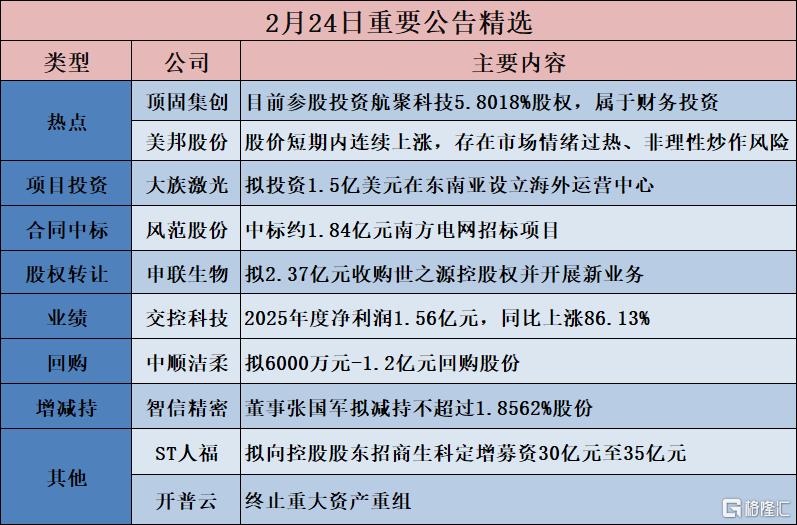
格隆汇公告精选︱渤海租赁:控股子公司Avolon之下属子公司拟110.61亿元出售飞机租赁资产
Ge Long Hui A P P· 2026-02-24 14:32
Group 1: Key Announcements - Xianggu Jichuang currently holds a 5.8018% stake in Hangju Technology, classified as a financial investment [1] - Meibang Co., Ltd. has seen a short-term continuous rise in stock price, indicating potential market sentiment overheating and irrational speculation risks [1] - Dazhu Laser plans to invest $150 million to establish an overseas operation center in Southeast Asia [1] - Fengfan Co., Ltd. won a bid for a project worth approximately 184 million yuan from the Southern Power Grid [1] - Jialian Biological intends to acquire controlling interest in Shizhi Yuan for 237 million yuan and expand into new business [1] - Jiaokong Technology forecasts a net profit of 156 million yuan for 2025, representing an 86.13% year-on-year increase [1] - Zhongshun Jierou plans to repurchase shares worth between 60 million and 120 million yuan [1] - Zhixin Precision's director Zhang Guojun plans to reduce his stake by no more than 1.8562% [1] - ST Renfu aims to raise 3 to 3.5 billion yuan through a private placement to its controlling shareholder,招商生科 [1] - Kaipu Cloud has terminated a significant asset restructuring [1] Group 2: Performance Highlights - Zhongke Shuguang expects a net profit of 2.113 billion yuan for 2025, a year-on-year increase of 10.54% [2] - Zhongwei Semiconductor reported a net profit of 285 million yuan for 2025, reflecting a 108.05% year-on-year growth [2] - Jiaokong Technology's net profit for 2025 is projected at 156 million yuan, up 86.13% year-on-year [2] - Sry New Materials anticipates a net profit of 154 million yuan for 2025, a 35.04% increase year-on-year [2] - Wens Foodstuff Group's net profit for 2025 is expected to be 5.235 billion yuan, down 43.59% year-on-year [2] Group 3: Equity Acquisitions - Changxin Bochuang plans to acquire a 93.8108% stake in Shanghai Honghui Guanglian Communication Technology [3] - Shenlian Biological intends to acquire controlling interest in Shizhi Yuan for 237 million yuan and expand into new business [3] - Tongwei Co., Ltd. plans to purchase 100% equity of Lihua Qingneng, with stock suspension [3] Group 4: Share Buybacks - Kaipu Cloud plans to repurchase shares worth between 50 million and 100 million yuan [3] - Zhongshun Jierou intends to repurchase shares worth between 60 million and 120 million yuan [3] - Yuanli Co., Ltd. plans to repurchase shares worth between 50 million and 60 million yuan [3] Group 5: Shareholding Changes - Conch Cement plans to increase its A-share holdings by 700 million to 1.4 billion yuan [3] - Fushi Holdings' Song Chunqing plans to reduce his stake by no more than 2% [3] - Zhixin Precision's director Zhang Guojun plans to reduce his stake by no more than 1.8562% [3] - Yashiguangdian's director Lin Xuefeng plans to reduce his stake by no more than 0.976% [3] Group 6: Other Developments - ST Renfu (rights protection) plans to raise 3 to 3.5 billion yuan through a private placement to its controlling shareholder [3] - ST Xiangxue (rights protection) received a decision to extend the pre-restructuring period [3] - Kaipu Cloud has terminated a significant asset restructuring [3]


今日晚间重要公告抢先看——光线传媒称公司来源于《飞驰人生3》的营业收入约为4300万元至5300万元;中微半导称2025年净利润2.85亿元,同比增长108.05%
Jin Rong Jie· 2026-02-24 13:28
Major Announcements - Light Media's film "Fast and Furious 3" has achieved a cumulative box office revenue of approximately 2.926 billion yuan, with the company's revenue from this film estimated between 43 million to 53 million yuan, which exceeds 50% of the company's audited consolidated financial statement revenue for the most recent fiscal year [1] - Dazhong Laser plans to invest 150 million USD to establish an overseas operation center in Southeast Asia to enhance service capabilities and meet international market demands [1] - Shunlian Bio intends to acquire controlling interest in Yanzhou Shizhi Source Biotechnology Co., Ltd. for 237 million yuan, aiming to fully develop its innovative drug business [2] - Shaoneng Co. signed a cooperation agreement with Yuancan Company for an independent energy storage power station project, with a total agreement amount of 22 million yuan [3] - China Tianying received investment approval for the expansion of its waste-to-energy project in Hanoi, with an investment amount of approximately 220 million USD [4] - Gansu Energy's 2 million kW wind power project has received approval from the local development and reform bureau [5] - Kexin Machinery obtained a production license for ultra-high pressure vessels [6] Financial Performance - Zhongwei Semiconductor reported a net profit of 285 million yuan for 2025, a year-on-year increase of 108.05%, with total revenue of 1.122 billion yuan, up 23.09% [9] - Weidao Nano reported a net profit of 213 million yuan for 2025, a year-on-year decrease of 6.12%, with total revenue of 2.632 billion yuan, down 2.52% [10] - Wens Foodstuff Group reported a net profit of 5.235 billion yuan for 2025, a year-on-year decrease of 43.59%, with total revenue of 103.884 billion yuan, down 1.67% [11] - SanSheng Guojian reported a net profit of 2.939 billion yuan for 2025, a year-on-year increase of 317.09%, with total revenue of 4.199 billion yuan, up 251.81% [12] - Yongxi Electronics reported a net profit of 82.24 million yuan for 2025, a year-on-year increase of 23.99%, with total revenue of 4.4 billion yuan, up 21.92% [14] - YaoMai Technology reported a net profit of 137 million yuan for 2025, a year-on-year increase of 42.63%, with total revenue of 619 million yuan, up 24.33% [15] - Zhongke Shuguang reported a net profit of 2.113 billion yuan for 2025, a year-on-year increase of 10.54%, with total revenue of 14.97 billion yuan, up 13.86% [15] Shareholder Actions - Zhongshun Jierou plans to repurchase shares worth between 60 million to 120 million yuan for employee stock ownership plans [21] - Yuanli Co. plans to repurchase shares worth between 50 million to 60 million yuan for stock incentive plans [21] - Huaneng Hydropower's controlling shareholder plans to increase its stake by 100 million to 150 million yuan [22] - Conch Cement's controlling shareholder plans to increase its stake by 700 million to 1.4 billion yuan [23] Stock Suspension - Dongyangguang announced a stock suspension due to plans to acquire control of Dongshu No. 1 [29] - Tongwei Co. announced a stock suspension due to plans to acquire 100% equity of Qinghai Lihua Qingneng [30] - Duorui Pharmaceutical announced a stock suspension as the offer period for its acquisition has expired [31]




盛合晶微IPO过会 开普云终止收购南宁泰克
Xin Lang Cai Jing· 2026-02-24 13:04
Group 1: Key Developments in Technology and Innovation - Elon Musk envisions launching AI satellites from the Moon using electromagnetic catapults to create a satellite network for data centers [4] - Xiaomi plans to focus on core technologies such as chips, AI, and operating systems over the next five years to become a global tech leader [3] - Apple intends to purchase over 100 million advanced chips from TSMC's Arizona factory by 2026 [5] Group 2: Investment and Financial Performance - Hubei province is increasing investments in emerging industries like integrated circuits and embodied intelligence while optimizing real estate investments to boost domestic demand [2] - AMD has agreed to sell AI chips worth up to $60 billion to Meta, which will deploy 6 GW of AMD GPUs [6] - Zhongwei Semiconductor reported a net profit of 285 million yuan for 2025, a year-on-year increase of 108.05% [9] - Sry New Materials achieved a net profit of 154 million yuan in 2025, reflecting a 35.04% year-on-year growth [12] - Sanofi Guojian reported a net profit of 2.939 billion yuan for 2025, a staggering increase of 317.09% [12] Group 3: Corporate Actions and Strategic Moves - Shenlian Bio plans to acquire a controlling stake in Shizhi Yuan for 237 million yuan to expand into innovative pharmaceuticals [8] - Kaipu Cloud terminated its acquisition of Nanning Taike due to market changes and lack of agreement on key terms [8] - Senno Medical's subsidiary received EU CE MDR certification for its Ghunter intracranial thrombectomy stent, enabling entry into the EU market [14] Group 4: Financing and Market Activity - Qianxun Intelligent completed nearly 2 billion yuan in financing, with a valuation exceeding 10 billion yuan [15] - Renxin Technology, a leader in high-speed automotive SerDes chips, completed a strategic round of financing led by SAIC and other industry capital [16]


斯瑞新材:2025年度业绩快报公告
Zheng Quan Ri Bao· 2026-02-24 12:44
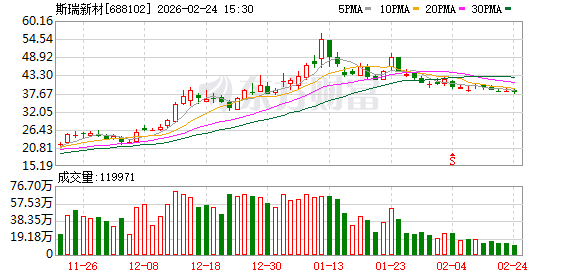
证券日报网讯 2月24日,斯瑞新材发布2025年度业绩快报公告称,公司2025年实现营业总收入156449.30 万元,同比增长17.66%;归属于母公司所有者的净利润15427.45万元,同比增长35.04%。 (文章来源:证券日报) ...
2月24日晚间重要公告一览
Xi Niu Cai Jing· 2026-02-24 10:15
Group 1 - Hengyu Environmental reported a revenue of 294 million yuan for 2025, an increase of 89.87%, and a net profit of 35.93 million yuan, up 106.25% year-on-year [1] - Yongxi Electronics achieved a revenue of 4.4 billion yuan in 2025, a growth of 21.92%, with a net profit of 82.24 million yuan, reflecting a year-on-year increase of 23.99% [2] - Zhongwei Semiconductor reported a revenue of 1.122 billion yuan for 2025, a 23.09% increase, and a net profit of 285 million yuan, up 108.05% year-on-year [3] - Sry New Materials achieved a revenue of 1.564 billion yuan in 2025, a growth of 17.66%, with a net profit of 154 million yuan, reflecting a year-on-year increase of 35.04% [14] - Jiaokong Technology reported a revenue of 2.537 billion yuan for 2025, a growth of 16.08%, and a net profit of 156 million yuan, up 86.13% year-on-year [15] - SanSheng Guojian reported a revenue of 4.199 billion yuan for 2025, a significant increase of 251.81%, with a net profit of 2.939 billion yuan, up 317.09% year-on-year [30] Group 2 - Aidi Pharmaceutical reported a revenue of 721 million yuan for 2025, a growth of 72.49%, but incurred a net loss of 19.73 million yuan, reducing losses from 142 million yuan in the previous year [5] - Weidao Nano reported a revenue of 2.632 billion yuan for 2025, a decrease of 2.52%, with a net profit of 213 million yuan, down 6.12% year-on-year [9] - Wens Foodstuff Group reported a revenue of 103.884 billion yuan for 2025, a decline of 1.67%, with a net profit of 5.235 billion yuan, down 43.59% year-on-year [29] - Supor reported a revenue of 22.772 billion yuan for 2025, a growth of 1.54%, with a net profit of 2.097 billion yuan, down 6.58% year-on-year [33] Group 3 - ShaoNeng Co. signed a significant operational contract worth 22 million yuan for a biomass power generation project [6] - Shunlian Bio plans to use 237 million yuan to acquire controlling interest in a joint venture, increasing its stake from 16.99% to 51% [7] - Huason Pharmaceutical's subsidiary received clinical trial approval for an innovative drug, indicating progress in its product pipeline [8] - Xinyang Technology's subsidiary received a medical device registration certificate, enhancing its product offerings [10][11] - Yida Co. obtained an investment project filing certificate for a chemical production project with a total investment of 642 million yuan [12]


斯瑞新材2025年度归母净利润1.54亿元 同比增长35.04%
Zhi Tong Cai Jing· 2026-02-24 09:16
报告期内,公司秉持"新材料引领未来"的使命,充分发挥核心竞争优势,持续推进技术创新和产业升 级。同时深化数字化转型升级,全面提升管理运营效率。面对下游需求持续增长的有利态势,公司主动 优化产业布局与产品结构,提升高附加值产品占比,带动收入和利润稳步增长。报告期内,公司完成向 特定对象发行A股股票,目前有序推进募投项目建设,募投项目产能逐步释放。同时,公司新的产业方 向开始放量增长,贡献效益增加。此外,欧元汇率上升对销售收入及汇兑收益产生积极影响。 斯瑞新材(688102.SH)发布2025年度业绩快报,报告期内,公司实现营业收入15.64亿元,同比增长 17.66%;实现归属于母公司所有者的净利润1.54亿元,同比增长35.04%。 斯瑞新材(688102.SH)发布2025年度业绩快报,报告期内,公司实现营业收入15.64亿元,同比增长 17.66%;实现归属于母公司所有者的净利润1.54亿元,同比增长35.04%。 ...
斯瑞新材(688102) - 2025 Q4 - 年度业绩
2026-02-24 09:05
证券代码:688102 证券简称:斯瑞新材 公告编号:2026-009 陕西斯瑞新材料股份有限公司 2025 年度业绩快报公告 本公司董事会及全体董事保证公告内容不存在任何虚假记载、误导性陈述或 者重大遗漏,并对其内容的真实性、准确性和完整性依法承担法律责任。 本公告所载2025年度主要财务数据为陕西斯瑞新材料股份有限公司(以下简 称"公司")初步核算数据,未经会计师事务所审计,具体数据以公司2025年年 度报告中披露的数据为准,提请投资者注意投资风险。 | 有者权益 | | | | | --- | --- | --- | --- | | 股本 | 77,490.19 | 72,733.79 | 6.54 | | 归属于母公司所有 | | | | | 者的每股净资产 | 2.45 | 1.53 | 60.13 | | (元) | | | | 注:1.本报告期初数同法定披露的上年年末数。 2.以上财务数据及指标以合并报表数据填列,但未经审计,最终结果以公司 2025 年年度报告为准。 二、经营业绩和财务状况情况说明 (一)报告期的经营情况、财务状况及影响经营业绩的主要因素 1、报告期的经营情况、财务状况 报告期 ...