
Sirui(688102)

Search documents
斯瑞新材:1月30日召开董事会会议
Mei Ri Jing Ji Xin Wen· 2026-01-30 08:27
Group 1 - The company Srei New Materials announced on January 30 that its fourth board meeting was held to discuss adjustments to the stock option incentive plan for 2023 [1] - The nuclear power construction industry is experiencing a surge in demand, with equipment manufacturers reporting orders scheduled until 2028 [1] - Employees in the equipment manufacturing sector are working in three shifts, with production lines operating 24 hours a day to meet the high demand [1]

斯瑞新材(688102) - 关于调整公司2023年股票期权激励计划行权价格的公告
2026-01-30 08:16
证券代码:688102 证券简称:斯瑞新材 公告编号:2026-007 1、2023 年 12 月 21 日,公司召开了第三届董事会独立董事专门会议第一次 会议、第三届董事会第十次会议,审议通过了《关于<公司 2023 年股票期权激励 计划(草案)>及其摘要的议案》《关于<公司 2023 年股票期权激励计划实施考核 管理办法>的议案》《关于提请股东大会授权董事会办理公司 2023 年股票期权激 励计划有关事项的议案》以及《关于提请召开公司 2024 年第一次临时股东大会 的议案》。同日,公司召开的第三届监事会第八次会议审议通过了《关于<公司 2023 年股票期权激励计划(草案)>及其摘要的议案》《关于<公司 2023 年股票期 权激励计划实施考核管理办法>的议案》《关于核实<公司 2023 年股票期权激励 计划首次授予激励对象名单>的议案》,公司监事会对本激励计划的相关事项进 行核实并出具相关核查意见。 2、2023 年 12 月 23 日,公司披露了《陕西斯瑞新材料股份有限公司 2023 年股票期权激励计划(草案)》《陕西斯瑞新材料股份有限公司 2023 年股票期 权激励计划(草案)摘要公告》(公告编号:2 ...
斯瑞新材(688102) - 国浩律师(西安)事务所关于陕西斯瑞新材料股份有限公司2023年股票期权激励计划调整相关事项之法律意见书
2026-01-30 08:16
国浩律师(西安)事务所 关 于 西安市雁塔区绿地中心 B 座 46 层 邮编:710065 The 46th Floor, Block B, Xi'an Greenland Center, Yanta District, Xi'an,710065,China 电话/Tel: +86 29 8819 9711 网址/Website: http://www.grandall.com.cn 2026 年 1 月 陕西斯瑞新材料股份有限公司 2023 年股票期权激励计划调整相关事项 之 法 律 意 见 书 | 第一节 | 引言 | 3 | | --- | --- | --- | | 一、释义 | | 3 | | 二、律师声明事项 | | 4 | | 第二节 | 正 文 6 | | | 一、本次调整所获得的批准和授权 | | 6 | | 二、本次调整的具体内容 | | 10 | | 三、结论意见 11 | | | | 第三节 | 签署页 12 | | 国浩律师(西安)事务所 法律意见书 国浩律师(西安)事务所 关于陕西斯瑞新材料股份有限公司 2023 年股票期权激励计划调整相关事项之 法律意见书 致:陕西斯瑞新材料股份 ...
斯瑞新材(688102) - 第四届董事会第九次会议决议公告
2026-01-30 08:15
二、董事会会议审议情况 证券代码:688102 证券简称:斯瑞新材 公告编号:2026-006 陕西斯瑞新材料股份有限公司 第四届董事会第九次会议决议公告 本公司董事会及全体董事保证公告内容不存在任何虚假记载、误导性陈述或 者重大遗漏,并对其内容的真实性、准确性和完整性依法承担法律责任。 一、董事会会议的召开情况 陕西斯瑞新材料股份有限公司(以下简称"公司")第四届董事会第九次会 议(以下简称"本次会议"或"会议")于 2026 年 1 月 30 日(星期五)在公司 4 楼会议室以现场结合通讯的方式召开,会议通知已于 2026 年 1 月 29 日送达各 位董事。会议由董事长王文斌先生召集和主持,本次会议应出席董事 7 人,实际 出席董事 7 人(其中:通讯方式出席 6 人)。 本次会议的召集和召开程序符合《中华人民共和国公司法》《陕西斯瑞新材 料股份有限公司章程》等法律、法规和规范性文件的规定。 经与会董事审议,做出以下决议: 审议通过《关于调整公司 2023 年股票期权激励计划行权价格的议案》 经审议,董事会认为:鉴于公司 2025 年前三季度权益分派实施方案,根据 公司 2024 年第一次临时股东大会的 ...
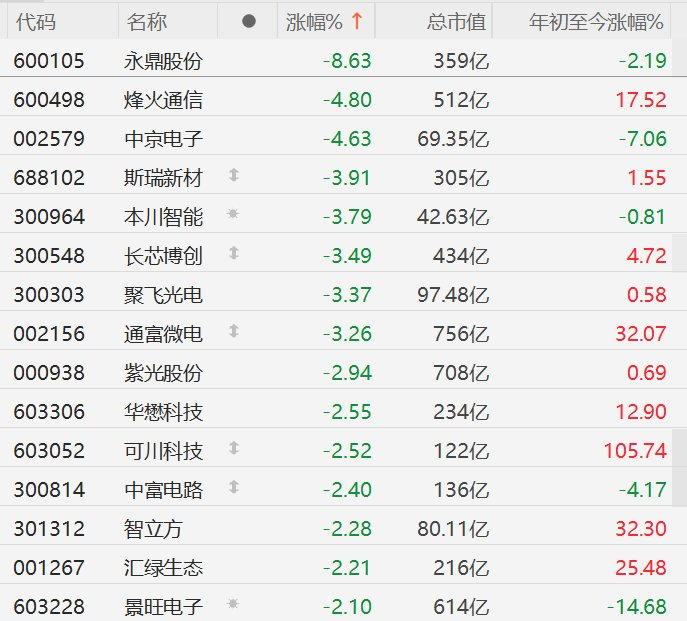
A股CPO概念股普跌,长芯博创、通富微电跌超3%
Ge Long Hui A P P· 2026-01-30 03:04
Group 1 - The CPO concept stocks in the A-share market experienced a widespread decline, with notable drops in several companies [1] - Yongding Co., Ltd. saw a significant decrease of over 8%, while Fenghuo Communication and Zhongjing Electronics fell by more than 4% [1] - Other companies such as Sry New Materials, Benchuan Intelligent, Changxin Bochuang, Jufei Optoelectronics, and Tongfu Microelectronics also reported declines exceeding 3% [1] Group 2 - Yongding Co., Ltd. reported a decline of 8.63% with a total market value of 35.9 billion [2] - Fenghuo Communication decreased by 4.80%, with a market capitalization of 51.2 billion, and has a year-to-date increase of 17.52% [2] - Zhongjing Electronics fell by 4.63%, with a market value of 6.935 billion, and a year-to-date decline of 7.06% [2] - Sry New Materials decreased by 3.91%, with a market capitalization of 30.5 billion, and a year-to-date increase of 1.55% [2] - Benchuan Intelligent saw a decline of 3.79%, with a market value of 4.263 billion, and a year-to-date decrease of 0.81% [2] - Changxin Bochuang dropped by 3.49%, with a market capitalization of 43.4 billion, and a year-to-date increase of 4.72% [2] - Jufei Optoelectronics declined by 3.37%, with a market value of 9.748 billion, and a year-to-date increase of 0.58% [2] - Tongfu Microelectronics fell by 3.26%, with a market capitalization of 75.6 billion, and a year-to-date increase of 32.07% [2] - Other companies such as Ziguang Co., Huamao Technology, and Kechuan Technology also reported declines, with varying market values and year-to-date performances [2]


商业航天为何会成为2026年的主线?
Soochow Securities· 2026-01-29 00:20
Investment Rating - The report maintains an "Overweight" rating for the commercial aerospace industry, indicating a positive outlook for the sector in the coming months [1]. Core Insights - The commercial aerospace industry is expected to undergo a significant transformation by 2026, driven by advancements in launch capabilities and the successful deployment of domestic rockets, which will remove previous constraints on industry growth [8][9]. - The competition in commercial aerospace is fundamentally a "land grab" for space sovereignty and resource allocation, emphasizing the need for increased launch frequency to secure China's position in low Earth orbit [10]. - The report highlights the strategic importance of commercial aerospace in national defense and resource acquisition, particularly in the context of lunar resources like Helium-3, which could reshape global energy dynamics [12]. - Key catalysts for the industry include domestic policy support and capital market developments, with significant IPOs expected from leading aerospace companies in 2026 [13][15]. Summary by Sections 1. Why has the domestic commercial aerospace industry reached a qualitative change? - The industry has transitioned from a limited payload capacity to a robust launch capability, marked by the successful launch of the Zhuque-3 rocket, which signifies a shift from speculative themes to a narrative driven by operational capacity [8]. 2. How to understand the importance of commercial aerospace? - The scarcity of low Earth orbit resources has made the commercial aerospace race a critical national strategy, with the need to enhance launch frequency to secure space assets and maintain competitive advantages [10][11]. 3. What subsequent catalysts are worth paying attention to in commercial aerospace? 3.1. Domestic: Accelerated release of policy and capital dividends - The report anticipates significant policy support and capital market activity, with major aerospace companies expected to enter the IPO market in 2026, reflecting the strategic importance of the sector [13]. 3.2. International: Clear policy framework and tight planning timeline - The U.S. has shifted from a public to a private ownership model for space resources, establishing a legal framework that encourages commercial investment in space resource development [15][16]. 4. Investment Recommendations 4.1. SpaceX Concept - Companies that could potentially enter the SpaceX supply chain are highlighted, indicating a strong future in commercial aerospace [17]. 4.2. Rocket Sector: "Many Stars, Few Rockets" Expected to Breakthrough - The report suggests that advancements in large-capacity reusable rocket technology will lead to significant changes and valuation adjustments in the sector [19]. 4.3. Satellite Sector: Certainty in Implementation - The urgency to secure low Earth orbit resources is driving domestic satellite constellations from planning to large-scale deployment [20]. 4.4. Space Computing and Space Photovoltaics: Next-Generation Core Tracks - The report identifies space computing and space photovoltaics as critical future sectors, emphasizing their role in supporting lunar economies and global intelligence ecosystems [22].


斯瑞新材的星辰与现实:13 亿营收之上,商业航天能撑起多大想象?
市值风云· 2026-01-28 11:08
Financial Performance - From 2019 to 2024, Srey New Materials' revenue grew from 570 million to 1.33 billion, with a compound annual growth rate (CAGR) of approximately 18.6%[5] - In the first three quarters of 2025, revenue reached 1.17 billion, representing a year-on-year growth of 21.7%[5] - Net profit attributable to shareholders increased from 30.5 million in 2019 to 110 million in 2024, with an average CAGR exceeding 30%[7] - In the first three quarters of 2025, net profit grew by 37.7% to 110 million, nearly matching the total for the previous year[7] Market Position and Product Development - Srey New Materials is one of only two companies in China to develop aerospace-grade high-strength and high-conductivity copper alloy materials, crucial for rocket engine thrust chambers[12][22] - The company’s materials can withstand combustion temperatures of 3000°C, addressing the "ablation" issue in rocket engines and filling a domestic technology gap[22] - The commercial aerospace business generated revenue of only 30 million in 2024, indicating it is still in the early stages of development[25] Industry Context and Future Outlook - The Chinese commercial aerospace market is projected to reach an annual output value of 85 billion by 2030, with the overall industry scale potentially reaching 7-10 trillion[18] - Srey New Materials plans to expand production capacity to meet increasing market demand, with a target of producing 300 tons of forgings and over a thousand thrust chamber components annually[25] - Despite being a leader in niche markets, the company faces limitations in growth potential, with its core business revenues stagnating around 500 million[38] Financial Health and Shareholder Returns - The company has a debt ratio of 30.7% as of September 2025, indicating reliance on debt for capital expenditures[42] - Srey New Materials has maintained a generous dividend policy, distributing a total of 167 million in cash dividends since its IPO, which accounts for over 40% of total profits during the same period[46]
斯瑞新材(688102) - 国泰海通证券股份有限公司关于陕西斯瑞新材料股份有限公司差异化分红事项的核查意见
2026-01-28 10:31
国泰海通证券股份有限公司 关于陕西斯瑞新材料股份有限公司 差异化分红事项的核查意见 国泰海通证券股份有限公司(以下简称"国泰海通"或"保荐机构")作为 陕西斯瑞新材料股份有限公司(以下简称"斯瑞新材"或"公司")首次公开发 行股票并在科创板上市以及2024年度向特定对象发行股票的保荐机构,根据《中 华人民共和国公司法》《中华人民共和国证券法》《上海证券交易所科创板股票上 市规则》《上海证券交易所上市公司自律监管指引第7号——回购股份》等有关规 定,对公司本次差异化分红事项进行了审慎核查,具体情况如下: 一、本次差异化权益分派方案 2025年5月20日,公司召开2024年年度股东大会,审议通过《提请股东大会 授权董事会制定2025年中期分红方案的议案》,在授权范围内经董事会三分之二 以上董事审议通过,可进行中期分红。现公司拟实施利润分配,于2026年1月4日 召开了公司第四届董事会第八次会议,审议通过了《关于公司2025年前三季度利 润分配方案的议案》,制定的本次利润分配方案如下:公司拟以实施权益分派股 权登记日登记的总股本扣减公司回购专用证券账户中的股份为基数分配利润,向 全体股东每10股派发现金红利0.40 ...
斯瑞新材的星辰与现实:13亿营收之上,商业航天能撑起多大想象?
Xin Lang Cai Jing· 2026-01-28 10:24
Core Viewpoint - The recent surge in A-share commercial aerospace concept stocks has been fueled by a series of positive developments, including the successful vertical recovery test of the Zhuque-3 rocket and the establishment of a commercial aerospace department by the National Space Administration, which has ignited market enthusiasm [3][37]. Company Performance - From 2019 to 2024, the revenue of Srey New Materials increased from 570 million to 1.33 billion yuan, with a compound annual growth rate of approximately 18.6%. In the first three quarters of 2025, revenue reached 1.17 billion yuan, representing a year-on-year growth of 21.7% [6][40]. - The net profit attributable to the parent company grew from 30.5 million yuan in 2019 to 110 million yuan in 2024, with a compound annual growth rate exceeding 30%. In the first three quarters of 2025, net profit increased by 37.7% to 110 million yuan, nearly matching the total for the previous year [8][42]. - The gross margin has been gradually improving, with a 3 percentage point increase in the first three quarters of 2025 compared to the entire year of 2023, indicating a rise in high-value-added products [10][44]. Industry Context - Srey New Materials specializes in aerospace-grade high-strength and high-conductivity copper alloy materials, which are critical for the thrust chambers of domestic commercial rocket engines. This technology has been validated in key tests by leading domestic rocket companies [13][53]. - The company is one of only two domestic firms to have successfully developed these materials, which can withstand combustion temperatures of up to 3000°C and possess excellent thermal conductivity, addressing long-standing challenges in the domestic aerospace industry [18][52]. - The commercial aerospace sector in China is still in its early stages, with the company's aerospace business generating only 30 million yuan in revenue in 2024, which is a small fraction of its overall revenue [20][54]. Market Position - Srey New Materials has established itself as a global supplier in the high-strength and high-conductivity copper alloy market, competing with international giants like KME and Mitsubishi, achieving comparable key parameters [26][60]. - The company has a significant market share in the domestic market for copper-chromium and copper-tungsten materials used in high-voltage electrical contacts, with over 60% market share domestically and about 50% globally [61][60]. Future Outlook - The company plans to expand its production capacity to meet growing market demand, with a target of producing 300 tons of forgings and over a thousand sets of thrust chamber components annually [20][54]. - The potential for growth in the commercial aerospace sector is significant, with projections indicating that the annual output value of rocket launches and satellite manufacturing in China could reach 85 billion yuan by 2030, with the overall commercial aerospace industry potentially reaching a scale of 7-10 trillion yuan [51][49].

斯瑞新材(688102) - 2025年前三季度权益分派实施公告
2026-01-28 10:15
证券代码:688102 证券简称:斯瑞新材 公告编号:2026-005 重要内容提示: | 股权登记日 | 除权(息)日 | 现金红利发放日 | | --- | --- | --- | | 2026/2/3 | 2026/2/4 | 2026/2/4 | 一、 通过分配方案的股东会届次和日期 本次利润分配方案经公司2025 年 5 月 20 日的2024年年度股东大会授权董事会 在符合利润分配的条件下具体制定,并经公司 2026 年 1 月 4 日召开的第四届董事 会第八次会议审议通过。 二、 分配方案 1. 发放年度:2025年前三季度 2. 分派对象: 陕西斯瑞新材料股份有限公司 2025年前三季度权益分派实施公告 本公司董事会及全体董事保证公告内容不存在任何虚假记载、误导性陈述 或者重大遗漏,并对其内容的真实性、准确性和完整性依法承担法律责任。 公司于 2025 年 5 月 20 日召开 2024 年年度股东会授权公司董事会制定 2025 年中期分红方案,公司于 2026 年 1 月 4 日召开了公司第四届董事会第八次会议, 审议通过了《关于公司 2025 年前三季度利润分配方案的议案》,同意公司以权益 ...