
SMIC(688981)

Search documents
晶圆巨头,“放弃”八英寸
半导体行业观察· 2026-01-19 01:54
Core Viewpoint - The global foundry market is witnessing a shift as leading companies like TSMC and Samsung Electronics reduce traditional processes such as 8-inch wafer production, focusing instead on advanced nodes. This presents an opportunity for Chinese foundries like SMIC and Hua Hong Semiconductor to capture market share, especially with the rising demand for power semiconductors driven by the AI industry [1][2]. Group 1: Market Dynamics - TSMC has announced plans to close its 6-inch and 8-inch wafer production lines next year, while Samsung is also expected to cut some of its 8-inch wafer capacity. TrendForce predicts a 2.4% decline in global 8-inch wafer production this year due to these reductions [1]. - Despite lower single-chip output from 8-inch processes compared to the mainstream 12-inch processes, 8-inch production is favored for small-batch, multi-variety manufacturing, making it a key focus for smaller foundries [1]. - The demand for power semiconductors, primarily produced on 8-inch lines for home appliances, automotive, and data centers, is increasing due to the growth of AI, leading to a projected price increase of 5% to 20% for older process nodes this year [1]. Group 2: Chinese Foundries' Position - Chinese foundries are emerging as alternatives for 8-inch chip production, with companies like SMIC, Hua Hong Semiconductor, and Huazhong Microelectronics providing these services. Due to surging demand, Chinese foundries have raised 8-inch chip prices by approximately 10% [2]. - Hua Hong Semiconductor's 8-inch production lines are nearing full utilization, largely due to orders from leading automotive chip manufacturers like Infineon and ON Semiconductor [2]. - Analysts note that as the U.S. imposes restrictions on advanced semiconductors in China, Chinese firms are strengthening their capabilities in older nodes, solidifying their position in the 8-inch wafer foundry market [2]. Group 3: Industry Outlook - TSMC plans to invest between $52 billion to $56 billion in capital expenditures this year to meet AI market demands, exceeding market expectations by over 20%. The company has also raised its revenue growth target for 2029 from an annual average of 20% to 25% [2]. - Samsung is accelerating the production of 3nm and below process technologies to cater to the orders from major global tech clients [2]. - Ongoing semiconductor industry conflicts between the U.S. and China may pose risks, as global automakers are hesitant to rely on Chinese foundries for semiconductor production to mitigate dependency on Chinese components [2].



陆家嘴财经早餐2026年1月17日星期六
Wind万得· 2026-01-16 23:51
Group 1 - The China Securities Regulatory Commission (CSRC) emphasized maintaining market stability and enhancing monitoring and regulation to prevent excessive speculation and market manipulation [3] - Canada and China reached a consensus on deepening economic and trade cooperation, signing the "China-Canada Economic and Trade Cooperation Roadmap," which includes an annual quota of 49,000 electric vehicles from China with a 6.1% most-favored-nation tariff [3] Group 2 - The State Council of China is focusing on boosting consumption and has outlined measures to clear overdue payments to businesses and ensure wage payments to migrant workers [4] - The Ministry of Commerce announced stronger support for green and smart product consumption through a recycling program for consumer goods [4] Group 3 - The State-owned Assets Supervision and Administration Commission (SASAC) is working on optimizing the layout and structure of state-owned enterprises, focusing on enhancing core business strengths [5] - The Market Supervision Administration has introduced new guidelines for recognizing illegal gains in market regulation, effective from March 20 [5] Group 4 - The A-share market experienced fluctuations, with the Shanghai Composite Index closing at 4,101.91 points, down 0.26%, while the Shenzhen Component Index and the ChiNext Index also saw slight declines [6] - The Hong Kong stock market showed mixed results, with the Hang Seng Index closing down 0.29% but showing a weekly gain of 2.34% [7] Group 5 - The Ministry of Housing and Urban-Rural Development highlighted significant investment opportunities in urban renewal projects during the 14th Five-Year Plan period [11] - The Ministry of Finance extended tax incentives for public rental housing, exempting certain taxes to promote construction [11] Group 6 - The China Automotive Power Battery Industry Innovation Alliance reported a 60.1% year-on-year increase in the cumulative production of power and energy storage batteries in 2025 [12] - The China Securities Association announced new rules allowing certain individual investors to redeem public pension fund shares early under specific conditions [12] Group 7 - The U.S. Federal Reserve officials indicated that current monetary policy remains moderately restrictive, with potential adjustments depending on labor market conditions [15][16] - The U.S. Senate approved funding for federal research institutions, rejecting previous budget cuts proposed by the Trump administration [16] Group 8 - The Chinese bond market showed signs of warming, with yields generally declining and the central bank conducting a net injection of liquidity [20] - Barclays analysts forecast a total issuance of U.S. corporate bonds to reach $2.46 trillion in 2026, marking an 11.8% increase year-on-year [20]




ETF复盘资讯|沪指险守4100点!半导体逆市狂飙,电子ETF翘尾收涨2.7%!AI应用概念股全线回调,159363回踩5日线
Sou Hu Cai Jing· 2026-01-16 13:53
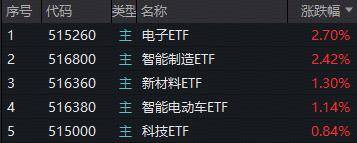
Core Viewpoint - The A-share market experienced a slight pullback on January 16, with the Shanghai Composite Index barely holding above the 4100-point mark, while the electronic sector showed resilience, leading gains in the market [1][4]. Market Performance - The Shanghai Composite Index closed down 0.26% at 4101.91 points, the Shenzhen Component Index fell 0.18%, and the ChiNext Index decreased by 0.20% [1]. - The total trading volume in the Shanghai, Shenzhen, and Beijing markets reached 30,568 billion yuan, an increase of 1,180 billion yuan compared to the previous day [1]. Sector Highlights - The electronic sector was the standout performer, with the electronic ETF (515260) rising by 2.7%, and the smart manufacturing ETF (516800) increasing by 2.42% [1][2]. - The new materials and new energy sectors also saw some individual stocks perform well, with the new materials ETF (516360) and the smart electric vehicle ETF (516380) both gaining over 1% [1]. Downward Trends - The AI medical concept continued to cool off, with the largest medical ETF (512170) dropping by 2.6% [1]. - AI application stocks experienced a broad pullback, with the ChiNext AI ETF (159363) declining by 1.81% [1]. Capital Inflows - The electronic sector attracted a net inflow of 30.511 billion yuan, leading all 31 first-level industries in terms of capital absorption [8]. - Key stocks within the electronic ETF, such as Zhaoyi Innovation and Changdian Technology, attracted significant capital inflows of 4.538 billion yuan and 3.181 billion yuan, respectively [8][9]. Policy Support - The central bank implemented a series of measures to support high-quality economic development, including a 0.25 percentage point reduction in re-lending and rediscount rates, and an increase in the re-lending quota for small and medium-sized enterprises by 500 billion yuan [2][3]. Future Outlook - Analysts predict that A-shares may see considerable incremental capital by 2026, potentially sustaining a slow bull market [3]. - The focus is expected to shift towards verifying economic conditions and performance, with active funds reinforcing a dual-line strategy of "technology + resource products" [3].



南向资金丨中芯国际获净买入10.84亿港元
Di Yi Cai Jing· 2026-01-16 09:58
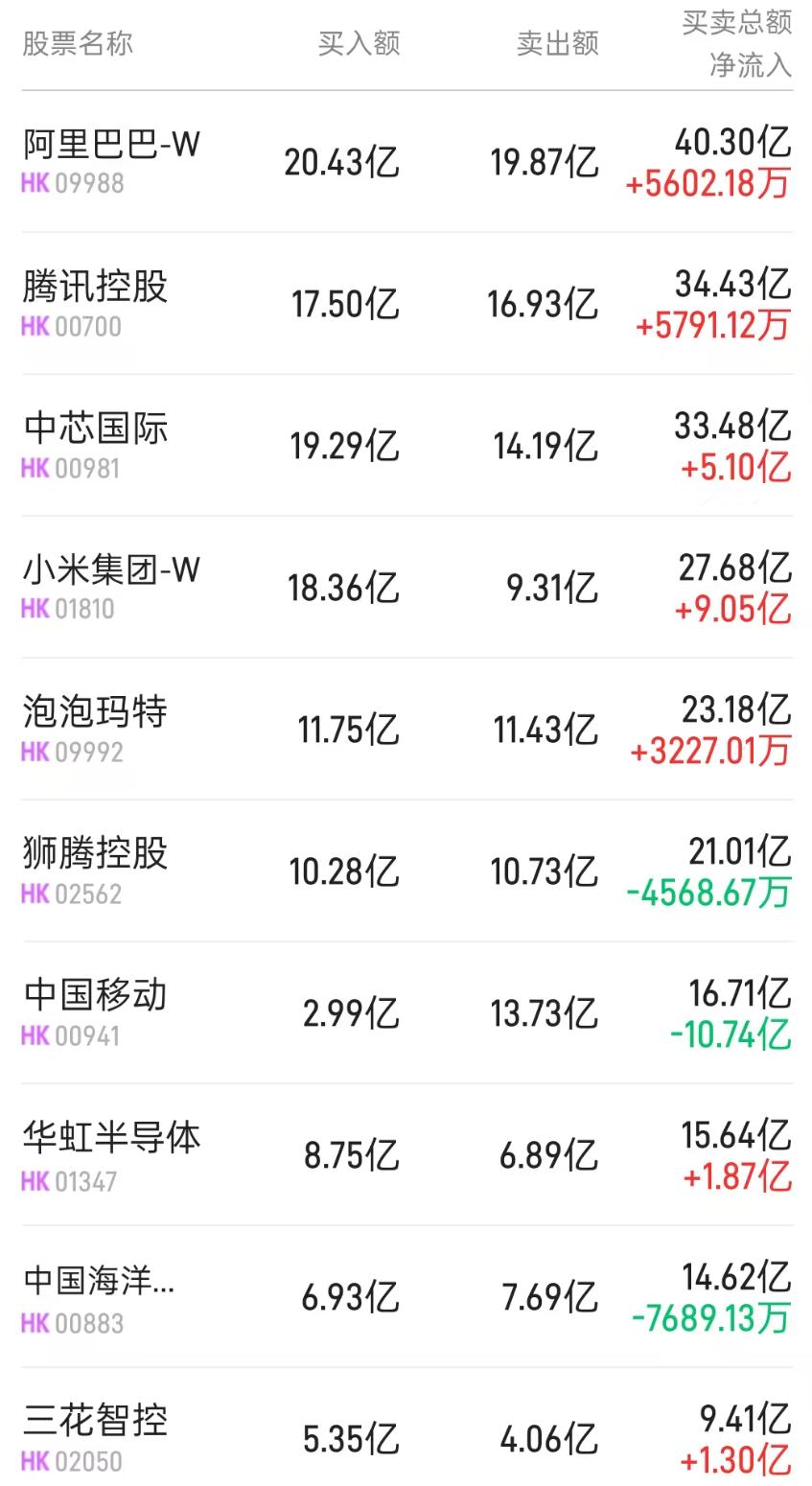
Group 1 - The net buying of southbound funds amounted to 0.94 billion HKD, with the top three net purchases being SMIC, Xiaomi Group-W, and Hua Hong Semiconductor, which received net purchases of 10.84 billion HKD, 8.67 billion HKD, and 5.85 billion HKD respectively [1] - On the selling side, China Mobile, Alibaba Health, and CNOOC experienced net sales of 10.74 billion HKD, 4.62 billion HKD, and 1.08 billion HKD respectively [1]



图解丨南下资金净买入中芯国际和华虹半导体,持续净卖出中国移动
Ge Long Hui· 2026-01-16 09:51
Group 1 - Southbound funds net bought Hong Kong stocks worth 93.5808 million HKD today [1] - Notable net purchases include SMIC at 1.084 billion HKD, Hua Hong Semiconductor at 585 million HKD, Pop Mart at 141 million HKD, and Sanhua Intelligent Control at 129 million HKD [1] - Significant net sales were observed in China Mobile at 1.074 billion HKD, Alibaba Health at 461 million HKD, and CNOOC at 108 million HKD [1] Group 2 - Southbound funds have net bought Tencent for 8 consecutive days, totaling 9.68457 billion HKD [1] - Alibaba has seen net purchases for 5 consecutive days, amounting to 4.42446 billion HKD [1] - China Mobile has experienced net sales for 10 consecutive days, totaling 8.06248 billion HKD [1]
北水动向|北水成交净买入0.94亿 芯片股再获加仓 北水抢筹中芯国际(00981)超10亿港元
智通财经网· 2026-01-16 09:48
Group 1: Market Overview - Northbound trading recorded a net buy of HKD 0.94 billion, with a net buy of HKD 10.06 billion from the Shanghai Stock Connect and a net sell of HKD 9.13 billion from the Shenzhen Stock Connect [1] - The most bought stocks included SMIC (00981), Xiaomi Group-W (01810), and Hua Hong Semiconductor (01347), while the most sold stocks were China Mobile (00941), Alibaba Health (00241), and CNOOC (00883) [1] Group 2: Stock Performance - Alibaba-W (09988) saw a net buy of HKD 395.9 million, while Lion Group (02562) and Alibaba Health (00241) experienced net sells of HKD 42 million and HKD 461 million respectively [6] - Tencent Holdings (00700) had a net buy of HKD 342.8 million, while China Mobile (00941) faced a significant net sell of HKD 10.74 billion [8] Group 3: Sector Insights - SMIC (00981) and Hua Hong Semiconductor (01347) received net buys of HKD 10.84 billion and HKD 5.85 billion respectively, driven by news of the U.S. easing export restrictions on Nvidia's H200 chips to China [4] - Xiaomi Group-W (01810) gained a net buy of HKD 8.67 billion, with the announcement of new purchasing incentives for its popular model, the Xiaomi YU7 [5] - Bubble Mart (09992) attracted a net buy of HKD 1.41 billion, with growth drivers identified for 2026, including monetization of existing IPs and new IP launches [5]
中芯国际概念涨3.44%,主力资金净流入这些股
Zheng Quan Shi Bao Wang· 2026-01-16 08:42
Group 1 - The core concept of the news is the performance of the semiconductor sector, particularly the rise of the SMIC (Semiconductor Manufacturing International Corporation) concept, which increased by 3.44% on January 16, ranking fourth among concept sectors [1][2] - Within the SMIC concept sector, 70 stocks rose, with notable performers including Meike Technology, which hit the daily limit with a 20% increase, and other companies like Bocheng Co., Shenghui Integration, and Yaxiang Integration also reaching their daily limits [1][2] - The sector saw a significant net inflow of capital amounting to 4.6 billion yuan, with 54 stocks experiencing net inflows, and 16 stocks receiving over 100 million yuan in net inflows [2][3] Group 2 - The top stocks in terms of net capital inflow included Changdian Technology, which had a net inflow of 2.413 billion yuan, followed by Lanke Technology, Beifang Huachuang, and Demingli, with net inflows of 552 million yuan, 503 million yuan, and 361 million yuan respectively [2][3] - The highest net inflow ratios were observed in Shenghui Integration, Changdian Technology, and Bocheng Co., with net inflow ratios of 27.62%, 25.98%, and 20.63% respectively [3][4] - The overall market performance showed a mixed trend, with some stocks like Zai Sheng Technology and Tianhua New Energy experiencing declines of 7.12% and 5.90% respectively, indicating volatility within the sector [6][7]


科创ETF(588050)开盘涨0.85%,重仓股中芯国际涨2.46%,海光信息涨1.08%
Xin Lang Cai Jing· 2026-01-16 05:17
Group 1 - The core point of the article highlights the performance of the Sci-Tech ETF (588050), which opened with a gain of 0.85% at 1.548 yuan [1] - Major holdings in the Sci-Tech ETF include companies like SMIC, which rose by 2.46%, and other firms such as Haiguang Information, Cambrian, and Langqi Technology, which also saw positive gains [1] - The ETF's performance benchmark is the Shanghai Stock Exchange Sci-Tech Innovation Board 50 Index, managed by ICBC Credit Suisse Asset Management, with a return of 7.04% since its inception on September 28, 2020, and a recent one-month return of 13.25% [1]




半导体ETF南方(159325)交投活跃上涨2.15%,长电科技涨停,AI芯片需求井喷,半导体行业仍处上行周期
Xin Lang Cai Jing· 2026-01-16 05:07
Group 1 - The semiconductor ETF Southern (159325) has risen by 2.15%, marking a three-day consecutive increase, with a turnover of 12.24% and a transaction volume of 34.83 million yuan, indicating active market trading [1] - Key stocks in the index, such as Changdian Technology, peaked with a 10.00% increase, while Fengfan Technology and Zhenlei Technology rose by 9.59% and 8.05% respectively, with Changdian Technology hitting the daily limit [1] - A joint international research team has made significant progress in new semiconductor materials, achieving controllable construction of "mosaic" heterojunctions in two-dimensional ionic soft lattice materials, paving the way for future high-performance light-emitting and integrated devices [1] Group 2 - According to UBS statistics, the global semiconductor market is projected to reach $1 trillion by 2026, with a year-on-year growth exceeding 40%, and $1.18 trillion by 2027, maintaining a growth rate of 13% [1] - Even excluding memory chips, the industry is expected to sustain double-digit growth, driven by saturated investments in AI infrastructure, with the storage market anticipated to see nearly 90% growth by 2026 due to the rigid demand for high-end DRAM from HBM and AI servers [1] - Huaxin Securities reports that TSMC's revenue for Q4 2025 is expected to grow by approximately 20% year-on-year, reaching 1.05 trillion New Taiwan dollars, exceeding market expectations, reflecting strong demand for AI chips and advanced processes [2] - TSMC's performance indicates that capital expenditures in the global AI sector will remain high in 2026, benefiting upstream equipment, materials, and the entire domestic semiconductor industry chain [2] - The Southern semiconductor ETF closely tracks the CSI Semiconductor Industry Select Index, which includes 50 large-cap, profitable, and high R&D investment companies, reflecting the overall performance of representative and investable stocks in the semiconductor industry [2]


集成电路ETF(159546)开盘涨1.00%,重仓股中芯国际涨2.46%,寒武纪涨0.35%
Xin Lang Cai Jing· 2026-01-16 02:45
Core Viewpoint - The integrated circuit ETF (159546) opened with a gain of 1.00%, indicating positive market sentiment towards the semiconductor sector [1] Group 1: ETF Performance - The integrated circuit ETF (159546) opened at 2.028 yuan [1] - Since its establishment on October 11, 2023, the fund has achieved a return of 101.35% [1] - The fund's one-month return stands at 14.93% [1] Group 2: Major Holdings Performance - Key holdings in the ETF include: - SMIC (中芯国际) up by 2.46% [1] - Cambricon (寒武纪) up by 0.35% [1] - Haiguang Information (海光信息) up by 1.08% [1] - Lattice Technology (澜起科技) up by 2.14% [1] - GigaDevice (兆易创新) up by 1.99% [1] - OmniVision (豪威集团) up by 0.82% [1] - Chipone (芯原股份) down by 0.25% [1] - JCET (长电科技) up by 2.30% [1] - Unisoc (紫光国微) up by 6.11% [1] - Tongfu Microelectronics (通富微电) up by 2.00% [1] Group 3: Management Information - The ETF is managed by Guotai Fund Management Co., Ltd. [1] - The fund manager is Ma Yiwen [1] - The performance benchmark for the ETF is the CSI All-Share Integrated Circuit Index [1]