PAB(000001)

Search documents
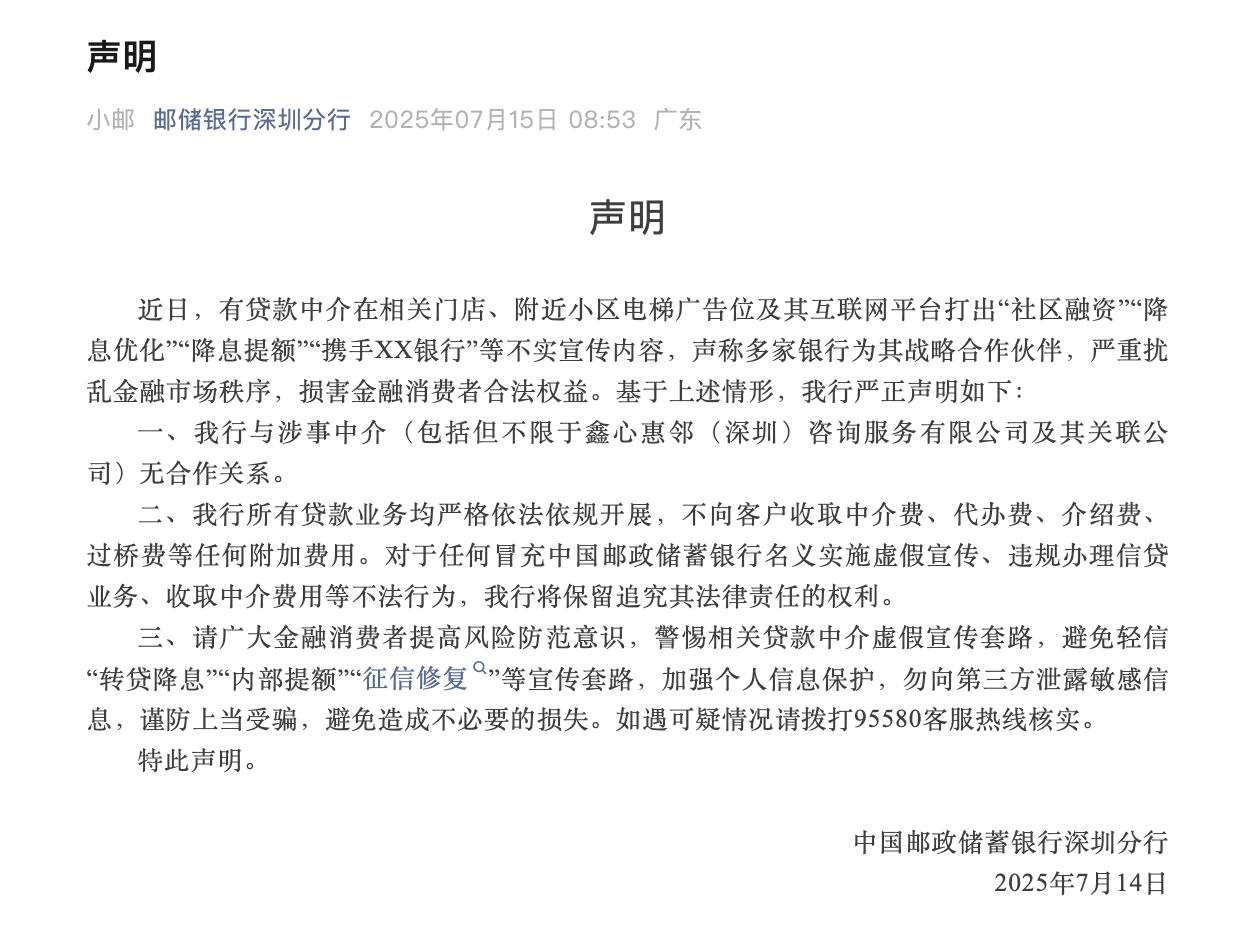
贷款中介假冒合作、推广转贷降息,深圳多家银行罕见点名澄清
Di Yi Cai Jing· 2025-07-17 10:34
Core Viewpoint - The banking sector is tightening its collaboration with loan intermediaries amid increasing regulatory scrutiny, with several banks publicly denying any association with illegal loan intermediaries, particularly naming "Xin Xin Hui Lin" as a problematic entity [1][2][4]. Group 1: Regulatory Actions - Regulatory authorities, including the Ministry of Public Security and the Financial Regulatory Bureau, have launched a special campaign to combat illegal loan intermediaries and related financial crimes, focusing on four main areas: illegal loan intermediary services, malicious debt evasion, illegal insurance claims, and improper debt collection practices [4][5]. - The Shenzhen Financial Regulatory Bureau has emphasized that addressing illegal loan intermediaries is a key focus of their work [4]. Group 2: Bank Responses - Approximately 15 banks in Shenzhen, including major institutions like Bank of China and Agricultural Bank of China, have issued statements clarifying that they do not collaborate with illegal intermediaries [2][4]. - Banks are enhancing their management of intermediary partners, with some institutions completely halting cooperation with loan intermediaries and conducting strict internal audits to prevent collusion [5][6]. Group 3: Issues with Loan Intermediaries - "Xin Xin Hui Lin" has been accused of misleading marketing practices, claiming to lower loan interest rates from 4.5% to 2.5%, which raises concerns about exaggerated claims [1][8]. - The company has been reported to use aggressive marketing tactics, including misleading advertisements in public spaces, to create the illusion of partnerships with banks [9]. - New trends in the loan intermediary market include the use of fraudulent marketing practices to attract consumers and the manipulation of property valuations to secure excessive loans [10].




星巴克变瑞幸、贵宾厅取消,银行的“羊毛”不好薅了|巴伦精选
Tai Mei Ti A P P· 2025-07-16 14:08
Group 1 - The core viewpoint of the articles highlights a significant reduction in credit card benefits across various banks, driven by cost pressures and a shift in the banking industry's strategy towards high-value customers [1][3][4] - The changes in benefits have led to customer dissatisfaction, with many users expressing their frustration on social media and even canceling their cards [5][6] - The credit card market is entering a phase of stock competition, with many banks experiencing negative growth in card issuance and a decline in transaction volumes [4][6] Group 2 - Banks are facing cost pressures due to narrowing interest margins, declining transaction amounts, and rising customer acquisition costs, prompting a need for efficiency [3][4] - The reduction in benefits is seen as a short-term cost-cutting measure, but it risks losing high-net-worth customers who are sensitive to service quality [5][6] - To retain high-value clients, banks are encouraged to offer personalized services and higher-yield products, moving away from traditional benefits [6][7] Group 3 - The industry is transitioning towards "data-driven services and scenario-based benefits," with banks innovating through co-branded cards and tailored offerings to enhance customer loyalty [7][8] - By leveraging big data, banks can provide customized products and services, increasing credit card usage frequency and overall customer satisfaction [8]






深圳银行集体“打假”指向违规贷款中介!涉事机构称已整改
Nan Fang Du Shi Bao· 2025-07-16 09:47
Core Viewpoint - Shenzhen banks have collectively issued statements targeting the misconduct of loan intermediaries, specifically addressing the actions of a consulting service agency named Xin Xin Hui Lin [1][5][17]. Group 1: Bank Responses - Nearly 20 banks in Shenzhen, including major institutions like Bank of China and Agricultural Bank of China, have released statements disavowing any partnership with the intermediary Xin Xin Hui Lin [1][5]. - The Bank of China emphasized that it does not charge intermediary fees or any related costs in its loan business [3]. - Postal Savings Bank of China highlighted that some intermediaries are using false advertisements to claim partnerships with banks, urging the public to be cautious of misleading loan offers [5][7]. Group 2: Intermediary Misconduct - Xin Xin Hui Lin has been accused of falsely advertising itself as a bridge between banks and communities, claiming to improve loan approval rates while charging various fees [7][9]. - The agency reportedly displayed logos of over 20 banks, misleading customers into believing it had strategic partnerships with these institutions [9][12]. - The actual control of Xin Xin Hui Lin is held by Gui Yaolin, who has registered multiple companies under the "Hui Lin" name, indicating a potential pattern of misconduct [12][14]. Group 3: Regulatory Response - The collective statements from banks were reportedly made in response to requests from Shenzhen's financial regulatory authorities, aiming to protect consumer rights and clarify the situation [5][7]. - The intermediary acknowledged its mistakes in using bank logos and stated it has undertaken corrective measures, asserting that it does not have any partnerships with financial institutions [17].

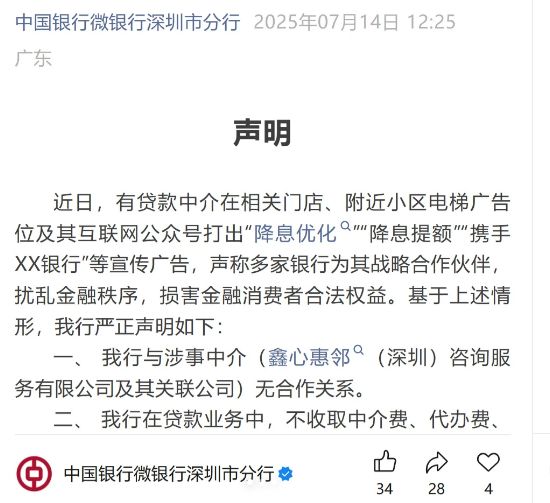
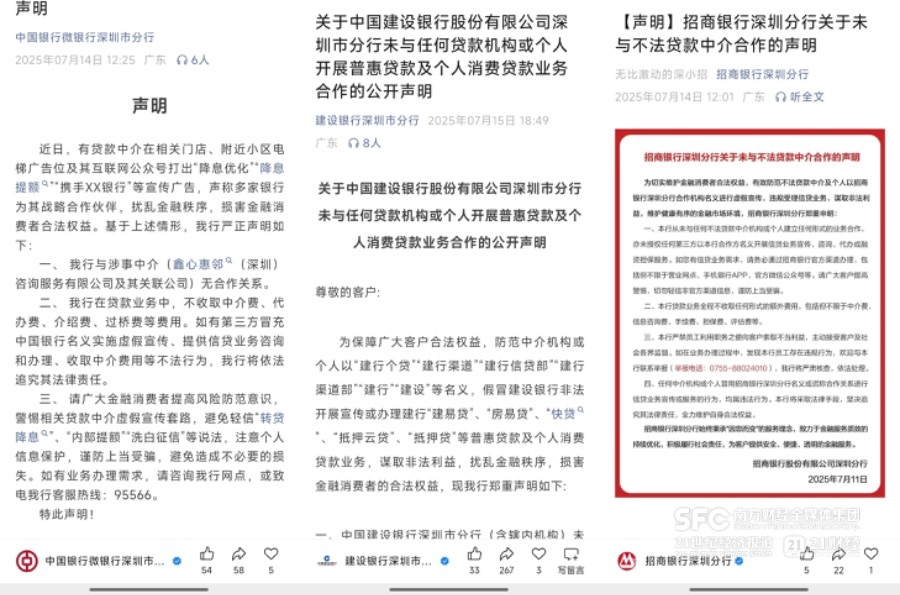
深圳19家银行“打假”某贷款中介,相关部门回应
2 1 Shi Ji Jing Ji Bao Dao· 2025-07-16 08:40
Group 1 - Multiple banks in Shenzhen have issued statements regarding a loan intermediary, Xin Xin Hui Lin (Shenzhen) Consulting Service Co., Ltd., which is accused of impersonating banks to attract customers [1][3] - The involved banks include major institutions such as China Construction Bank, Industrial and Commercial Bank of China, Bank of China, Agricultural Bank of China, and others, totaling 19 banks that have released related statements [1] - Xin Xin Hui Lin claims to provide services for lowering interest rates and has been promoting itself as a "lower interest station," despite banks denying any partnership with the intermediary [3][4] Group 2 - Regulatory authorities have intervened in the investigation of the loan intermediary's practices, which included misleading advertisements claiming partnerships with various banks [2][4] - Recent regulatory actions have intensified scrutiny on loan assistance platforms, with the Ningxia local financial management bureau revoking the operating qualifications of seven loan intermediaries [4] - A notice was issued by regulatory bodies in April to strengthen the management of internet loan assistance services, set to take effect on October 1 [5]
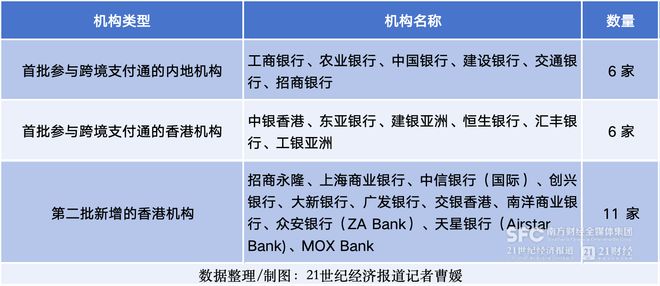
跨境支付通香港收款行扩容至17家,首次纳入数字银行
2 1 Shi Ji Jing Ji Bao Dao· 2025-07-16 04:34
Core Insights - The Cross-Border Payment System has expanded to 17 banks in Hong Kong within a month of its launch, enhancing connectivity between mainland China's online payment system and Hong Kong's Fast Payment System [1][2] - The system offers advantages over traditional cross-border remittances, including instant transfers, simplified documentation, lower costs, and ease of use [1] - The initial participating banks include six from mainland China and six from Hong Kong, with an additional eleven Hong Kong banks recently added to the system [1][3] Summary by Category Participating Institutions - The first batch of participating mainland banks includes: Industrial and Commercial Bank of China, Agricultural Bank of China, Bank of China, China Construction Bank, Bank of Communications, and China Merchants Bank [1][3] - The first batch of participating Hong Kong banks includes: Bank of China (Hong Kong), Bank of East Asia, China Construction Bank (Asia), Hang Seng Bank, HSBC, and ICBC (Asia) [1][3] - The second batch of newly added Hong Kong banks includes: CMB Wing Lung Bank, Shanghai Commercial Bank, CITIC Bank International, Chuangxin Bank, Dah Sing Bank, Guangfa Bank, China Everbright Bank, Nanyang Commercial Bank, ZA Bank, Airstar Bank, and MOX Bank [1][3] Digital Banking Inclusion - This expansion marks the first inclusion of digital banks in the Cross-Border Payment System, with MOX Bank, ZA Bank, and Airstar Bank being notable participants [2][3] User Experience and Limitations - Some newly added banks have not yet officially opened cross-border payment services to customers, leading to mixed experiences among users [4] - The system supports bilateral currency and RMB cross-border remittance between mainland China and Hong Kong, with specific limits on transaction amounts [4][5] Transaction Limits - For northbound transactions, the limit is set at HKD 10,000 per person per day and HKD 200,000 per year, while southbound transactions are subject to an annual foreign exchange limit of USD 50,000 [4][5]

“红利雨”来了!上市银行分红哪家强:真土豪还是“铁公鸡”
Nan Fang Du Shi Bao· 2025-07-16 02:16
Core Viewpoint - A significant number of listed banks in China are distributing cash dividends, with 37 out of 42 A-share listed banks having completed their annual dividend distributions by July 16, 2024, totaling 632.6 billion yuan, marking a 3.1% increase year-on-year [2][5][11]. Dividend Distribution - The total cash dividends distributed by 42 A-share listed banks for 2024 amount to 632.6 billion yuan, with Industrial and Commercial Bank of China (ICBC) and China Construction Bank (CCB) leading with 109.77 billion yuan and 100.75 billion yuan respectively [2][5][7]. - Notably, Zhengzhou Bank has the lowest total dividend of 18.2 million yuan, with a dividend rate of only 9.69%, the lowest among the listed banks [2][6][11]. Timing of Dividend Payments - Several banks, including SPDB and Ningbo Bank, have advanced their dividend payment dates, with SPDB distributing dividends on July 16 and Ningbo Bank distributing 5.943 billion yuan [3][4]. - Traditionally, annual dividends are distributed between June and July, but this year, four state-owned banks completed their distributions earlier, in April and May [4][5]. Year-on-Year Comparison - Among the 42 listed banks, only three banks saw a decline in their total dividend amounts compared to 2023: Zhejiang Commercial Bank, Minsheng Bank, and Ping An Bank, with declines of 4.88%, 11.11%, and 15.44% respectively [9][10]. - Conversely, 34 banks experienced an increase in their dividend amounts, with the highest growth seen in Zhengzhou Bank, which had no dividends in 2023 but distributed 18.2 million yuan in 2024 [9][10]. Future Dividend Plans - Many banks have outlined their cash dividend targets for 2025, with plans to distribute at least 30% of their net profits as cash dividends annually [12].



如何看待银行股持续新高?
Xin Lang Ji Jin· 2025-07-15 05:26
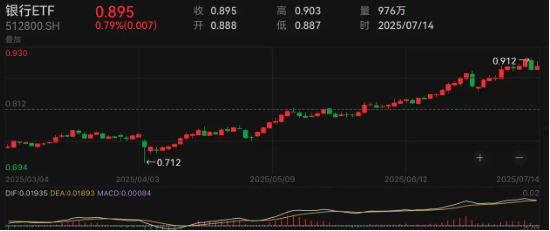
Core Viewpoint - The recent surge in bank stocks in the A-share market, particularly the bank ETF (512800), has drawn significant attention, with major banks reaching historical highs, although there was a notable drop on July 11, 2025, indicating potential market sentiment peaks [2][3][4]. Policy Factors - The issuance of 500 billion yuan in special government bonds and a targeted injection of 520 billion yuan into the four major banks is expected to alleviate capital pressure and signify a shift in the banking system's role [8]. - Non-symmetric interest rate cuts and reduced deposit costs are crucial for the recovery of bank profitability [8]. Financial Performance - According to Tianfeng Securities, the net interest margin for banks is projected to narrow to 1.42% by 2025, a significant slowdown compared to the previous two years, while local debt policies are reducing risk premiums on public assets, improving asset quality [9]. - As of the end of Q1 2025, insurance capital held 27.821 billion shares of bank stocks, with a market value of 265.78 billion yuan, indicating strong institutional support for the banking sector [9]. Market Dynamics - The bank ETF (512800) has seen its scale exceed 13.4 billion yuan in 2025, with an average daily trading volume of over 500 million yuan, highlighting its liquidity and attractiveness as an investment vehicle [12]. - The banking sector's weight in the CSI 300 index is 13.2%, with ETF funds contributing to the valuation recovery of bank stocks [12]. Earnings and Growth Potential - The six major state-owned banks reported a combined daily profit of approximately 3.827 billion yuan in Q1 2025, maintaining steady growth despite a slight slowdown compared to 2024 [12]. - Regional banks like Beijing Bank and Jiangsu Bank have achieved double-digit profit growth through regional economic advantages and digital transformation [12]. Investment Outlook - Analysts suggest that the current bank stock rally marks the beginning of a long cycle rather than a short-term trend, with potential for the price-to-book ratio to recover from 0.73 to above 1 [13]. - The bank ETF (512800) is recommended for investors seeking exposure to the banking sector, as it tracks the CSI Bank Index and covers all 42 listed banks, providing a diversified investment option [20]. Conclusion - The combination of policy support, stable fundamentals, and attractive dividend yields positions bank stocks as a favorable investment in the current low-interest-rate environment, with expectations for continued capital inflow and valuation recovery [21].
上市银行年度“红包”密集落地
Zhong Guo Zheng Quan Bao· 2025-07-14 20:55
Group 1 - The current period marks a peak for cash dividends among listed banks in A-shares, with over 30 banks having announced their annual dividends [1] - Industrial and Commercial Bank of China (ICBC) distributed approximately 44.378 billion yuan in cash dividends on July 14, with a per-share dividend of about 0.16 yuan [1] - Other banks such as China Merchants Bank and Agricultural Bank of China have also announced significant cash dividends, with China Merchants Bank distributing around 41.258 billion yuan and Agricultural Bank of China planning to distribute approximately 40.065 billion yuan [1] Group 2 - Several listed banks have indicated intentions for mid-term dividends for 2025, with Changsha Bank planning to distribute dividends based on its net profit, which has totaled 9.373 billion yuan from 2018 to 2024 [2] - The banking sector has shown strong stock performance this year, with several banks experiencing stock price increases exceeding 30% as of July 14 [2] - High dividend yields, with some banks exceeding 4.5%, are contributing to the positive performance of bank stocks, as the average dividend yield of state-owned banks surpasses the yield of 10-year government bonds [2] Group 3 - Multiple brokerages remain optimistic about bank stocks, citing the increasing certainty of insurance capital allocation to bank stocks amid an "asset shortage" [3] - The long-term investment and value investment strategies of insurance capital align with the stable dividend yields and potential for performance improvement in the banking sector [3] - A series of financial policies and structural tools are expected to support the positive accumulation of fundamental factors for banks, indicating a potential performance turning point [3] Group 4 - Some banks have announced share buyback plans, but these have been delayed due to stock price fluctuations and other factors, as seen with Huaxia Bank's announcement regarding its planned share buyback [4] - Chengdu Bank's major shareholders have also postponed their buyback plans due to the stock price exceeding the set upper limit, with the stock reaching a historical high of 20.96 yuan per share [4] - The implementation of buyback plans will depend on future stock price movements and overall market trends [4]



5连升!杠杆资金“盯上”这些方向
Zhong Guo Ji Jin Bao· 2025-07-14 13:03
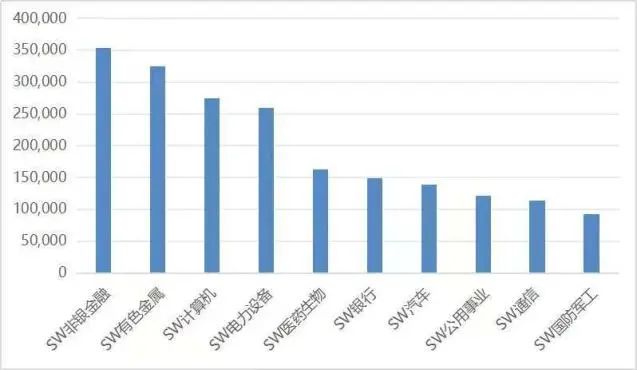
Core Insights - The A-share financing balance has increased for five consecutive trading days, reaching 18,757.94 billion yuan, with a financing balance of 18,625.86 billion yuan [1][2] - The sectors attracting the most financing include non-bank financials, non-ferrous metals, computers, electrical equipment, and pharmaceuticals, with significant net purchases during the period [1][2] Financing Trends - As of July 11, the A-share market's financing balance was reported at 18,625.86 billion yuan, with a margin balance of 132.08 billion yuan [2] - The financing balance increased by 63.59 billion yuan, 54.88 billion yuan, 38.43 billion yuan, 47.68 billion yuan, and 20.82 billion yuan over the five days from July 7 to July 11 [2] - Among the 31 sectors, 22 experienced an increase in financing balance, with the non-bank financial sector seeing the largest increase of 35.35 billion yuan [2] Sector Performance - The non-bank financial sector and non-ferrous metals sector are highlighted for their strong performance, with the latter benefiting from rising prices and improved earnings forecasts [4] - North Rare Earth's profit forecast indicates a year-on-year increase of 1,883% to 2,015 million yuan, reflecting the sector's positive outlook [4] Individual Stock Activity - During the financing balance increase, 84 stocks saw net purchases exceeding 100 million yuan, with the top ten stocks including BYD, Zijin Mining, and Northern Rare Earth, among others [6] Market Participation - As of June 30, 2025, the number of individual investors in margin trading reached 7,479,900, an increase of 252,100 from the end of 2024 [9] - Securities firms are actively expanding their margin trading business while ensuring risk management, with strategies focusing on enhancing customer experience and developing innovative products [9]




5连升!杠杆资金“盯上”这些方向
中国基金报· 2025-07-14 12:40
Core Viewpoint - The recent increase in A-share financing balance indicates a growing interest from investors, particularly in the non-bank financial and non-ferrous metal sectors, with a total financing balance reaching 18,757.94 billion yuan [2][4]. Group 1: Financing Balance Trends - The A-share market's financing balance has seen a continuous increase for five consecutive trading days, with the latest balance reported at 18,625.86 billion yuan, reflecting net increases of 6.36 billion yuan, 5.49 billion yuan, 3.84 billion yuan, 4.77 billion yuan, and 2.08 billion yuan during the period from July 7 to July 11 [4]. - Among the 31 industries classified by Shenwan, 22 experienced an increase in financing balance, with the non-bank financial sector leading with an increase of 3.54 billion yuan [4]. Group 2: Sector Performance - The non-bank financial and non-ferrous metal sectors have attracted the most financing, with significant net inflows, while the computer, power equipment, and pharmaceutical sectors also saw increases in financing balance during the same period [4]. - The performance of the non-ferrous metal sector is supported by rising prices, with Northern Rare Earth forecasting a net profit increase of 1,883% to 2.015 billion yuan for the first half of the year, indicating strong sector health [5]. Group 3: Individual Stock Activity - During the financing balance increase, 84 stocks received over 100 million yuan in net purchases, with the top ten stocks being BYD, Zijin Mining, PetroChina Capital, and others, showing significant investor interest [9]. Group 4: Brokerages and Market Activity - Brokerages are optimistic about the recovery of investment banking activities and increased market activity, which is expected to boost their performance [5]. - The number of individual investors engaging in margin trading reached 7.4799 million as of June 30, 2025, indicating a growing participation in the market [10].