
TCL TECH.(000100)

Search documents
“国补”及体育赛事加码 TCL科技拟现金收购深圳华星半导体10.77%股权
Zheng Quan Shi Bao Wang· 2025-12-15 13:43
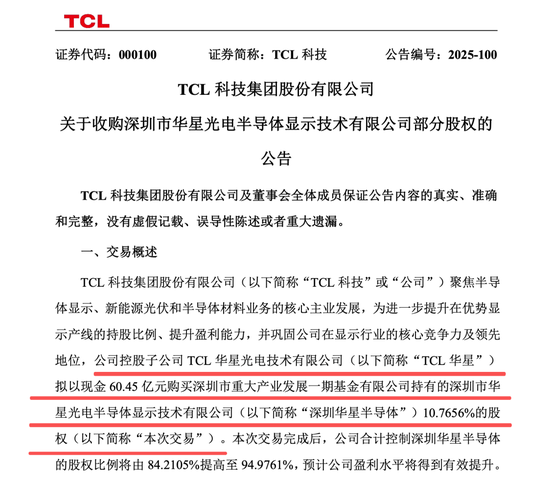
Core Viewpoint - TCL Technology plans to acquire a 10.7656% stake in its subsidiary, Shenzhen Huaxing Semiconductor Display Technology Co., Ltd., for 6.045 billion yuan, increasing its total control to approximately 95% and enhancing its profitability [1][3] Group 1: Acquisition Details - The acquisition is a strategic move to focus on the core semiconductor display business and optimize asset structure, reinforcing TCL's leading position in the global large-size display market [1][2] - Shenzhen Huaxing Semiconductor operates two G11 generation high-generation panel production lines, which are rare globally, producing ultra-large size displays [2] Group 2: Financial Performance - As of December 31, 2024, Shenzhen Huaxing Semiconductor reported total assets of 68.04 billion yuan and net assets of 44.85 billion yuan, with a projected revenue of 24.158 billion yuan and net profit of 2.807 billion yuan for the same year [3] - By June 30, 2025, total assets are expected to decrease to 64.769 billion yuan, with net assets rising to 46.564 billion yuan, and a revenue of 12.023 billion yuan with a net profit of 1.709 billion yuan [3] Group 3: Market Opportunities - The television panel market is anticipated to enter a demand explosion phase by 2026, driven by major global sporting events, including the FIFA World Cup and the Winter Olympics, which are expected to boost demand for large, high-definition televisions [4][5] - The continuation of consumer policies in China, such as the "old-for-new" program, is expected to stimulate market consumption, particularly for high-end television products [5]

特种芯片龙头成立研究院,攻关端侧AI芯片新架构!| 盘后公告精选
Jin Shi Shu Ju· 2025-12-15 13:33
Group 1 - Unicom Guowei has established a Central Research Institute focusing on the development of edge AI chips for applications in autonomous driving, embodied robots, and low-altitude flying vehicles [2] - The research will also include new types of storage devices based on two-dimensional materials and high-performance special sensor chips [2] - Aerospace Electronics plans to increase its investment in Aerospace Long March Rocket Technology Co., Ltd. by 728 million yuan, maintaining the existing shareholding structure [3] Group 2 - Aerospace Rainbow successfully completed the first flight test of its self-developed Rainbow-7 high-altitude, high-speed, long-endurance drone, achieving all preset parameters [4] - The project is still in the research and testing phase, with further rigorous testing and validation required before mass production [4] Group 3 - Changchun High-tech's subsidiary signed an exclusive licensing agreement for the GenSci098 injection project, potentially earning up to 1.365 billion USD in milestone payments [5] - The agreement includes an initial payment of 120 million USD and additional milestone payments related to development and commercialization [5] Group 4 - TCL Technology plans to acquire a 10.7656% stake in Shenzhen Huaxing Semiconductor for 6.045 billion yuan, increasing its ownership from 84.2105% to 94.9761% [26] - This acquisition aims to enhance TCL's competitiveness and profitability in the semiconductor display industry [26] Group 5 - Zhongmin Resources announced the successful ignition of its Tsumeb smelting plant's multi-metal comprehensive recycling project, with an annual processing capacity of 80,000 tons [11] - The project will produce various products, including germanium ingots and zinc ingots, with a design capacity of 33 tons/year for germanium [11] Group 6 - Xinhua Insurance reported a 16% year-on-year increase in original insurance premium income, totaling 188.85 billion yuan from January to November 2025 [43] - This growth reflects the company's strong performance in the insurance market [43]


深圳华星半导体2024年净利润28.07亿,2025年1-6月净利润17.09亿,TCL华星拟现金收购其少数股权
Cai Fu Zai Xian· 2025-12-15 13:12
Core Viewpoint - TCL Technology plans to acquire a 10.7656% stake in its subsidiary, Shenzhen Huaxing Semiconductor Display Technology Co., Ltd., for 6.045 billion yuan, increasing its total ownership from 84.2105% to 94.9761%, which is expected to enhance the company's profitability significantly [1][3]. Group 1: Acquisition Details - The acquisition is a strategic move to focus on the core semiconductor display business and optimize asset structure, reinforcing TCL's leading position in the global large-size display market [1][2]. - Shenzhen Huaxing Semiconductor operates two G11 generation high-generation panel production lines, which are crucial for producing large-size display products [1][2]. Group 2: Financial Performance - As of December 31, 2024, Shenzhen Huaxing Semiconductor reported total assets of 68.04 billion yuan and net assets of 44.85 billion yuan, with a projected revenue of 24.158 billion yuan and net profit of 2.807 billion yuan for the same year [2]. - By June 30, 2025, total assets are expected to decrease to 64.769 billion yuan, while net assets will rise to 46.564 billion yuan, indicating a reduction in liabilities and an improvement in profitability, with a net profit margin increasing from 11.6% to 14% [2]. Group 3: Market Outlook - The upcoming global sports events in 2026, including the FIFA World Cup and the Winter Olympics, are anticipated to drive demand for large-screen and high-definition televisions, creating a favorable market environment for panel manufacturers [4][5]. - The continuation of consumer policies in China, such as the "old-for-new" program, is expected to stimulate market consumption, particularly for high-end large-size televisions, providing a solid demand foundation for panel manufacturers [4][5]. - With panel prices stabilizing and the trend towards larger sizes accelerating, TCL Technology is positioned to capitalize on market opportunities and enhance shareholder value through its strengthened competitive advantage [5].
000100,大动作!拟逾60亿元加仓半导体!
Xin Lang Cai Jing· 2025-12-15 12:44
Core Viewpoint - TCL Technology is accelerating its acquisition of minority stakes in high-generation production lines, which is expected to further enhance the net profit attributable to the parent company [1][6]. Company Summary - On December 15, TCL Technology announced that its subsidiary, TCL Huaxing Optoelectronics Technology Co., Ltd., plans to acquire a 10.7656% stake in Shenzhen Huaxing Semiconductor Display Technology Co., Ltd. for cash of 6.045 billion yuan. After the transaction, TCL's total control over Shenzhen Huaxing Semiconductor will increase from 84.2105% to 94.9761%, which is anticipated to effectively improve the company's profitability [1][6]. - Shenzhen Huaxing Semiconductor focuses on the semiconductor display business and operates two G11 display panel production lines, primarily producing large-size TFT-LCD display devices. The acquisition is expected to strengthen TCL's core competitiveness in the semiconductor display industry [3][8]. Financial Performance - As of December 31, 2024, Shenzhen Huaxing Semiconductor reported total assets of 68.04 billion yuan and net assets of 44.85 billion yuan, with projected revenue of 24.158 billion yuan and net profit of 2.807 billion yuan for the same year. By June 30, 2025, total assets are expected to be 64.769 billion yuan, with net assets of 46.564 billion yuan, and revenue of 12.023 billion yuan with a net profit of 1.709 billion yuan. The decreasing asset-liability ratio and increasing net profit margin indicate a strengthening of the asset's profitability and quality [3][9]. Industry Outlook - The large-size semiconductor display industry has seen an optimization in its structure, with a healthier supply-demand relationship. The market for television panels is entering a stocking peak season, and prices are expected to stabilize in December according to TrendForce [4][9]. - The Central Economic Work Conference has outlined plans to optimize the "Two New" policy by 2026, which includes large-scale equipment updates and a "national subsidy" for consumer goods. This is expected to boost demand for consumer electronics and display panels [4][9]. - The upcoming FIFA World Cup in 2026, hosted by the USA, Canada, and Mexico, is anticipated to significantly drive demand for large-size television panels, benefiting Shenzhen Huaxing Semiconductor, which specializes in this market [5][10].


TCL科技:第八届董事会第十七次会议决议公告
Zheng Quan Ri Bao· 2025-12-15 12:28
Group 1 - TCL Technology announced the approval of a proposal to acquire a portion of the equity of Shenzhen Huaxing Optoelectronics Semiconductor Display Technology Co., Ltd. during its 17th meeting of the 8th Board of Directors [2]
TCL科技拟60.45亿元增持华星半导体 持股比例或将逼近95%
Xi Niu Cai Jing· 2025-12-15 12:22
Group 1 - TCL Technology announced an investment of 6.045 billion yuan to acquire a 10.7656% stake in Shenzhen Huaxing Semiconductor Display Technology Co., increasing its ownership from 84.2105% to 94.9761% [1] - Shenzhen Huaxing Semiconductor is a core asset of TCL Technology, focusing on semiconductor display business with two G11 display panel production lines, primarily producing large-size TFT-LCD display devices [4] - Financial data for Shenzhen Huaxing Semiconductor shows strong performance in the first half of 2025, with total assets of 64.769 billion yuan, net assets of 46.564 billion yuan, operating revenue of 12.023 billion yuan, and net profit of 1.709 billion yuan [4] Group 2 - TCL Technology reported operating revenue of 136.065 billion yuan and a net profit attributable to shareholders of 3.047 billion yuan for the first three quarters of 2025 [4] - The completion of this transaction is expected to significantly enhance the profitability within the consolidated financial statements of TCL Technology [4]
A股公告精选 | 沐曦股份(688802.SH)将于12月17日在科创板上市
智通财经网· 2025-12-15 12:17
Group 1 - Muxi Co., Ltd. will list its common stock on the Sci-Tech Innovation Board on December 17, 2025 [1] - Xinghua New Materials signed a strategic cooperation agreement with Guoteng Company to collaborate in the quantum technology field [2] - TCL Technology's subsidiary plans to acquire a 10.7656% stake in Shenzhen Huaxing Semiconductor for 60.45 billion RMB [3] Group 2 - Jingjia Micro's subsidiary has completed key stages of its edge AI SoC chip, marking a significant project breakthrough [4] - Cambricon plans to use 2.778 billion RMB of its capital reserve to offset losses [5] - Bojun Technology's subsidiary intends to invest 600 million RMB in an automotive lightweight component production base in Chongqing [6] Group 3 - Longqi Technology plans to invest approximately 1.5 billion RMB to build an AI + smart terminal digital benchmark factory in Nanchang [7] - Taili Technology signed a strategic cooperation framework agreement with Jinan University to establish an advanced functional materials research institute with an investment of 100 million RMB [8][9] - Pengding Holdings plans to invest a total of 4.297 billion RMB in a production facility in Thailand by 2026 [10] Group 4 - China Metallurgical Group reported a new contract amount of 958.13 billion RMB from January to November 2025, a decrease of 8.6% year-on-year [16] - 吉祥航空 reported an 8.92% year-on-year increase in passenger turnover in November 2025 [17] - Hainan Airport's passenger throughput reached 2.0909 million in November 2025, a year-on-year increase of 8.16% [20] Group 5 - Xinhua Insurance reported a cumulative original insurance premium income of 188.85 billion RMB from January to November 2025, a year-on-year increase of 16% [21] - Huafeng Aluminum's controlling shareholder plans to reduce its stake by up to 2.17% [22] - Digital Vision plans to repurchase shares worth 80 million to 120 million RMB [23]


今日财经要闻TOP10|2025年12月15日
Xin Lang Cai Jing· 2025-12-15 11:56
Group 1: Autonomous Driving - China's first batch of L3 conditional autonomous driving vehicles has received approval for road testing in designated areas of Beijing and Chongqing, marking a significant step towards commercialization [1] - The two approved models include an electric sedan capable of 50 km/h in congested traffic and another capable of 80 km/h on highways and urban expressways, both limited to specific routes [1] Group 2: Financial Sector Reforms - The China Securities Regulatory Commission (CSRC) has initiated reforms to enhance the inclusivity and attractiveness of the capital market, focusing on the implementation of the "1+6" reform measures for the Sci-Tech Innovation Board [3][10] - The CSRC aims to promote high-quality development in the private equity fund sector and expedite the pilot program for commercial real estate REITs [10] - A new round of corporate governance initiatives will be launched to encourage quality companies to increase dividend payouts and share buybacks [11] Group 3: Company Financials - Cambrian Technology plans to use approximately 2.78 billion yuan from its capital reserve to offset accumulated losses, with the aim of bringing its negative retained earnings to zero by the end of 2024 [8] - TCL Technology intends to acquire a 10.7656% stake in Shenzhen Huaxing Semiconductor for 6.045 billion yuan, increasing its ownership from 84.21% to 94.98%, to enhance its competitiveness in the semiconductor display industry [12] Group 4: Currency and Real Estate Market - The onshore and offshore RMB against the USD reached a 14-month high, with the onshore rate peaking at 7.0500 and the offshore rate at 7.046, indicating a favorable external environment for the RMB [13] - In November 2025, the sales prices of commercial residential properties in 70 major cities in China showed a month-on-month decline, with first-tier cities experiencing a 0.4% decrease in new residential prices [14]


60.45亿!TCL科技拟再度收购深圳华星半导体股权
WitsView睿智显示· 2025-12-15 11:31
Core Viewpoint - TCL Technology aims to enhance its stake in Shenzhen Huaxing Semiconductor Display Technology Co., Ltd. by acquiring an additional 10.7656% equity for 6.045 billion yuan, increasing its total ownership from 84.2105% to 94.9761%, which is expected to improve profitability and strengthen its competitive position in the display industry [1][4]. Group 1 - The acquisition is part of TCL Technology's strategy to consolidate its core competitiveness in the display sector [1][4]. - Shenzhen Huaxing Semiconductor focuses on the production, processing, and sales of large-size TFT-LCD display devices, with its main products being large-size TFT-LCD display devices and semiconductor display materials [4][5]. - The company operates two 11th generation panel production lines, utilizing 3370mm x 2940mm glass substrates, which efficiently cut 65-inch and 75-inch TV panels [4][5]. Group 2 - Following the acquisition, the shareholding structure of Shenzhen Huaxing Semiconductor will be TCL Technology and its subsidiary TCL Huaxing holding 21.5311% and 35.4067% respectively, while Guangdong Huaxing Optical Industry Investment Co., Ltd. holds 27.2727%, and the Shenzhen Major Industry Development Phase I Fund holds 10.7656% [5]. - Financial projections for 2024 indicate that Shenzhen Huaxing Semiconductor will have total assets of 68.04 billion yuan, net assets of 44.85 billion yuan, and expected revenue of 24.158 billion yuan with a net profit of 2.807 billion yuan [5]. - For the first half of 2025, the company is projected to have total assets of 64.769 billion yuan, net assets of 46.564 billion yuan, with revenue of 12.023 billion yuan and a net profit of 1.709 billion yuan [5].
TCL科技子公司拟60.45亿元收购深圳华星半导体10.77%股权 进一步强化主业
Zhi Tong Cai Jing· 2025-12-15 10:58
Core Viewpoint - TCL Technology plans to acquire a 10.7656% stake in Shenzhen Huaxing Semiconductor Display Technology Co., Ltd. for 6.045 billion yuan, increasing its total ownership from 84.2105% to 94.9761%, which is expected to enhance the company's profitability [1] Group 1: Company Overview - TCL Huaxing focuses on the semiconductor display business and operates two G11 display panel production lines, specializing in large-size TFT-LCD display devices [1] - The main products include large-size TFT-LCD display devices, with customized production services based on customer needs, primarily used in televisions and commercial displays [1] Group 2: Strategic Implications - The acquisition of minority shares in Shenzhen Huaxing Semiconductor is aimed at strengthening the core business and enhancing the company's competitive edge in the semiconductor display industry [1]