Midea Group(000333)

Search documents
美的集团(00300.HK)1月13日耗资2亿元回购261.3万股A股
Ge Long Hui· 2026-01-13 11:15
Group 1 - The core announcement is that Midea Group (00300.HK) plans to repurchase 2 billion RMB worth of A-shares, totaling 2.613 million shares [1] - The repurchase price is set between 76.18 and 76.8 RMB per share [1]

“聪明钱”持仓披露 这十大行业持股市值超千亿
天天基金网· 2026-01-13 09:18
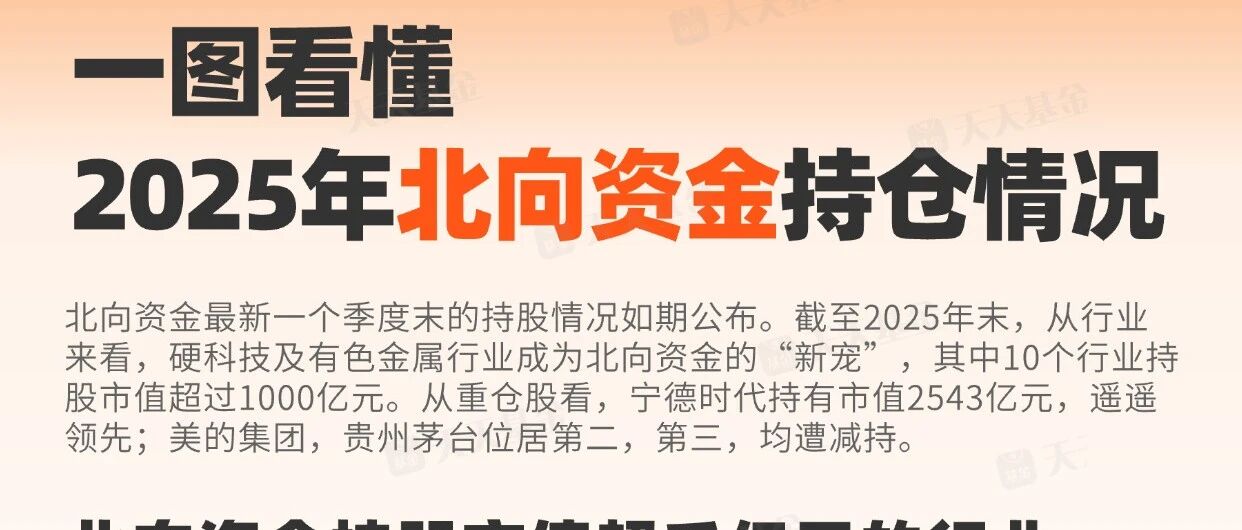
Core Viewpoint - As of the end of 2025, the northbound capital has shifted its focus towards hard technology and non-ferrous metals industries, with ten industries having a market value of over 100 billion yuan in holdings [1][7]. Industry Summary - The market value of holdings in the power equipment industry reached 449.5 billion yuan, while the electronics industry had 387 billion yuan, and the non-ferrous metals industry saw a significant increase to 185.6 billion yuan, marking a growth of over 170% compared to the end of 2024 [3][7]. - The banking sector's holdings increased by 56.45% to 217.6 billion yuan, while the machinery equipment sector saw a rise to 98.6 billion yuan [3][4]. - The food and beverage sector experienced a decline of 35.52%, with holdings dropping to 138.8 billion yuan [4]. Top Holdings Summary - The top holding, Ningde Times, had a market value of 254.3 billion yuan, representing a 76.57% increase in holdings [5][8]. - Midea Group and Kweichow Moutai ranked second and third, with holdings of 77 billion yuan and 75.8 billion yuan, respectively, both experiencing reductions of 7.99% and 35.82% [5][8]. - Other notable top holdings included China Merchants Bank at 51.4 billion yuan, Zijin Mining at 47.1 billion yuan, and Northern Huachuang at 45.7 billion yuan, with the latter seeing a remarkable increase of 267.34% [5][8].



“聪明钱”持仓披露 这十大行业持股市值超千亿
天天基金网· 2026-01-13 08:47
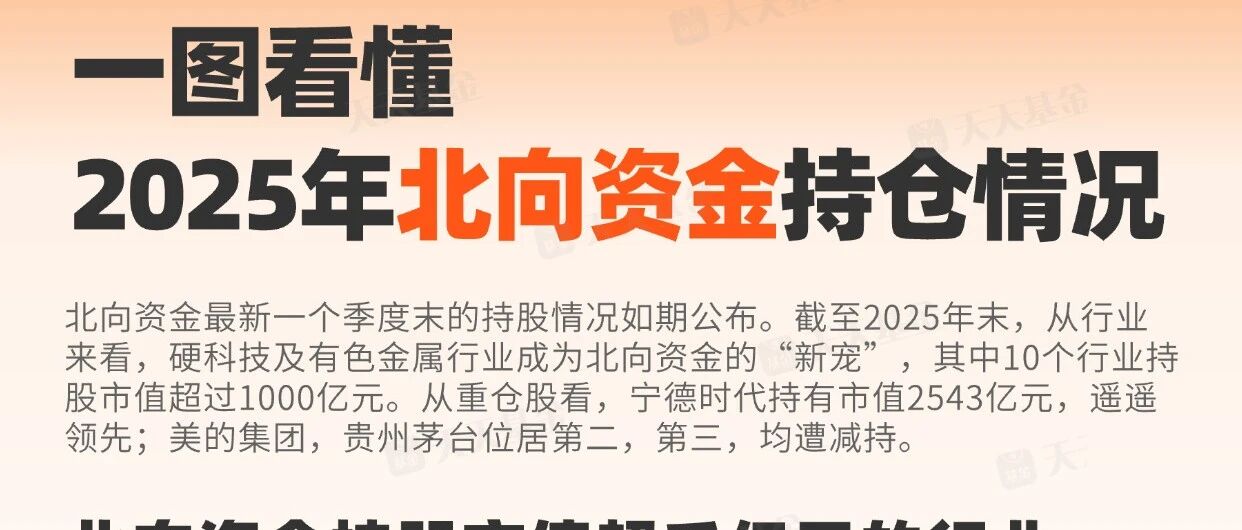
Core Viewpoint - As of the end of 2025, the northbound capital has shifted its focus towards hard technology and non-ferrous metals industries, with ten industries having a market value of over 100 billion yuan [1][7]. Industry Summary - The top three industries by market value held by northbound capital at the end of 2025 are: - Power Equipment: 449.5 billion yuan, a 60.04% increase from 2024 [3][7]. - Electronics: 387 billion yuan, an 85.02% increase from 2024 [3][7]. - Non-ferrous Metals: 185.6 billion yuan, a 173.04% increase from 2024 [3][7]. - Other industries with significant holdings include: - Banking: 217.6 billion yuan, a 56.45% increase [3]. - Machinery: 98.6 billion yuan, a decrease of 3.49% [3]. - Pharmaceuticals: 148.2 billion yuan, a decrease of 35.52% [4]. Major Holdings - The top ten stocks held by northbound capital at the end of 2025 include: - Ningde Times: 254.3 billion yuan, a 76.57% increase [5][8]. - Midea Group: 77 billion yuan, a decrease of 7.99% [5][8]. - Kweichow Moutai: 75.8 billion yuan, a decrease of 35.82% [5][8]. - China Merchants Bank: 51.4 billion yuan, a 2.92% increase [5][8]. - Zijin Mining: 47.1 billion yuan, a 120.18% increase [5][8]. - Notable changes in the top ten include: - Northern Huachuang, Zhongji Xuchuang, and Lixun Precision entering the list, while Longjiang Power, Mindray Medical, and BYD dropped out [8].



美的集团成交额创2025年3月20日以来新高
Zheng Quan Shi Bao Wang· 2026-01-13 07:06
(文章来源:证券时报网) 数据宝统计,截至14:21,美的集团成交额61.17亿元,创2025年3月20日以来新高。最新股价下跌 2.39%,换手率1.16%。上一交易日该股全天成交额为41.17亿元。(数据宝) ...
美的取得变频设备散热优化专利
Sou Hu Cai Jing· 2026-01-13 07:04
Group 1 - Midea Group Co., Ltd. has obtained a patent for "Variable Frequency Equipment, Compressors, and HVAC Equipment," with authorization announcement number CN115884577B, applied on December 2022 [1] - Guangdong Midea HVAC Equipment Co., Ltd., established in 2005, is primarily engaged in the manufacturing of electrical machinery and equipment, with a registered capital of 500 million RMB [1] - Guangdong Midea HVAC Equipment Co., Ltd. has invested in 6 companies, participated in 3,315 bidding projects, holds 5,000 patent records, and possesses 136 administrative licenses [1] - Chongqing Midea General Refrigeration Equipment Co., Ltd., established in 2004, focuses on the manufacturing of specialized equipment, with a registered capital of 500 million RMB [1] - Chongqing Midea General Refrigeration Equipment Co., Ltd. has invested in 3 companies, participated in 644 bidding projects, holds 831 patent records, and possesses 42 administrative licenses [1] Group 2 - Midea Group Co., Ltd., founded in 2000, is primarily engaged in the manufacturing of general equipment, with a registered capital of approximately 7.68 billion RMB [2] - Midea Group Co., Ltd. has invested in 132 companies, participated in 5,000 bidding projects, and has 5,000 trademark records and 5,000 patent records [2] - The company also holds 86 administrative licenses [2]
沪深300ESGETF南方(560180)跌4.80%,半日成交额63.71万元
Xin Lang Cai Jing· 2026-01-13 03:41
Group 1 - The core point of the article highlights the performance of the HuShen 300 ESG ETF managed by Southern Fund Management, which experienced a decline of 4.80% as of the midday close on January 13, with a trading volume of 637,100 yuan [1] - The top holdings of the ETF include companies such as CATL, Kweichow Moutai, and BYD, with varying performance; for instance, CATL rose by 0.24%, while Kweichow Moutai fell by 0.30% [1] - Since its inception on April 13, 2023, the ETF has achieved a return of 21.37%, with a monthly return of 4.63% [1] Group 2 - The ETF's performance benchmark is the HuShen 300 ESG Index return rate, indicating its focus on sustainable investment [1] - The fund manager is Southern Fund Management Co., Ltd., and the fund manager is Li Jialiang [1]


中国消费必定重走日本老路吗?这份研究给出了新答案
3 6 Ke· 2026-01-13 02:34
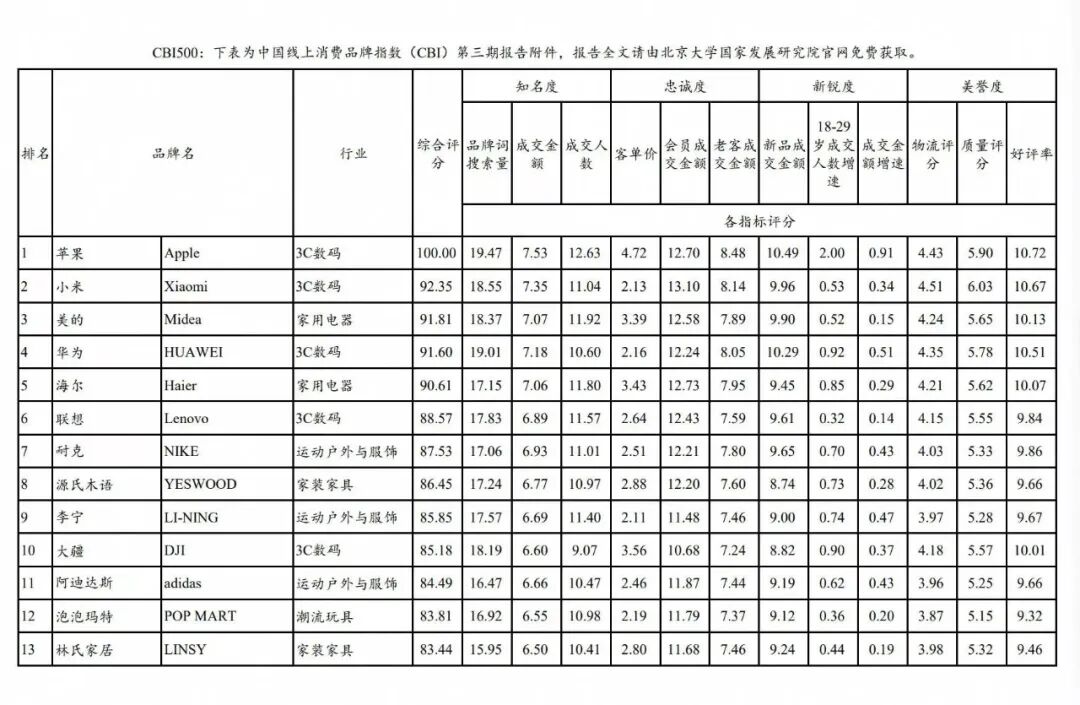
Core Viewpoint - The article discusses the evolving consumer behavior in China, contrasting it with Japan's "lost three decades," emphasizing a trend towards selective consumption upgrades rather than a decline in consumption quality [1][2]. Group 1: Consumer Behavior Trends - The Chinese online consumption brand index (CBI) reached 62.65 in Q3 2025, showing a 4.4% increase year-on-year and a 0.92% increase compared to the same quarter in 2024, indicating a stable growth in consumer preference for high-quality brands [2][4]. - The CBI reflects the proportion of consumers purchasing high-quality branded goods, suggesting that consumers are not entering a "consumption menopause" but are instead actively seeking quality [3][4]. - The trend of "selective consumption upgrade" is evident, where consumers pursue cost-effectiveness for necessities while being willing to pay a premium for emotional and experiential products [5][6]. Group 2: Brand Performance and Market Dynamics - Brands like DJI and Pop Mart have shown significant growth, with DJI entering the top ten for the first time, indicating a shift towards innovative products that create new demand rather than relying on price competition [7][16]. - The CBI report highlights that brands achieving high scores are not necessarily those known for low prices but those that create unique experiences and emotional value for consumers [7][18]. - The report indicates a seasonal pattern in consumer behavior, with higher CBI scores during promotional periods, but the third quarter's performance reflects a solid foundation for brands in non-promotional times [12][14]. Group 3: Platform Strategies and Market Evolution - E-commerce platforms like Taobao are shifting their focus towards supporting quality brands and original merchants, moving away from price wars to fostering product quality and service [24][25]. - The growth in the CBI index is attributed to a strategic shift in platform policies that encourage brands to enhance their value proposition rather than compete solely on price [25][26]. - The article emphasizes that a market balanced between daily sales and promotional periods is more resilient, indicating that brands are building long-term value rather than relying on short-term sales spikes [26][28].





中国消费 2026 展望:围绕五大投资主题选股-China Consumer 2026 Outlook Stock Picking with Five Investment Themes
2026-01-13 02:11
Summary of the Conference Call on China Consumer Sector Outlook 2026 Industry Overview - The focus is on the **China consumer sector** with an emphasis on stock picking strategies for 2026E, balancing "value" vs "growth" investments [1][11] - Anticipation of a less inflationary environment and low expectations for immediate consumption boosts from government policies [1][11] Key Investment Themes 1. **Shift Towards Experience/Service Consumption** - Consumers are increasingly valuing emotional experiences over basic needs, seeking happiness and self-expression [2][23] - 66% of respondents in a survey indicated a willingness to spend more for special moments [23] - Notable examples include Pop Mart's affordable entertainment options and Haidilao's casual dining as social venues [2][23] 2. **Focus on Well-being** - Increased spending on wellness, including health, fitness, and nutrition [3] - Growth potential identified in sportswear (Anta), health supplements (H&H), beauty care (Mao Geping), and tourism (Atour) [3] 3. **Rising "Silver" Economy** - The aging population is creating demand for leisure and cultural experiences [4] - Industries like tourism (Atour, H World), sportswear (Anta), and health supplements (H&H) are expected to benefit [4] 4. **Emerging New Channels** - Growth in omni-channel operations and new offline channels such as membership stores and snack specialty chains [5] - Food companies like Eastroc and Nongfu are adapting to these changes [5] 5. **Multi-brand Strategy** - Industry leaders are expanding brand portfolios to meet diversified consumer demands [6] - Companies like Anta and Midea are revising growth targets to ease channel inventory pressure [6] Top Buys in Consumer Sector - **Consumer Discretionary**: Anta (2020.HK), Pop Mart (9992.HK), Haidilao (6862.HK), Atour (ATAT.O), Midea (300.HK) [1][14] - **Consumer Staples**: CR Beer (291.HK), Eastroc (605499.SS), Mao Geping (1318.HK) [1][14] Additional Insights - The report emphasizes the importance of sustainable profit growth amid a dynamic marketplace [1][11] - The analysis includes a pecking order of various consumer sub-sectors, highlighting the relative strengths of companies within those sectors [1][14] - The report also notes the potential for companies like Li Ning and Haitian to outperform in case of a better-than-expected recovery in consumption [1] Conclusion - The China consumer sector is poised for a transformation driven by changing consumer preferences towards emotional and experiential consumption, with significant opportunities identified across various industries and companies. The focus on well-being, the aging population, and the emergence of new channels are critical factors influencing investment strategies for 2026E [1][2][3][4][5][6]


北向资金2025全景图: 买卖总额突破50万亿 科技及资源股持仓市值大增
Zheng Quan Shi Bao· 2026-01-12 22:28
Core Insights - Northbound capital has shown significant growth in trading activity and investment preferences, particularly favoring hard technology and non-ferrous metals sectors in 2025 [1][2][3][7]. Group 1: Market Performance - By the end of 2025, northbound capital held nearly 1.08 trillion shares of A-shares, with a market value surpassing 2.59 trillion yuan, marking a nearly 20% increase from the previous year [2]. - The total trading volume of northbound capital exceeded 50.33 trillion yuan in 2025, representing a more than 40% increase year-on-year, contributing nearly 6% to the overall A-share market trading volume [3]. - The trading activity of northbound capital reached new heights, with 33 trading days exceeding 300 billion yuan, 27 of which occurred in 2025 [3]. Group 2: ETF Trading - Northbound capital's ETF trading volume surpassed 810 billion yuan in 2025, a 76% increase from 2024, indicating a growing preference for ETF investments among foreign investors [4]. - The proportion of ETF trading in the total northbound capital trading volume reached 1.62%, setting a historical high [4]. Group 3: Sector Preferences - The hard technology and non-ferrous metals sectors emerged as the new favorites for northbound capital, with 14 industries seeing holdings exceed 50 billion yuan, and 10 industries surpassing 100 billion yuan [7]. - The electric equipment sector led with a holding value of over 449.6 billion yuan, followed by the electronics sector at over 387 billion yuan, and the non-ferrous metals sector at over 185.5 billion yuan [7]. - The non-ferrous metals sector saw a remarkable growth of over 172% in holdings compared to the end of 2024, reflecting a shift in investment focus [8]. Group 4: Stock Concentration - The concentration of holdings by northbound capital reached a five-year low in 2025, indicating a trend towards diversification in investment strategies [10]. - The top 20 companies held by northbound capital accounted for less than 36% of total holdings, a decrease of over 2 percentage points from 2021 [11]. Group 5: Popular Investment Themes - In 2025, eight out of ten popular investment themes, including commercial aerospace and semiconductor sectors, saw over 50% of their constituent stocks receiving increased holdings from northbound capital [9]. - The commercial aerospace sector, in particular, had over 80% of its stocks increased in holdings, driven by strong market performance and supportive policies [9]. Group 6: Long-term Trends - Eighteen stocks have been consistently increased in holdings for five consecutive quarters, primarily in the machinery, electric equipment, and automotive sectors, indicating strong institutional confidence [12]. - Conversely, 26 stocks have seen reductions in holdings over the same period, mainly in the pharmaceutical, banking, and consumer sectors, reflecting a shift in investment focus [12][13].
曾被吐槽“鸡肋”的AI智能锁,快被年轻人玩坏了
创业邦· 2026-01-12 10:19
Core Viewpoint - The smart lock industry has evolved significantly over the past decade, transitioning from basic electronic locks to advanced AI-driven solutions that enhance security and convenience, with a projected market growth from $2.77 billion in 2024 to $8.1 billion by 2030 [5][7]. Market Overview - The smart lock market in China is experiencing rapid growth, with a penetration rate exceeding 40% in first-tier cities by 2025 [5]. - The global smart door lock market is expected to reach $27.7 billion in 2024 and grow to $81 billion by 2030, indicating a robust demand for smart locking solutions [7]. Industry Dynamics - Major tech companies like Xiaomi, Huawei, and Haier are heavily investing in the smart lock sector, leading to intense competition and a "red ocean" market environment [7][12]. - The number of smart lock brands in China surged from 600 in 2015 to over 3,500 by mid-2018, highlighting the industry's explosive growth [19]. Technological Advancements - The evolution of smart locks has been driven by advancements in AI, biometrics, and IoT technologies, transforming locks from passive security devices to proactive smart solutions [21]. - New features such as 3D facial recognition and palm vein identification are becoming standard in high-end models, addressing previous limitations of fingerprint recognition [34][38]. Consumer Experience - The shift from basic functionality to enhanced user experience is evident, with smart locks now integrating with home automation systems to create a seamless living environment [26][32]. - Companies are focusing on user-friendly features, such as visitor interaction capabilities and automated home settings upon unlocking [30][32]. Challenges and Concerns - Despite advancements, the reliability of smart locks remains a concern, with reports of malfunction leading to security breaches and user dissatisfaction [40][42]. - Data privacy issues are also critical, as many smart locks collect sensitive user information, raising concerns about potential data breaches if not properly secured [44]. Conclusion - The smart lock industry is at a pivotal point, where the focus is not only on technological innovation but also on ensuring security and user trust. The ultimate goal is to provide a reliable solution that allows users to feel safe and secure in their homes [46].