
Midea Group(000333)

Search documents
美的集团(000333):25年业绩点评:注重股东回报,龙头韧性凸现
SINOLINK SECURITIES· 2026-03-31 06:51
Investment Rating - The report maintains a "Buy" rating for the company, indicating an expected price increase of over 15% in the next 6-12 months [5][14]. Core Insights - The company achieved a revenue of 456.5 billion RMB in 2026, representing a year-on-year growth of 12.1%, with a net profit attributable to shareholders of 43.9 billion RMB, up 14.0% year-on-year [2]. - The C-end business demonstrated strong resilience, with a revenue of 299.93 billion RMB in 2025, reflecting an 11.3% increase year-on-year, driven by digital transformation and inventory efficiency improvements [3]. - The B-end business continued to grow robustly, generating 122.75 billion RMB in revenue in 2025, a 17.5% increase year-on-year, with significant contributions from HVAC and new sectors like elevators and data centers [4]. - The company plans to repurchase shares in 2026, emphasizing shareholder returns, with projected net profits for 2026-2028 expected to grow by 9.3%, 10.3%, and 10.6% respectively [5]. Summary by Sections Performance Review - In Q4 2025, the company reported a revenue of 93.4 billion RMB, a 5.9% increase year-on-year, but a net profit decline of 11.4% to 6.1 billion RMB [2]. Operational Analysis - The C-end business's growth was supported by a focus on DTC transformation and digital business model innovation, improving inventory turnover efficiency by over 10% [3]. - The overseas business saw significant growth, with OBM revenue accounting for over 45% of the smart home business's overseas income, and notable acquisitions like TEKA contributing to double-digit growth in Europe [3]. Financial Metrics - The company achieved a gross margin of 26.4% in 2025, with a net profit margin of 9.6%, reflecting a 0.2 percentage point increase year-on-year [4]. - The projected revenue for 2026 is estimated at 489.52 billion RMB, with a growth rate of 6.77% [11].

300344,暴跌超70%!两大板块,逆市上行
证券时报· 2026-03-31 05:55
Market Overview - The A-share market experienced a decline in the morning session on March 31, with major indices showing varying degrees of decrease. The Shanghai Composite Index fell by 0.38%, the Shenzhen Component Index dropped by 1.45%, the Sci-Tech Innovation Board Index decreased by 1.88%, and the ChiNext Index declined by 2.36% [3][4]. Sector Performance - The home appliance and food and beverage sectors rose against the market trend, with the home appliance sector increasing by over 2%. Leading stock Midea Group surged by 6.05% [2][5]. - The food and beverage sector also showed significant strength, with leading stock Kweichow Moutai rising by over 2% [7]. Notable Stocks - Midea Group announced a share repurchase plan, intending to buy back shares worth no more than 13 billion yuan and no less than 6.5 billion yuan, with a maximum repurchase price of 100 yuan per share [6]. - Kweichow Moutai decided to adjust the sales contract price of its flagship product from 1169 yuan to 1269 yuan per bottle, which is expected to impact its operating performance [8]. Special Cases - A stock, Lifan Technology (300344), entered the delisting arrangement period, with its price plummeting by over 73% during the session. The company faced penalties for false disclosures in its financial reports [10][11][13].




Midea запускает VRF V9 -- Переосмысление эффективности, надежности и простоты установки в коммерческих системах ОВКВ
Prnewswire· 2026-03-31 03:24
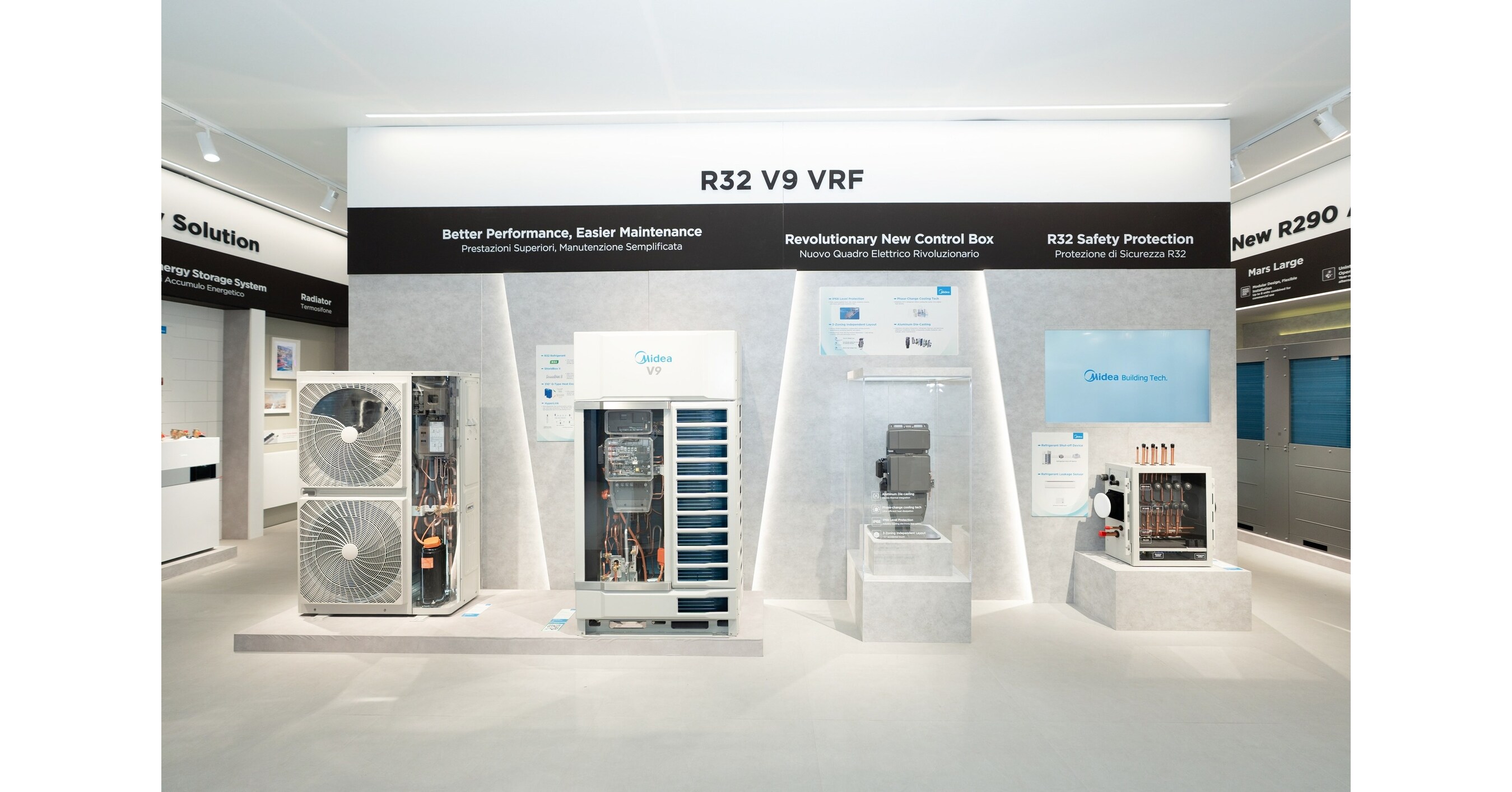
Group 1 - Midea has officially launched the V9 VRF system, which offers a comprehensive technical solution aimed at meeting urgent needs for owners in commercial HVAC systems [2][3] - The V9 VRF system features a 15% improvement in efficiency and operates effectively at temperatures up to 30°C [1] - The V9 system includes the ShieldBox II with an IP68 rating, enhancing its reliability and durability in various environments [1] Group 2 - Midea Building Technologies (MBT) made a strong impression at the MCE 2026 exhibition by showcasing the V9 VRF system along with two other key innovations [3]
全球大公司要闻 | 特斯拉将建超级芯片工厂,茅台宣布涨价
Wind万得· 2026-03-31 01:19
Key Points - Guizhou Moutai announced a price increase for its Feitian Moutai liquor, raising the sales contract price from 1169 yuan to 1269 yuan per bottle, effective March 31 [2] - Midea Group aims to achieve a revenue of 456.45 billion yuan in 2025, a year-on-year increase of 12.11%, and a net profit of 43.945 billion yuan, up 14.03%. The company plans to distribute 4.3 yuan per share and repurchase shares worth 6.5 to 13 billion yuan [2] - iQIYI has submitted a listing application to the Hong Kong Stock Exchange for its Class A ordinary shares and plans to repurchase up to 100 million USD of its shares within the next 18 months to optimize its capital structure [3] - Tesla launched the TERAFAB superchip factory with a target annual capacity exceeding 1 terawatt of computing power, with an investment of approximately 20 billion USD [9] - Toyota announced a share buyback at 3067 yen per share and plans to increase global production by 6% in April to June to meet demand [12]




盘前公告淘金:中国东航拟5-10亿回购股份注销,中际旭创2025年净利润108亿元同比增长109%
Jin Rong Jie· 2026-03-31 00:49
Important Events - Moore Threads signed a contract worth 660 million yuan for the Moore Threads Quasar Intelligent Computing Cluster [1] - Jingwang Electronics has begun shipping 1.6T optical module PCBs [1] - Oni Electronics signed a strategic cooperation agreement for AI workstations with Muxi Co., Ltd [1] - Jerry Holdings signed a sales contract for gas turbine generator sets worth 2.359 billion yuan [1] - China Merchants Energy ordered 10 VLCC oil tankers at a total price of approximately 8.566 billion yuan [1] - China Shipbuilding (core stock) signed a contract for the construction of 10 very large crude carriers with a domestic well-known shipowner, with a value between 8 billion to 9 billion yuan [1] Investment - Dongpeng Beverage plans to use no more than 15 billion yuan of idle self-owned funds for cash management by 2026 [1] - TCL Technology intends to acquire a 45% stake in Guangzhou Huaxing Semiconductor (core stock) for a transaction price of 9.325 billion yuan [1] Buybacks & Increases - China Eastern Airlines plans to repurchase shares worth 500 million to 1 billion yuan, which will all be canceled to reduce registered capital, with a repurchase price not exceeding 5 yuan per share [1] Performance - Agricultural Bank (core stock) expects double-digit growth in revenue and profit by 2025, with average daily RMB deposits growing at the fastest rate in the industry [1] - Mindray Medical anticipates international business revenue of 17.65 billion yuan by 2025, accounting for 53% of total revenue [1] - Silis expects a record revenue of 165.05 billion yuan in 2025, with R&D investment increasing by 77.4% to 12.51 billion yuan [1] - Jixin Technology forecasts a net profit growth of 343.81% for 2025 [1] - Zhaoyan New Drug expects a net profit of 298 million yuan in 2025, a year-on-year increase of 302% [1] - Birun Technology anticipates a total revenue of 1.03 billion yuan in 2025, a 207% increase from the previous year [1] - Zhongji Xuchuang expects a net profit of 10.8 billion yuan in 2025, a year-on-year increase of 109%, and plans to distribute 10 yuan per 10 shares [1] - Salt Lake Co. anticipates a net profit growth of 81.76% in 2025, achieving revenue of 15.501 billion yuan [1] - CICC expects a net profit growth of 71.93% in 2025, planning to distribute 2.3 yuan per 10 shares [1] - Ninebot Company forecasts a net profit growth of 62.17% in 2025 [1] - Lianqi Technology expects a net profit growth of 58.4% in 2025 [1] - Zhaoyi Innovation anticipates a net profit growth of 49.47% in 2025, planning to distribute 7.5 yuan per 10 shares [1] - Zhongwei Company expects a net profit growth of 30.69% in 2025, planning to convert 10 shares into 4.9 shares and distribute 3.5 yuan [1] - Midea Group anticipates a net profit growth of 14.03% in 2025, planning to distribute 38 yuan per 10 shares and repurchase A-shares worth 6.5 billion to 13 billion yuan [1] - Ganfeng Lithium expects a net profit of 1.613 billion yuan in 2025, turning a profit from a loss [1] Quarterly Performance - Newray Co. expects a year-on-year net profit increase of 474%-604% in the first quarter, with price increases across the entire range of hard alloy and tool products [2] - Huarui Precision anticipates a year-on-year net profit increase of 413%-550% in the first quarter, driven by both volume and price increases [2]



世界数据组织成立;美的集团拟大额回购……盘前重要消息一览
证券时报· 2026-03-31 00:04
Group 1 - The World Data Organization (WDO) was established on March 30 in Beijing, aiming to bridge the data gap, unlock data value, and promote the digital economy [3] - The State Administration for Market Regulation issued a notice to combat "involution" competition in key industries such as platform economy, photovoltaic, lithium batteries, and new energy vehicles [3] - The Ministry of Commerce announced measures to boost consumption, including optimizing the trade-in policy for consumer goods and promoting the efficient circulation of second-hand cars [4] Group 2 - Hangzhou introduced a new housing provident fund policy, increasing the maximum loan amount for ordinary families to 1.8 million yuan, with potential increases for specific groups [4] - An international team, including researchers from Sweden's Karolinska Institute, developed a new method for generating CAR-T cells for cancer immunotherapy, with results published in the journal Nature [5] - U.S. President Trump indicated serious negotiations with Iran regarding military actions, while also threatening to destroy Iranian infrastructure if agreements are not reached [6] Group 3 - The Iranian parliament approved a bill to charge fees for ships passing through the Strait of Hormuz, which includes prohibiting vessels from the U.S. and Israel [9] - The U.S. Secretary of State stated that Iran must not be allowed to permanently control the Strait of Hormuz or establish a fee system [8] - U.S. stock indices showed mixed results, with the Dow Jones up 0.11% and the Nasdaq down 0.73%, while oil prices reached their highest level since July 2022 at $102.88 per barrel [7] Group 4 - Midea Group plans to repurchase shares worth between 6.5 billion and 13 billion yuan, with a projected net profit growth of 14.03% for 2025 [9] - SF Holding announced a plan to use up to 38 billion yuan for financial products and adjusted its share repurchase amount to between 3 billion and 6 billion yuan [9] - Zhongji Xuchuang expects a net profit growth of 108.78% for 2025 and plans to distribute 10 yuan per 10 shares [10]




【早报】法案通过!伊朗:拟对霍尔木兹海峡征收通行费;美油近四年来首次站上100美元
财联社· 2026-03-30 23:12
Macro News - The Chinese Ministry of Foreign Affairs emphasized that dialogue with Japan regarding Taiwan should respect mutual interests and adhere to existing agreements [4] - The State Administration for Market Regulation announced measures to combat "involution" in key industries such as platform economy, photovoltaic, lithium batteries, and new energy vehicles [4] - U.S. President Trump threatened to destroy Iran's energy infrastructure if a deal is not reached soon, specifically targeting power plants, oil wells, and desalination facilities [4][5] - Iran's parliament approved a bill to charge fees for ships passing through the Strait of Hormuz, which will be implemented in Iranian rials and will prohibit U.S. and Israeli vessels from passing [4] Industry News - The World Data Organization was established in Beijing, aiming to bridge the data gap and enhance the digital economy [8] - The demand for various types of aviation engines in China is expected to exceed 11,600 units over the next 20 years, with a market value of over 85.17 billion yuan [8] - Samsung Electronics has completed the first phase of process upgrades at its Xi'an factory, transitioning from traditional 128-layer NAND flash to mass production of 236-layer products [9] - Morgan Stanley analysts reported that the oil market is depleting its buffer stocks, with significant production and refining capacities currently offline [9] - The aluminum price on the London Metal Exchange (LME) rose significantly due to attacks on major aluminum plants in the UAE and Bahrain [23] Company News - Guizhou Moutai announced an increase in the sales contract price of its 53-degree Flying Moutai from 1,169 yuan to 1,269 yuan per bottle [11][12] - China Merchants Energy announced a total contract value of approximately 8.566 billion yuan for the construction of 10 VLCC oil tankers [13] - Midea Group plans to repurchase A-shares worth between 6.5 billion and 13 billion yuan [14] - Agricultural Bank of China reported a net profit of 292 billion yuan for 2025, a year-on-year increase of 3.3% [19] - China Bank reported a net profit of 243.021 billion yuan for 2025, a year-on-year increase of 2.18% [20]




美的集团(00300) - 海外监管公告 - 美的集团股份有限公司董事会关於2025年度独立董事独立...
2026-03-30 14:05
香港交易及結算所有限公司及香港聯合交易所有限公司對本公告的內容概不負責,對其準確性 或完整性亦不發表任何聲明,並明確表示,概不就因本公告全部或任何部份內容而產生或因倚 賴該等內容而引致之任何損失承擔任何責任。 Midea Group Co., Ltd. 美的集團股份有限公司 (於中華人民共和國註冊成立的股份有限公司) (股份代號:0300) 海外監管公告 本公告乃根據香港聯合交易所有限公司證券上市規則第13.10B條而做出。 茲載列美的集團股份有限公司於深圳證券交易所網站(www.szse.cn)刊登的公告如 下,僅供參閱。 关于 2025 年度独立董事独立性情况的专项意见 根据《上市公司独立董事管理办法》《深圳证券交易所上市公司自律监管指 引第 1 号——主板上市公司规范运作》《香港联合交易所有限公司证券上市规则》 等规定,美的集团股份有限公司(以下简称"公司")董事会就第五届董事会独 立董事许定波、肖耿、刘俏和邱锂力的独立性情况进行了评估并出具如下专项意 见: 经核查,公司第五届董事会独立董事许定波、肖耿、刘俏和邱锂力的任职经 历以及签署的相关自查文件真实、准确,上述人员未在公司担任除独立董事以外 的任何 ...
美的集团(00300) - 海外监管公告 - 美的集团股份有限公司关於2026年开展外匯衍生品业务的...
2026-03-30 13:59
香港交易及結算所有限公司及香港聯合交易所有限公司對本公告的內容概不負責,對其準確性 或完整性亦不發表任何聲明,並明確表示,概不就因本公告全部或任何部份內容而產生或因倚 賴該等內容而引致之任何損失承擔任何責任。 Midea Group Co., Ltd. 美的集團股份有限公司 (於中華人民共和國註冊成立的股份有限公司) (股份代號:0300) 海外監管公告 本公告乃根據香港聯合交易所有限公司證券上市規則第13.10B條而做出。 茲載列美的集團股份有限公司於深圳證券交易所網站(www.szse.cn)刊登的公告如 下,僅供參閱。 承董事會命 美的集團股份有限公司 董事長、執行董事兼總裁 方洪波先生 香港,2026年3月30日 於本公告日期,董事會成員包括(i)執行董事方洪波先生、王建國先生、顧炎民博 士、管金偉先生及張添博士,(ii)非執行董事趙軍先生,及(iii)獨立非執行董事許 定波博士、肖耿博士、劉俏博士及邱鋰力博士。 证券代码:000333 证券简称:美的集团 公告编号:2026-015 美的集团股份有限公司 关于 2026 年开展外汇衍生品业务的公告 本公司及董事会全体成员保证信息披露的内容真实、准确、 ...
美的集团(00300) - 海外监管公告 - 美的集团股份有限公司2025年度内部控制评价报告、截至...
2026-03-30 13:53
香港交易及結算所有限公司及香港聯合交易所有限公司對本公告的內容概不負責,對其準確性 或完整性亦不發表任何聲明,並明確表示,概不就因本公告全部或任何部份內容而產生或因倚 賴該等內容而引致之任何損失承擔任何責任。 Midea Group Co., Ltd. 美的集團股份有限公司 (於中華人民共和國註冊成立的股份有限公司) (股份代號:0300) 海外監管公告 本公告乃根據香港聯合交易所有限公司證券上市規則第13.10B條而做出。 茲載列美的集團股份有限公司於深圳證券交易所網站(www.szse.cn)刊登的公告如 下,僅供參閱。 承董事會命 美的集團股份有限公司 董事長、執行董事兼總裁 方洪波先生 香港,2026年3月30日 於本公告日期,董事會成員包括(i)執行董事方洪波先生、王建國先生、顧炎民博 士、管金偉先生及張添博士,(ii)非執行董事趙軍先生,及(iii)獨立非執行董事許 定波博士、肖耿博士、劉俏博士及邱鋰力博士。 美的集团股份有限公司 2025 年度内部控制评价报告 美的集团股份有限公司全体股东: 一、重要声明 按照企业内部控制规范体系的规定,建立健全和有效实施内部控制,评价其有效 性,并如实披露内部 ...