JCF(000420)

Search documents
吉林化纤: 关于召开2025年第三次临时股东会通知的更正公告
Zheng Quan Zhi Xing· 2025-08-14 08:10
证券代码:000420 证券简称:吉林化纤 公告编号:2025-36 吉林化纤股份有限公司 本公司及董事会全体成员保证信息披露的内容真实、准确、完整,没有虚假记载、 误导性陈述或重大遗漏。 吉林化纤股份有限公司(以下简称"公司")于2025年7月31日在巨潮资讯网 (www.cninfo.com.cn)披露了《关于提请召开2025年第三次临时股东会的通知》(公 告编号:2025-26),经事后审查发现通知中附件"授权委托书"中有关提案信息披露 有误,现将相关内容予以更正如下: 更正前: | | | 备注 | | --- | --- | --- | | 提案编码 | 提案名称 | 该列打勾的栏目可以 | | | | 投票 | | 累计投票议案 | | --- | | 《关于公司董事会换届选举第十一届董事会非独立董事的议 | | | 选举票 | | --- | --- | --- | --- | | 案》 数 | | | | | 选举票 | | | | | 数 | | | | | 同 | 反 | 弃 | | | 非累计投票议案 | | | | | 意 | 对 | 权 | | …… 更正后: 授权委托书 兹委托 先 ...

吉林化纤: 提请召开2025年第三次临时股东会通知(更正后)
Zheng Quan Zhi Xing· 2025-08-14 08:10
后) 本公司及董事会全体成员保证信息披露的内容真实、准确、完整,没有虚假记载、 误导性陈述或重大遗漏。 一、召开会议的基本情况 (一)股东会届次:2025年第三次临时股东会 吉林化纤股份有限公司 《关于提请召开2025年第三次临时股东会的通知》(更正 (二)股东会的召集人:吉林化纤股份有限公司第十届董事会第十七次会议审议通过 提请召开2025年第三次临时股东会。 (三)会议召开的合法、合规性:本次会议的召集和召开符合《中华人民共和国公司 法》及《吉林化纤股份有限公司章程》的有关规定,合法有效。 证券代码:000420 证券简称:吉林化纤 公告编号:2025-37 于股权登记日下午收市时,在中国结算深圳分公司登记在册的公司全体股东均有权 出席股东会,并可以以书面形式委托代理人出席会议和参加表决,该股东代理人不必是 本公司股东。 室。 二、会议审议事项 (四)会议召开的日期、时间: 现场会议时间:2025年8月18日(星期一)14:00; 网络投票时间:其中,通过深圳证券交易所交易系统网络投票的时间为:2025年8 月18日上午9:15—9:25,9:30—11:30,下午13:00—15:00;通过深圳证券交易 ...
AMAC化纤指数下跌0.57%,前十大权重包含凯赛生物等
Jin Rong Jie· 2025-08-12 15:27
Core Viewpoint - The AMAC Chemical Fiber Index experienced a decline of 0.57%, closing at 3837.96 points, with a trading volume of 3.384 billion yuan, despite showing positive growth over the past month, three months, and year-to-date [1] Group 1: Index Performance - The AMAC Chemical Fiber Index has increased by 6.53% over the past month [1] - The index has risen by 9.31% over the last three months [1] - Year-to-date, the index has shown a growth of 9.89% [1] Group 2: Index Composition - The top ten holdings of the AMAC Chemical Fiber Index are: Tongkun Co., Ltd. (13.53%), Guangwei Composites (11.72%), Kaisa Biotechnology (11.33%), Huafeng Chemical (10.12%), Hengyi Petrochemical (8.51%), Zhongjian Technology (8.44%), New Fengming (6.32%), Jilin Chemical Fiber (5.23%), Taihe New Materials (4.32%), and Hailide (3.15%) [1] - The market share of the AMAC Chemical Fiber Index is composed of 60.77% from the Shenzhen Stock Exchange and 39.23% from the Shanghai Stock Exchange [1] Group 3: Industry Classification - The AMAC Chemical Fiber Index is entirely composed of the raw materials sector, with a 100% allocation [1]



吉林化纤(000420)8月12日主力资金净流出2500.11万元
Sou Hu Cai Jing· 2025-08-12 11:27
金融界消息 截至2025年8月12日收盘,吉林化纤(000420)报收于4.12元,下跌1.44%,换手率2.84%, 成交量69.81万手,成交金额2.88亿元。 资金流向方面,今日主力资金净流出2500.11万元,占比成交额8.67%。其中,超大单净流出341.37万 元、占成交额1.18%,大单净流出2158.74万元、占成交额7.49%,中单净流出流入176.63万元、占成交 额0.61%,小单净流入2323.48万元、占成交额8.06%。 天眼查商业履历信息显示,吉林化纤股份有限公司,成立于1988年,位于吉林市,是一家以从事化学纤 维制造业为主的企业。企业注册资本245886.8343万人民币,实缴资本6947万人民币。公司法定代表人 为金东杰。 通过天眼查大数据分析,吉林化纤股份有限公司共对外投资了8家企业,参与招投标项目539次,专利信 息51条,此外企业还拥有行政许可48个。 吉林化纤最新一期业绩显示,截至2025一季报,公司营业总收入12.14亿元、同比增长32.39%,归属净 利润826.98万元,同比减少60.59%,扣非净利润807.67万元,同比减少49.14%,流动比率0.493 ...
活力中国调研行丨“一根丝”牵起发展新动能
Xin Hua Wang· 2025-08-12 06:35
Core Viewpoint - The article highlights the significant advancements and market potential of carbon fiber, particularly through the efforts of Jilin Chemical Fiber Group, which has transitioned from reliance on imports to becoming a leading producer in the industry [1][4]. Group 1: Carbon Fiber Production and Innovation - Carbon fiber, known as "black gold," is noted for its strength, being 7 to 9 times stronger than steel while being extremely lightweight [1]. - Jilin Chemical Fiber Group has developed proprietary technologies for carbon fiber production, achieving a sales volume of over 25,000 tons in the first half of the year, representing a 65% year-on-year increase, with an annual forecast of over 56,000 tons [3][4]. - The company has successfully reduced its dependency on imports by establishing a domestic production capability since 2012, following years of research and development [3][4]. Group 2: Market Applications and Demand - The carbon fiber products have found applications in various sectors, including wind energy, sports equipment, and automotive components, with the wind power sector holding a 95% market share in the domestic market [4]. - The demand for carbon fiber is driven by the rapid growth of low-altitude economy, wind energy, and sports industries, prompting the company to aim for an annual production capacity of 70,000 tons by next year [4]. Group 3: Broader Industry Context - Jilin Chemical Fiber Group also produces other fibers, such as artificial silk and bamboo fiber, with significant global market shares of 34% and 90%, respectively [5]. - The overall high-tech manufacturing sector in Jilin Province has shown robust growth, with a 17.9% increase in value added in the first quarter, indicating a strengthening industrial base [8].

冲项目 拼创新 抢生产——吉林省制造业暑期奋战忙
Xin Hua She· 2025-08-09 08:03
Group 1 - In August, Jilin Province's industrial base is experiencing strong production momentum, particularly in the renewable energy sector, with significant project construction underway [1] - The total investment for the Zhongnengjian Songyuan Hydrogen Energy Industrial Park project is 6.946 billion yuan, aiming for trial production by September [1] - As of June, the installed capacity of renewable energy in Jilin Province reached 31.2053 million kilowatts, accounting for 63.93% of the total installed capacity [1] Group 2 - The CR450BF train set, capable of running at speeds of 400 km/h and testing above 450 km/h, is undergoing trials after being developed through independent innovation [2][3] - The China National Railway Group and other research units have created a technical system for high-speed trains, achieving comprehensive innovation in theory, technology, equipment, standards, and management [3] Group 3 - Jilin Chemical Fiber Group has seen a 5.9 times year-on-year increase in the production of carbon fiber composite products, focusing on the carbon fiber sector to enhance productivity [3][6] - The province is promoting high-quality development through the expansion of the renewable energy industry, innovation in major technological equipment, and upgrades in traditional industries [6]
化学纤维行业CFO薪酬观察:优彩资源业绩下滑 CFO徐平年薪57.26万元同比近乎翻倍 涨幅行业登顶
Xin Lang Zheng Quan· 2025-08-07 09:21
Core Insights - The total salary of CFOs in A-share listed companies reached 4.27 billion yuan in 2024, with an average annual salary of 814,800 yuan [1] - The chemical fiber industry saw a total CFO salary of 12.80 million yuan, with an average salary of 640,000 yuan, reflecting a year-on-year increase of 4.38% [2] Salary Analysis - The highest-paid CFO in the chemical fiber industry is Sun Jie from Huafeng Chemical, earning 1.75 million yuan, which is 2.7 times the industry average [3] - The lowest-paid CFO is Qu Dajun from Jilin Chemical Fiber, with an annual salary of 160,000 yuan, only a quarter of the industry average [3] - Xu Ping from Youcai Resources experienced the highest salary increase, with a 93% rise to 572,600 yuan, despite the company's revenue declining by 3.7% [4] Educational and Age Demographics - In the chemical fiber industry, 70% of CFOs hold a bachelor's degree, while 15% have an associate degree and 15% have a master's degree [3] - Most CFOs are over 40 years old, with the youngest being 35 years old [3] Performance Metrics - Huafeng Chemical reported a revenue of 26.93 billion yuan in 2024, a 2.4% increase, but its net profit decreased by 10.4% to 2.22 billion yuan [3] - Jiejian Equipment achieved a revenue of 3.883 billion yuan, a 3.9% increase, but its net profit fell by 13.9% [3] Regulatory Actions - Two CFOs in the chemical fiber industry faced administrative penalties in 2024, with one receiving a warning from the Henan Securities Regulatory Bureau [5][6]


活力中国调研行•走进吉林丨吉林产业跃迁:龙头企业领航 工业集群崛起
Sou Hu Cai Jing· 2025-08-06 16:30
Group 1: Overview of Jilin Province's Economic Development - Jilin Province is experiencing a vibrant economic development, driven by key industries such as advanced manufacturing, automotive, and new materials [2][4][14] - The province's development is characterized by the integration of industry and culture, showcasing a coordinated development model [2][4] Group 2: China FAW Group (China First Automobile Works) - China FAW is the leading player in Jilin's automotive industry, playing a crucial role in the establishment of the "Changchun International Automobile City" concept [4][14] - The company has fostered a complete automotive industry chain, from parts manufacturing to vehicle production, enhancing regional economic collaboration [4][5] - Jilin Shibao Machinery Manufacturing Co., a key supplier to China FAW, exemplifies the growth of automotive component manufacturers in the region [4][5] Group 3: CRRC Changchun Railway Vehicles Co., Ltd. - CRRC Changchun is a prominent player in the rail transportation sector, focusing on the research and manufacturing of rail transit equipment [7][8] - The company has achieved significant technological advancements, particularly in high-speed train technology, contributing to China's rapid rail development [8][9] - CRRC Changchun is leading the digital transformation in the industry by establishing a supply chain management platform that connects nearly sixty enterprises [9][19] Group 4: Jilin Chemical Fiber Group - Jilin Chemical Fiber Group has made breakthroughs in carbon fiber production, which is lightweight yet stronger than steel, marking a significant advancement in new materials [12][13] - The company has invested heavily in R&D, collaborating with universities and research institutions to accelerate the development of high-performance fiber materials [13][20] - The establishment of a complete industrial chain around high-performance fiber materials has positively impacted the local economy and industry structure [13][20] Group 5: Future Directions - Changchun aims to strengthen its industrial economy by focusing on advanced manufacturing and integrating technology with industry [14][21] - Leading enterprises like China FAW, CRRC Changchun, and Jilin Chemical Fiber Group are pivotal in driving economic growth and technological innovation in Jilin Province [14][21]


2025年中国再生纤维素纤维行业发展历程、产业链、产量、竞争格局及发展趋势研判:绿色可持续发展理念深入人心,再生纤维素纤维产量达到515.5万吨[图]
Chan Ye Xin Xi Wang· 2025-08-04 06:33
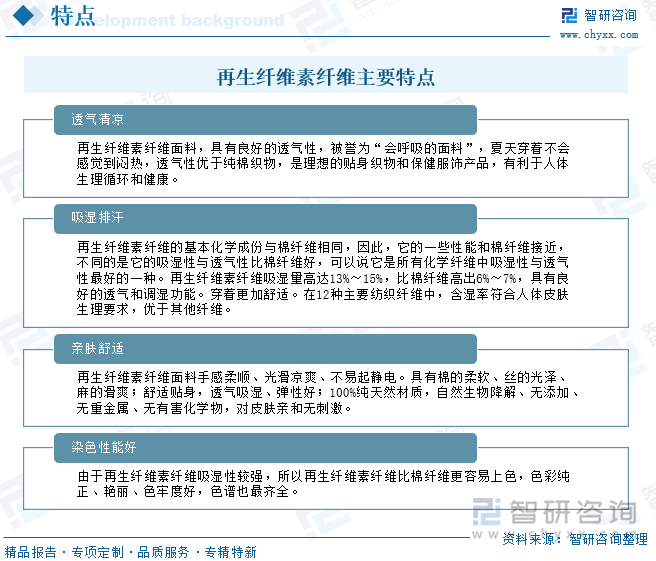
Core Viewpoint - The demand for regenerated cellulose fibers is increasing due to rising environmental awareness and government policies, leading to expanded production and market opportunities in the industry [1][13]. Industry Overview - Regenerated cellulose fibers are made from natural cellulose sources without altering their chemical structure, resulting in improved physical properties such as moisture absorption and breathability compared to cotton [3][5]. - The production of regenerated cellulose fibers in China is projected to reach 5.155 million tons in 2024, representing a year-on-year increase of 7.5% [1][13]. - The main categories of regenerated cellulose fibers include viscose fibers and differentiated fibers, with viscose fibers dominating the market, expected to reach 4.435 million tons in 2024, accounting for 86% of the total production [14]. Industry Chain - The industry chain encompasses the procurement of raw materials like cotton, hemp, bamboo, and trees, leading to applications in clothing and home textiles [9][11]. - Regenerated cellulose fibers are widely used in clothing due to their breathability and moisture absorption, as well as in home textiles like towels and curtains [9]. Competitive Landscape - Leading companies in the regenerated cellulose fiber industry include Xinjiang Zhongtai Chemical Co., Ltd., Nanjing Chemical Fiber Co., Ltd., and New乡化纤股份有限公司, which leverage technology and brand strength to maintain market share [16][17]. - Smaller and medium-sized enterprises are also emerging, focusing on technological upgrades and niche market development [16]. Development Trends - The industry is expected to undergo intelligent upgrades, with technologies like vortex spinning enhancing production efficiency and product quality [21]. - Market demand for regenerated cellulose fibers is anticipated to grow across various sectors, including apparel, home textiles, and medical applications, driven by increasing environmental consciousness [22]. - There is a trend towards product diversification, with companies developing functional fibers to meet specific consumer needs, such as temperature-regulating and antibacterial properties [24].


【吉林化纤(000420.SZ)】粘胶长丝景气持续,碳纤维板块有望减亏——动态跟踪报告(赵乃迪/胡星月)
光大证券研究· 2025-08-02 00:03
Group 1: Viscose Filament Yarn Segment - The company is gradually increasing its market share in the viscose filament yarn sector, with global production capacity estimated at 250,000 to 280,000 tons per year, and China's capacity stable at around 210,000 to 240,000 tons per year [4] - As of the end of 2024, the company has a production capacity of 90,000 tons per year for viscose filament yarn, with a diverse range of differentiated products, capturing over 45% of the high-end market [4] - The company achieved a revenue of 2.791 billion yuan in the viscose filament yarn segment in 2024, reflecting a year-on-year increase of 4%, while the gross margin for viscose filament and short yarn was 20.44%, a decrease of 1.03 percentage points year-on-year [4] Group 2: Carbon Fiber Segment - The carbon fiber industry is experiencing improved market conditions, with the company operating a 12,000 tons per year carbon fiber composite production line, achieving a capacity utilization rate of 44.59% in 2024 [5] - The company reported a revenue of 320 million yuan from its carbon fiber segment in 2024, a year-on-year decrease of 12.6%, with a gross margin of -26.74%, an increase of 7.1 percentage points year-on-year [5] - The average price of carbon fiber in China has shown signs of stabilization, with a reported price of 83.75 yuan/kg as of July 31, 2025, a year-on-year decline of 8.2% [5] Group 3: Industry Capacity and Trends - The carbon fiber industry is currently facing overcapacity, with a total production capacity of 159,500 tons in China, and an expected addition of approximately 465,300 tons from 2025 to 2028 [6] - The majority of production enterprises are currently operating at a loss, which may delay the actual release of planned capacities [7] - The central government's strong stance on "anti-involution" is expected to help reduce supply and increase industry concentration, thereby improving the overall market conditions for the carbon fiber industry [7]