YUNNAN BAIYAO(000538)

Search documents
云南白药:围绕“云南白药”主品牌,科学地建立品牌矩阵,实现清晰的品牌区隔
Zheng Quan Ri Bao Wang· 2025-09-30 09:19
Core Viewpoint - Yunnan Baiyao, a 123-year-old national brand, is expanding its brand portfolio from pharmaceuticals to personal health care products, raw medicinal materials, and health products, thereby enhancing brand value and reach [1] Brand Strategy - The company focuses on the "Yunnan Baiyao" main brand and has established a scientific brand matrix based on product functionality and relevance to the core values of Yunnan Baiyao [1] - This strategy aims to create clear brand differentiation and continuously expand the brand's audience [1]

云南白药:云南白药胶囊常用于跌打损伤、瘀血肿痛等
Zheng Quan Ri Bao Wang· 2025-09-30 09:19
Core Viewpoint - Yunnan Baiyao (000538) has clarified the uses of its capsules, which are commonly employed for treating various injuries and conditions, emphasizing the importance of following instructions or medical advice for usage [1] Summary by Relevant Categories Product Usage - Yunnan Baiyao capsules are indicated for treating injuries such as bruises, contusions, and various types of bleeding, as well as for conditions like abscesses, soft tissue injuries, closed fractures, and skin infections [1]
云南白药:截至2025年上半年末公司普通股股东总数为161130户
Zheng Quan Ri Bao Wang· 2025-09-30 09:11
Core Insights - Yunnan Baiyao reported that as of the end of the first half of 2025, the total number of common stock shareholders is expected to reach 161,130 [1] Company Summary - The company is actively engaging with investors through platforms to provide updates on shareholder statistics [1]
云南白药:公司秉承“守护生命与健康”的使命,积极关注大健康市场的机会
Zheng Quan Ri Bao Wang· 2025-09-30 08:43
Core Viewpoint - Yunnan Baiyao (000538) emphasizes its commitment to the mission of "protecting life and health" while actively exploring opportunities in the health and wellness market [1] Group 1 - The company is focused on the health and wellness market [1]
云南白药(000538) - 关于持股5%以上股东非公开发行可交换公司债券对持有的部分公司股票办理完成担保及信托登记的公告
2025-09-29 10:46
股票代码:000538 股票简称:云南白药 公告编号:2025-34 云南白药集团股份有限公司 关于持股 5%以上股东非公开发行可交换公司债券对持有 的部分公司股票办理完成担保及信托登记的公告 本公司及董事会全体成员保证信息披露内容的真实、准确、完整,没有虚 假记载、误导性陈述或重大遗漏。 云南白药集团股份有限公司(以下简称"公司"或"云南白药")于 2025 年 9 月 23 日披露了《关于持股 5%以上股东拟非公开发行可交换公司债券及 拟对其持有的部分股票办理担保及信托登记的公告》(公告编号:2025-33), 公司持股 5%以上股东新华都实业集团股份有限公司(以下简称"新华都") 拟以其持有的部分公司 A 股股票为标的非公开发行可交换公司债券(以下简 称"本次可交换债券"),并已获得深圳证券交易所出具的《关于新华都实 业集团股份有限公司非公开发行可交换公司债券符合深交所挂牌条件的无 异议函》(深证函〔2025〕881 号,以下简称"《无异议函》"),发行规 模不超过 20 亿元人民币。 公司于 2025 年 9 月 29 收到新华都的书面通知,新华都本次可交换债券 拟启动发行,新华都将持有的云南白药 5 ...
中药板块9月29日涨0.27%,吉林敖东领涨,主力资金净流出2.44亿元
Zheng Xing Xing Ye Ri Bao· 2025-09-29 08:46
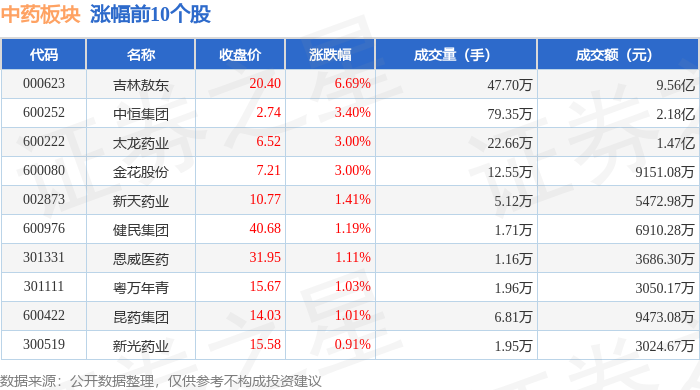
Core Insights - The traditional Chinese medicine sector saw a slight increase of 0.27% on September 29, with Jilin Aodong leading the gains [1] - The Shanghai Composite Index closed at 3862.53, up 0.9%, while the Shenzhen Component Index closed at 13479.43, up 2.05% [1] Stock Performance - Jilin Aodong (000623) closed at 20.40, with a rise of 6.69% and a trading volume of 477,000 shares, amounting to a transaction value of 956 million yuan [1] - Other notable performers included: - Zhongheng Group (600252) at 2.74, up 3.40% with a volume of 793,500 shares [1] - Tailong Pharmaceutical (600222) at 6.52, up 3.00% with a volume of 226,600 shares [1] - Jinhua Co., Ltd. (600080) at 7.21, up 3.00% with a volume of 125,500 shares [1] Fund Flow Analysis - The traditional Chinese medicine sector experienced a net outflow of 244 million yuan from institutional investors, while retail investors saw a net inflow of 204 million yuan [2] - The main fund inflows and outflows for specific stocks included: - Jilin Aodong had a net inflow of 91.59 million yuan from institutional investors [3] - Yunnan Baiyao saw a net inflow of 26.21 million yuan from institutional investors [3] - Taikang Group (600129) had a net inflow of 6.25 million yuan from institutional investors [3]


云南白药:以全产业链布局向价值驱动转型的中药企业典型样本
2 1 Shi Ji Jing Ji Bao Dao· 2025-09-26 12:18
Core Insights - The Chinese medicine industry is undergoing a significant transformation, with the centralized procurement of traditional Chinese medicine (TCM) products acting as a catalyst for change, prompting major companies to integrate their supply chains to adapt to market pressures and regulatory shifts [1][2] Group 1: Industry Trends - The centralized procurement led by Hubei allows for a 60% price component and 40% based on technical factors, emphasizing the importance of quality and innovation in TCM [2] - The State Council's 2025 report highlights the need for high-quality development in the TCM sector, indicating a shift from resource-driven competition to quality-driven value [2][12] - The TCM industry has experienced a volatile price environment, with the index rising from over 2000 points in 2019 to a peak of 3600 points, followed by a decline due to oversupply and market speculation [3] Group 2: Company Performance - Yunnan Baiyao reported a revenue of 21.257 billion yuan in the first half of 2025, a year-on-year increase of 3.92%, with net profit reaching 3.633 billion yuan, up 13.93% [4] - In 2024, Yunnan Baiyao achieved a revenue of 40.033 billion yuan, a 2.36% increase, and a net profit of 4.523 billion yuan, reflecting a 20.18% growth [4] Group 3: Supply Chain Integration - Yunnan Baiyao's strategy involves integrating the entire supply chain, from seed selection to processing, ensuring quality and stability in raw materials [5][6] - The company has developed a model that promotes collaboration with local farmers, allowing them to sell fresh herbs directly to Yunnan Baiyao, thus enhancing quality and income for farmers [10] Group 4: Digital Transformation - Yunnan Baiyao is leveraging digital platforms to enhance supply chain transparency and efficiency, enabling full-process collaboration and traceability in TCM production [8] - The company has introduced a data product for tracing Yunnan's unique TCM materials, promoting industry-wide data sharing and collaboration [8] Group 5: Future Outlook - Yunnan Baiyao aims to expand its market presence internationally, utilizing its geographical advantages and establishing a new international trading center for medicinal materials [11] - The company has initiated a 10 billion yuan industry fund to support the development of the TCM sector, indicating a commitment to long-term growth and innovation [11][12]
一买就套,一卖就飞,云南白药把自己活成了散户?
Hu Xiu· 2025-09-24 09:31
Core Viewpoint - Yunnan Baiyao, once a highly profitable company earning over 2 billion annually, has faced significant challenges leading to its decline in the stock market and subsequent exit from trading, raising questions about the underlying reasons for its performance issues [1] Group 1 - Yunnan Baiyao was celebrated for its extraordinary profits, achieving over 2 billion in earnings in a single year, which contributed to its reputation as a remarkable investment opportunity in the A-share market [1] - The company has experienced a drastic shift from being a "stock god" to becoming a "韭菜" (a term used to describe retail investors who suffer losses), indicating a severe downturn in its market performance [1] - Following its withdrawal from the stock market, Yunnan Baiyao has encountered new challenges within its core business operations, suggesting a deeper issue beyond just stock market performance [1]
A股“老登”持股曝光,敢不敢对号入座
第一财经· 2025-09-24 02:08
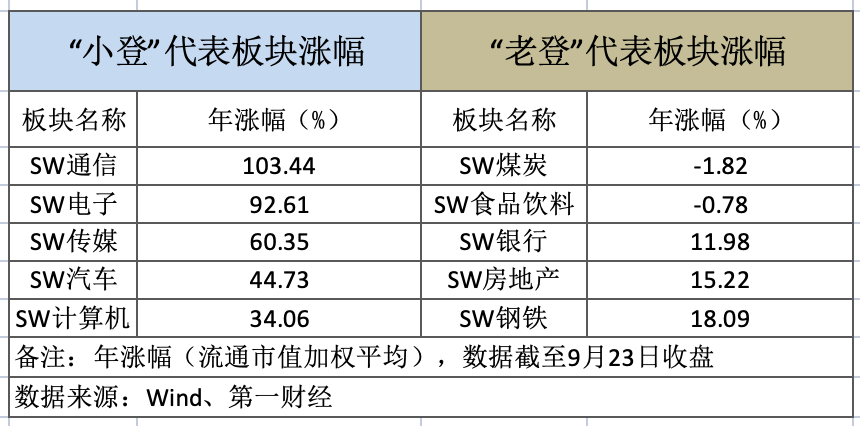
Core Viewpoint - The article discusses the significant divergence in stock market performance between traditional "old stocks" (represented by sectors like liquor, real estate, and coal) and "new stocks" (focused on technology sectors such as AI and semiconductors) in 2023, highlighting a shift in investor sentiment and market dynamics [2][9]. Group 1: Market Performance Overview - As of September 23, 2023, the Shanghai Composite Index has risen by 14.02%, with technology sectors like SW Communication and SW Electronics showing remarkable gains of 103% and 93% respectively, while traditional sectors like SW Coal and SW Food & Beverage have declined by 1.82% and 0.78% [2][3]. - The article notes that many traditional blue-chip stocks have underperformed, with 16 out of 21 stocks in the SW liquor sector experiencing price declines this year, including a 3.16% drop in Kweichow Moutai [5][6]. Group 2: Individual Stock Performance - Notable "new stocks" include Cambricon Technologies (688256.SH), which has seen a price increase of 105.22%, and other companies in the AI sector like NewEase (300502.SZ) and Zhongji Xuchuang (300308.SZ), with annual gains of 329% and 253% respectively [4][6]. - In contrast, several "old stocks" such as Haitian Flavoring (603288.SH) and Gree Electric (000651.SZ) have reported declines of 12.68% and 6.96% respectively, despite some of these companies showing double-digit profit growth in the first half of the year [5][6]. Group 3: Investment Philosophy and Market Sentiment - The article highlights a growing divide between "old stock" investors, who favor value investing based on stable cash flows and dividends, and "new stock" investors, who are more focused on growth potential in technology sectors [9][10]. - The current market sentiment is characterized by a trend-driven investment approach, with younger investors and quantitative funds favoring short-term trends, leading to extreme sector divergence [10].





A股大分化:“小登”追AI算力狂赚,“老登”守白酒地产躲牛市
Di Yi Cai Jing· 2025-09-23 13:39
Core Viewpoint - The market is experiencing a significant divergence between traditional "old stocks" (represented by sectors like liquor, real estate, and coal) and "new stocks" (focused on technology sectors such as AI and semiconductors), with the latter showing substantial gains while the former declines [1][3][8]. Group 1: Market Performance - As of September 23, the Shanghai Composite Index has risen by 14.02% year-to-date, with technology sectors like SW Communication and SW Electronics seeing gains of 103% and 93% respectively, while traditional sectors like SW Coal and SW Food & Beverage have declined by 1.82% and 0.78% [1][2]. - The performance of individual stocks reflects this trend, with tech stocks like Cambrian (688256.SH) doubling in price, while major liquor stocks like Kweichow Moutai (600519.SH) have seen a decline of 3.16% [3][5]. Group 2: Sector Analysis - The "new stocks" or "small stocks" have shown remarkable growth, with companies like Xinji Technology (300502.SZ) and Zhongji Xuchuang (300308.SZ) experiencing year-to-date increases of 329% and 253% respectively, driven by the AI computing wave [3][5]. - In contrast, the "old stocks" have struggled, with 16 out of 21 major liquor stocks experiencing declines, and several blue-chip stocks like Haitian Flavoring (603288.SH) and Gree Electric (000651.SZ) also showing negative performance [4][5]. Group 3: Investment Perspectives - The divide between "old stocks" and "new stocks" has sparked debates within the investment community, with traditional investors advocating for value investing based on cash flow and safety margins, while tech investors focus on growth potential and disruptive technologies [6][7]. - Current market dynamics suggest that the tech sector is seen as a trend-driven investment, supported by policies favoring AI and computing power, while traditional value investment strategies are becoming less effective, leading to extreme sector divergence [8].