
CHANGAN AUTOMOBILE-B(000625)

Search documents
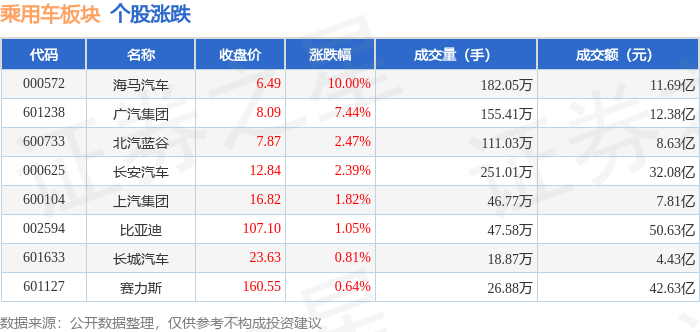
乘用车板块10月15日涨1.61%,海马汽车领涨,主力资金净流入12.6亿元
Zheng Xing Xing Ye Ri Bao· 2025-10-15 08:29
Core Viewpoint - The passenger car sector experienced a rise of 1.61% on October 15, with Haima Automobile leading the gains, while the Shanghai Composite Index closed at 3912.21, up 1.22% [1] Group 1: Market Performance - The passenger car sector's individual stock performance showed significant increases, with notable gainers including: - Haima Automobile (10.00% increase, closing at 6.49) - GAC Group (7.44% increase, closing at 60.8) - Changan Automobile (2.39% increase, closing at 12.84) [1] - The overall trading volume for the passenger car sector was substantial, with Changan Automobile recording a transaction volume of 2.51 million shares and a transaction value of 3.208 billion [1] Group 2: Capital Flow - The passenger car sector saw a net inflow of 1.26 billion from main funds, while retail investors experienced a net outflow of 810 million [1] - Individual stock capital flows indicated: - Changan Automobile had a main fund net inflow of 651 million, while retail investors had a net outflow of 386 million [2] - BYD experienced a main fund net inflow of 245 million, with a retail net outflow of 158 million [2] - Haima Automobile had a main fund net inflow of 238 million, with retail investors seeing a net outflow of 116 million [2]







中国汽车制造商 - 11 组数据与 11 大趋势(2025 年 9 月总结)-China_Auto_Manufacturers_11_Figures_11_Trends_Sep-25_Summary
2025-10-15 03:14
Summary of Key Points from the Conference Call Industry Overview - The conference call focuses on the **China Auto Manufacturers** industry, specifically the **New Energy Vehicle (NEV)** market trends as of September 2025. Core Insights and Arguments 1. **NEV Market Growth**: - In September 2025, domestically produced NEV passenger vehicle (NEV-PV) sales increased by **17% month-over-month (MoM)** and **17% year-over-year (YoY)**, surpassing expectations [1][9][10]. 2. **BEV Market Penetration**: - Battery Electric Vehicle (BEV) penetration rose, while Internal Combustion Engine (ICE) sales penetration fell to **41.6%**, a decline of **1.9 percentage points (ppt) MoM** [2][10]. 3. **Market Share Changes**: - **Tesla**, **Changan**, and **Seres** gained BEV market share, each increasing by **0.4, 0.4, and 0.2 ppt MoM**, respectively. Conversely, **Geely** and **BYD** lost market share by **1.2 and 0.6 ppt MoM** [2][3]. - **GWM**, **Geely**, and **DF** gained PHEV market share by **1.9, 1.0, and 0.6 ppt MoM**, while **BYD** and **Changan** lost share [2][3]. 4. **Inventory Levels**: - Overall inventory for major OEMs decreased from **2.6 months** at the end of August to **2.3 months** at the end of September [5][26]. - Passenger Vehicle (PV) inventory dropped to **2.0 months**, NEV inventory to **1.4 months**, and ICE inventory to **2.8 months** [5][26]. 5. **Tesla's Performance**: - Tesla's domestic insurance retail sales reached **70,862 units**, a **25% increase MoM** but flat YoY. Wholesales were **90,812 units**, up **9% MoM** and **3% YoY** [4][22]. 6. **Chinese Brands' Market Share**: - Local Chinese brands maintained a high NEV market share of **83.2%**, unchanged MoM, compared to US brands at **12.9%**, which increased by **0.5 ppt MoM** [6][10]. 7. **ICE Market Dynamics**: - German brands saw an increase in ICE market share, while Chinese brands' ICE market share fell by **1.3 ppt MoM** to **33.7%** [3][10]. 8. **Sales Performance by OEM**: - Notable sales figures for September 2025 include: - **BYD**: 342,892 units (-11% YoY) - **Geely**: 158,514 units (+88% YoY) - **Tesla**: 70,862 units (0% YoY) - **Li Auto**: 34,325 units (-35% YoY) [9][22]. Additional Important Insights - The overall NEV-PV retail sales totaled **1,288,348 units**, reflecting a **16% increase YoY** [9][10]. - The report indicates a competitive landscape with significant shifts in market share among both local and international brands, highlighting the dynamic nature of the NEV sector in China [1][6][10]. This summary encapsulates the key points discussed in the conference call regarding the current state and trends within the China Auto Manufacturers industry, particularly focusing on the NEV market.


长安汽车涨2.07%,成交额7.61亿元,主力资金净流入1.07亿元
Xin Lang Cai Jing· 2025-10-15 02:10
Core Insights - Changan Automobile's stock price increased by 2.07% on October 15, reaching 12.80 CNY per share, with a total market capitalization of 126.9 billion CNY [1] - The company reported a year-to-date stock price decline of 2.03%, but a recent uptick of 4.66% over the last five trading days [1] Financial Performance - For the first half of 2025, Changan Automobile achieved operating revenue of 72.691 billion CNY, a year-on-year decrease of 5.25%, and a net profit attributable to shareholders of 2.291 billion CNY, down 19.09% year-on-year [2] - Cumulative cash dividends since the A-share listing amount to 24.109 billion CNY, with 8.667 billion CNY distributed over the last three years [3] Shareholder Structure - As of August 31, 2025, the number of shareholders stood at 619,200, with no change from the previous period [2] - The top ten circulating shareholders include significant holdings by various ETFs, with Hong Kong Central Clearing Limited holding 110 million shares, a decrease of 1.3604 million shares from the previous period [3]
汽车行业重点公司三季报业绩前瞻
2025-10-14 14:44
Summary of Key Points from the Automotive Industry Conference Call Industry Overview - The automotive industry is experiencing a slowdown in overall growth, with key companies showing a sequential sales growth of 7.29%, surpassing the industry average of 5.6% [2][8] - The performance of new energy vehicle manufacturers is notably stronger compared to traditional automakers [8] Company Performance and Expectations BYD - BYD's Q3 profit is expected to be between 8 billion to 8.5 billion yuan, a significant increase from 6.6 billion yuan in Q2, despite a year-on-year sales decline of 1.82% [1][3][4] - The increase in profit is attributed to higher per-vehicle profit and reduced end-user promotions [4] Geely - Geely's Q3 sales are projected to grow by 7.89%, with an expected profit of approximately 4.3 billion yuan, reflecting a year-on-year increase of 75% and a sequential increase of about 20% [1][5] - The growth is driven by the "anti-involution" effect and contributions from high-value models such as the Xingyao 8, M9, and Lynk & Co 900 [5] Great Wall Motors - Great Wall Motors achieved Q3 sales of 353,600 units, a sequential increase of 13%, with exports being a key growth driver [1][6] - Expected revenue is around 60 billion yuan, with profits estimated between 4.2 billion to 4.5 billion yuan, benefiting from improved gross margins [6] Changan Automobile - Changan's Q3 sales reached 77,100 units, with a sequential growth of 9.4% [1][7] - The expected revenue is around 44 billion yuan, with profits estimated between 1.5 billion to 1.8 billion yuan, aided by reduced losses in the new energy sector [7] New Energy Vehicle Manufacturers - Leap Motor: Sales of 174,000 units, with a sequential growth of nearly 30%, expected revenue of around 18 billion yuan, and achieving breakeven or slight profit [1][9] - Li Auto: Sales of 93,000 units, with expected profits of 300 to 500 million yuan [1][9] - Xpeng Motors: Sales of 116,000 units, expected revenue of around 21 billion yuan, but still facing losses of 400 to 500 million yuan [1][9] Traditional Automakers - SAIC Motor: Q3 revenue around 165 billion yuan, a year-on-year increase of 39%, with expected profits of 3.5 to 4 billion yuan [10] - BAIC BluePark: Q3 revenue around 6 billion yuan, but slightly higher losses compared to Q2 [10] - GAC Group: Q3 revenue increased by 10% year-on-year, but still in a loss position [10] Component Manufacturers - The automotive electronics sector is expected to perform well in 2025, benefiting from lower procurement costs and reduced pricing pressure from automakers [11] - Companies like Desay SV, Huayang Group, and Jingwei Hirain are expected to exceed expectations in Q3, with Desay SV's profit projected at around 700 million yuan, a year-on-year increase of over 20% [11][12] - Other component manufacturers such as Wemaise and Newray Ford are also expected to show strong performance, with Wemaise's year-on-year growth estimated to exceed 100% [13] Key Takeaways - The automotive industry is gradually recovering, with various companies implementing proactive measures to address market competition and challenges [8] - Geely, Great Wall, and Leap Motor are highlighted as the most likely to exceed expectations in the automotive sector [15] - In the component sector, companies like Jingwei Hirain, Wemaise, and Fuyao Glass are expected to outperform market expectations [16]



零部件行业观点-20251014
Shenwan Hongyuan Securities· 2025-10-14 12:17
Investment Rating - The report maintains a positive outlook on the automotive parts industry, suggesting an "Overweight" rating, indicating that the industry is expected to outperform the overall market [2][11]. Core Insights - The automotive parts sector is experiencing a sustained rally, driven by developments in the robotics sector, particularly influenced by Tesla's supply chain. The report emphasizes the importance of monitoring Tesla's dynamics and suggests focusing on bottom opportunities as many stocks in the sector have reached relatively high levels [2][3]. - Key companies to watch include Xingyu, Changshu Automotive Trim, Daimay, and Ningbo Huaxiang, which are expected to benefit from upcoming quarterly performance releases and fundamental changes [2][3]. Company Summaries Xingyu - Xingyu is shifting its strategic focus from domestic new energy vehicle clients to expanding into overseas markets, particularly in Europe, with strengthened collaborations with Volkswagen and BMW. The company anticipates securing headlight project designations by the end of this year or next year, with production ramping up in overseas factories starting in 2027 [4]. - The domestic market growth from 2025 to 2027 is expected to be driven by the adoption of high-end headlights by new energy vehicle clients, with potential increases in per-vehicle value from over 1,000 yuan for standard LEDs to over 4,000 yuan for HD headlights and even 10,000 yuan for DLP headlights [4]. - The competitive landscape is favorable for domestic leaders like Xingyu, as international competitors face operational pressures, providing a conducive environment for growth [4]. Changshu Automotive Trim - The company is focusing on applications involving PEEK materials, leveraging its core capabilities in injection molding. A recent strategic partnership with a Dutch sensor company aims to develop next-generation tactile sensing technology for automotive and robotics manufacturing, with plans for mass production in China [5]. Ningbo Huaxiang - Ningbo Huaxiang is entering the robotics sector through its unique ODM model, which is considered rare. The company has established a presence in the PEEK materials field, which may yield cost advantages. Expected profits for next year are around 1.5 billion yuan, corresponding to a PE ratio of approximately 20 times for 2026 [5]. Daimay - As an interior parts supplier, Daimay's capabilities align with the transformation into biomimetic materials and robotic skin. The company is a supplier for Tesla and has a mature overseas customer base, suggesting potential developments in the robotics field [5]. Investment Recommendations - The report recommends focusing on domestic leading manufacturers such as BYD, Geely, and XPeng, as well as companies with strong performance growth and capabilities in robotics or overseas expansion, including Fuyao Glass, Xinquan, Fuda, Shuanghuan Transmission, and Yinlun [2].


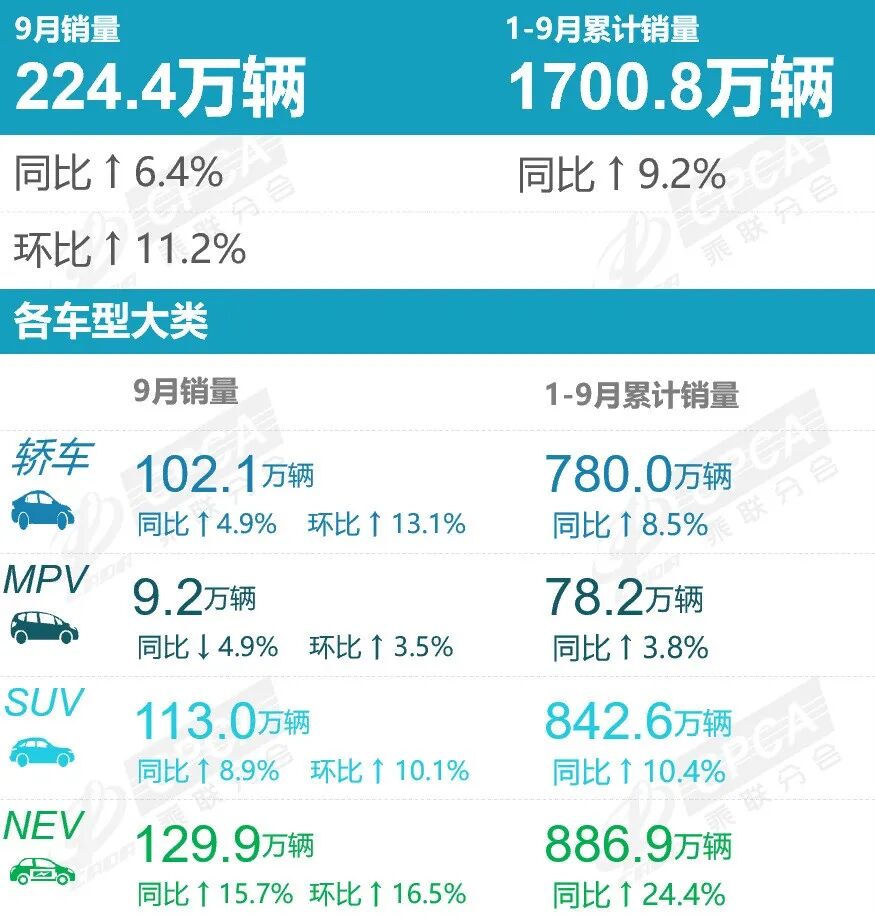
乘联分会:9月份国内狭义乘用车市场零售销量达224.4万辆 同比增长6.4%
智通财经网· 2025-10-14 09:12
Core Insights - In September 2025, the retail sales of narrow passenger vehicles in China reached 2.244 million units, marking a year-on-year increase of 6.4% and a month-on-month increase of 11.2% [1] - Cumulatively, from January to September 2025, the total sales reached 17.008 million units, reflecting a year-on-year growth of 9.2% [1] - The automotive market is experiencing strong growth ahead of year-end policy adjustments, with a shift towards stable pricing and reduced promotions [2] Wholesale Sales Rankings (September 2025) - BYD Auto led the wholesale sales with 393,060 units, a month-on-month increase of 5.8% but a year-on-year decrease of 5.9%, capturing a market share of 14.1% [3] - Geely Auto and Chery Auto followed with 273,125 and 269,070 units respectively, showing significant year-on-year growth of 35.2% and 13.5% [3] - The top ten manufacturers collectively reflect a diverse performance, with some experiencing declines while others show robust growth [3] Retail Sales Rankings (September 2025) - BYD Auto also topped the retail sales with 347,353 units, a month-on-month increase of 12.0% but a year-on-year decrease of 10.2%, holding a market share of 15.5% [5] - Geely Auto and Volkswagen ranked second and third with 232,460 and 138,655 units respectively, with Geely showing a year-on-year increase of 42.8% [5] - The retail landscape indicates a competitive environment with varying performance among the top players [5] Wholesale Sales Rankings (January to September 2025) - For the first nine months of 2025, BYD Auto led with 3.218 million units sold, a year-on-year increase of 17.6% and a market share of 15.4% [4] - Geely Auto and Chery Auto followed with significant growth rates of 45.7% and 14.3% respectively [4] - The overall market dynamics suggest a strong recovery and growth trajectory for several manufacturers [4] Retail Sales Rankings (January to September 2025) - In the cumulative sales from January to September 2025, BYD Auto again led with 2.542 million units, reflecting a modest year-on-year growth of 3.1% [6] - Geely Auto showed remarkable growth of 59.4%, reaching 1.875 million units [6] - The retail performance indicates a competitive market with varying growth rates among manufacturers [6] New Energy Vehicle (NEV) Wholesale Sales Rankings (September 2025) - BYD Auto dominated the NEV wholesale market with 393,060 units, holding a market share of 26.3% despite a year-on-year decline of 5.9% [7] - Geely Auto and Tesla China followed with significant increases in sales, particularly Geely with an 81.3% year-on-year growth [7] - The NEV segment is showing strong growth potential, with several manufacturers capitalizing on the trend [7] New Energy Vehicle (NEV) Retail Sales Rankings (September 2025) - In retail sales for NEVs, BYD Auto again led with 347,353 units, capturing a market share of 26.7% [9] - Geely Auto and Changan Auto followed with 150,570 and 84,237 units respectively, indicating strong year-on-year growth [9] - The NEV retail market is becoming increasingly competitive, with several players showing significant growth [9] New Energy Vehicle (NEV) Wholesale Sales Rankings (January to September 2025) - From January to September 2025, BYD Auto led the NEV wholesale market with 3.218 million units, reflecting a year-on-year growth of 17.6% [8] - Geely Auto showed impressive growth of 113.9%, reaching 1.167 million units [8] - The NEV market is expanding rapidly, with several manufacturers gaining market share [8] New Energy Vehicle (NEV) Retail Sales Rankings (January to September 2025) - In the NEV retail segment, BYD Auto led with 2.542 million units sold, a year-on-year growth of 3.1% [10] - Geely Auto and Changan Auto also showed strong performance with year-on-year growth rates of 107.2% and 40.2% respectively [10] - The NEV retail market is characterized by significant growth opportunities for various manufacturers [10]
【联合发布】新能源商用车周报(2025年10月第2周)
乘联分会· 2025-10-14 08:43
Core Insights - The article discusses the rapid growth and trends in the new energy commercial vehicle market, particularly focusing on electric trucks and the impact of government policies on this sector [4][21]. Policy and Regulations - The Ministry of Transport and six other departments have jointly issued implementation opinions on "AI + Transportation," aiming for widespread application of AI in the transportation sector by 2027 and deep integration by 2030 [6][8]. - The National Development and Reform Commission has announced measures to regulate price competition, urging operators to adhere to pricing guidelines to maintain market order [9][11]. Market Insights - From January to August 2025, sales of new energy tractors increased by 243.5% year-on-year, reaching 85,100 units, with a penetration rate of 31.9% [21][25]. - The mainstream products in the market are those with battery capacities between 301-430 kWh, while products with capacities of 500-600 kWh are rapidly gaining traction [25][31]. - Traditional heavy truck manufacturers are accelerating their entry into the new energy vehicle market, intensifying competition [25][32]. - Future demand is expected to shift from short-distance transport to long-haul transportation scenarios [33][35]. Company Monitoring - Changan Automobile has launched new models, including the "Xingta" and "Kua Yue Xingguang," focusing on user experience and comfort [38][40]. - Zhongtong Bus has introduced the H12E-Plus and N12D electric buses, specifically designed for the European market [42][48]. - Supao Technology has partnered with Alltrucks to provide comprehensive service support for its electric truck customers across Europe [46][50].

【月度排名】2025年9月厂商销量排名快报
乘联分会· 2025-10-14 08:43
Core Viewpoint - The domestic narrow passenger car market in China shows strong growth in September 2025, with retail sales reaching 2.244 million units, a year-on-year increase of 6.4% and a month-on-month increase of 11.2% [2][3]. Sales Data Summary - In September 2025, the cumulative sales for the first nine months reached 17.008 million units, reflecting a year-on-year growth of 9.2% [2][3]. - The breakdown of September sales by vehicle type includes: - SUVs: 474,000 units, year-on-year increase of 4.9%, month-on-month increase of 13.1% [3]. - MPVs: 92,000 units, year-on-year decrease of 4.9%, month-on-month increase of 3.5% [3]. - Sedans: 1.13 million units, year-on-year increase of 8.9%, month-on-month increase of 10.1% [3]. - New Energy Vehicles (NEVs): 1.299 million units, year-on-year increase of 15.7%, month-on-month increase of 16.5% [3]. Manufacturer Performance - The top manufacturers by retail sales in September 2025 are: - BYD: 393,060 units, month-on-month increase of 5.8%, year-on-year decrease of 5.9%, market share of 14.1% [6]. - Geely: 273,125 units, month-on-month increase of 9.2%, year-on-year increase of 35.2%, market share of 9.8% [6]. - Chery: 269,070 units, month-on-month increase of 16.3%, year-on-year increase of 13.5%, market share of 9.6% [6]. - Cumulative sales from January to September 2025 show: - BYD: 3.218 million units, year-on-year increase of 17.6%, market share of 15.4% [7]. - Geely: 2.170 million units, year-on-year increase of 45.7%, market share of 10.4% [7]. New Energy Vehicle (NEV) Insights - In September 2025, the NEV wholesale sales rankings are led by: - BYD: 393,060 units, month-on-month increase of 5.8%, year-on-year decrease of 5.9%, market share of 26.3% [10]. - Geely: 165,201 units, month-on-month increase of 12.1%, year-on-year increase of 81.3%, market share of 11.1% [10]. - Cumulative NEV sales from January to September 2025 show: - BYD: 3.218 million units, year-on-year increase of 17.6%, market share of 30.8% [11].




汽车整车板块震荡拉升,众泰汽车触及涨停
Mei Ri Jing Ji Xin Wen· 2025-10-14 03:07
Core Viewpoint - The automotive sector experienced a significant rally on October 14, with multiple companies seeing notable stock price increases, indicating positive market sentiment in the industry [1] Group 1: Stock Performance - Zhongtai Automobile reached its daily limit up, reflecting strong investor interest [1] - Haima Automobile saw an increase of over 4%, contributing to the overall positive trend in the sector [1] - Other companies such as Hanma Technology, Zhongtong Bus, Changan Automobile, and BYD also experienced upward movement in their stock prices, indicating a broad-based rally within the automotive industry [1]


“金九”成色足 9月乘用车销量创历史新高
Bei Jing Ri Bao Ke Hu Duan· 2025-10-13 13:15
Core Insights - The passenger car market in China achieved a record retail sales of 2.241 million units in September, marking a year-on-year growth of 6.3% and a month-on-month increase of 11.0% [1] - The cumulative retail sales for the first three quarters reached 17.005 million units, reflecting a year-on-year growth of 9.2% [1] - The market is characterized by strong growth due to the launch of over 70 new models and the impact of year-end subsidy policies [1] Group 1: Market Performance - In September, the retail sales of new energy passenger vehicles reached 1.296 million units, showing a year-on-year increase of 15.5% and a month-on-month increase of 16.2% [2] - The penetration rate of new energy vehicles in the overall passenger car retail market reached 57.8% in September, up 5 percentage points from the same period last year [2] - Domestic brands accounted for 78.1% of new energy vehicle sales, while luxury brands had a penetration rate of 34.5%, and mainstream joint venture brands only reached 7.4% [2] Group 2: Company Performance - BYD led the domestic new energy passenger vehicle market with retail sales of 347,000 units, followed by Geely and Changan with 151,000 and 84,000 units respectively [2] - Tesla China ranked fifth in sales among new energy vehicle manufacturers [2] - New entrants like Leap Motor, Hongmeng Zhixing, and Xiaomi Auto topped the retail sales among new force brands [2] Group 3: Future Outlook - The market is expected to maintain stable growth in the fourth quarter, driven by policy guidance and a strong growth foundation [3] - The adjustment of the new energy vehicle purchase tax policy from "full exemption" to "half exemption" is likely to stimulate consumer purchases before year-end [3] - The overall market forecast for the year is expected to be revised upward due to the combination of policy support and high export growth [3]