
CHANGAN AUTOMOBILE-B(000625)

Search documents
重庆长安汽车股份有限公司2026年第一次临时股东会决议公告
Shang Hai Zheng Quan Bao· 2026-01-16 18:59
登录新浪财经APP 搜索【信披】查看更多考评等级 证券代码:000625(200625) 证券简称:长安汽车(长安B) 公告编号:2026-03 重庆长安汽车股份有限公司 2026年第一次临时股东会决议公告 特别提示: 1.本次股东会未出现否决提案的情形。 2.本次股东会未涉及变更以往股东会已通过的决议。 一、会议召开的情况 1.召开时间: (1)现场会议召开日期和时间:2026年1月16日下午2:00; (2)网络投票时间:2026年1月16日。其中,通过深圳证券交易所交易系统进行网络投票的具体时间为 2026年1月16日9:15-9:25,9:30-11:30和13:00-15:00;通过深圳证券交易所互联网投票系统投票的具体时 间为2026年1月16日9:15-15:00。 2.召开地点:重庆市江北区东升门路61号金融城2号T2栋长安汽车会议室。 3.召开方式:采用现场投票及网络投票相结合的方式。 4.股东会召集人:公司董事会 本公司及董事会全体成员保证信息披露的内容真实、准确、完整,没有虚假记载、误导性陈述或重大遗 漏。 2.A股股东出席情况 出席会议的A股股东及股东代理人共5,373人,代表公司有表 ...

超20款车光速调价,丰田“自杀式”反击,2026价格战再升级
3 6 Ke· 2026-01-16 12:53
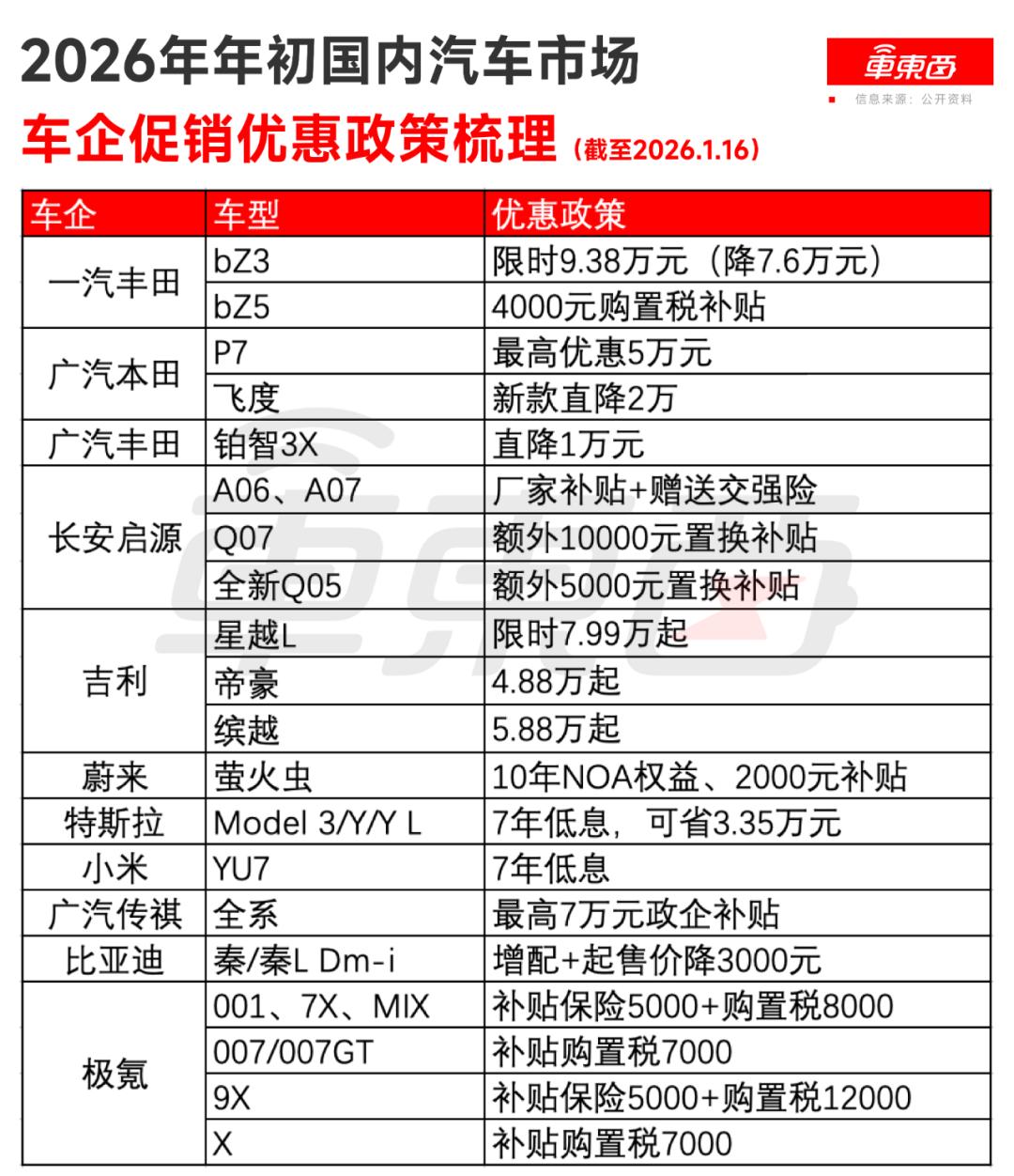
Core Viewpoint - The automotive industry is experiencing an intense price war initiated by luxury brands, leading to significant price reductions across various models from multiple manufacturers, creating a new wave of discounts in the market [1][6]. Group 1: Price Reductions and Promotions - BMW has initiated a price drop of up to 300,000 yuan, prompting over 10 automakers to follow suit with more than 20 mainstream models participating in the price reduction trend [1]. - Geely's Emgrand is now priced at 48,800 yuan, while the new Honda Fit has seen a price cut of 20,000 yuan, setting a new low at 66,800 yuan [1][13]. - Toyota's bZ3 electric sedan has been drastically reduced to 93,800 yuan, a decrease of 76,000 yuan, representing a nearly 45% drop from its previous price [9]. Group 2: Competitive Strategies - The competition has escalated with joint efforts from joint venture brands, particularly Japanese automakers, who are adopting aggressive pricing strategies to reclaim market share [7]. - Various automakers are employing a combination of subsidies, enhanced features, and financing options to attract buyers, rather than relying solely on price cuts [20][30]. - NIO's Firefly brand is offering cash subsidies along with a 10-year NOA (Navigation on Autopilot) free usage right, showcasing a strategic approach to enhance customer value [32]. Group 3: Market Dynamics and Consumer Impact - The price war has led to a significant reduction in the entry price for electric vehicles, making them more accessible to consumers [9][19]. - The automotive market is witnessing a shift where companies are not just competing on price but also on the value offered through financing and additional features, which may lead to a more sustainable competitive environment [37]. - The ongoing promotions and price adjustments are expected to drive sales ahead of the Chinese New Year, indicating a strategic push by manufacturers to maximize order volumes during this peak season [37].





长安汽车(000625) - 公司章程(2026年1月)
2026-01-16 11:46
重庆长安汽车股份有限公司 章 程 二○二六年一月 1 目 录 2 第一章 总则 第二章 经营宗旨、范围和期限 第三章 股份 第一节 股份发行 第二节 股份增减和回购 第三节 股份转让 第四章 股东和股东会 第一节 股东的一般规定 第二节 控股股东和实际控制人 第三节 股东会的一般规定 第四节 股东会的召集 第五节 股东会的提案与通知 第六节 股东会的召开 第七节 股东会的表决和决议 第五章 党委 第六章 董事会 第一节 董事 第二节 董事会 第三节 独立董事 第四节 董事会专门委员会 第七章 高级管理人员 第八章 民主管理与劳动管理 第九章 财务会计制度、利润分配和审计 3 第一节 财务会计制度 第二节 内部审计 第三节 会计师事务所的聘任 第十章 通知和公告 第一节 通知 第二节 公告 第十一章 合并、分立、增资、减资、解散和清算 第一节 合并、分立、增资和减资 第二节 解散和清算 第十二章 修改章程 第十三章 附则 第一章 总则 第一条 为规范重庆长安汽车股份有限公司(以下简称公司)的组织和行为,全 面贯彻落实"两个一以贯之"重要要求,坚持和加强党的全面领导,完善公司法人 治理结构,建设中国特色现代企业制 ...
长安汽车(000625) - 2026年第一次临时股东会决议公告
2026-01-16 11:45
证券代码:000625(200625) 证券简称:长安汽车(长安 B) 公告编号:2026-03 2.本次股东会未涉及变更以往股东会已通过的决议。 一、会议召开的情况 1.召开时间: (1)现场会议召开日期和时间:2026 年 1 月 16 日下午 2:00; 重庆长安汽车股份有限公司 2026 年第一次临时股东会决议公告 本公司及董事会全体成员保证信息披露的内容真实、准确、完整,没有虚假记载、误导性陈 述或重大遗漏。 1.本次股东会未出现否决提案的情形。 特别提示: 4.股东会召集人:公司董事会 5.股东会主持人:董事长朱华荣先生 6.会议的召开符合《公司法》《上市公司股东会规则》及《公司章程》的规定。 二、会议的出席情况 1.出席的总体情况 出席会议的股东及股东代理人共5,510人,代表公司有表决权股份数4,368,130,526 股,占公司有表决权股份总数的 44.060%。 (2)网络投票时间:2026 年 1 月 16 日。其中,通过深圳证券交易所交易系统进 行网络投票的具体时间为 2026 年 1 月 16 日 9:15-9:25,9:30-11:30 和 13:00-15:00;通 过深圳证券交 ...
长安汽车(000625) - 北京市中伦(深圳)律师事务所关于重庆长安汽车股份有限公司2026年第一次临时股东会的法律意见书
2026-01-16 11:45
北京市中伦(深圳)律师事务所 关于重庆长安汽车股份有限公司 2026 年第一次临时股东会的 法律意见书 二〇二六年一月 北京 • 上海 • 深圳 • 广州 • 武汉 • 成都 • 重庆 • 青岛 • 杭州 • 南京 • 海口 • 东京 • 香港 • 伦敦 • 纽约 • 洛杉矶 • 旧金山 • 阿拉木图 Beijing • Shanghai • Shenzhen • Guangzhou • Wuhan • Chengdu • Chongqing • Qingdao • Hangzhou • Nanjing • Haikou • Tokyo • Hong Kong • London • New York • Los Angeles • San Francisco • Almaty 关于重庆长安汽车股份有限公司 2026 年第一次临时股东会的 法律意见书 致:重庆长安汽车股份有限公司 根据《中华人民共和国公司法》(下称"《公司法》")、中国证监会发布 的《上市公司股东会规则》(下称"《股东会规则》")及公司现行章程(下称 "《公司章程》")的有关规定,北京市中伦(深圳)律师事务所(下称"本所") 接受重庆长安汽车股 ...
长安汽车:布局人形机器人及飞行汽车,力争2028年量产人形机器人
2 1 Shi Ji Jing Ji Bao Dao· 2026-01-16 10:49
21智讯1月16日电,长安汽车在投资者关系活动中表示,公司围绕'1+N+X'战略布局机器人业务,以人 形机器人为主线,覆盖生产制造、门店及家庭等多应用场景。关键技术方面联合头部科技企业研发大模 型与核心算力设施,产品规划按近-中-远期三步走,力争2028年实现人形机器人量产,2030年推出商用 航线飞行汽车,加速推动具身智能与新兴产业落地。 ...
长安汽车(000625) - 2026年01月16日投资者关系活动记录表
2026-01-16 10:38
Sales Performance - In 2025, Changan Automobile's total sales reached 2.913 million units, a year-on-year increase of 8.5%, marking a nine-year high [1] - New energy vehicle (NEV) sales exceeded 1.1 million units, up 51% year-on-year, with a compound annual growth rate (CAGR) of 97.3% during the 14th Five-Year Plan [1] - Overseas sales reached 637,000 units in 2025, an 18.9% increase, with a CAGR of 50.5% during the same period [1] - The sales target for 2026 is set at 3.3 million units, a 13.3% increase, with NEV sales projected at 1.4 million units (up 26.2%) and overseas sales at 750,000 units (up 17.7%) [5] Brand Development - During the 14th Five-Year Plan, Changan launched three smart NEV brands: Avita, Deep Blue, and Changan Qiyuan [2] - Avita has maintained over 10,000 units in monthly sales for 10 consecutive months, while Deep Blue surpassed 700,000 units in sales within three years [2] - A total of 24 NEV models were launched, including 6 from Avita, 6 from Deep Blue, and 7 from Changan Qiyuan [2] Technological Advancements - Changan's self-developed battery brand "Jinzhongzhao" has superior thermal insulation performance, outperforming the industry by 30% [2] - The company has introduced the world's first multi-in-one electric drive and a hybrid engine with a thermal efficiency of 44.39% [2] - The "Beidou Tianshu" intelligent safety plan has evolved to version 2.0, focusing on comprehensive safety across various dimensions [3] Global Expansion - Changan's global sales network expanded from 63 countries in 2020 to 117 countries by 2025 [4] - The company established 7 spare parts centers and 5 service engineering centers globally, covering over 100 countries [4] - The number of overseas models increased from 17 to 41 during the 14th Five-Year Plan, including 25 fuel vehicles and 16 NEVs [4] Future Goals - By 2028, Changan aims to achieve cumulative sales of 40 million units for Chinese brands and break through 5 million units in annual production and sales by 2030, with NEVs accounting for over 60% [5] - The company plans to launch 43 new models over the next three years, including 35 NEVs and 8 fuel-efficient vehicles [6] - Continuous investment of over 5% of revenue in R&D is planned, focusing on AI, software, and next-generation battery technologies [7]
1.5万买的智驾包成“摆设”?多位深蓝车主投诉,供应商倒闭谁来担责?
Nan Fang Du Shi Bao· 2026-01-16 09:56
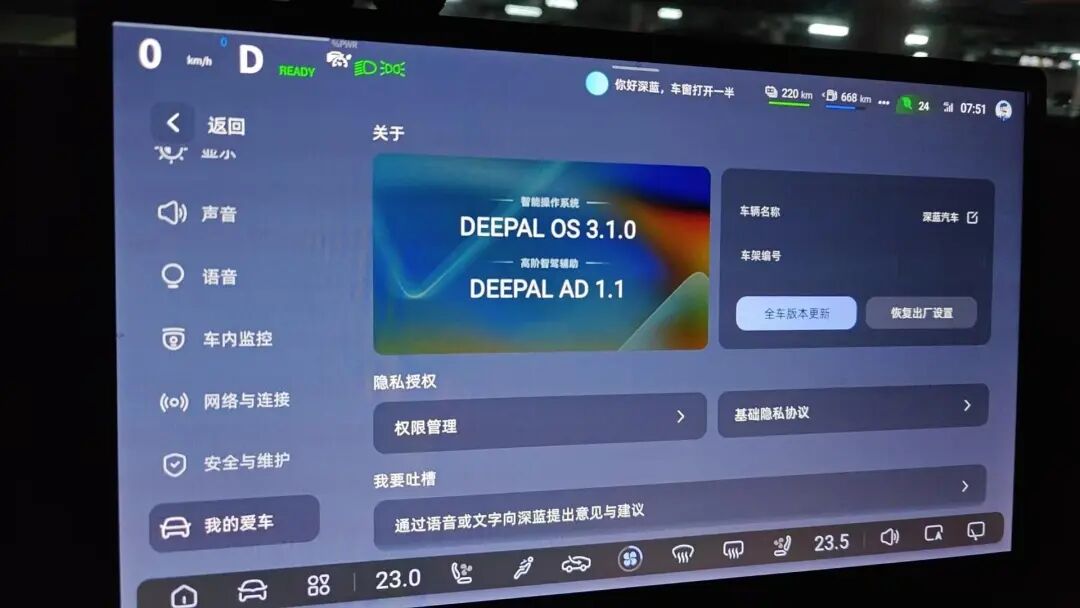
买车两年,承诺的智驾系统更新基本没兑现,智驾供应商更换之后,更是长期等待解决方案未果。在深蓝S7i车主林先生加入的车主维权群内,多位车主 投诉称遭遇同样情况。截至发稿前,前述问题仍未得到解决。 南都·湾财社记者就车主们反映的问题发采访函给深蓝汽车,但截至发稿前未获回复。 车主投诉:花1.5万元买的高阶智驾包 两年没兑现 近期,广东中山车主林先生反映,2024年1月份,他购买了一台深蓝S7i 200max增程版,购车两年,厂家智驾OTA承诺的内容并没有兑现。他表示,购车 时对方承诺的高阶智驾包迟迟没有推送,智驾功能存在严重故障但被告知只能"等OTA升级"。当他向客服或及售后反映这个问题时,对方一直答复"会尽 快联系处理",但是至今问题得不到解决。 "经销商给我的回复,就是厂家没有中断更新。实际上,我从买车到现在已两年,操作系统有升级,但更看重的智能驾驶仅更新过一次。"林先生称,该车 型的新款车型已经不用Deepl AD智驾了。至于如何解决,目前多方的说法就是"等待更新",却没有后续解决方案。 "我们这个智驾包花了15000元买的配置,后续完全不更新,这等于花智驾版的钱,享受的却是普通版服务,甚至还没有普通版更新 ...
重庆长安汽车软件科技取得自动驾驶安全通过汇流道纵向决策规划方法专利
Jin Rong Jie· 2026-01-16 02:50
声明:市场有风险,投资需谨慎。本文为AI基于第三方数据生成,仅供参考,不构成个人投资建议。 天眼查资料显示,重庆长安汽车软件科技有限公司,成立于2019年,位于重庆市,是一家以从事软件和 信息技术服务业为主的企业。企业注册资本9900万人民币。通过天眼查大数据分析,重庆长安汽车软件 科技有限公司参与招投标项目27次,专利信息38条,此外企业还拥有行政许可3个。 国家知识产权局信息显示,重庆长安汽车软件科技有限公司取得一项名为"一种自动驾驶安全通过汇流 道的纵向决策规划方法"的专利,授权公告号CN114872728B,申请日期为2022年4月。 财经频道更多独家策划、专家专栏,免费查阅>> ...
长安汽车申请空调控制方法专利,提高空调控制的智能化
Jin Rong Jie· 2026-01-16 01:20
Group 1 - Chongqing Changan Automobile Co., Ltd. has applied for a patent titled "An Air Conditioning Control Method, System, and Vehicle," with publication number CN121316495A, and the application date is November 2025 [1] - The patent involves vehicle control technology, specifically focusing on an air conditioning control method that determines target parameter values for controlled parameters based on the heating needs of the passenger compartment [1] - The controlled parameters include evaporation temperature and the opening degree of the hot and cold air doors, utilizing a control optimization model to optimize these target parameter values for more precise air conditioning control [1] Group 2 - Chongqing Changan Automobile Co., Ltd. was established in 1996 and is primarily engaged in the automotive manufacturing industry, with a registered capital of 991,408.606 million RMB [2] - The company has invested in 120 enterprises and participated in 5,000 bidding projects, holding 3,116 trademark information records and 5,000 patent records, along with 1,056 administrative licenses [2]