
GREE(000651)

Search documents
“董明珠健康家”半年开了970家,近30家开业超一月门店零售总额约3.9亿元
Sou Hu Cai Jing· 2025-09-17 05:21
Core Insights - The "Dong Mingzhu Health Home" brand has established 970 stores nationwide, with 293 stores that have been open for over 30 days generating a retail total of approximately 390 million yuan [1][3]. Group 1 - In February 2025, Gree Electric announced the launch of the new strategic brand "Dong Mingzhu Health Home," which sparked significant discussion [3]. - Dong Mingzhu stated that renaming "Gree Specialty Store" to "Dong Mingzhu Health Home" reflects her commitment to the brand, indicating that failure would have serious consequences [3]. - The first store of "Dong Mingzhu Health Home" opened in Tongzhou, Beijing, on March 13, 2025, with plans to establish 10,000 stores nationwide [3]. Group 2 - Gree Electric's goal for 2025 is to build 3,000 "Dong Mingzhu Health Home" stores, with an initial batch of 500 stores set to launch in March, followed by 2,500 stores to be opened monthly [3]. - During the first extraordinary shareholders' meeting of 2025, Dong Mingzhu was re-elected as a non-independent director with over 3.3 billion votes in favor, allowing her to continue for another three years [5]. - The 2024 annual shareholders' meeting featured significant participation from Gree's younger management team, although Dong Mingzhu remained the central figure [5].

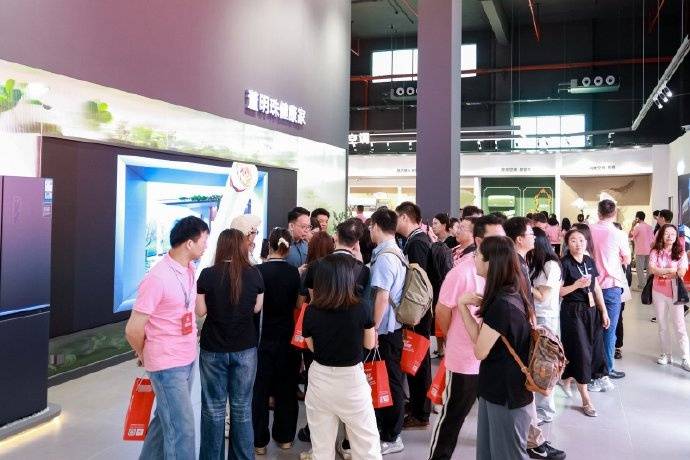
董明珠健康家2000㎡大湾区体验中心落地东莞
Xin Lang Cai Jing· 2025-09-17 04:59
Core Points - Gree Electric Appliances held a strategic launch event for its new health home appliance products on September 17 in Dongguan, Guangdong [1] - The Dong Mingzhu Health Home Experience Center in Dongguan has a total usable area of 2000 square meters [1] - Gree released 16 new health home appliance products, all of which are now available at the experience center in the Greater Bay Area [1]
国信证券:8月家电零售增长良好 企业亮相IFA彰显出海决心
Zhi Tong Cai Jing· 2025-09-17 03:38
Core Insights - The home appliance retail sector in China showed a positive growth trend in August, with offline sales improving and online sales remaining stable despite entering a low season [1][2] - Home appliance exports faced challenges, with a year-on-year decline of 6% in August, but companies are showing confidence in overseas expansion [1][3] - Domestic appliance manufacturers showcased new products at the IFA exhibition in Berlin, indicating strong intentions to penetrate international markets [1][4] Retail Performance - In August, the total retail sales of consumer goods in China grew by 3.4% year-on-year, with cumulative growth of 4.6% [2] - The retail sales of home appliances and audio-visual equipment increased by 14.3% year-on-year, with cumulative growth of 28.4% [2] - The growth of offline retail was boosted by the arrival of the third batch of national subsidy funds, while online sales of essential items saw a slowdown [2] Export Trends - In August, the export value of home appliances reached 60.37 billion yuan, a year-on-year decrease of 6.3%, with a dollar value of 8.43 billion USD, also down by 6.6% [3] - The average export price decreased by 3.2% to 20.9 USD per unit [3] - The decline in exports has narrowed slightly due to easing tariff policies, and companies are accelerating overseas production capacity [3] Product Launches and Market Strategy - The IFA exhibition featured major Chinese appliance brands like Midea, Haier, and TCL, showcasing innovative products and emphasizing their commitment to international markets [4] - Midea's exhibition theme was "Master Your Home," highlighting smart home appliances, while Haier introduced its latest AI technology [4] - Stone Technology launched its first all-terrain robotic lawn mower, indicating diversification into new product categories [4] Investment Recommendations - Recommended stocks include Midea Group, Bear Electric, and Stone Technology for their strong market positions and product offerings [1][4]



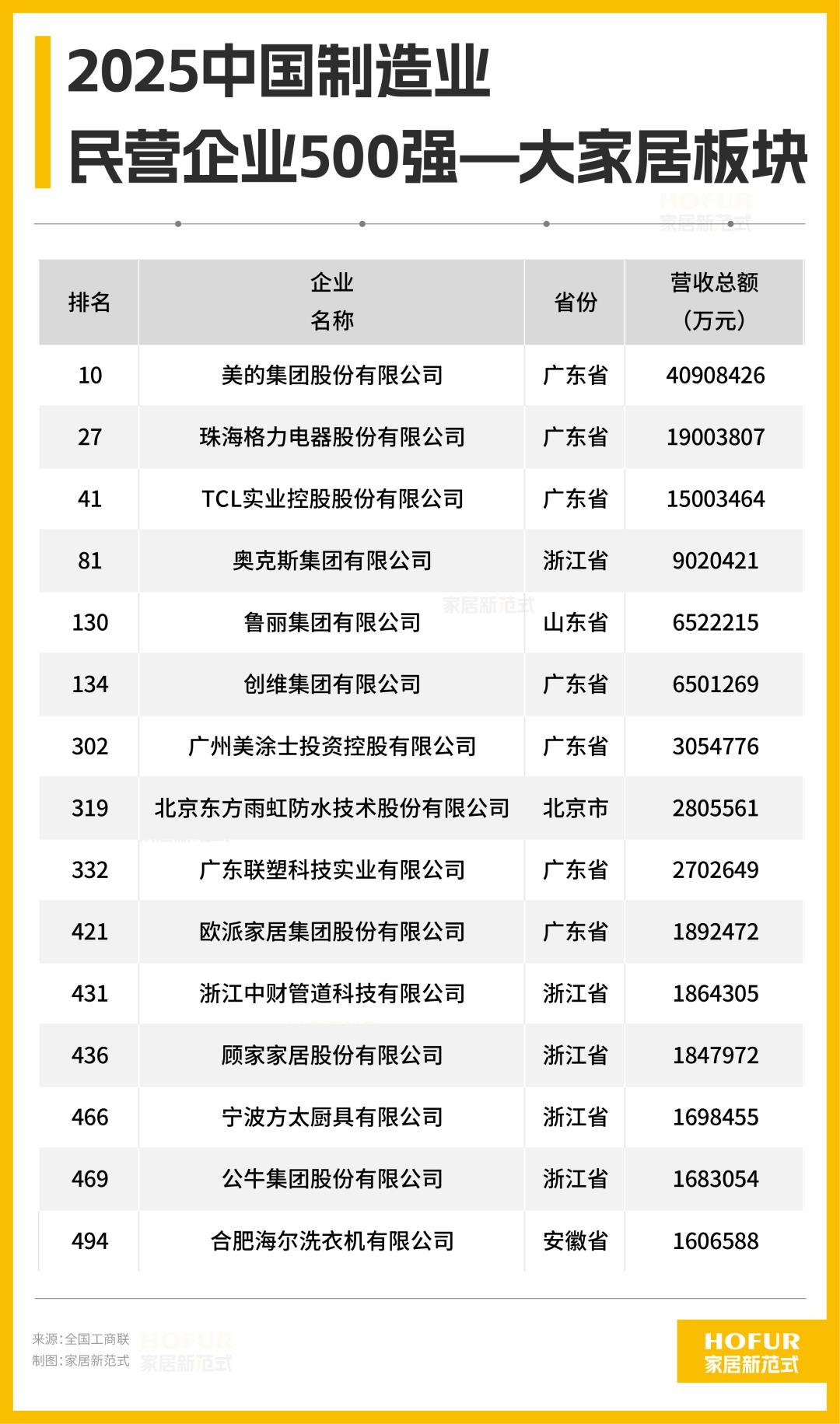
中国民企500强出炉,15家大家居企业上榜凸显产业变局
3 6 Ke· 2025-09-17 02:16
Core Viewpoint - The 2025 China Manufacturing Private Enterprises Top 500 list highlights the significance of private manufacturing companies in China's economy, showcasing their revenue and competitive advantages in the home furnishing industry. Group 1: Key Companies and Revenue - The top four companies in the home appliance sector are Midea Group, Gree Electric, TCL Industries, and Aux Group, all ranking within the top 100 of the list, with Midea Group leading at a revenue of 4090.84 billion yuan in 2024 [3][4] - Gree Electric reported a revenue of 1900.38 billion yuan in 2024, with its air conditioning business being the primary revenue contributor [3] - TCL Industries achieved a revenue of 1500.35 billion yuan in 2024, expanding its scale through acquisitions [3][4] - Aux Group's revenue reached 902.04 billion yuan in 2024, with a diversified business layout [4] Group 2: Home Furnishing and Building Material Companies - The home furnishing sector includes 15 companies, with notable entries like Luli Group, Oppein Home, and Kuka Home, with revenues of 652.22 billion yuan, 189.30 billion yuan, and 184.80 billion yuan respectively in 2024 [5][6] - Luli Group focuses on eco-friendly materials and custom home products, while Oppein and Kuka are leaders in their respective segments [5] - The building materials sector features companies like Meitu士 and Dongfang Yuhong, with revenues of 305.48 billion yuan and 280.56 billion yuan respectively [5][6] Group 3: Industry Trends and Characteristics - Companies in the top 500 exhibit high R&D investment, with Midea Group spending 16.23 billion yuan and Gree Electric 6.90 billion yuan in 2024, indicating a focus on technological advancement [7] - Many of these companies participate in setting industry standards, enhancing their influence in the market [8][9] - The shift towards smart and digital transformation is evident, with companies investing in automated production lines and digital platforms to improve efficiency [9] - A trend of international expansion is noted, with companies like Kuka Home investing in overseas production bases to enhance their global competitiveness [10]
一体化压铸概念涨3.12% 主力资金净流入这些股
Zheng Quan Shi Bao Wang· 2025-09-16 09:20
Market Performance - The integrated die-casting concept rose by 3.12%, ranking fourth among concept sectors, with 43 stocks increasing in value [1] - Notable gainers included Meilixin with a 20% limit-up, Rongtai Co., Changyuan Donggu, and Aikedi, all hitting the limit-up as well [1] - Leading stocks in terms of percentage increase included Xusheng Group, Top Group, and Duoli Technology, which rose by 8.29%, 7.67%, and 6.42% respectively [1] Capital Flow - The integrated die-casting sector saw a net inflow of 1.523 billion yuan, with 32 stocks receiving net inflows from major funds [2] - Top Group led the net inflow with 498 million yuan, followed by Huichuan Technology, Shengli Precision, and Genesis with net inflows of 331 million yuan, 227 million yuan, and 143 million yuan respectively [2] - Stocks with the highest net inflow ratios included Changyuan Donggu, Shengli Precision, and Furan De, with ratios of 15.55%, 14.57%, and 13.14% respectively [3] Stock Performance - Top Group had a daily increase of 7.67% with a turnover rate of 6.92% and a net inflow of 497.98 million yuan [3] - Huichuan Technology increased by 4.17% with a net inflow of 331.37 million yuan and a turnover rate of 3.41% [3] - Other notable performers included Aikedi with a 9.99% increase and a net inflow ratio of 13.07%, and Xusheng Group with an 8.29% increase and a net inflow ratio of 7.53% [3]




白色家电板块9月16日跌0.78%,格力电器领跌,主力资金净流出7.89亿元
Zheng Xing Xing Ye Ri Bao· 2025-09-16 08:46
Market Overview - On September 16, the white goods sector declined by 0.78% compared to the previous trading day, with Gree Electric Appliances leading the decline [1] - The Shanghai Composite Index closed at 3861.87, up 0.04%, while the Shenzhen Component Index closed at 13063.97, up 0.45% [1] Individual Stock Performance - Notable gainers in the white goods sector included: - Xueqi Electric (Code: 001387) with a closing price of 14.10, up 1.73% on a trading volume of 32,800 shares and a turnover of 45.95 million yuan [1] - Changhong Meiling (Code: 000521) closed at 7.49, up 1.49% with a trading volume of 141,100 shares and a turnover of 105 million yuan [1] - Aucma (Code: 600336) closed at 6.78, up 1.35% with a trading volume of 131,900 shares and a turnover of 89.09 million yuan [1] - Major decliners included: - Gree Electric (Code: 000651) closed at 40.50, down 1.07% with a trading volume of 555,700 shares and a turnover of 2.257 billion yuan [1] - Midea Group (Code: 000333) closed at 74.46, down 0.94% with a trading volume of 456,000 shares and a turnover of 3.396 billion yuan [1] Capital Flow Analysis - The white goods sector experienced a net outflow of 789 million yuan from institutional investors, while retail investors saw a net inflow of 572 million yuan [1] - Specific stock capital flows included: - Haier Smart Home (Code: 600690) had a net inflow of 26.03 million yuan from institutional investors, but a net outflow of 33.99 million yuan from retail investors [2] - Changhong Meiling (Code: 000521) saw a net inflow of 17.75 million yuan from institutional investors, but a net outflow of 13.20 million yuan from retail investors [2] - Gree Electric (Code: 000651) had a significant net outflow of 370 million yuan from institutional investors, while retail investors contributed a net inflow of 237 million yuan [2]

高盛:小米集团-W进入中国冷气机市场 美的集团料最具韧性
Zhi Tong Cai Jing· 2025-09-16 08:26
Core Insights - Goldman Sachs reports that the Chinese air conditioning market remains attractive due to high market consolidation, strong profitability of leaders, and balanced supply-demand dynamics [1] Industry Overview - The competition among Xiaomi Group-W (01810) and industry leaders is linked to the overall efficiency of the industry value chain, from supply chain and manufacturing to distribution networks [1] - Increased competition is expected to enhance industry efficiency and potentially reduce the profit pool [1] Company Ratings - Goldman Sachs maintains a "Buy" rating for Midea Group (000333), Haier Smart Home (600690), Hisense Home Appliances (000921), and Xiaomi [1] - The rating for Gree Electric Appliances (000651.SZ) is downgraded from "Buy" to "Neutral" due to weakened demand and intensified competition affecting growth prospects, although a projected dividend yield of 7 cents provides valuation support [1] Company Performance Expectations - Midea is anticipated to be the most resilient manufacturer, leveraging its global leading production advantages and continuously improving distribution efficiency to potentially increase market share [1] - Gree's profitability is expected to be most impacted among peers, given the company's reliance on the Chinese market [1] - Xiaomi is projected to become a leading player in second-tier cities, with a mid-term market share expected to rise to approximately 10%, benefiting from its distribution network, product ecosystem, and improved production capabilities [1] - Further market share growth will depend on strategies related to mid-to-high-end products and offline channels [1]

高盛:小米集团-W(01810)进入中国冷气机市场 美的集团(00300)料最具韧性
智通财经网· 2025-09-16 08:22
Core Viewpoint - The Chinese air conditioning market remains attractive due to high market consolidation, strong profitability of leaders, and balanced supply-demand dynamics [1] Industry Summary - The competition among Xiaomi Group-W (01810) and industry leaders is linked to the overall efficiency of the industry value chain, from supply chain and manufacturing to distribution networks [1] - Increased competition is expected to enhance industry efficiency and potentially reduce profit pools [1] Company Summary - Goldman Sachs maintains a "Buy" rating for Midea Group (00300), Haier Smart Home (06690), Hisense Home Appliances (00921), and Xiaomi, while downgrading Gree Electric Appliances (000651.SZ) from "Buy" to "Neutral" due to weakened demand and intensified competition affecting growth prospects [1] - Midea is anticipated to be the most resilient manufacturer, leveraging its global production advantages and continuous improvement in distribution efficiency to potentially increase market share [1] - Gree's profitability is expected to be most impacted among peers, given its reliance on the Chinese market [1] - Xiaomi is projected to become a leading player in second-tier cities, with a mid-term market share expected to rise to approximately 10%, benefiting from its distribution network, product ecosystem, and improved production capabilities [1] - Further market share growth will depend on strategies related to mid-to-high-end products and offline channels [1]
ST英飞拓(002528.SZ):与格力电器目前暂无业务合作

Ge Long Hui· 2025-09-16 07:11
Group 1 - The core point of the article is that ST Yingfeitou (002528.SZ) has stated there is currently no business cooperation with Gree Electric Appliances [1] Group 2 - The company made this statement on an interactive platform, indicating transparency in its communication with stakeholders [1]
中国空调何以走俏国外市场
Zhong Guo Zhi Liang Xin Wen Wang· 2025-09-16 06:57
Core Viewpoint - China's air conditioning exports are projected to reach nearly 94 million units in the 2025 cooling year, marking a 14.7% year-on-year increase, with Europe experiencing a significant growth of 39.5% [1] Group 1: Market Demand and Growth - The increase in air conditioning exports is driven by extreme summer temperatures in Europe, where many regions have seen temperatures exceed 40°C, leading to a shift in perception of air conditioning from a luxury to a necessity [1] - China's air conditioning brands, including Gree, Midea, and Haier, have increased their market share in Europe from 27% in 2023 to 41% in 2025 [1] - The penetration rate of Chinese air conditioning products in Europe has risen from 12% in 2020 to 27% in 2025, indicating a rapid market expansion [3] Group 2: Competitive Advantages - Chinese air conditioning products are competitive due to their energy efficiency, with many meeting the EU's A+++ standard, and their prices being 20%-30% lower than local European brands [1] - The focus on green and energy-efficient technologies has become a key selling point for Chinese air conditioning products, aligning with strict EU environmental standards [2] - Innovations such as low-noise systems and solar-powered air conditioning units are enhancing the green competitiveness of Chinese brands [2] Group 3: Targeted Innovation and Market Strategy - Chinese air conditioning companies are adopting targeted innovation strategies, such as offering portable air conditioning units that are easy to install, catering to the high installation costs in Europe [3] - Products designed for specific demographics, such as simplified controls for elderly users and emotionally designed products for younger consumers, are part of the differentiated approach to market entry [3] - Companies like Midea and Gree have invested in local operations and R&D in Europe to better understand consumer needs and adapt products accordingly [3] Group 4: Future Market Opportunities and Challenges - The International Energy Agency predicts that the number of air conditioning units in the EU will double by 2050, creating a demand for over 10 million units annually in the coming years [4] - However, European manufacturers face a significant supply gap, with local production capacity projected at only 3.2 million units in 2024, presenting a market opportunity for Chinese companies [4] - Chinese air conditioning manufacturers must prepare for stricter EU regulations on refrigerants by 2026, which will require about 35% of current exports to undergo technical modifications [4] - Long-term competitiveness will depend on transitioning from price competition to value competition, focusing on brand building, localization, and sustainable technology development [4]