GREE(000651)

Search documents
小米抢走10%空调市场份额?高盛:美的有韧性,格力最易受冲击
Hua Er Jie Jian Wen· 2025-09-16 04:33
高盛认为小米正在中国空调市场发起新一轮攻势,预计中期内市场份额将提升至约10%。 追风交易台消息,9月15日高盛研报指出,中国家电市场的"鲶鱼"小米正在空调领域掀起波澜,预计 2026年市场份额将提升至约10%。这场竞争的本质并非单纯的价格战,而是供应链、制造、渠道和生态 系统效率的全面对决。 研报分析认为,美的集团凭借其全球领先的制造优势和持续优化的渠道效率,被视为最具韧性的参与 者,甚至有望进一步扩大份额。 相比之下,高度依赖国内空调业务、产品溢价最高且应对策略相对迟缓的格力电器,被高盛认定为最易 受冲击的巨头,并因此将其评级从"买入"下调至"中性"。 小米则凭借其生态系统和分销效率,有望成为稳固的第二梯队领导者。简而言之,市场正在奖励效率更 高、适应性更强的玩家。 新战场:小米重拳出击,搅动高利润空调市场 中国分体式空调市场长期以来是一个"香饽饽"——市场高度集中,龙头企业享有高利润,供需平衡。 从2019年到2024年,该行业的收入年复合增长率为4%,而制造商的净利润年复合增长率则高达8%,总 利润池从220亿元人民币增长至320亿元人民币。 头部企业美的和格力的毛利率显著高于第二梯队企业,这得益于其 ...



大行评级|高盛:中国冷气机市场在多方面具吸引力 维持美的、小米“买入”评级
Ge Long Hui· 2025-09-16 03:51
Group 1 - The report from Goldman Sachs indicates that the Chinese air conditioning market remains attractive due to high market consolidation and leaders having high profitability rates, along with supply-demand balance and core profitability strategies of leaders [1] - Competition between Xiaomi and industry leaders is related to the overall efficiency of the industry value chain, from supply chain and manufacturing to distribution networks, which is expected to enhance industry efficiency and potentially reduce profit pools [1] - Midea is anticipated to be the most resilient manufacturer, leveraging its global leading production advantages and continuous improvement in distribution efficiency to potentially increase market share [1] Group 2 - Gree's profitability is expected to be most affected among peers, considering the company's reliance on the Chinese market [1] - Xiaomi is projected to become a leading player in second-tier cities, with a mid-term market share expected to rise to approximately 10%, benefiting from its distribution network, product ecosystem, and improvements in production capacity [1] - The company maintains a "buy" rating for Midea, Haier Smart Home, Hisense Home Appliances, and Xiaomi, while downgrading Gree's rating from "buy" to "neutral" [1]

这些科技公司入围中国企业500强,京东冲进前十,闻泰科技升幅最大




第一财经· 2025-09-15 14:46
Core Viewpoint - The "2025 China Top 500 Enterprises" list shows an increase in the entry threshold to 47.96 billion yuan, with 251 state-owned enterprises and 249 private enterprises making the list. Notably, 15 companies reported revenues exceeding 100 billion yuan [3]. Group 1: Rankings and Revenue - JD.com, a private technology company, ranked 10th this year, up from 12th last year, with a revenue of 115.88 billion yuan in 2024 and a 22.4% year-on-year revenue growth in Q2 2025 [3]. - Other notable technology companies in the top 100 include China Mobile (14), Alibaba (17), Huawei (23), Tencent (31), and Xiaomi (76), with most showing varying degrees of improvement in rankings compared to last year [3]. - Noteworthy increases in rankings among technology companies include Wentai Technology (up 58 places), Inspur Group (up 47 places), and Pinduoduo (up 46 places) [3]. Group 2: Company Performance - Wentai Technology reported total revenue of 73.598 billion yuan in 2024, a year-on-year increase of 20.23%, but recorded a net loss of 2.833 billion yuan, marking its first loss since 2016 [4]. - In the first half of the year, Wentai achieved revenue of 25.341 billion yuan, with a net profit of 474 million yuan, reflecting a significant year-on-year growth of 237.36% [5]. - Companies experiencing notable declines in rankings include Suning (down 44 places), ZTE (down 13 places), and Gree and Vipshop (both down 12 places) [5].


格力电器今日大宗交易平价成交60万股,成交额2456.4万元
Xin Lang Cai Jing· 2025-09-15 08:55
Summary of Key Points Core Viewpoint - On September 15, Gree Electric Appliances executed a block trade of 600,000 shares, amounting to 24.564 million yuan, which represented 1.21% of the total trading volume for that day, with a transaction price of 40.94 yuan, remaining stable compared to the market closing price of 40.94 yuan [1][2]. Group 1: Transaction Details - The block trade involved 600,000 shares of Gree Electric Appliances at a price of 40.94 yuan per share [1][2]. - The total transaction value was 24.564 million yuan [1][2]. - The trade accounted for 1.21% of the total trading volume on that day [1]. Group 2: Brokerage Information - The buyer and seller of the block trade were both from Huatai Securities Co., Ltd., specifically from the Guangzhou Zhujiang West Road Securities Business Department [2].
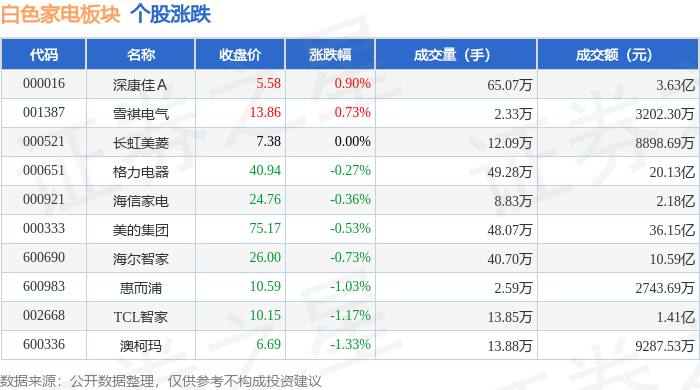
白色家电板块9月15日跌0.5%,澳柯玛领跌,主力资金净流出4.13亿元
Zheng Xing Xing Ye Ri Bao· 2025-09-15 08:42
Market Overview - The white goods sector experienced a decline of 0.5% on September 15, with Aucma leading the drop [1] - The Shanghai Composite Index closed at 3860.5, down 0.26%, while the Shenzhen Component Index rose by 0.63% to 13005.77 [1] Individual Stock Performance - Major stocks in the white goods sector showed varied performance, with Gree Electric down by 0.27% and Midea Group down by 0.53% [1] - Aucma saw the largest decline at 1.33%, while Snow Qi Electric and Changhong Meiling had slight increases of 0.73% and 0.00% respectively [1] Trading Volume and Capital Flow - The total net outflow of main funds in the white goods sector was 413 million yuan, while retail investors saw a net inflow of 432 million yuan [1] - The trading volume for Gree Electric reached 20.13 billion yuan, indicating significant investor interest despite the decline [1] Fund Flow Analysis - Snow Qi Electric had a net inflow of 2.33% from retail investors, while Aucma and Hisense Home Appliances experienced significant net outflows from main funds [2] - Retail investors contributed positively to the capital flow in several stocks, with notable inflows in Deep Kangjia A and Haier Smart Home [2]


家电行业8月月报及9月投资策略:业绩稳中有进相对估值底部-20250915
Guolian Minsheng Securities· 2025-09-15 08:28
Group 1 - The report highlights a stable performance in the home appliance industry, with a focus on the support for domestic demand through policies and the potential turning point in exports [5][6] - White goods are expected to maintain strong sales momentum, supported by the third batch of subsidies for trade-in programs, with leading companies like Midea Group, Haier Smart Home, Hisense Home Appliances, and Gree Electric showing robust financial performance [7][8] - The black goods segment benefits from domestic trade-in policies, with a steady increase in average prices and a projected stable growth in the global market size by 2025, recommending Hisense Visual and TCL Electronics as key players [7][8] Group 2 - The report indicates that the two-wheeler market will see accelerated growth due to national subsidies, with leading companies like Yadea Holdings expected to outperform the industry significantly [7] - The post-cycle segment shows improved operations, with a narrowing decline due to supportive policies in real estate, recommending companies like Robam Appliances and Vatti Corporation for investment [7] - The small appliance sector is experiencing a turnaround, with expectations for improved demand and market dynamics by 2025, highlighting companies like Ecovacs Robotics and Supor as potential investment opportunities [7] Group 3 - The report provides a market review for August, noting that the home appliance index increased by 4.73%, although it underperformed compared to the broader market indices [16][17] - The relative valuation of the home appliance sector is at a low point, with a PE ratio of 14.14 times, indicating potential investment value [17][18] - Key data tracking shows fluctuations in commodity prices, with copper and aluminum prices increasing year-on-year, while shipping rates have decreased [22][24]



自由现金流ETF(159201)近1月日均成交3.43亿元,排名可比基金第一
Xin Lang Cai Jing· 2025-09-15 02:14
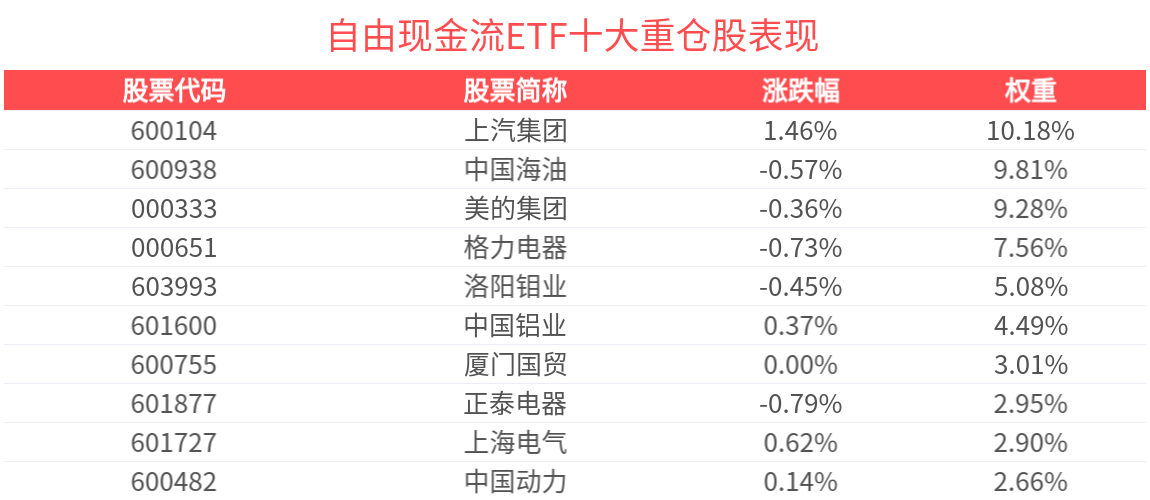
Group 1 - The core viewpoint of the news is the performance and characteristics of the National Index of Free Cash Flow and its corresponding ETF, highlighting the positive trends in liquidity and returns [1][2] - As of September 12, 2025, the Free Cash Flow ETF has seen a net inflow of 97.92 million yuan over the last 10 trading days, with 7 days of net inflow [1] - The Free Cash Flow ETF has achieved a net value increase of 12.46% over the past 6 months, with a maximum monthly return of 7% since its inception [1] Group 2 - The National Index of Free Cash Flow closely tracks the performance of companies with high and stable free cash flow levels in the Shanghai and Shenzhen stock exchanges [2] - The top ten weighted stocks in the National Index of Free Cash Flow as of August 29, 2025, include SAIC Motor, China National Offshore Oil Corporation, Midea Group, and others, accounting for 57.95% of the index [2] - The performance of individual stocks within the top ten includes SAIC Motor with a 1.46% increase and China National Offshore Oil Corporation with a 0.57% decrease [4]





中国家电行业:A 股会议及消费者调研关键要点-China Consumer Appliances Sector_ Key takeaways from A-Share Conference and consumer tour
2025-09-15 01:49
Summary of Key Points from the Conference Call Industry Overview - **Industry**: China Consumer Appliances Sector - **Event**: A-Share Conference and consumer tour held on September 1-4, 2025, involving major companies like Midea, Haier, Hisense, and Gongniu [2][3] Core Insights 1. **Intensified Domestic Competition**: - Midea has shifted its strategy from profitability to top-line growth, indicating increased competition in the air conditioning (AC) sector for the second half of 2025, which may pressure margins for smaller brands and Gree [3][6] - Hisense also noted heightened competition and potential pricing adjustments [3][6] 2. **Focus on Premiumization**: - Premium brands from Midea and Haier are experiencing robust sales growth, with Midea's premium brands generating a 60% year-over-year revenue increase to approximately RMB 10 billion in the first half of 2025 [3][6] 3. **Direct-to-Consumer (DTC) Transformation**: - Midea is enhancing customer engagement and traffic acquisition to improve operating profit margins (OPM) after establishing infrastructure [3][7] - Haier is leveraging digital inventory management to improve channel turnover and reduce stock-keeping units (SKUs) [3][12] 4. **Investor Interest in Arashi (Insta360)**: - Arashi, a leader in 360/action cameras, is gaining attention due to its software advantages in image processing, which are seen as a competitive edge over DJI [3][20][21] - Sales of Insta360 products surged following DJI's launch of a competing product, indicating a positive market response [3][20] 5. **Cautious Outlook for Appliance Sector**: - The overall outlook for China's appliance sector is cautious, anticipating a post-subsidy downcycle from Q3 2025 to 2027, with intensified competition impacting profitability [4][6] Company-Specific Highlights Midea - **Overseas Growth**: Midea is optimistic about its growth prospects in 2H25 and 2026, particularly in overseas markets, despite the diminishing impact of trade-in subsidies [6][8] - **Premium Brand Performance**: Revenue from premium brands is expected to grow by 10-20% even as subsidy benefits fade [6] Haier - **Retail Transformation**: Haier is focused on improving its retail operations and expects to benefit from the ongoing retail transformation in China [10][12] - **US Market Performance**: Haier reported low-single-digit revenue growth in the US, driven by price increases and market share gains [13][14] Hisense - **Stable Margins**: Despite price drops in the HVAC sector, Hisense anticipates stable margins in 2H25 due to reduced material costs and improved manufacturing efficiency [15][16] Gongniu - **Channel Transformation**: Gongniu plans to expand its flagship stores from 2,200 to approximately 3,000 by the end of 2025, focusing on improving store efficiency [17][18] - **New Product Development**: The company is exploring new energy solutions and smart lighting products, aiming to enhance its market presence [19] Additional Insights - **Ziel Home Furnishing**: Ziel is experiencing strong overseas sales, particularly in Europe and North America, despite challenges from rising US tariffs [23][24] - **Aqara's Smart Home Solutions**: Aqara is leveraging AIoT for product innovation, which could drive growth in the smart home segment [26][27] Risks and Considerations - **Market Risks**: The main risks for the consumer appliances sector include potential impacts from China's property market curbs, raw material price increases, and changes in US tax policy affecting exports [29]

破局与重构:2025 空调行业趋势与消费需求白皮书
艾瑞咨询· 2025-09-15 00:05
Core Viewpoint - The air conditioning industry is undergoing a critical phase of "breaking through and restructuring," driven by policies promoting low-carbon transformation, extreme high temperatures, and consumer subsidy policies, leading to increased market demand. The consumer focus is shifting from basic temperature control to "comfort + health + high-end" upgrades, with comfort and health-oriented air conditioners emerging as clear new growth points [1]. Group 1: Environmental Factors - The dual drivers of policy and technological innovation are reshaping the air conditioning market, emphasizing energy efficiency and low-carbon transformation, which is expected to stabilize the industry's lifecycle development [2]. - National subsidy policies have reduced consumer purchase costs, while extreme high temperatures have directly stimulated market demand, enhancing air conditioning sales and positively impacting the related supply chain [3]. Group 2: Market Dynamics - The air conditioning market is entering a mature phase with stable growth, where online sales account for 60% of the market, and traditional e-commerce remains the core traffic entry point. Price differentiation is evident, with low-priced and high-priced segments both seeing increased market share [5]. Group 3: Consumer Demand - Social media discussions reflect the evolving demands for air conditioning, with energy efficiency, comfort, cooling performance, aesthetics, and health becoming the top ten topics of interest for 2025 [9]. - The evolution of air conditioning from a "single temperature regulator" to a "quality lifestyle hub" that integrates comfort, health, and aesthetics is evident, with a focus on improving air quality and harmonizing with home decor [11]. - The high-end air conditioning market is evolving towards a comprehensive experience that combines "extreme comfort + health purification + aesthetic integration + smart connectivity" [13]. Group 4: Opportunities and Trends - The transition from "selling products" to "selling lifestyles" is a significant opportunity, focusing on specific living scenarios, spatial functions, and emotional needs of users [15]. - The demand for air conditioning is shifting towards comfort, health, and high-end features, indicating a deeper consumer need for quality and experience [17]. - The main consumer groups for air conditioning are shifting towards younger generations, particularly those born in the 2000s and 1990s, with a focus on comfort in family settings [19]. Group 5: Purchase Behavior - Consumers are increasingly motivated by the need for functionality and quality of life improvements, moving from basic needs to higher quality and better experiences [21]. - The primary information channel for consumers is e-commerce platforms, with JD.com recognized as the leading source for appliance information and purchases [24]. - Performance and quality are critical factors in purchase decisions, with consumers becoming more rational and focused on comprehensive experiences rather than just price sensitivity [28]. Group 6: Product Features and User Feedback - High satisfaction rates (over 99%) for features like "no-wind" and "soft wind" indicate strong consumer preference for comfort and health functionalities in air conditioning products [58]. - The integration of health features, such as air purification and self-cleaning technologies, is becoming a key selling point, enhancing the overall value of air conditioning products [57]. Group 7: Collaborative Innovations - JD.com collaborates with major air conditioning brands to promote comfort and health technologies, successfully driving sales of various air conditioning products that meet evolving consumer demands [61].


格力、小米,谁是“空调二哥”
2 1 Shi Ji Jing Ji Bao Dao· 2025-09-14 00:35
Core Viewpoint - The home appliance industry is experiencing a shift from stable competition among traditional giants to a more dynamic landscape, with Xiaomi emerging as a significant challenger to established players like Midea, Haier, and Gree [1][3]. Group 1: Company Performance - Midea Group reported a revenue of 252.3 billion yuan for the first half of the year, a year-on-year increase of 15.7%, with a net profit of 26.7 billion yuan, up 26% [4]. - Xiaomi's IoT and lifestyle products revenue surged by 50.7% to 71.05 billion yuan, driven by strong sales in major appliances [5]. - Gree Electric's revenue for the first half was 97.33 billion yuan, a decline of 2.46%, with a notable drop in the second quarter compared to the first [6][7]. Group 2: Market Dynamics - The home appliance market in China saw a retail total of 453.7 billion yuan in the first half of 2025, reflecting a year-on-year growth of 9.2% [3]. - The air conditioning segment experienced a retail revenue of 126.3 billion yuan, a significant increase of 12.4% [3]. - The competition is intensifying, with Xiaomi's market share in online air conditioning sales increasing, while Gree's share has slightly decreased [10]. Group 3: Strategic Initiatives - Midea is focusing on a "technology leadership" strategy, with R&D investments exceeding 43 billion yuan from 2022 to 2024, and 8.8 billion yuan in the first half of this year [4][5]. - Xiaomi's strategy emphasizes integrating its appliances into a broader ecosystem, aiming to become a top brand in major appliances by 2030 [1][6]. - Gree is facing challenges in diversifying its business and adapting to market changes, which has impacted its performance [7][9]. Group 4: International Expansion - Midea's overseas revenue reached 107.2 billion yuan in the first half of the year, a growth of 17.7%, with a shift towards self-owned brands [13][14]. - Gree's overseas revenue was 16.33 billion yuan, growing by 10.19%, but still represents less than 20% of its total revenue [15]. - The global market presents significant opportunities for growth, with many countries lacking dominant brands, allowing for potential entry by Chinese manufacturers [13].